If you drive in Dubai, fuel costs are a permanent line item in your budget — and not a stable one. The UAE operates a deregulated, market-linked pricing system introduced in 2015, which means petrol prices are reviewed and reset every single month by the Fuel Price Committee under the Ministry of Energy and Infrastructure. When global oil markets move, pump prices follow. There’s no subsidy buffer, no fixed rate, and no month where the announcement is guaranteed to go in your favour.
That reality makes fuel efficiency a year-round discipline, not a response to any particular spike. The drivers who manage their fuel spend well aren’t doing anything complicated — they’ve made a small number of habit and maintenance changes that compound quietly across every tank, every month, regardless of what the committee announces on the last day of the month.
The ten tips below are based on UAE road conditions, Dubai’s specific traffic patterns, and the actual products and programmes available at local stations. Implemented together, they represent the complete picture of what a Dubai driver can control — which turns out to be more than most people realise.
| 💡 UAE fuel pricing: All petrol prices are set uniformly nationwide by the Fuel Price Committee. There is no price difference between ADNOC, ENOC, EPPCO, or Emarat — the monthly rate applies at every pump across the country. Your only variables are how efficiently you use each litre and which loyalty programme earns you something back on the purchase. |
Petrol Saving Tips Every Dubai Driver Should Know
1. Check Your Tyre Pressure — Monthly, Not Annually Potential saving: 3–5% fuel efficiency
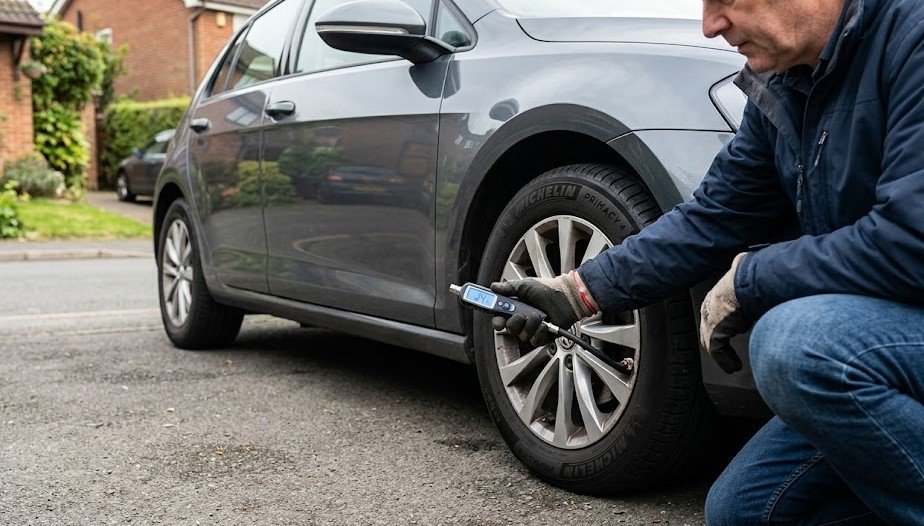
This is the most underused and most immediately actionable fuel-saving measure available to any driver in Dubai. Underinflated tyres increase rolling resistance — the engine has to work harder to move the same distance — and the effect on fuel consumption is direct, measurable, and consistent.
Properly inflated tyres can improve fuel efficiency by 3–5%, according to data consistently cited by both Pitstop Arabia’s UAE fuel efficiency analysis and the RTA’s official fuel economy guidance. On a car spending AED 800–1,000 on fuel per month, that translates to AED 25–50 in direct savings — for two minutes of work at a petrol station forecourt.
Dubai’s conditions make this more important than it sounds. The extreme summer heat causes tyre pressure to fluctuate significantly — tyres correctly inflated in the morning will read differently after sitting in a parking lot at 45°C all day. The correct protocol is to check cold pressure (first thing in the morning, before driving), using the figure on the sticker inside the driver’s door jamb rather than the maximum figure printed on the tyre sidewall. Every two weeks through summer. Every four weeks in the cooler months is adequate.
Most petrol stations across Dubai have air pumps available free of charge. ADNOC and ENOC forecourts are the most consistent. If yours isn’t working, Pitstop and SimplyTyres both offer mobile tyre services.
| ✅ Action — Do This Now Check cold tyre pressure this week against the driver’s door sticker spec Set a monthly phone reminder — make it recurring Summer months: check every 2 weeks (heat causes pressure to fluctuate more) A 1 PSI drop in all four tyres = roughly 0.2% reduction in fuel efficiency |
2. Drive at 100–120 km/h on the Highway — Not 140
Potential saving: 10–20% on highway runs
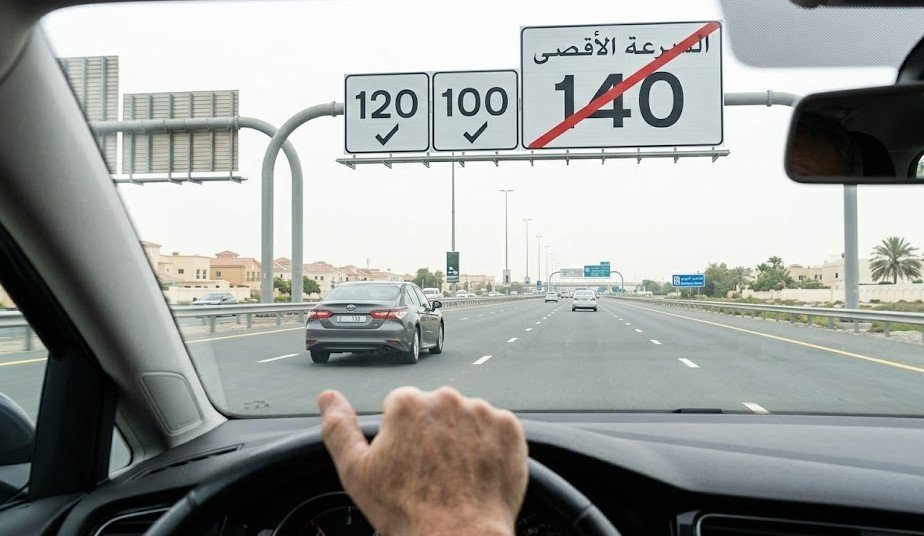
Aerodynamic drag increases with the square of speed. In practical terms: the difference in fuel consumption between driving at 100 km/h and 140 km/h is not 40% — it’s closer to 80–100% more energy fighting the air, simply because drag is a squared relationship. The engine doesn’t scale linearly with speed. It scales exponentially.
The UAE speed limit on most highways is 120 km/h with a tolerance of 20 km/h above posted limits. Driving at 100–110 km/h represents the efficiency sweet spot for most petrol engines . For highway commuters — particularly those running Abu Dhabi to Dubai regularly — this single habit change can reduce fuel consumption by 10–20% on motorway sections.
Cruise control is your practical tool here. On a straight highway stretch, the natural human tendency is to drift 10–15 km/h above the intended speed, especially when traffic thins. Setting cruise control at 110 km/h on Sheikh Zayed Road or the E11 holds the speed consistently, eliminates the creep, and delivers the efficiency gain without requiring active attention.
| ✅ Action — Highway Driving Use cruise control on E11, E311, and Al Ain Road — set at 100–110 km/h Avoid the fast lane on long journeys: it pulls average speed above the efficient range Saving estimate: AED 80–200/month for frequent inter-emirate commuters Added benefit: reduced Salik charges if you use quieter routes at moderate speeds |
Related : 15 Best Car Rental In Dubai (Guide)
3. Sign Up for ADNOC Rewards and ENOC Yes Rewards — Today
Potential saving: AED 50–150+/month
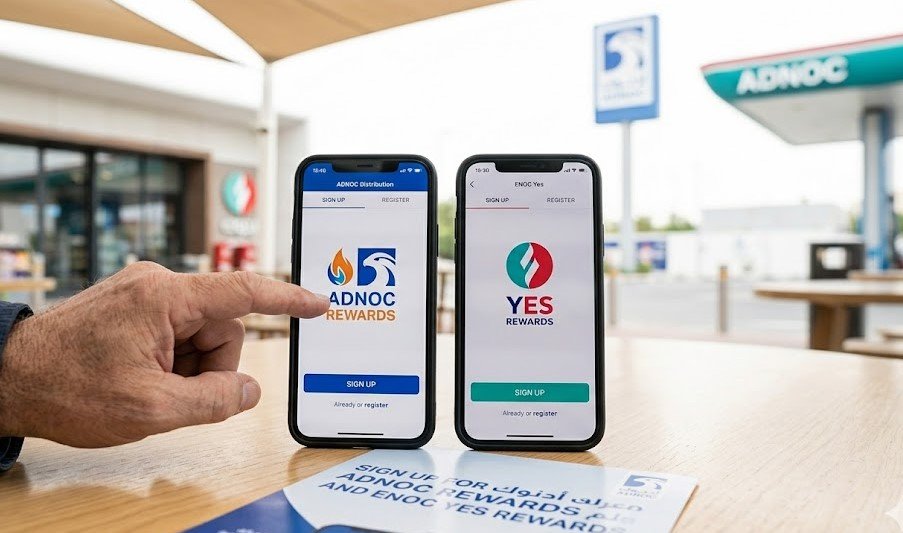
Every litre of fuel you buy without a loyalty card is a litre you’ve paid full price for when you didn’t have to. Both major UAE fuel operators run established rewards programmes — ADNOC Rewards and ENOC’s Yes Rewards — and both allow you to earn points on every fill-up and redeem them against future fuel purchases.
ADNOC Rewards — the UAE’s first fuel loyalty programme, now with over 2.5 million members — has expanded further: it’s now linked to the Shukran retail loyalty network (Landmark Group’s 7 million-member programme), meaning points earned at the pump can be converted and spent at Centrepoint, Splash, and other Landmark brands. Paying with the ADNOC Distribution app at the pump adds a 25% bonus points uplift automatically on every transaction.
On the credit card side, the FAB ADNOC Rewards card returns up to 15% in combined rewards on fuel and transport spend. The Emirates Islamic RTA card offers 10% cashback on fuel with no annual fee, among the highest free-card fuel rates in the market. Using either at the pump doesn’t cost anything extra — it just ensures every transaction generates a return rather than nothing.
| ✅ Action — Rewards Setup Download the ADNOC Distribution app — register for Rewards before your next fill ENOC drivers: register for Yes Rewards at the station or via the ENOC app Consider the FAB ADNOC credit card (up to 15% return) or Emirates Islamic RTA card (10% cashback, no annual fee) Pay at the pump with the ADNOC app: automatic 25% bonus points on every transaction ADNOC Rewards members spend 20% more value per visit than non-members — the data confirms it works |
4. Stop Idling.
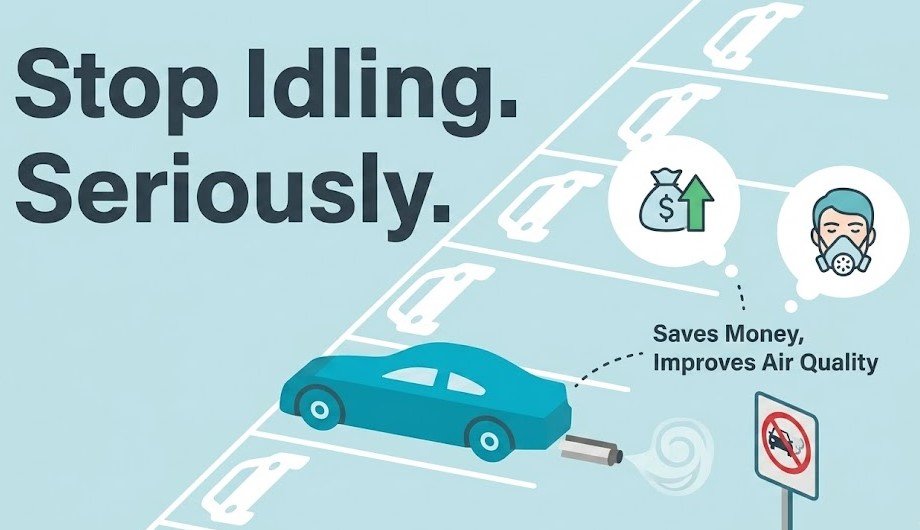
Idling is burning fuel to go nowhere. In a city where you can sit in a school drop-off queue for 15 minutes, wait in a drive-through for 10, or park in a mall basement with the engine running while your family finishes shopping, the cumulative effect on a monthly fuel bill is real.
An engine at idle consumes approximately 0.5 to 1 litre of fuel per hour for smaller cars and up to 1.5 to 2 litres per hour for large SUVs. Dubai’s fleet skews heavily toward the larger end — Patrols, Land Cruisers, Explorers — and Nissan Patrol fuel consumption extended air-conditioning while parked is one of the fastest ways to drain a large tank. Three hours of daily parking-lot idling across a month can add AED 80–100 to your bill without moving an inch.
The counterargument — that turning off and restarting costs more fuel than idling — is a myth that dates to carburettor-era engines. Modern fuel-injected engines use less fuel restarting from cold than they consume in 60 seconds of idle. If you’re parked and stationary for more than a minute, turning the engine off is the right call. Waiting in traffic is different — turning off and on in stop-start motorway conditions isn’t practical. But a parked engine with the AC running while you wait for someone is exactly the situation to address.
| Idling Habits Engine off if parked and waiting for more than 60 seconds School drop-offs, mall car parks, drive-throughs: all prime idling points Park in shade or a covered bay where possible — reduces the AC load when you restart Large SUV owners: idling costs you disproportionately more than compact car drivers |
5. Use the AC Smarter — Don’t Just Blast It
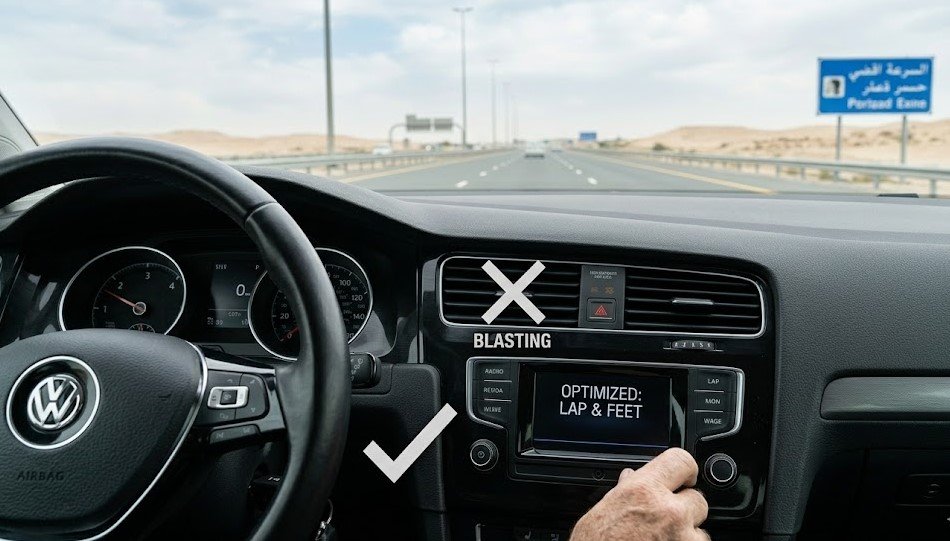
Air conditioning in Dubai is not optional — the question is how you use it, not whether. Running the AC at maximum with recirculation off, on a car that’s been parked in the sun for three hours, is the worst-case scenario for fuel consumption. There’s a better sequence.
First: when you get into a hot car, open all four windows for 60–90 seconds and let the heat escape before turning the AC on. Running the AC on a 60°C interior takes significantly more energy than cooling a 40°C one. Second: switch to recirculation mode once the cabin is cool — the button with the car and curved arrow. Recirculation cools already-chilled interior air rather than pulling in hot external air. Third: set the temperature to 24–26°C rather than the coldest setting. Most people overcool their cars — the compressor runs harder and longer than needed.
The combined fuel saving from proper AC management sits at 6–10% in UAE driving conditions — higher than in temperate climates because of how heavily the system runs year-round. In summer, when the compressor runs almost continuously, this habit change matters more than most others.
| ✅ AC Protocol Windows down for 90 seconds before switching the AC on in a hot car Switch to recirculation mode once the cabin reaches target temperature Set temperature at 24–26°C — not the lowest setting Park facing away from the sun where possible; reduces initial cabin temperature Have the AC system serviced annually — a poorly maintained system works harder |
6. Smooth Driving Over Aggressive Driving
The difference between a smooth driver and an aggressive driver on the same route, in the same car, in the same traffic is not small. Smooth driving — anticipating stops, accelerating gradually, maintaining following distance — can improve fuel economy by up to 30% in urban conditions compared to aggressive stop-start driving. In Dubai traffic, where roads switch constantly between open highway and congested urban sections, the gains compound.
Anticipate red lights: if a signal is red ahead, ease off the accelerator early and coast to a stop rather than maintaining speed and braking hard. Keep a generous following distance — this gives you time to react without braking sharply when the car ahead decelerates. Accelerate from standstill gently. None of this requires driving below the flow of traffic. It requires looking further ahead — three or four cars, not one. The fuel savings come from the physics: every time you brake from speed, you’re discarding kinetic energy the engine already burned fuel to create.
| ✅ Driving Style Look 4–5 cars ahead on highways and major roads — anticipate, don’t react Coast to red lights: ease off at 200m, not 20m Gradual acceleration from standstill — UAE traffic often opens up after signals anyway Remove roof racks and bike carriers when not in use: aerodynamic drag costs fuel at highway speeds Plan Salik routes in advance rather than rethinking at each gate |
7. Service Your Car on Schedule — Especially Filters and Oil

A neglected car burns more fuel than it needs to. Dubai’s environment accelerates wear in three specific ways: the dust clogs air filters faster than in temperate climates, heat degrades engine oil faster, and constant thermal stress shortens maintenance intervals relative to manufacturer specs written for European conditions.
A dirty air filter restricts the air-fuel mixture reaching the cylinders, forcing the engine to work harder. Degraded engine oil increases friction throughout the drivetrain. Worn spark plugs cause incomplete combustion. recommends to fully synthetic oil rated for high temperatures and service intervals of 10,000 km or as specified — erring toward the shorter interval for UAE conditions rather than the maximum.
The practical application is simple: if you’re approaching a service interval, do the service rather than extend it. The fuel saving from a properly maintained car versus one running a few thousand kilometres overdue on an oil change, with a partially blocked air filter, is real and immediate — and it compounds across every kilometre until the next service.
| ✅ Maintenance Schedule Air filter: inspect every 10,000 km; replace more frequently in dusty conditions Engine oil: fully synthetic, high-temperature rated — change on schedule, not late Spark plugs and fuel injectors: service as per manufacturer schedule Wheel alignment: misaligned wheels increase rolling resistance — check annually Overdue servicing costs more in fuel than the service itself costs to complete |
8. Use the Right Fuel Grade for Your Engine
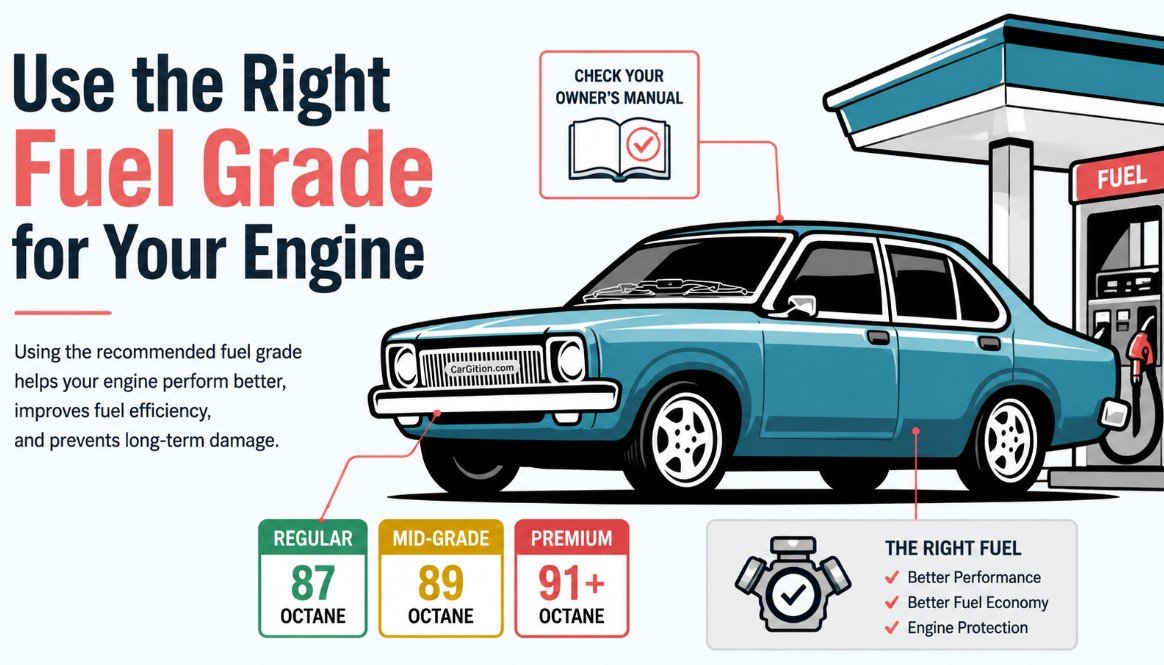
Many drivers in Dubai pay for Super 98 fuel when their car’s engine does not require it and receives no benefit from it. This is money spent on a premium that delivers nothing to most engines — and the cost difference between grades, across a month of full tanks, is not trivial.
The fuel grade your car actually needs is specified in the owner’s manual — listed as the minimum octane requirement. Most standard petrol engines (non-turbocharged, non-performance) are designed for 91 or 95 octane. Filling them with 98 produces no measurable increase in power, economy, or engine longevity. The higher octane is specifically designed for high-compression or turbocharged engines calibrated to benefit from it.
If your manual specifies 95, run 95. If it specifies 98, run 98. If it specifies 91, that’s what your engine is tuned for. Check the manual — not the habit you’ve always had, not what the person who sold you the car suggested. Running a higher grade than required costs more every month without giving anything back.
| Fuel Grade Check Open your owner’s manual and confirm the minimum octane requirement Super 98 only necessary if the engine specification genuinely requires it The per-litre difference between 91 and 98 adds up across 4+ fills per month Turbocharged engines (many modern SUVs and performance cars) genuinely need 98 — verify before switching This is a one-time check that saves money every month indefinitely |
9. Rethink the Commute — Even One Day a Week Makes a Difference
The most fuel-efficient journey is the one you don’t make. Dubai’s remote and hybrid working culture has matured significantly, and many employers across technology, finance, media, and consultancy operate flexible schedules that allow one to two days of remote work per week. One fewer daily commute per week, for a driver doing 40 kilometres each way between, say, Silicon Oasis and Business Bay, removes roughly 320 kilometres of fuel consumption per month — a meaningful reduction at any price per litre.
Carpooling is the parallel option for those who can’t work remotely. Sharing the commute with one colleague halves fuel costs for both parties. Dubai’s communities are large enough that colleagues often live in the same development or nearby — the logistics are simpler than they seem. Apps including Roo and Carpool UAE exist specifically for this market, and the commuter corridors between Silicon Oasis, Sports City, JVC, and the employment hubs along Sheikh Zayed Road are the routes where organised sharing makes the most financial sense.
| ✅ Rethink Your Commute One work-from-home day per week = roughly 25% off your commuting fuel spend Check your employment contract — hybrid arrangements are increasingly standard across sectors Carpool with one colleague on the same route: halves both fuel bills Carpooling apps active in Dubai: Roo, Carpool UAE, community WhatsApp groups Dubai Metro Day Pass: AED 22 — covers Business Bay, Downtown, Marina commutes from the metro network |
10. Remove Unnecessary Weight and Roof Accessories
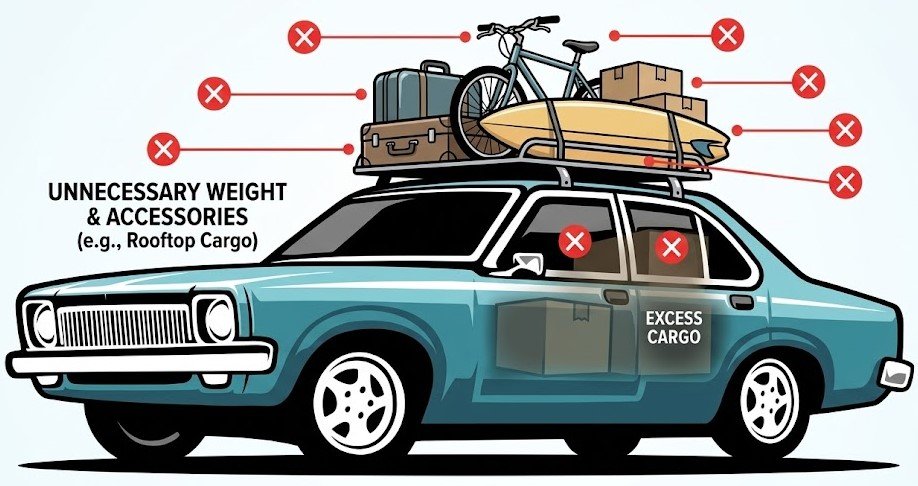
Roof racks, bike carriers, and kayak mounts create aerodynamic drag that increases fuel consumption even when nothing is mounted on them — the structure itself disrupts airflow over the car. At highway speeds, a roof rack adds a measurable fuel consumption penalty that compounds across every kilometre.
Beyond aerodynamics, weight matters directly. Property Finder’s UAE fuel consumption analysis notes that every 50 kg of unnecessary weight increases fuel consumption by approximately 1–2%. For a family SUV that’s become the default cargo hauler — gym equipment, sandboards, camping gear, the spare tyre kit that hasn’t moved in a year — a clear-out of the boot and removal of unused roof accessories is a practical, one-time step that pays back continuously.
A lighter car accelerates more efficiently, brakes with less distance, and asks less of the engine on every metre of every journey. The saving per tip won’t be dramatic in isolation — but combined with the other nine on this list, it closes out a complete picture of what controllable fuel management looks like for a Dubai driver.
| ✅ Weight Reduction Remove roof racks, bike carriers, and mounts when not actively in use Clear the boot of gear that’s been there for months — sandboards, gym kit, camping equipment 50 kg removed = 1–2% fuel saving; 100 kg removed = 2–4% Lighter cars also brake shorter and handle better — the safety case aligns with the fuel case One-off clear-out; no ongoing effort required after the first time |
What the Tips Add Up To
None of these tips individually neutralises a meaningful fuel price increase. But the honest question isn’t whether each tip covers every rise — it’s how much of your fuel spend you can recover through things entirely within your control. The answer, applied consistently, is more than most drivers assume.
The rough breakdown: 3–5% from correct tyre pressure, 10–20% from highway speed discipline, 6–10% from AC management, up to 30% urban gain from smooth driving (translating to roughly 8–12% across a mixed month), 5–10% from proper servicing, the grade difference from using the correct fuel, AED 50–150 from rewards programmes, and the variable but often substantial gains from reducing commutes or removing deadweight.
The drivers who benefit most are those doing the most kilometres — inter-emirate commuters, large SUV owners, anyone driving more than 2,000 km per month. For that group, the combination of speed management, AC discipline, and rewards stacking alone recovers a meaningful portion of what higher prices add to their monthly bills.
The Bigger Picture: Where UAE Fuel Costs Are Heading
The UAE’s market-linked pricing system means pump prices will continue to move with global oil benchmarks. That’s the structural reality and it isn’t changing. What is changing, gradually but measurably, is the broader transport ecosystem.
The government has been actively incentivising hybrid and electric vehicle adoption — and the economics of that shift improve as petrol prices rise. The ADNOC rewards programme now includes EV charging through E2GO alongside fuel rewards. Etihad Rail’s passenger service, launching in 2026 across Dubai, Abu Dhabi, and Fujairah, offers a genuine alternative for inter-emirate commuters. Dubai Metro’s Blue Line, approved for September 2029, will connect communities in eastern Dubai that are currently entirely car-dependent.
None of those alternatives remove the immediate reality of a monthly petrol bill. But they’re worth tracking as they develop — each one represents an eventual reduction in the kilometres that need to be driven, and by extension, the fuel that needs to be bought.
In the meantime, the ten tips above are the complete set of things a Dubai driver can control. The fuel price is announced at the end of every month. Everything else is within your hands.
Quick Reference: All 10 Tips at a Glance
| # | Tip | Effort Required | Estimated Monthly Saving |
| 1 | Tyre pressure (monthly check) | 5 min/month | AED 25–50 |
| 2 | Highway speed discipline (100–110) | Habit change | AED 80–200 |
| 3 | Loyalty rewards + cashback card | One-time setup | AED 50–150+ |
| 4 | Stop unnecessary idling | Habit change | AED 40–80 |
| 5 | Smarter AC use | Habit change | AED 60–120 |
| 6 | Smooth driving style | Habit change | AED 80–200 |
| 7 | Service on schedule (filters, oil) | Quarterly action | Prevents 5–10% efficiency loss |
| 8 | Use the correct fuel grade | One-time check | Grade difference × fills per month |
| 9 | Reduce commute / carpool | Planning required | AED 200–400+ |
| 10 | Remove roof racks & excess weight | One-off clear-out | AED 15–40 |
Disclaimer: The information provided in this article is for general informational and educational purposes only. While these tips are designed to help improve fuel efficiency based on standard driving practices, actual petrol savings may vary depending on your vehicle’s make, model, condition, and individual driving habits. Always prioritize road safety and adhere to local UAE traffic laws and regulations.