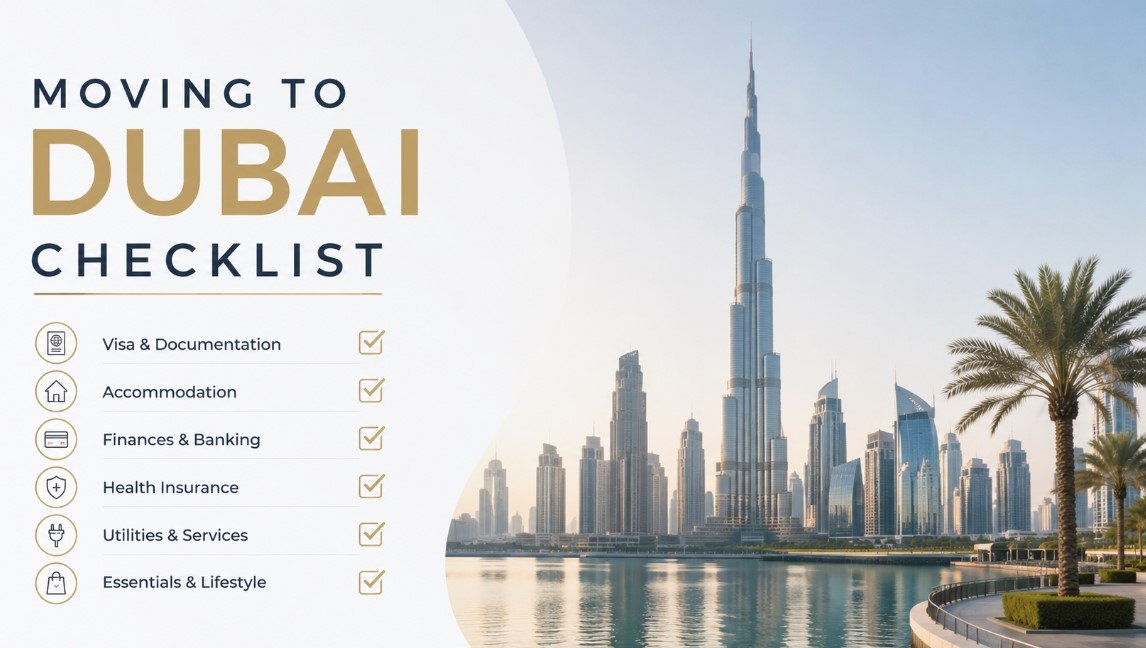
Dubai is not a difficult city to move to — but it is an unforgiving one if you show up without a plan. The paperwork moves in a specific order. Skip a step and something downstream breaks. Miss a deadline and you’re paying fines or starting applications over. The city rewards people who prepare.
The good news: the move is smoother than it’s ever been. Digital applications, faster Emirates ID processing, a broader range of self-sponsored visa options, and a rental market that — after years of double-digit increases — has finally started to stabilise. Dubai’s population surpassed four million in early 2026, with new residents arriving continuously, and the infrastructure has largely kept pace.
Moving to Dubai Checklist covers everything: the visa landscape, the step-by-step admin process, housing and neighbourhood choices, a realistic cost-of-living breakdown, and the things that most relocation guides forget to mention. Use it to plan, not just to read.
Moving to Dubai Checklist
Before You Leave: The Pre-Departure Checklist
Most Dubai relocation stress happens because people start the process after they’ve landed rather than before. Several steps — document attestation, embassy registration, certain visa category applications — are significantly easier, cheaper, and faster to handle from your home country.
| Task | Why It Matters | |
| ✅ | Check passport validity (6+ months) | Renew before applying for anything UAE-related |
| ✅ | Confirm your visa route | Employment, Green Visa, Golden Visa, family sponsorship |
| ✅ | Get documents attested / apostilled | Educational certificates, marriage cert, birth certs |
| ✅ | Organise document translations | Arabic translations for key personal documents |
| ✅ | Arrange health insurance | Mandatory in Dubai — get at least minimum DHA-compliant cover |
| ✅ | Line up short-term accommodation | Hotel or furnished flat while you apartment-hunt (2–4 weeks minimum) |
| ✅ | Open a non-UAE bank account with international access | Wise or similar for the first few weeks before UAE bank opens |
| ✅ | Ship or store belongings | Customs rules: no alcohol, restricted medications need documentation |
| ✅ | Research neighbourhoods | Proximity to workplace, school, Metro — visit before committing |
| ✅ | Secure a job offer (if employment route) | Most employment visas begin with the employer’s PRO |
| ✅ | Notify home country tax authority | Tax residency change obligations vary by nationality — check your country |
| ✅ | Register with your country’s embassy | Advisable for emergency consular access |
Document Attestation: The One People Forget Until It’s Painful
The UAE requires that foreign personal documents — educational certificates, marriage certificates, birth certificates — be officially authenticated before they’re legally recognised. The process varies by country of origin, but typically involves your home country’s foreign affairs ministry (or apostille stamp if your country participates in the Hague Convention), then the UAE embassy in your country, then the UAE Ministry of Foreign Affairs (MOFA) after you arrive.
What this means practically: if you’re a doctor, teacher, accountant, or engineer whose licence requires academic verification, or if you’re bringing a spouse and need marriage certificate recognition, or if you’ll enrol children in school and need birth certificates — start this process at least two months before your move date. Some countries have backlogs that stretch this to three months.
⚠️ Document attestation cannot be rushed by much. If you need your medical degree attested for HAAD/DHA professional licensing, or your marriage certificate to sponsor a spouse’s visa, and you start the process on landing day, you will wait. Begin before you leave.
Useful link : Documents Attestation : This service provides attestation by the Ministry of Foreign Affairs and UAE
Choosing Your Visa Route: What’s Available
The UAE’s residency visa landscape has changed substantially since 2022. Self-sponsored options — once limited to investors — now cover skilled workers, freelancers, remote workers, and retirees. Understanding which route applies to you before you arrive shapes everything from your family sponsorship rights to how long you can stay outside the UAE without your visa lapsing.
| Visa Type | Duration | Who Qualifies | Key Notes |
| Employment Visa | 2–3 years | Employer-sponsored; employer handles application | Most common; employer pays costs; tied to company |
| Green Visa | 5 years | Self-sponsored skilled workers & freelancers | No employer needed; AED 4,000/mo min. to sponsor family |
| Golden Visa | 5 or 10 years | Investors (AED 2M+ property), professionals (AED 30K basic salary) | No 6-month absence limit; sponsor family with no salary minimum |
| Freelance Permit | 1–2 years | Issued by freezone or DED; specific activity only | Lower cost; restricted to named freelance activity |
| Retirement Visa | 5 years | 55+ with property, savings, or income thresholds | Renewable; must meet financial minimums at renewal |
| Remote Work Visa | 1 year (renewable) | Work for foreign employer from UAE | Known as Digital Nomad Visa; no UAE employer needed |
The Golden Visa
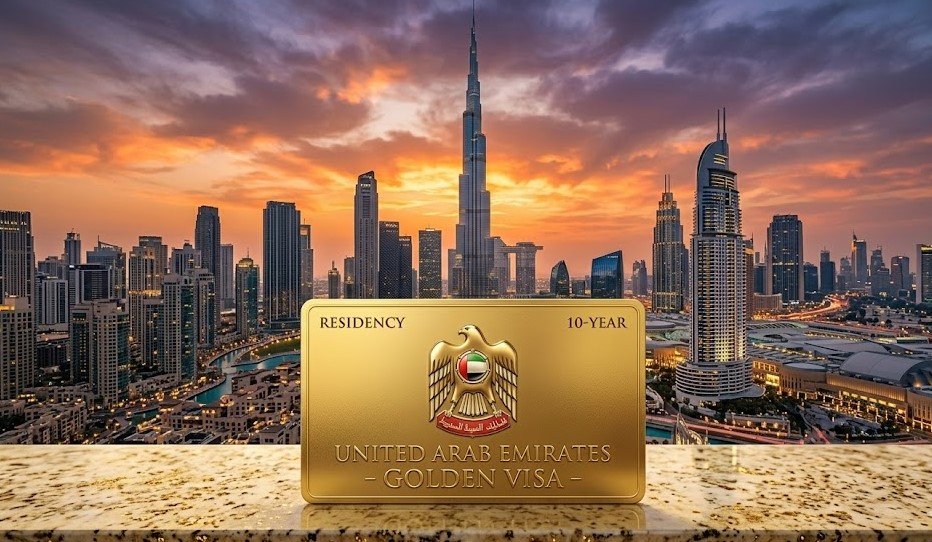
The Golden Visa remains the most sought-after long-term residency option, primarily for two reasons: the 10-year duration eliminates the recurring visa renewal cycle, and Golden Visa holders are exempt from the standard 180-day continuous absence rule that causes standard employment visa holders to plan their international travel carefully.
The salary route — one of the most common paths for professionals — tightened in late 2025. Applicants must now show a basic monthly salary of AED 30,000 for the past two years, with allowances (housing, transport, performance bonuses) explicitly excluded from the calculation. If your salary package reaches AED 30,000 through allowances but your basic is AED 22,000, you don’t currently qualify under the salary route.
The property route requires AED 2 million or more in UAE real estate — owned outright or mortgaged, with the outstanding loan not exceeding the minimum threshold net of payments made. Off-plan properties have specific conditions attached. If you’re considering buying property in Dubai partially as a Golden Visa qualifying investment, confirm the current GDRFA rules on the property type and completion status before committing.
The Green Visa: Overlooked and Often the Right Answer

For skilled professionals and freelancers who don’t meet the Golden Visa salary threshold but don’t want to be tied to an employer’s visa, the Green Visa is worth serious consideration. It’s a five-year self-sponsored residency with the same absence-limit exemption as the Golden Visa — critical for anyone who splits their time between the UAE and elsewhere.
Green Visa holders can sponsor family members, but unlike Golden Visa holders, they must meet the standard family sponsorship salary threshold: AED 4,000 per month in Dubai (or AED 3,000 if the employer provides housing). It’s a meaningful distinction for anyone planning to bring a spouse or children.
💡 Visa choice tip: If you’re employed and your salary is below AED 30,000 basic, the Green Visa is often more appropriate than spending two years trying to qualify for Golden. Talk to an ICP-registered PRO or specialist before applying — the wrong visa category creates complications at renewal.
The Step-by-Step Setup Process: What to Do and in What Order
Every step in setting up your Dubai life depends on the step before it. This is not bureaucratic inefficiency — it’s how the system is designed. Understanding the sequence prevents you from showing up at a DEWA office with documents that reference an Ejari you don’t have yet.
| # | Step | Where / How | Key Notes |
| 1 | Residency Visa | GDRFA / ICP portal, or through employer PRO | Foundation of everything else — do this first |
| 2 | Medical Fitness Test | Approved health centres (MOH-listed) | Required for visa stamping; chest X-ray + blood test |
| 3 | Emirates ID | ICA service centres or via employer PRO | Issued within 5–10 working days; required for almost everything |
| 4 | Tenancy Contract + Ejari | Dubai REST app or authorised typing centre | Ejari costs AED 177–220; required for DEWA, schools, visa renewal |
| 5 | DEWA Connection | dewa.gov.ae or DEWA app | Needs Ejari ref + Emirates ID; deposit AED 2,000 (apt) / AED 4,000 (villa) |
| 6 | UAE Bank Account | Emirates NBD, Mashreq, ADCB, Wio, Liv | Emirates ID required; allow 1–3 weeks for full activation |
| 7 | UAE SIM Card | Etisalat (now e&) or du outlets | Passport + Emirates ID required; eSIM available from e& |
| 8 | Health Insurance | DHA-compliant insurer; employer often provides | Mandatory; needed for visa renewal; buy before you need it |
| 9 | Driving Licence Conversion | RTA service centres | Eye test required; conversion for eligible countries; no test if eligible |
| 10 | School Enrolment | Direct to school; bring attested documents | Start months early — top schools fill quickly; KHDA regulates fees |
| 11 | Vehicle Registration / Car Purchase | RTA; Emirates ID + licence required | Import a car (customs applies) or buy locally; dealer financing available |
| 12 | Ejari-linked Services | DEWA, Empower (district cooling), du/e& (telecom) | Some utilities tied to Ejari address; update if you move |
Emirates ID: Your Most Important Document in the UAE
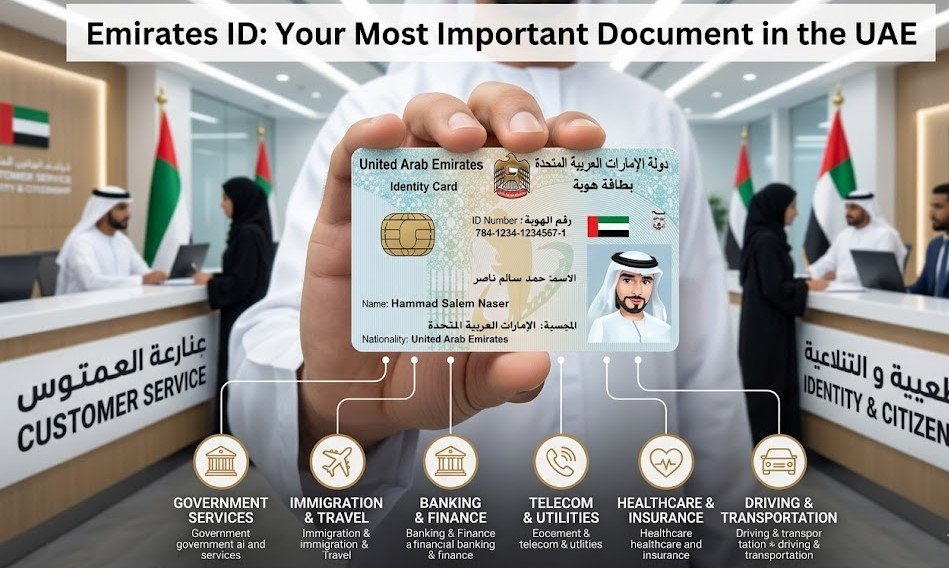
The Emirates ID functions as your identity, your address verification, your insurance linkage, and your banking KYC document in one card. Almost nothing in the UAE can be processed without it. Banks won’t open accounts, schools won’t enrol students, and utility connections won’t process without an Emirates ID number at minimum, and often the physical card.
For employment visa holders, the Emirates ID is typically processed as part of the visa application — your company’s PRO coordinates this. For self-sponsored visa applicants, you apply through the ICP portal (icp.gov.ae) independently. The card typically arrives within five to ten working days. Do not book your furniture delivery, sign a permanent tenancy contract, or commit to a school start date until you have your Emirates ID number confirmed — the number is what matters for most applications, and it’s issued before the physical card arrives.
Ejari: The Rental Registration That Unlocks Everything Else
Ejari is Dubai’s mandatory tenancy registration system, run by RERA (Real Estate Regulatory Agency) under the Dubai Land Department. Every residential tenancy in Dubai must be registered through it. This is not optional — an unregistered tenancy is legally unenforceable, and without Ejari you cannot connect DEWA, enrol children in school, or renew your visa.
The practical process: once you’ve signed your tenancy contract, register it via the Dubai REST app (costs AED 100 online plus a small service fee, totalling around AED 177) or at an authorised typing centre (around AED 220, same-day processing). You’ll need your tenancy contract, Emirates ID, and the landlord’s title deed. The Ejari certificate is issued digitally and you’re done.
🏠 Before you sign a lease: Check your proposed rent against the RERA Rental Index (available on the DLD website). Landlords can only raise rent at renewal if the current rent is below the RERA benchmark for the area. Knowing this before you sign gives you real negotiating leverage — and protects you at renewal.
DEWA: Setting Up Utilities
DEWA (Dubai Electricity and Water Authority) connection requires your Ejari registration number, Emirates ID, and a refundable security deposit — AED 2,000 for an apartment and AED 4,000 for a villa. The connection is processed through the DEWA app or website, typically within 24 to 48 hours once documents are submitted.
One thing many new residents discover too late: in buildings with district cooling (Empower or Tabreed), you’ll have a separate chiller account in addition to DEWA. Always ask whether a building is ‘chiller free’ before signing — if it’s not, budget an additional AED 500–1,000 per month during summer months for the cooling bill. This is separate from and in addition to your DEWA electricity and water bill.
🌡️ Summer utility reality: Dubai summer runs May through October. AC runs almost continuously. DEWA bills for a mid-size apartment can reach AED 800–1,500 per month in July and August even with conscientious usage. Factor this into your monthly budget before committing to a rent level.
Housing: Neighbourhoods, Rents, and How to Choose
Dubai’s residential market is not one market — it’s fifteen or so parallel ones, each with different price points, community characters, transport access, and suitability for different life stages. The single biggest mistake new residents make is choosing an apartment based on proximity to a known landmark rather than proximity to their actual daily life.
Rent growth across Dubai has moderated significantly , slowing to around 4–6% annually compared to the double-digit increases of 2023 and 2024. Supply is improving — particularly in areas like JVC, Arjan, and Dubai South — giving tenants more negotiating room than they’ve had in several years. That doesn’t mean it’s cheap. It means it’s at least not accelerating.
| Area | Approx. Annual Rent | Cost Level | Who It Suits |
| Downtown / DIFC / Business Bay | AED 95k–150k+/yr (1BR) | 💰💰💰💰 | Central; DIFC metro; walkable; high density; best for finance/media workers |
| Dubai Marina / JBR | AED 80k–130k/yr (1BR) | 💰💰💰💰 | Waterfront lifestyle; walkable; busy; great transport; loud on weekends |
| Jumeirah Lake Towers (JLT) | AED 55k–90k/yr (1BR) | 💰💰💰 | Good value near Marina; DMCC workers; Metro access; community feel |
| Jumeirah Village Circle (JVC) | AED 50k–80k/yr (1BR) | 💰💰 | Affordable; improving supply; family-friendly; no Metro (car needed) |
| Dubai Hills Estate | AED 180k–280k/yr (villa) | 💰💰💰 | Top family community; schools; parks; Emaar Hills Mall; car-dependent |
| Palm Jumeirah | AED 150k–400k+/yr (apt) | 💰💰💰💰💰 | Prestige waterfront; Monorail; dining; private beaches; expensive utilities |
| Mirdif / Al Qusais | AED 40k–65k/yr (apt) | 💰 | Budget-friendly suburban; popular South Asian expats; Deira City Centre access |
| Arjan / Dubai Science Park | AED 55k–78k/yr (1BR) | 💰💰 | Newer mid-range; softening rents; near Miracle Garden; car needed |
Disclaimer: Rental prices and area profiles are approximate and based on current market trends in Dubai. Actual costs may vary depending on property type, building quality, furnishing, lease terms, and market conditions. Always verify listings and conduct your own research before making any rental decision.The Rent Payment System: Cheques, Direct Debit, and the 2026 Reality
Dubai’s rent payment culture has traditionally involved post-dated cheques — often one, two, or four cheques covering the full annual rent — deposited at fixed intervals. For a new arrival without a UAE bank account, this creates an immediate chicken-and-egg problem: you need somewhere to live before you can open a bank account, but you need cheques to rent.
The shift toward monthly direct debit payments is accelerating , with larger property management companies moving to this model. If you can negotiate monthly payments — sometimes at a slight premium versus annual cheque deals — it’s worth it for the cash-flow flexibility, especially in the first year. Furnished short-term rentals (typically month-to-month through platforms like Airbnb for Business or furnished flat agencies) bridge the gap while your bank account and permanent address come together.
Two other rental rules that matter: landlords must give 90 days’ written notice before any rent increase, and they can only increase rent at renewal — not mid-tenancy. Increases are governed by the RERA Rental Index; if your rent is already at or above the RERA benchmark for your area, any proposed increase can be challenged at the Rental Disputes Centre.
Hidden Housing Costs That Catch People Out
- Agent commission: Typically 5% of annual rent, paid upfront to the letting agent. On a AED 80,000/year apartment, that’s AED 4,000 — not always mentioned until negotiation time.
- Security deposit: Usually 5% of annual rent (unfurnished) or 10% (furnished). Refundable at end of tenancy minus deductions — keep a documented condition report at check-in.
- Dubai housing fee: 5% of annual rent divided across 12 months, added to your DEWA bill. Often missed in budget planning — typically AED 250–500/month.
- Municipality fees and chiller: See DEWA section above. Budget these before, not after, signing.
- Maintenance responsibility: In most Dubai leases, the tenant covers minor maintenance (under AED 500–1,000); the landlord covers major systems. Confirm what’s in your specific contract before signing.
Cost of Living in Dubai : What a Realistic Budget Looks Like
The zero personal income tax is real and it makes a material difference to take-home pay. But Dubai’s cost of living — particularly housing, schooling, and utilities in summer — is genuinely high, and first-year residents who arrive expecting that the tax saving alone covers everything are often surprised. The table below is based on real 2026 market data, not optimistic estimates.
Related : Dubai Cost of Living Calculator
| Expense | Typical Cost | Notes |
| Studio apartment (mid-range) | AED 4,200–5,500/mo | JVC, Arjan, Dubai Silicon Oasis |
| 1-bedroom apartment (mid-range) | AED 5,500–8,000/mo | JLT, Business Bay, Dubai Hills |
| 2-bedroom apartment (family) | AED 8,000–14,000/mo | Dubai Hills, JBR, Mirdif |
| 3-bedroom villa (family) | AED 15,000–25,000+/mo | Arabian Ranches, Dubai Hills, Jumeirah |
| DEWA (utilities) — 1BR | AED 400–700/mo | Summer months significantly higher (AC) |
| Chiller fee (district cooling) | AED 500–1,000/mo | Summer peak; ask if building is ‘chiller free’ |
| Internet (100–200 Mbps) | AED 350–500/mo | Etisalat / du; fibre widely available |
| Groceries — single person | AED 1,200–1,800/mo | Carrefour, Spinneys, LuLu Hypermarket |
| Groceries — family of 4 | AED 3,500–5,500/mo | Imported goods pricier; local produce cheaper |
| School fees (private, mid-range) | AED 35,000–75,000/yr | Varies hugely by curriculum; GEMS, Taaleem |
| School fees (premium international) | AED 75,000–150,000+/yr | IB, British A-Level premium schools |
| Health insurance — individual | AED 1,500–3,500/yr (basic) | DHA-compliant required; comprehensive from AED 6,000+ |
| Health insurance — family of 4 | AED 8,000–20,000+/yr | Depends on ages, coverage, insurer |
| Petrol (per litre) | AED 2.82 (early 2026) | Government-regulated; reviewed monthly |
| Metro/bus commute (monthly) | AED 100–350/mo | Nol card; Gold Class or Silver Class |
| Taxi / Careem (daily commuter) | AED 600–1,500/mo | Depends heavily on distance; surge pricing applies |
| Gym membership | AED 250–600/mo | Fitness First, Gold’s Gym; many buildings have gyms |
| Eating out — mid-range restaurant | AED 80–160 per person | Dine-in malls or JBR; delivery via Deliveroo cheaper |
| Dubai housing fee (on DEWA bill) | 5% of annual rent / 12 | Often overlooked; AED 250–500/mo typical |
Disclaimer: Costs are approximate and may vary based on location, lifestyle, provider, and market conditions. Please verify current prices before making financial or relocation decisions.Putting It Together: Monthly Budget Scenarios
Single Professional, Mid-Range Life (JLT / Business Bay)
- 1BR apartment: AED 6,500/mo
- DEWA + chiller + internet: AED 900/mo
- Groceries: AED 1,400/mo
- Transport (Metro + occasional taxi): AED 500/mo
- Eating out (2–3 times/week): AED 1,200/mo
- Health insurance: AED 250/mo (basic DHA-compliant)
- Gym + lifestyle: AED 500/mo
- Housing fee (DEWA bill): AED 330/mo
- Monthly total: approximately AED 11,580 (~USD 3,150)
Family of Four (2BR apartment, one school-age child)
- 2BR apartment (Dubai Hills / JVC): AED 12,000/mo
- Utilities + chiller: AED 1,400/mo
- School fees (mid-range British): AED 4,500/mo
- Family groceries: AED 4,000/mo
- Car (finance + insurance + petrol + Salik): AED 3,500/mo
- Family health insurance: AED 1,200/mo
- Activities, dining, lifestyle: AED 2,500/mo
- Housing fee: AED 600/mo
- Monthly total: approximately AED 29,700 (~USD 8,100)
💰 Tax saving reality check: A UK professional earning AED 40,000/month (approximately £87,000/year) saves roughly AED 10,000–12,000/year in avoided UK income tax at the higher rate band. Against a family-of-four monthly spend of ~AED 30,000, that’s meaningful but not the whole story. The lifestyle quality — space, safety, weather — is the real draw for most families.
Practical Necessities: Banking, Driving, Schools & Health
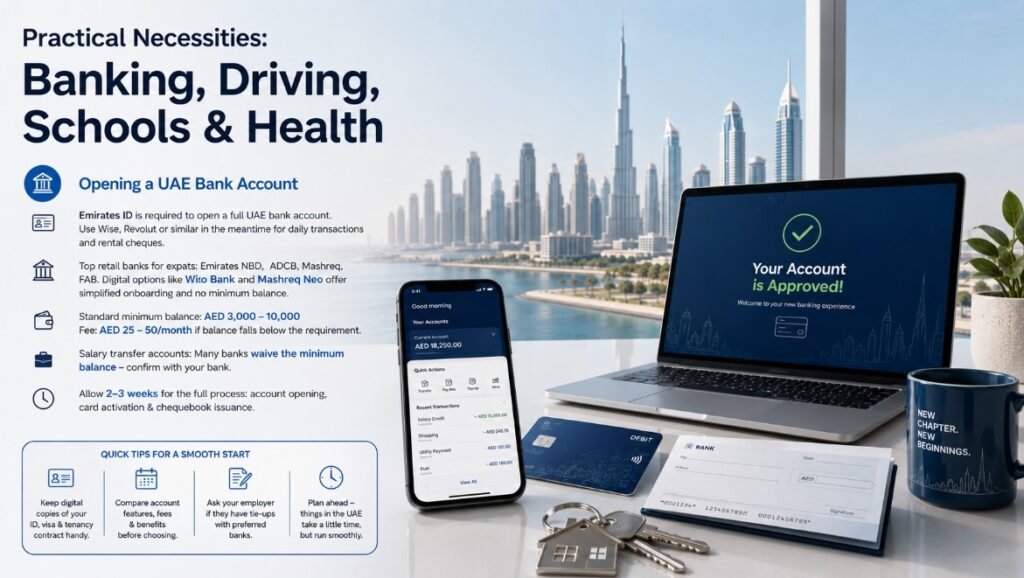
Opening a UAE Bank Account
You need your Emirates ID to open a full UAE bank account. In the gap between arriving and receiving your Emirates ID, keep an internationally accessible account (Wise, Revolut, or similar) for daily transactions and to write rental cheques — some banks allow account opening with a passport and visa stamp, but this is increasingly the exception.
The main retail options for expats are Emirates NBD, Abu Dhabi Commercial Bank (ADCB), Mashreq, and First Abu Dhabi Bank (FAB). Each has different minimum balance requirements and fee structures. Digital-native options like Wio Bank (a UAE-licensed digital bank) and Mashreq Neo have simplified onboarding and no minimum balance requirements, making them popular first accounts while your primary bank processes.
- Standard minimum balance: AED 3,000–10,000 for most retail accounts; fee around AED 25–50/month if you fall below.
- Salary transfer accounts: If your employer transfers salary directly, many banks waive the minimum balance requirement — confirm this when opening.
- Allow 2–3 weeks: Account opening, card activation, and chequebook issuance rarely happens in one day. Plan accordingly.
Driving Licence: Conversion and What to Expect
Residents from a long list of eligible countries — including the UK, US, Australia, Germany, France, Canada, South Africa, and most Western nations — can convert their home country driving licence to a UAE licence without taking a driving test. The conversion is processed through the RTA (Roads and Transport Authority).
Requirements for direct conversion: original valid foreign licence (not expired), passport with UAE residency visa, Emirates ID, and an eye test certificate (available on-site at RTA service centres). The process takes one visit and typically a few hours, including the eye test.
If your country is not on the eligible list, or your licence is expired, you’ll go through the full UAE test route — theory test, yard test, and road test. Budget AED 3,000–5,000 for driving lessons and test fees if starting from scratch.
Schools: Start Early, and Understand the Fee Structure
School fees are, for many families, the single largest monthly expense after rent. Private international schools range from AED 12,500 to over AED 150,000 per year depending on curriculum and school. The most popular expat schools — GEMS, Taaleem, Jumeirah English Speaking School (JESS) — have waiting lists that can stretch 6–12 months for popular year groups.
Curriculum options in Dubai are wide: British, American, IB, Indian CBSE, and others. Most expat families with children going to university in the UK default to British curriculum; American families prefer the American curriculum. IB is a solid cross-border option but typically at the premium end of the price range.
- KHDA (Knowledge and Human Development Authority): Dubai’s school regulator. Check a school’s most recent inspection rating before applying — it’s publicly available and tells you a lot more than marketing materials.
- Registration fees: Usually AED 500–2,000 per child; non-refundable.
- Sibling discounts: Many schools offer 5–10% for additional children — ask.
- Transport: School buses are widely available at AED 5,000–10,000/year; many parents drive in the first year while they learn the road patterns.
Health Insurance: Mandatory and Non-Negotiable
Health insurance is legally mandatory for all residents of Dubai. If your employer doesn’t provide it — which they’re required to do — you must arrange your own DHA-compliant plan. The minimum coverage requirements are set by the Dubai Health Authority (DHA) and include emergency care, inpatient, and outpatient coverage above defined minimums.
Individual basic plans start around AED 1,500–3,500/year. Comprehensive family coverage with good outpatient benefits runs AED 15,000–30,000+/year for a family of four. Dubai’s private healthcare is genuinely excellent — but only if your insurance actually covers the network you use. Always check whether your preferred hospitals and clinics are in-network before selecting a plan.
Things Nobody Tells You Before You Move
The Cheque Culture
When you hand a landlord post-dated cheques for rent, those cheques are powerful legal instruments that act as “executive deeds.”
If a cheque bounces, the landlord can bypass the police and go straight to the execution courts to instantly freeze your assets or trigger a travel ban. Never issue a cheque you’re not certain will clear on the date it’s deposited; this immediate civil enforcement mechanism is far stricter than Western banking norms and frequently catches unbriefed expats off guard.
Ramadan Changes Everything — Plan Around It
Ramadan shifts working hours (typically 9am–2pm or 9am–3pm for government services), closes many restaurants during daylight hours, and changes the social tempo of the city. If you’re arriving in a Ramadan period, expect slower processing times at government offices and a different daily rhythm. It’s also one of the most atmospheric times to be in Dubai if you embrace it.
The 6-Month Absence Rule for Standard Visas
Employment visa holders who spend more than six consecutive months outside the UAE risk having their residency visa automatically cancelled. This matters for people who travel extensively, take extended home leave, or work remotely from their home country for long stretches. The Golden Visa and Green Visa exempt holders from this rule — a major practical reason why some professionals seek these routes specifically.
VAT Exists and Applies to Most Things
The UAE introduced 5% VAT in 2018. It applies to most goods and services, including rent (no — residential rent is exempt), school fees (no — exempt for approved schools), healthcare (no — exempt), eating out (yes), retail (yes), and professional services (yes). It’s low by international standards but worth accounting for in budget calculations.
The Summer Is Genuinely Extreme
Outdoor temperatures in Dubai reach 45°C+ in July and August. Humidity makes it feel worse. Daily life between June and September is largely indoors — malls, gyms, offices, and indoor restaurants. Running, cycling, or walking outdoors becomes a 5am-only activity. This shapes lifestyle, school holiday timing, and when the social scene moves to rooftop pools versus indoor venues. If you’re visiting to scout neighbourhoods, come in January or February — the climate is genuinely beautiful.
Making It Work: The Mindset Behind a Successful Move
The people who settle well in Dubai share a few common traits. They came with realistic expectations about the administrative process — it moves step by step and cannot be rushed. They chose housing based on their actual daily life, not proximity to landmarks they visited as tourists. They planned their finances for 18 months, not 6, because year-one costs (deposits, school registration fees, furnishing) are front-loaded.
They also found community quickly. Dubai is a transient city by design — a large percentage of the population is in the first or second year of their stint — and the social infrastructure reflects that. WhatsApp groups, community apps like Meetup and Internations, school-gate networks, and professional communities form fast. The city rewards people who engage with it rather than waiting to feel settled first.
The paperwork, the heat, the cheques, the driving — none of it is insurmountable with preparation. What you get in return is a tax-free salary, a safe and well-organised city, access to one of the world’s most cosmopolitan communities, and a lifestyle that — for most people who make the move — they end up staying far longer than the two-year plan they arrived with.
Key Official Sources
- ICP (Federal Authority for Identity & Citizenship): icp.gov.ae
- GDRFA Dubai — Visa and immigration services: gdrfad.gov.ae
- Dubai DHA (Dubai Health Authority) — Health insurance requirements: www.dha.gov.ae
- RERA / DLD — Ejari and rental regulations: dubailand.gov.ae
- DEWA — Utility connection: www.dewa.gov.ae
- RTA — Driving licence conversion: www.rta.ae
- KHDA — Dubai school regulations : www.khda.gov.ae
Disclaimer: All information reflects publicly available sources . Visa requirements, fee structures, and regulatory rules change regularly. Always verify current requirements through official UAE government portals before making decisions. This article does not constitute legal, immigration, or financial advice.