
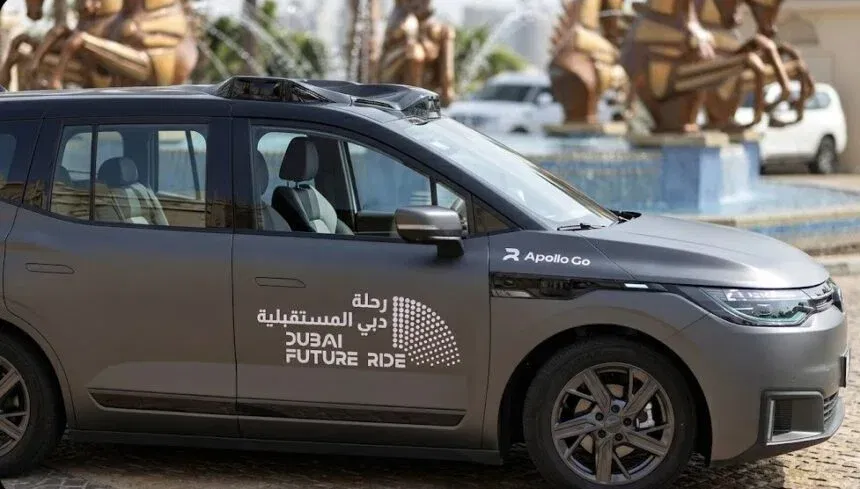
Dubai has a well-earned reputation for skipping straight past ‘bold idea’ and landing on ‘fully operational.’ The world’s tallest tower, an indoor ski slope in the desert, a police force that drives Lamborghinis — none of these were especially modest ambitions, and all of them happened. So when the Roads and Transport Authority (RTA) announced that driverless taxis had officially launched for commercial use, it felt less like a shock and more like the city simply following its own internal logic. The robotaxis are here, they’re real, and — for a limited time at least — you can ride one for free.
| 100 Taxis in phase one | 4,000 Ultimate fleet target | 25% Driverless journeys by 2030 | Dhs 22B Projected annual return |
The launch marks a pivotal moment in the Dubai Autonomous Transportation Strategy, which aims to transform how residents and tourists move through the city. If you’re curious about how to hail one, what it costs, or simply how a car manages to navigate the organized chaos of city traffic without a human hand on the wheel, here is everything you need to know about the driverless taxi revolution in Dubai.
1. Where You Can Find Driverless Taxi in Dubai – The Launch Zones
While the long-term goal is to have autonomous vehicles crisscrossing every neighborhood from Deira to Dubai Marina, the initial rollout is strategically focused. Currently, the commercial operations are concentrated in the Umm Suqeim and Jumeirah areas. These coastal districts were chosen for their sophisticated infrastructure and well-mapped roads, providing the perfect environment for the first phase of 100 autonomous vehicles.
If you find yourself near the Burj Al Arab or cruising along Jumeirah Beach Road, you are in the prime “hot zone” for spotting these futuristic cabs. The Roads and Transport Authority (RTA) has indicated that this is only the beginning, with plans to expand the service area as the fleet grows and the AI continues to learn the nuances of Dubai’s specific traffic patterns.
The Roads and Transport Authority (RTA) in Dubai announces the launch of commercial operations of the autonomous taxi service in Umm Suqeim and Jumeirah, in partnership with Apollo Go and WeRide, a global leader in autonomous driving technologies. The vehicles are available via… pic.twitter.com/z1Iho3d9m6
— Dubai Media Office (@DXBMediaOffice) March 30, 20262. How to Book Your First Ride
In Dubai, convenience is king, and the booking process for a driverless taxi reflects that. There are two primary ways to summon a robotaxi. For those who want the dedicated experience, the Apollo Go app is the primary platform for the service. Apollo Go, operated by the Chinese tech giant Baidu, is the brains behind the fleet’s operation.
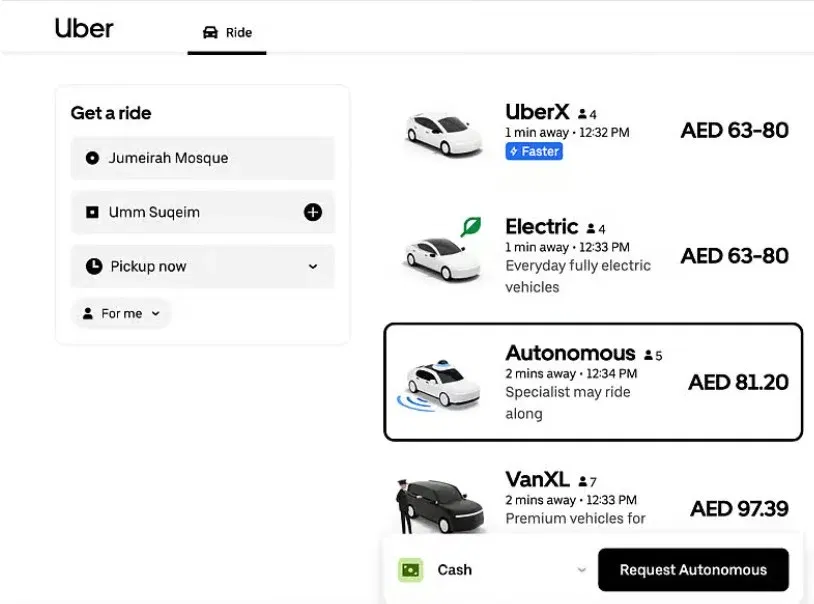
Alternatively, if you prefer to stick to familiar platforms, you can find these vehicles integrated directly into the Uber app. When you are within the service zones, a new “Autonomous” option will appear alongside the usual UberX or UberXL choices. This integration makes the transition to driverless tech feel less like a daunting leap into the future and more like a simple upgrade to your daily commute.
3. The Opportunity for a Free Experience
One of the most exciting aspects of the current launch phase is the accessibility. For a limited time, the RTA and its partners are offering complimentary rides to those booking via the Apollo Go app in the Umm Suqeim and Jumeirah areas. This is a deliberate move to encourage public adoption and demystify the technology for the average commuter.
Because these free rides are part of the initial launch phase, they are expected to be in high demand. If you’re a tech enthusiast or just someone who wants to experience the thrill of a ghost-driven car without reaching for your wallet, you’ll need to be quick. Once the promotional period ends, the service will shift fully into its commercial pricing structure.
4. Understanding the Cost: Comparing Fares
When the service isn’t free, how much should you expect to pay? Current data suggests that a trip in an autonomous taxi is priced competitively with premium ride-hailing services. On the Uber app, autonomous trips are typically priced between Dhs63 and Dhs80.
While this may be slightly higher than a standard budget taxi, the price reflects the cutting-edge nature of the service and the premium technology involved. As the fleet expands from the current 100 vehicles toward the ultimate goal of 4,000, economies of scale are expected to bring these costs down, eventually making driverless transport one of the most cost-effective ways to get around the city.
5. The Technology Powering the Fleet
What replaces the human driver isn’t a single piece of software — it’s an integrated stack of AI, hardware, and real-time data. The vehicles are equipped with LiDAR, cameras, and radar that together create a continuous 360-degree picture of the surrounding environment. This feeds into high-definition digital maps and deep learning algorithms that process every variable — pedestrians crossing mid-block, a delivery vehicle double-parked, traffic signals changing — and makes decisions faster than any human reaction time could match.
The system doesn’t just react; it predicts. By analysing the trajectories and speeds of other vehicles and pedestrians, the AI anticipates likely movements seconds ahead, adjusting accordingly. The result is a driving style that passengers often describe as smooth and unhurried — partly because the system isn’t prone to the frustration, distraction, or fatigue that affects every human driver eventually.
6. Safety and the “Safety Specialist”
A common question for first-time riders “Is there really no one in the car?”. The honest answer is: mostly. The vehicles operate at what the industry calls Level 4 autonomy, meaning they are fully capable of navigating without any human input. However, during this initial commercial phase, some rides may include a safety specialist seated in the front — not driving, not touching the controls, but monitoring the system and providing reassurance for passengers who might find the experience a little surreal.
So yes, the steering wheel will turn on its own. The car will brake, accelerate, and navigate complex intersections without anyone’s hands on anything. The safety specialist is there as a precaution and a comfort measure, not because the technology requires them. Think of it less as a safety net and more as a soft landing for the public’s first introduction to genuine autonomous mobility.
7. Why Dubai is Going Driverless
This isn’t just about looking like a scene from a sci-fi movie. The Dubai Autonomous Transportation Strategy is a calculated economic and social move. By 2030, Dubai wants 25 percent of all public transport journeys to be driverless.
The motivations are three-fold:
- Safety: Human error is responsible for over 90 percent of traffic accidents. By removing the human element, the government expects to reduce accidents by 12 percent.
- Productivity: The strategy aims to increase individual productivity by 13 percent, as “commute time” becomes “work or relaxation time.”
- Economics: The shift is expected to generate Dhs22 billion in annual economic returns by reducing transport costs, lowering pollution, and increasing the overall efficiency of the city’s infrastructure.
| Dhs 900M Savings in transport costs | Dhs 1.5B Reduction in pollution costs | Dhs 18B Transport efficiency gains |
Source : Dubai Autonomous Transportation Strategy and wam.ae
8. Environmental Impact and Sustainability
Sustainability is a core pillar of Dubai’s future vision, especially following the momentum of COP28. The autonomous taxi fleet is largely comprised of electric or hybrid vehicles, contributing to a predicted Dhs1.5 billion reduction in environmental pollution.
By optimizing routes through AI and reducing the “idling” time often associated with human-driven taxis looking for fares, the autonomous fleet helps lower the city’s overall carbon footprint. It is a cleaner, greener way to navigate an urban environment that is traditionally dominated by heavy traffic.
9. Improving “First and Last-Mile” Connectivity
One of the less-discussed but most meaningful aspects of autonomous taxis is what they offer to people who can’t easily use conventional transport. Mattar Al Tayer specifically highlighted how these vehicles serve senior citizens, people with mobility limitations, and what the RTA terms ‘people of determination’ — residents whose access to independent movement has historically depended on others.
The RTA’s First and Last Mile Strategy also becomes significantly more viable with autonomous taxis in the mix. The persistent challenge of getting from your front door to the nearest metro station — or from that station to your actual destination — is exactly the kind of short, on-demand trip that a robotaxi handles efficiently. Rather than replacing Dubai’s metro or bus network, the autonomous fleet is designed to plug the gaps in it.
10. The Road to 4,000 Taxis
The 100 vehicles on the road today are, in the language of these things, a phase one. The RTA’s published roadmap calls for gradual expansion of the fleet toward an ultimate target of 4,000 autonomous taxis operating across Dubai. As the AI accumulates more local driving data — the particular cadence of Sheikh Zayed Road at 8am, the narrow side streets off Al Wasl, the specific way pedestrians behave on JBR on a Friday evening — the system becomes progressively better suited to the full range of Dubai’s environments.
For context, Abu Dhabi has already been running a similar service on Yas Island, with plans to expand to Al Reem Island, Al Maryah Island, and Al Saadiyat Island. The Gulf-wide trajectory is fairly clear: autonomous mobility isn’t arriving at some distant point in the future. It’s already parked at the kerb, waiting for you to tap ‘book.’
Whether you try it this week with a free ride or wait until the fleet fills out and the pricing normalises, the driverless taxi era in Dubai is not a pilot programme. It is, as of March 30, 2026, the present.
Sum up
The arrival of driverless taxis in Dubai is more than just a novelty; it is a glimpse into a future where transportation is a seamless, invisible service. Whether you’re a resident looking to cut down your commute time or a tourist wanting to experience the cutting edge of tech, the streets of Jumeirah are currently offering a front-row seat to the future of mobility. If you’re in the area, download the app and see for yourself—the future is already parked at the curb.
Related : Top 13 Cheapest Electric Cars in UAE Specs, Prices & Charging Guide