Ejari Guide :Everything tenants, landlords and property managers need to know about registering, renewing and cancelling a tenancy contract on Dubai’s Ejari system, including current fees, required documents and the steps for each channel.
Anyone who’s rented in Dubai knows the drill — you sign the lease, you’re handed the keys, and then someone says “don’t forget your Ejari” like it’s the most obvious next step in the world. For first-timers, it rarely is.
Ejari is the one piece of paperwork that turns your private rental agreement into something Dubai’s systems actually recognise. Skip it, and you’ll hit a wall the moment you try to switch on the electricity, renew a visa, or sort out a dispute with your landlord. Get it right, and it’s a five-minute formality that quietly keeps everything else running.
Here’s exactly how it works (Ejari Guide) , what it costs, and what tends to trip people up.
Ejari Guide
What Is Ejari?
Ejari, meaning “my rent” in Arabic, is Dubai’s official tenancy registration system, run by the Dubai Land Department (DLD) on behalf of the Real Estate Regulatory Agency (RERA). Introduced in 2010, it replaced a patchwork of informal paper agreements with a single, government-recognised record for every rental contract in the emirate. Each certificate it produces carries a unique Ejari number, which other departments use to look up and verify the contract behind it.
Registering a tenancy contract through Ejari creates an official record that other Dubai authorities rely on. In practice, this is what most government and utility services actually check before moving forward with anything tied to a rented address — from connecting electricity and water to processing a residence visa or reviewing a rental disagreement.
Whether you’re renting an apartment, a villa or a commercial unit, Ejari registration is the step that turns a private tenancy contract into something Dubai’s systems recognise.
Why Ejari Matters Day to Day
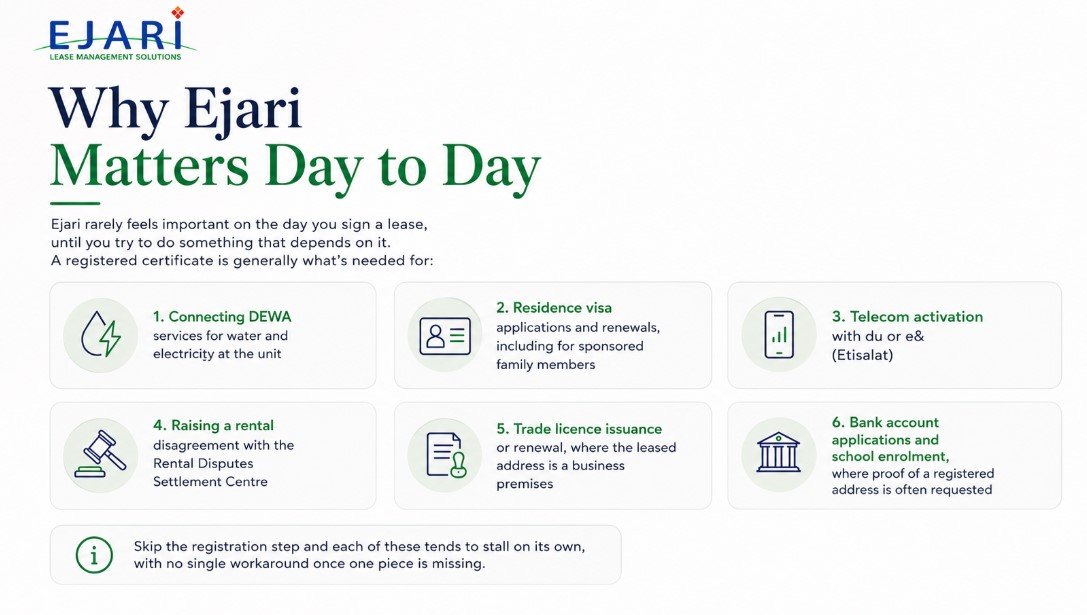
Ejari rarely feels important on the day you sign a lease, until you try to do something that depends on it. A registered certificate is generally what’s needed for:
- Connecting DEWA services for water and electricity at the unit
- Residence visa applications and renewals, including for sponsored family members
- Telecom activation with du or e& (Etisalat)
- Raising a rental disagreement with the Rental Disputes Settlement Centre
- Trade licence issuance or renewal, where the leased address is a business premises
- Bank account applications and school enrolment, where proof of a registered address is often requested
Skip the registration step and each of these tends to stall on its own, with no single workaround once one piece is missing.
Related : The Top Guide to Buying vs. Renting in Dubai
Who Usually Handles the Registration
Responsibility for registering a tenancy is generally associated with the landlord, but in day-to-day practice it shifts around a lot. Some landlords handle it directly, plenty hand it to their leasing agent or property manager, and a large share of tenants end up doing it themselves simply because they’re the ones who need the certificate fastest, for a DEWA connection or a visa file. The Dubai Land Department’s Ejari registration service isn’t fussy about who submits the request; it mainly needs the tenant and landlord details, and the property itself, to be accurate and current.
Who actually covers the fee is a separate conversation from who submits the paperwork, and the two get mixed up often. Since this varies from one lease to the next, it’s worth confirming in writing before signing — a single line in the tenancy contract avoids a common source of friction later.
How to Register Online
For most residential leases where both parties are individuals, the fastest route is digital, through the Dubai REST app or the Dubai Land Department‘s website. The general flow looks like this:
- Log in to the Ejari system or Dubai REST app and select the registration or renewal service.
- Enter the tenancy details and upload the unified tenancy contract (this is typically the only document the app asks for, for both individuals and companies registering this way).
- Pay the service fee through the app.
- The submission is reviewed and approved through the system.
- The e-Contract Registration Certificate arrives by email.
A UAE Pass login speeds this up considerably, since it pulls Emirates ID and contact details automatically rather than requiring manual entry. Where both parties are individuals and the property’s ownership data is current in the system, approval is usually a matter of hours rather than days.
Registering at a Trustee Centre
Online self-service isn’t available to everyone. If the property is being leased through a company without its own Ejari system access, or the landlord doesn’t have a digital profile, registration typically goes through a Real Estate Trustee Centre instead. The process there generally looks like this:
- Visit the nearest Real Estate Trustee Centre, or the managing property company if one is appointed.
- Submit the required paperwork, checked on the spot for anything missing.
- The transaction is reviewed and approved in the system.
- Pay the applicable fee and collect a receipt.
- Receive the e-Contract Registration Certificate.
Service time for this route tends to be fairly quick once you’re being served, excluding any wait. A few conditions usually apply: the applicant needs to be the tenant or hold an official power of attorney, and the landlord needs to be the registered owner or have a representative with the same. Current conditions are listed on the DLD service page for registering or renewing a rental contract.
Documents You’ll Typically Need
The paperwork can differ slightly depending on the channel:
- Via the app: a clear copy of the unified tenancy contract is usually the only document the system asks for, for both individual and corporate applicants.
- Via a Trustee Centre: the original unified tenancy contract, the applicant’s Emirates ID, and an official power of attorney if someone other than the tenant or landlord is handling the submission.
- Commonly requested alongside the above: the landlord’s passport or trade licence, a copy of the title deed (mainly for a property’s first-ever registration), and the property’s DEWA premises number, since this is what ties the certificate to the correct unit.
- Where a security deposit was paid, the receipt is sometimes requested as supporting evidence, and commercial leases generally need a copy of the tenant’s trade licence.
- For a renewal specifically, the most recent DEWA bill alongside the new signed contract is usually expected.
Two Numbers Worth Having Ready
Two property identifiers come up constantly during Ejari registration, and it’s worth knowing what they are before you start:
- The DEWA premises number: a code tied to the unit’s electricity and water account, usually found on a DEWA bill. It’s what links the Ejari certificate to the correct property for utility purposes.
- The Makani number: a geo-address code for the building itself, often displayed near the entrance or available through the landlord or building management.
A mismatch between either of these and the address on the tenancy contract is one of the more common reasons a submission gets sent back for correction, so it’s worth double-checking both before you submit.
Checking Your Ejari Status or Getting a Copy Later
Once a certificate has been issued, it’s not something you need to track down a printed copy of forever. Dubai Land Department maintains a rental certificate download service that lets a registered tenant or landlord retrieve a digital copy of an existing Ejari certificate using their account details. This is generally the quickest way to get a replacement copy for a visa application, a bank, or a school admissions office without having to go back to a Trustee Centre.
What Ejari Typically Costs
Ejari pricing is set centrally by Dubai Land Department and published on its own fee schedule. The breakdown below reflects that schedule and is generally the same whether you’re registering for the first time or renewing:
| Disclaimer: the figures below reflect Dubai Land Department’s published fee schedule at the time this guide was last checked. Government fees can be revised at any point, and service partner charges in particular have changed before. Always confirm the current amount on the Dubai REST app or the official DLD website before making a payment, and treat the numbers here as a planning guide rather than a guaranteed price. |
| Fee component | Dubai REST / DLD website | Trustee Centre |
| Tenancy contract registration fee | AED 100 | AED 100 |
| Knowledge fee | AED 10 | AED 10 |
| Innovation fee | AED 10 | AED 10 |
| Service partner fee + VAT | AED 55 + AED 2.75 | AED 95 + VAT |
| Total | AED 177.75 | AED 220 |
Cancellation is generally handled differently from registration: doing it through the Dubai REST app or DLD website typically carries no charge, while processing the same cancellation at a Trustee Centre comes with a smaller service partner fee. Again, it’s worth checking the live rate before paying. Accepted payment methods across channels usually include credit card, cash, and the Noqodi e-wallet.
Don’t Forget About Co-Occupants
Dubai Land Department also runs a dedicated co-occupant management service inside the same DLD and Dubai REST ecosystem, allowing tenants and owners to add, update or remove the names of people living in a property alongside the primary contract holder.
If you’re sharing a property with flatmates, housing extended family, or sponsoring dependents on a visa, it’s worth keeping this list current rather than treating it as an afterthought — mismatches between who’s actually living somewhere and what’s on file tend to surface at inconvenient moments, like in the middle of a visa renewal.
Renewing Your Ejari
Ejari doesn’t roll over automatically. Every new lease term, even an exact repeat of last year’s contract with the same landlord, needs its own fresh certificate. There’s no built-in grace period, so the safest habit is starting the renewal a couple of weeks before the current certificate’s expiry rather than waiting for it to lapse.
The renewal procedure mirrors initial registration closely: the same channels, a similar fee structure, and the same general flow through either Dubai REST or a Trustee Centre. The main addition is the latest DEWA bill, which helps confirm the unit is still actively connected and in the same tenant’s name.
Cancelling Ejari When a Tenancy Ends
Closing out an Ejari record properly matters more than most tenants realise, since a property generally can’t carry two active registrations at once. Skip the cancellation step and the next tenant, or the landlord trying to re-list the unit, can end up blocked.
The DLD’s cancellation service runs through either a Trustee Centre visit or the same online channels used for registration: submit the documents, have them checked, settle any fee due, and receive confirmation once approved.
A final DEWA bill showing the account is settled, plus the original tenancy contract or its registered Ejari number, are the core requirements. Where the move-out isn’t mutual, a No Objection Certificate from the other party may also be requested before the closure goes through.
Common Mistakes That Slow Things Down
Most registration delays trace back to a handful of repeat offenders rather than anything complicated:
- The DEWA premises number or Makani number doesn’t match the address on the contract.
- The tenant’s Emirates ID or visa has expired, or is close enough to expiry to get flagged.
- Pages of the tenancy contract are missing, unsigned, or scanned at an angle that makes them hard to verify.
- The wrong attachment type is uploaded against a document slot in the app, which the system treats as missing rather than mismatched.
A quick check of these four points before submitting tends to save a second trip or a resubmission.
What Happens If You Skip It
Treating Ejari as optional paperwork tends to cause problems in a fairly predictable order. Utilities don’t connect without it. A visa renewal stalls. A disagreement with the other party has nowhere official to go, since the Rental Disputes Settlement Centre generally only reviews cases tied to a registered contract.
None of these on their own are dramatic, but together they make an unregistered lease a genuinely fragile thing to rely on, which is really the point of having the system in the first place.
Quick Answers to Common Questions
Who actually pays the Ejari fee — tenant or landlord?
It varies, and Ejari itself doesn’t dictate who pays. In most Dubai leases the tenant ends up covering it in practice, but it’s worth putting this in writing rather than assuming.
Can a tenant register Ejari without the landlord’s involvement?
Only up to a point. A tenant can usually initiate the request through Dubai REST, but the landlord’s accurate, up-to-date ownership details still need to be on file for the system to approve it.
Does an Ejari certificate carry over automatically into a new lease term?
No. A fresh certificate is generally required for every new contract period, even when the landlord, the unit and the rent are unchanged from the year before.
Is Ejari needed for a holiday-home or short-term rental?
Individual short stays booked through a licensed holiday-home operator typically aren’t registered on Ejari one by one. The annual agreement between the property owner and the management company, however, usually does need its own Ejari registration.
What if the landlord won’t cooperate with registration?
Since responsibility is generally associated with the landlord, a tenant facing resistance can raise the matter with RERA rather than leaving the lease unregistered indefinitely.
How long does Ejari registration usually take?
When the documents are correct and the DEWA premises number matches, online approval is often a matter of hours. A Trustee Centre visit can be faster still if everything is in order on the spot, since the certificate is frequently issued during the same visit.
Can I check the status of my application before the certificate is issued?
Yes. Submissions made through Dubai REST or the DLD website are generally trackable from the same account used to submit them, so there’s no need to call or visit in person just to check progress.