
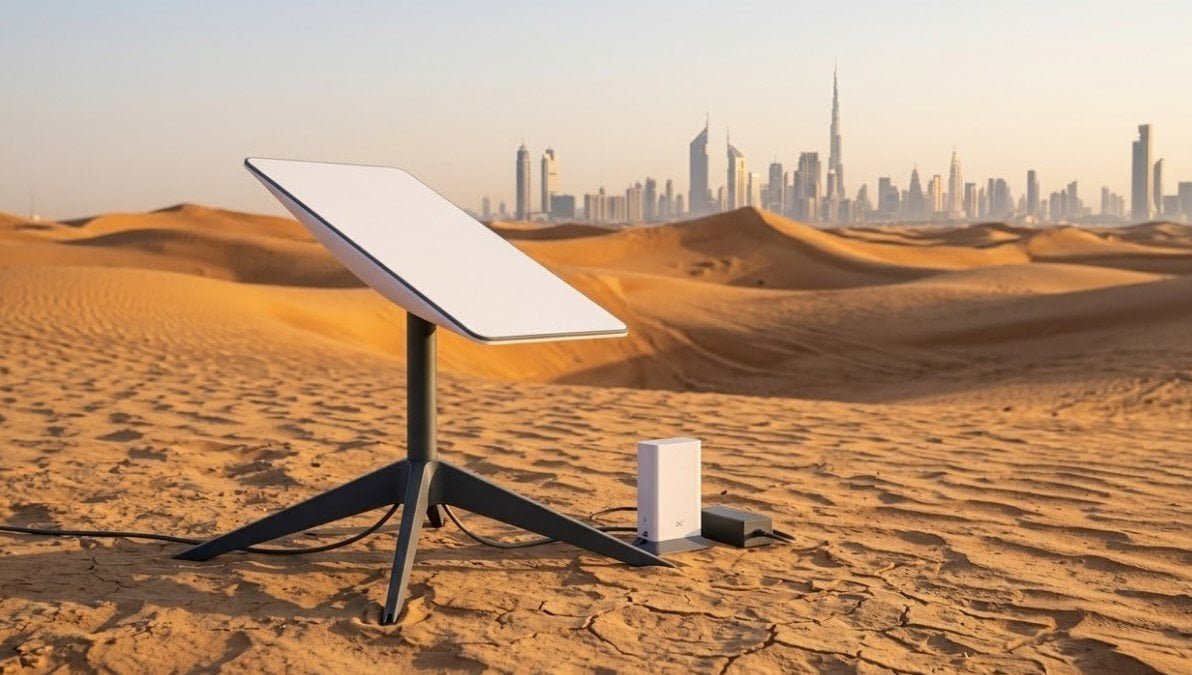
The wait is finally over for tech enthusiasts and remote workers across the Emirates. After months of anticipation and regulatory groundwork, Starlink has officially arrived in the UAE, marking a significant shift in the regional telecommunications landscape.
While the UAE already boasts some of the world’s fastest fiber-optic networks in its urban centers, the introduction of SpaceX’s low-Earth orbit (LEO) satellite service introduces a new layer of connectivity that was previously difficult to achieve in certain settings.
Many people wonder if switching from traditional providers makes sense. The answer depends on your specific needs and location. We’ll explore pricing, performance, and practical considerations. You’ll discover whether this satellite internet service fits your requirements.
Update (Aug 2026): The UAE’s TDRA granted Starlink a 10-year licence to operate nationwide satellite internet for homes, businesses, government, maritime, and aviation, fully integrating it into the national telecom framework.
What is Starlink Satellite Internet Technology?
Starlink represents a revolutionary approach to internet connectivity. The service uses thousands of satellites orbiting Earth at low altitude. These satellites create a mesh network that covers the entire planet.
Traditional internet relies on cables running underground or along poles. Satellite internet bypasses this infrastructure entirely. Your home connects directly to satellites overhead through a dish antenna.

The system works differently from older satellite internet services. Starlink satellites orbit much closer to Earth. This reduces latency significantly compared to traditional satellite connections.
How the Technology Works
The Starlink system has three main components working together. First, satellites in space receive and transmit data signals. Second, ground stations connect the satellite network to the internet backbone. Third, user terminals at your location communicate with passing satellites.
Each satellite moves quickly across the sky. Your dish automatically tracks and switches between satellites. This happens seamlessly without interrupting your connection. The process requires no manual adjustment from users.
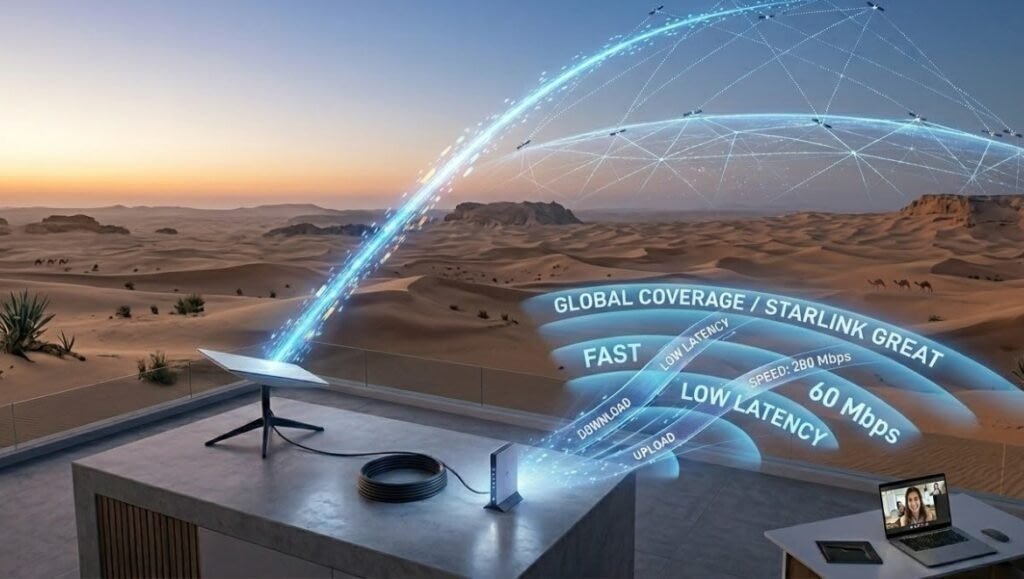
Key Technical Specifications
- Low Earth orbit satellites positioned 340-550 km above ground
- Phased array antenna technology in user terminal
- Automatic satellite tracking and switching capability
- Weather-resistant equipment designed for outdoor installation
- Self-heating dish prevents snow and ice accumulation
- Power consumption approximately 100 watts during operation
Introduction to Starlink in UAE
The integration of Starlink into the UAE’s telecommunications landscape marks a strategic evolution in the nation’s digital infrastructure, reinforcing its position as a global leader in connectivity. While the UAE already boasts world-class fiber and 5G networks in its urban centers, this expansion ensures that high-speed access is no longer confined by geography. From the depths of the desert to several kilometers offshore, the digital boundary has effectively been removed, providing seamless coverage across the entire Emirates.
This move is a testament to the UAE’s forward-thinking regulatory environment. By bringing cutting-edge satellite technology into the official fold, the country ensures that its residents and businesses are at the forefront of the global tech conversation. This is not merely a secondary option for internet access; it is a sophisticated, long-term addition to the national grid, offering a level of stability and permanence backed by a decade-long commitment to innovation.
For professionals and enterprises, this represents a new era of digital independence and operational resilience. High-speed connectivity is no longer tethered to physical cables beneath the street. Whether supporting maritime operations or providing a failover for remote work, this satellite layer offers an extra-secure, wireless redundancy. It guarantees that even in the most remote locations or during unforeseen local infrastructure issues, the UAE remains a “bulletproof” hub for the global digital economy.
Ralated : Beyond the Box: The 23 Best Third-Party Starlink Accessories
Starlink UAE Service Plans & Costs
Choosing the right Starlink plan in the UAE depends largely on your lifestyle and how you intend to use the service. SpaceX has introduced a tiered structure to cater to different budgets, from casual home users to heavy-duty enterprise clients.
The standard Residential plan is the most common choice for those living in villas or areas with limited fiber access. It offers unlimited data and high-priority access during peak hours. For those who are more budget-conscious or have lower data demands, the Residential Lite plan is a welcome addition, offering a lower entry price while still maintaining the core benefits of the LEO network.
For businesses and adventurers, the Roam and Business plans provide the flexibility needed for mobility and high-performance requirements. The Roam plan is particularly popular among the UAE’s overlanding community, allowing you to take your internet with you on weekend camping trips to Jebel Jais or the Liwa Oasis.
Starlink UAE Price per Month
When calculating the total cost of Starlink, you have to look at both the recurring monthly fee and the initial hardware investment. As of early 2026, the pricing in the UAE has stabilized into the following categories:
- Residential Lite: Approximately AED 230 per month. This is designed for basic browsing and streaming for smaller households.
- Standard Residential: Approximately AED 300 per month. This provides full-speed access and is the “sweet spot” for most families.
- Business: Starting from AED 248 per month (for basic tiers), with higher-priority plans reaching significantly more based on data needs.
- Roam (Portable): Starting at AED 185 per month for 100GB or AED 605 per month for unlimited data.
It is worth noting that Starlink operates on a month-to-month basis. Unlike many local ISP contracts that might lock you in for 12 or 24 months, you can pause or cancel your Starlink subscription at any time without hefty exit fees.
One thing worth knowing: Roam plans are billed in USD, so the AED equivalent will shift slightly with exchange rates. Keep that in mind when budgeting if you’re on one of those plans.
One thing worth knowing:
-
Roam plans are billed in USD, so the AED equivalent will shift slightly with exchange rates. Keep that in mind when budgeting if you’re on one of those plans.
Starlink Equipment in UAE
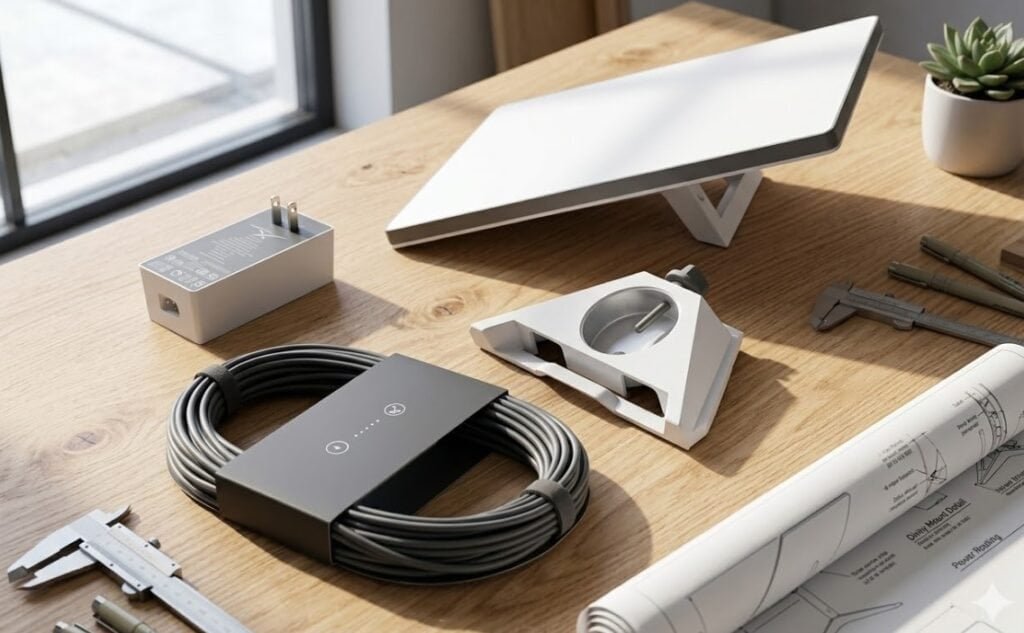
One of the unique aspects of Starlink is that you own the equipment. When you subscribe, you aren’t just renting a router; you are purchasing a sophisticated phased-array antenna that is capable of tracking satellites moving at thousands of miles per hour across the sky.
Starlink Mini UAE
The recent launch of the Starlink Mini has caused quite a stir in the UAE market. Unlike the standard dish, which is roughly the size of a pizza box and requires a separate router, the Starlink Mini is incredibly compact—roughly the size of a thick laptop. It features an integrated Wi-Fi router, meaning the entire system is contained within the dish itself.
The Mini is specifically designed for portability. It fits easily into a backpack and has a much lower power draw, making it possible to run off a portable power station or even a car’s 12V outlet. In the UAE, where outdoor culture and “glamping” are huge, the Mini is quickly becoming the must-have accessory for off-grid enthusiasts.
How much is Starlink equipment?
The upfront cost of the hardware is the biggest barrier for most new users. In the UAE, the pricing for the kits is as follows:
- Standard Kit: Approximately AED 1,465. This includes the latest Gen 4 dish (non-actuated), a Wi-Fi 6 router, and the necessary cabling.
- Starlink Mini Kit: Approximately AED 1,099. A more affordable, portable option for those who don’t need the maximum throughput of the standard dish.
- Flat High-Performance Kit: This is the enterprise-grade hardware designed for permanent mounting on vehicles or maritime vessels, often costing over AED 9,000.
When buying in the UAE, you can order directly through the Starlink website or through authorized local retailers like Elcome or TechBros. Shipping is generally fast, often arriving within 3 to 5 business days, with local duty and taxes already factored into the checkout price in many cases.
How to Use Starlink in UAE
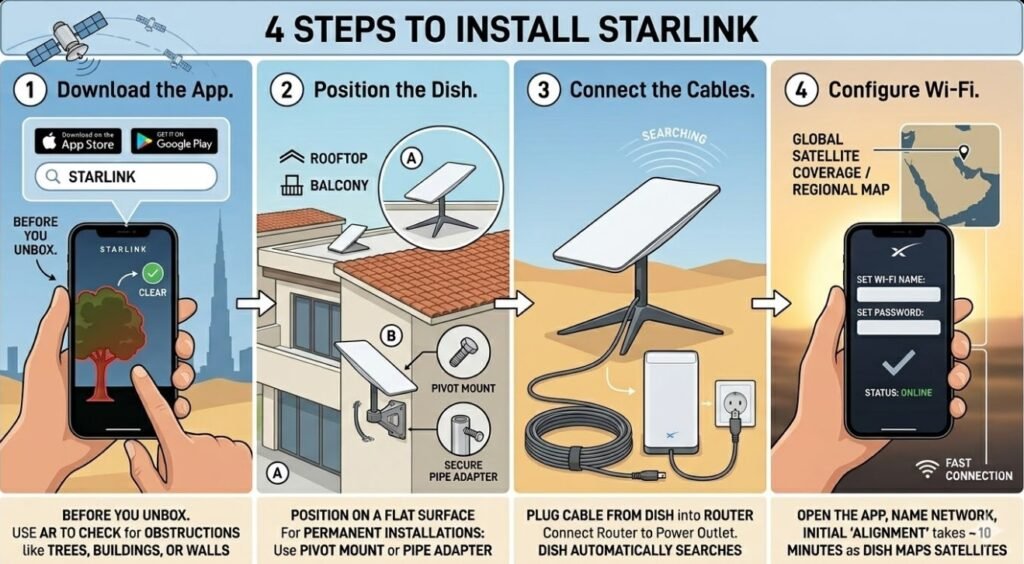
Setting up Starlink is intentionally designed to be “idiot-proof.” There is no need for a technician to visit your home, drill holes, or configure complex network settings.
Step 1: Download the App Before you even unbox the hardware, download the Starlink app on your smartphone. It uses augmented reality (AR) to help you check for obstructions. You point your phone at the sky, and it will tell you if any trees, buildings, or walls will block the satellite signal.
Step 2: Position the Dish Place the dish on a flat surface with a clear view of the sky. In the UAE, this usually means a rooftop or a balcony. For permanent installations, many residents use a “Pivot Mount” or a “Pipe Adapter” to secure the dish to the side of a villa.
Step 3: Connect the Cables Plug the cable from the dish into the router, and then connect the router to a power outlet. The dish will automatically start searching for satellites.
Step 4: Configure Wi-Fi Open the app, name your network, set a password, and you are online. The initial “alignment” process usually takes about 10 minutes as the dish maps the satellites above it.
Tips for optimizing Starlink performance in the UAE
The UAE’s unique environment presents a few specific challenges for Starlink users. First, the heat. While Starlink dishes are rated to operate in temperatures up to 50°C, the intense summer sun can cause the hardware to throttle its speed to prevent overheating. Placing the dish in a spot that gets some natural airflow can help.
Additionally, dust and sand accumulation on the face of the dish can occasionally degrade signal quality. A quick wipe with a damp cloth every few weeks during the shamal (sandstorm) season will ensure your speeds stay consistent.
Speeds, Latency, and Performance
When it comes to performance, Starlink in the UAE is impressive, though it occupies a different niche than fiber.
In real-world testing across Dubai, Sharjah, and Abu Dhabi, users are seeing download speeds up to 400+ Mbps. During off-peak hours, it isn’t uncommon to see bursts exceeding 300 Mbps. Upload speeds typically hover between 15 Mbps and 30 Mbps.
Latency is where Starlink truly shines compared to older satellite technology. While traditional satellite internet might have a lag of 600ms or more, Starlink in the UAE generally averages 25ms to 45ms. This is low enough for smooth Zoom calls, lag-free online gaming, and responsive web browsing.
Comparison with Traditional ISPs
If you have access to a 1 Gbps fiber line from Etisalat for AED 400, Starlink is probably not for you. Fiber will always be more stable and offer higher peak speeds. However, for those on “Home Wireless” 5G plans that suffer from network congestion or those in areas where the only option is a slow copper line, Starlink is a significant upgrade. It provides a consistent level of service that isn’t affected by how many people in your neighborhood are using the local cell tower.
Starlink UAE Coverage
Currently, Starlink’s coverage extends across the entire United Arab Emirates. From the skyscrapers of Dubai Marina to the rocky terrain of Hatta and the rolling dunes of the Liwa Desert, the signal is remarkably consistent.
- Supported Areas: Every emirate is covered. The service is also active in UAE territorial waters, making it an excellent choice for yacht owners.
- Future Expansion: As SpaceX continues to launch more “V2 Mini” satellites, the capacity of the network in the UAE will increase. This means that even as more users sign up, speeds should remain stable or even improve.
- Factors Affecting Signal: The biggest enemy of Starlink in the UAE is physical obstructions. Because the satellites are in LEO, they move across the sky rapidly. If a tall building blocks even a small “slice” of the sky, your connection will drop for a few seconds every time a satellite passes behind that building. This makes Starlink difficult to use in high-rise apartment balconies unless they have a completely unobstructed northward or southward view.
Benefits of Starlink in UAE
The primary advantage of Starlink is independence. You are no longer reliant on the physical infrastructure of your neighborhood. If a construction crew accidentally cuts a fiber line down the street—a common occurrence in rapidly developing areas of the UAE—your Starlink connection remains unaffected.
For businesses, Starlink provides an essential “Plan B.” Many offices in the DIFC or Abu Dhabi Global Market use Starlink as a redundant backup. If their primary line goes down, the network automatically switches to the satellite, ensuring that critical operations never stop.
In the maritime sector, Starlink has been transformative. Previously, high-speed internet at sea was the exclusive luxury of massive cruise ships or superyachts. Now, a fishing boat or a medium-sized yacht can have “at-home” internet speeds for a fraction of the previous cost.
Potential Challenges & Considerations
While the technology is impressive, there are a few local considerations to keep in mind.
Environmental Maintenance (The “Dust Factor”): In the UAE, fine desert sand and dust can accumulate quickly on the flat surface of the dish. While the hardware is rugged, a thick layer of dust can eventually degrade signal quality or cause the device to work harder to maintain a connection. Users will need to ensure their mounting location is safely accessible for a quick periodic wipe-down, especially after a Shamal or dust storm.
Second is the installation in apartments. Most UAE residents live in high-rise buildings. If you don’t have roof access, Starlink might be impossible to use effectively. The dish needs a wide, clear cone of vision toward the sky. A standard window or a small balcony with a roof overhead will likely cause frequent “micro-drops” in connectivity.
Finally, there is the initial investment. Spending over AED 1,400 on hardware is a significant commitment. While the monthly cost is competitive, the “buy-in” is much higher than the free routers typically provided by Etisalat or du.
Conclusion
Is Starlink the right choice for you? If you live in a well-connected apartment in a major city, probably not. The existing fiber infrastructure is world-class and likely more convenient.
However, if you live in a villa on the outskirts of the city, own a business that requires 100% uptime, or spend your weekends exploring the vast UAE wilderness, Starlink is nothing short of a revolution. It bridges the digital divide, bringing high-speed, low-latency internet to the most remote corners of the country. With the introduction of the Starlink Mini and more affordable plans like Residential Lite, SpaceX has made it easier than ever for UAE residents to stay connected, no matter where they are.
FAQ: Starlink in the UAE
Is Starlink officially available in the UAE?
Starlink began accepting orders in March 2026, and received its full 10-year operating licence from TDRA in August 2026
What is the upfront cost for the equipment?
The Standard Kit costs AED 1,465, while the more portable Starlink Mini Kit is priced at AED 1,099. These are one-time hardware purchases that include the dish, router, and cabling.
Does Starlink work in the middle of the desert?
Absolutely. This is one of Starlink’s biggest selling points in the region. Whether you are in the Liwa Desert or deep in the Hajar Mountains, as long as you have a clear view of the sky and a power source (like a portable battery or car outlet), you will have high-speed internet.
Can I use Starlink in an apartment?
It is challenging. Starlink requires a wide, 110-degree “cone” of clear sky to stay connected. Most apartment balconies have an overhang or a limited field of view, which will cause the connection to drop every few minutes. Unless you have roof access or a top-floor terrace with zero obstructions, Starlink is generally better suited for villas or outdoor use.
Will Starlink be affected by UAE sandstorms?
Light dust won’t stop the signal, but a heavy sandstorm can temporarily degrade speeds or increase latency, similar to how heavy rain affects satellite TV. However, the hardware is ruggedized and designed to withstand the UAE’s heat (up to 50°C) and environmental conditions. A simple cleaning of the dish face after a storm is usually all that’s needed.
Is VoIP (WhatsApp/Skype calling) allowed on Starlink?
Starlink operates under the regulatory framework of the UAE’s TDRA. This means the service follows the same local regulations as Etisalat and du regarding VoIP services and content filtering.
Disclaimer :The information in this post is for informational purposes only . This blog is not affiliated with or endorsed by Starlink or SpaceX. Internet speeds, monthly pricing (AED), and equipment costs are subject to change and may vary based on your specific location. Users are responsible for ensuring their setup complies with all local TDRA regulations. For official details and orders, always visit Starlink.com.
Next to read : Top 10 High-Paying Freelance Skills in Demand in Dubai This Year





[…] you have been waiting for Starlink to officially arrive in the UAE, the wait is essentially over. On August 28, 2026, the […]