Finding a 5G signal in the city is rarely the issue—it’s the moment you drive beyond the reach of those urban towers that the connection drops. For anyone who spends time off the grid, staying connected has always meant hauling around bulky equipment or simply accepting the “No Service” bars on your phone.
The Starlink Mini is a direct response to that problem.
This review takes a look at how this portable kit actually fits into a mobile lifestyle. We’ll skip the marketing talk and get straight into the real-world performance, the specific power requirements you’ll need to avoid a “blackout” in the field, and the latest regulations you need to know before you power it up.
Related : UAE Grants Starlink a 10-Year Licence: Everything Residents Need to Know
Table of Contents – Starlink Mini UAE
Pros & Cons
Every piece of technology has its trade-offs, and the Starlink Mini is no exception. While it is designed for maximum portability, there are a few technical compromises you should consider before adding it to your kit.
Here is a quick look at how the pros and cons stack up:
Specs at a Glance
If you are looking for the raw data, this section covers the official technical specifications. While the marketing focuses on its size, the real details lie in the power efficiency and the specific hardware built into this compact unit.
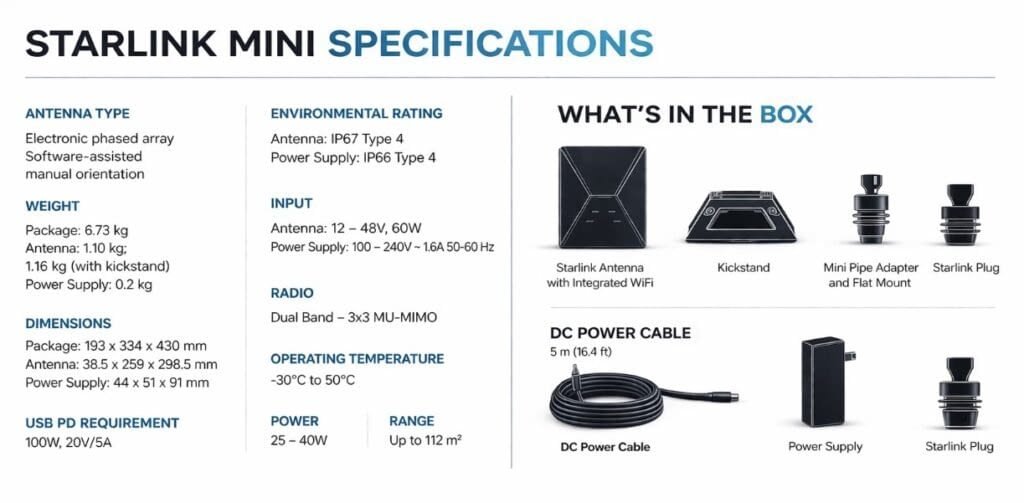
Here are the Starlink Mini specs at a glance:
| Spec | Detail |
|---|---|
| Dish size | 30 × 26 cm (roughly A4 page size) |
| Thickness | 3.8 cm |
| Weight | 1.1 kg (dish only) or 1.16 kg (with kickstand) |
| Wi-Fi standard | Wi-Fi 5 (802.11ac) with 3×3 MU-MIMO. |
| Frequency bands | Dual-band — 2.4 GHz and 5 GHz |
| Max connected devices | Up to 128 |
| Wi-Fi range | 112 m² (approx. 1,200 sq. ft.). |
| Wireless security | WPA2 |
| Power consumption | 25W – 40W Average (can peak higher during boot/snow melt). |
| Weatherproofing | IP67 — dust and water resistant |
| Wired LAN ports | 1 |
| Supported voltage range | 12V to 48V |
| Technology | Beamforming, MU-MIMO |
| IPv6 | Supported |
Two Important “Gotchas” to Note:
What Is Starlink Mini?
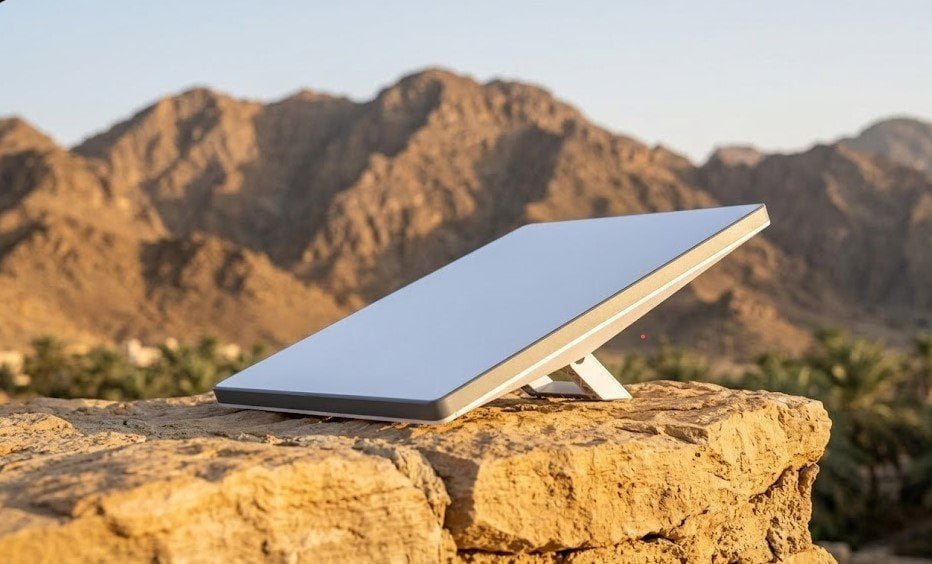
Starlink Mini is the compact, travel-ready version of the standard Starlink V4 dish manufactured by SpaceX. It is built on the same core satellite technology and phased-array antenna system as the full residential dish — the difference is that everything has been shrunk down, simplified, and packaged into a single go-anywhere unit that weighs just 1.2 kilograms and fits comfortably inside a backpack.
The dish face measures 30 by 26 centimetres — roughly the size of an A4 sheet of paper — and at just 3.8 centimetres thick, it slides easily into a bag alongside your laptop, clothes, and camping gear. This is a genuinely portable device in a way that the standard residential kit simply is not. The full V4 dish is designed to be bolted to a roof or mounted on a pole and left there. The Mini is designed to go wherever you go.

What makes the Mini particularly convenient is that it has a Wi-Fi router built directly into the unit. There is no need for a separate router, no extra cables to manage, and no complicated multi-component setup. You unfold the integrated kickstand, place it on a flat surface with a clear view of the sky, connect the power cable, open the Starlink app, and you are online. From box to connected in under ten minutes.
The built-in router supports Wi-Fi 5 across dual bands — 2.4 GHz and 5 GHz — with MU-MIMO technology that allows up to 128 devices to connect simultaneously. For a campsite, a temporary office, or a vehicle setup, that is more than enough capacity.
The Mini also carries a full IP67 weatherproof rating, meaning it is sealed against dust and capable of withstanding water immersion — the same protection level as the residential V4 dish. It includes Starlink’s automatic snow-melt feature too, which is less relevant in the UAE’s climate but useful for those taking the dish on trips to cooler or wetter regions, such as parts of northern Oman or mountainous terrain during winter.
Starlink officially opened its doors to UAE residents and businesses in March 2026 making this one of the more recent satellite internet options to arrive in the Gulf market. For users in a region where certain remote areas still have limited fixed broadband or mobile coverage, the timing is significant.
💡 Pro Tip: The USB-C “100W Rule”
Who Is Starlink Mini For?

The Mini is not trying to replace your home broadband. It is designed for a specific type of user — someone who regularly moves around, ventures off the beaten path, or needs reliable internet in locations where fixed infrastructure simply does not reach. In the UAE, that profile fits more people than you might expect.
Campers and overlanders are the most obvious audience. The UAE has a passionate and growing overlanding community, and destinations like the wadis of Ras Al Khaimah, the red dunes of Al Badayer in Sharjah, the Hajar Mountains stretching into Oman, and the vast Empty Quarter in Abu Dhabi’s south are all places where mobile coverage can be patchy or entirely absent. With the Starlink Mini, you can set up a reliable internet connection at a desert campsite the same way you would at home — without relying on a weak 4G signal or hunting for a hotspot.
Remote workers and digital nomads are another clear fit. There is a growing number of professionals in the UAE who work flexibly — from co-working spaces, from home, or occasionally from somewhere more remote. If you have a client call to take or a deadline to meet and you are spending a few days at a farm stay in the Al Ain region or a retreat in the mountains, the Mini ensures your connectivity travels with you.
Event organisers and field teams also benefit significantly. Outdoor festivals, corporate desert retreats, film and media productions, construction site offices, and pop-up markets all frequently need temporary internet. Setting up a wired or mobile solution at a remote outdoor venue can be complicated and expensive. The Starlink Mini provides a single, self-contained answer — carry it in, point it at the sky, and have Wi-Fi running for everyone on site within minutes.
Emergency response and humanitarian operations represent perhaps the most critical use case. When natural disasters, infrastructure failures, or emergencies knock out local communications — whether that is flooding in low-lying coastal areas, a power grid failure in a remote region, or a rescue operation in the mountains — the ability to deploy satellite internet quickly can be the difference between coordinated response and chaos. The Mini’s compact size and fast setup make it one of the most practical tools available for exactly these situations.
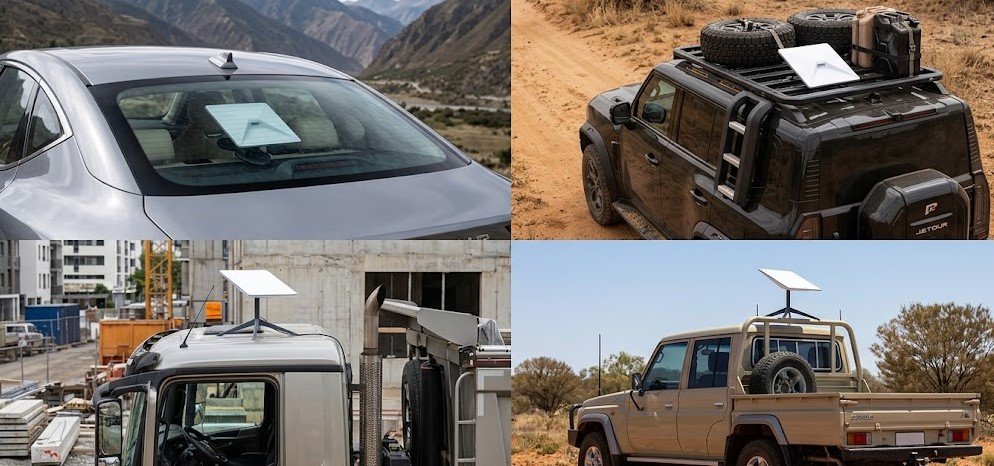
Vehicle users are another category entirely. Enterprising users across the world have mounted the Starlink Mini in rear windshields of saloon cars, on the roof racks of SUVs and Land Cruisers, and in the cabs of trucks. The Starlink Roam plan, which is what Mini users need, supports in-motion use — meaning the dish can maintain a connection while the vehicle is moving. This is particularly relevant for long drives across the UAE and into Saudi Arabia or Oman, where stretches of highway pass through areas with limited mobile coverage. One thing to note: speeds drop somewhat when the vehicle is travelling fast or changing direction, as the dish needs time to recalculate the positions of overhead satellites. This is a minor limitation for most users, but worth knowing if you plan to use it primarily while driving at highway speed.
It is also worth briefly acknowledging the alternatives. For users who need satellite internet on the go but want the performance of the full residential dish, it is technically possible to use the larger V4 unit in a mobile setup — though it requires a more complex installation and different power arrangements. On the other end of the spectrum, older satellite hotspot solutions like the Iridium Go offer a battery-powered option with a much smaller form factor, but are limited to speeds of under 100 Kbps — barely enough for email. Beyond those options, connectivity on the go largely comes down to mobile hotspots, which are only as good as the nearest cell tower.
Related : Beyond the Box: The 23 Best Third-Party Starlink Accessories
Important Notice
Equipment Cost and Service Plans
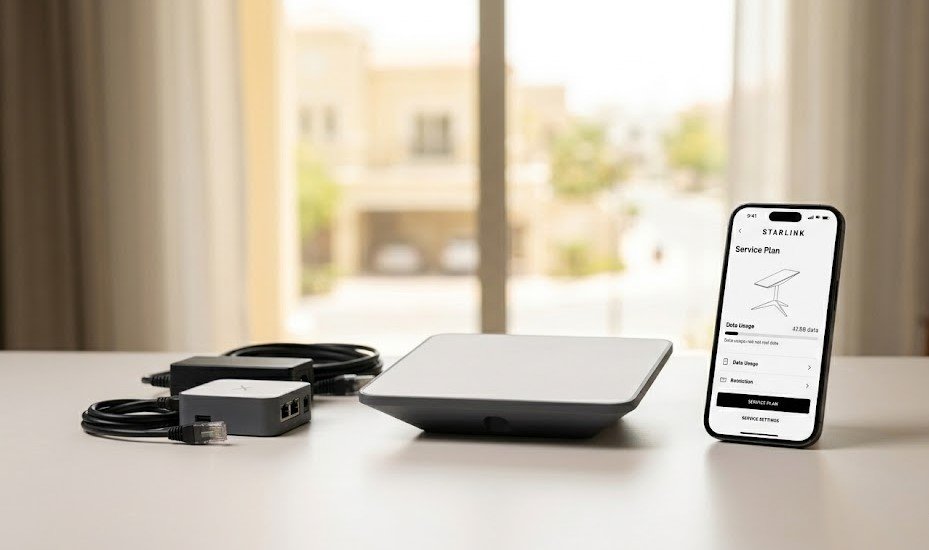
The Starlink Mini Kit is officially priced at AED 1,099 -1600 in the UAE—a drop from its initial international launch price of $599 (AED 2,200).
The kit is a complete “all-in-one” solution that includes:
- The Starlink Mini Dish (with an integrated Wi-Fi 5 router).
- A 15-metre DC power cable and a weather-resistant mains power adapter.
- Both a built-in kickstand and a pipe adapter mount included in the box.
Unlike the standard residential kit, which requires you to buy a pole mount separately, the Mini comes with the adapter included—making it ready for both tabletop use and more permanent mounting right out of the box.
What changed?
- The Price: It is now AED 1,099–1600.
- The Value: The inclusion of the pipe adapter as standard makes it a more versatile “pro” package for the price compared to the larger V4 dish.
- Starlink is now officially supported for the UAE market and while third-party listings often appear on local marketplaces, the most reliable way to secure a kit is through the official resellers ( like elcome , samax and ensuring your hardware is fully optimized for the region and backed by official support.
| Plan | Data Allowance | Approx Monthly Cost (AED) |
| Mobile – 100 GB | 100 GB per month* | AED 190 |
| Mobile – Unlimited | No data cap | AED 370 |
The Roam 100GB plan (AED 185–190/month) is the new entry-level standard in the UAE, replacing the old 50GB tier. It’s ideal for weekend campers or remote workers with moderate needs. A major 2026 upgrade: if you hit your limit, you no longer get cut off—you transition to unlimited low-speed data, sufficient for WhatsApp and basic emails while off-grid.
Starlink pricing is dynamic. always verify the latest hardware and monthly fees directly on their availability map before purchasing.
For power users, content creators, or those using the Mini as a primary connection, the Roam Unlimited plan (AED 370/month) is the better investment. It removes all speed caps and officially supports in-motion use up to 160 km/h, making it the ultimate tool for long desert expeditions and cross-border road trips.
💡 Pro Tip: The “Closet Saver” (Standby Mode)
Setup — Genuinely Easy
One of the Starlink Mini’s most underrated qualities is how simple it is to get running. The unit ships pre-assembled with the kickstand already attached. There is no installation manual to decipher, no separate components to wire together, and no technical background required.
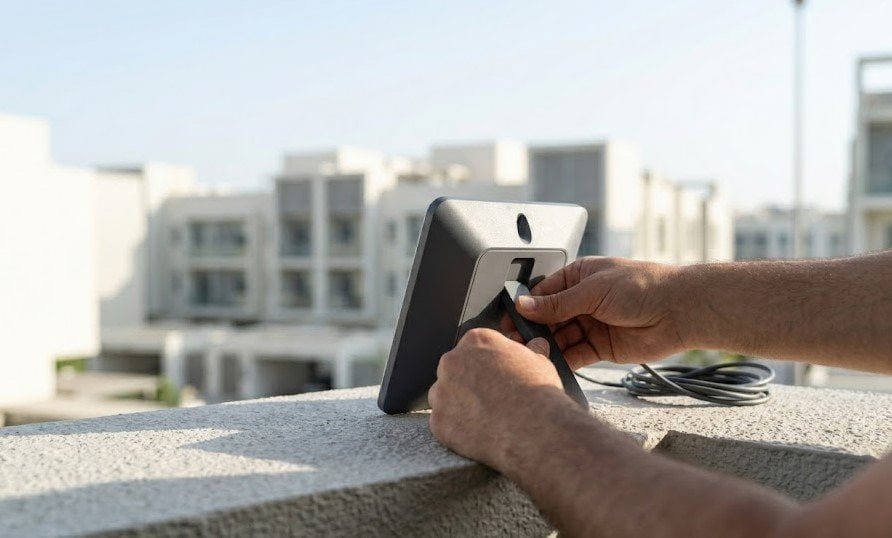
The process is straightforward: find a flat spot with a clear, unobstructed view of the sky — no buildings, trees, or overhanging structures blocking the upper hemisphere — and set the dish down. Connect the 15-metre power cable to the unit and plug the other end into the included mains adapter. Open the Starlink app on your phone, follow the on-screen prompts to check for obstructions and orient the dish correctly, and activate your service. Most users are online within five to ten minutes of opening the box for the first time.
The included mains power adapter carries an IP66 weather resistance rating, meaning it can handle direct exposure to rain, blowing dust, and splashing water. This is particularly useful in the UAE context, where outdoor power outlets at campsites or event venues may be exposed to the elements. You do not need to shelter the adapter to keep it functioning safely outdoors.
For users who want to run the Mini from a vehicle’s 12-volt socket — a very common setup among overlanders and road-trippers — this is entirely possible without any voltage converter. However, there is an important practical note: the 15-metre cable included in the kit is too long to maintain stable voltage when running from 12V power. A shorter cable and the appropriate adapter plug are needed. Since the Mini supports a voltage range of 12V to 48V, it is also fully compatible with the higher-voltage electrical systems found in electric vehicles. The Tesla Model Y, for example — one of the most popular EVs in the UAE — delivers around 16 volts from its accessory circuit, well within the Mini’s supported range.
The power efficiency of the Mini is another genuine advantage for off-grid use. At just 25-40 watts of consumption, it draws roughly a third of what the full residential dish requires — 70 watts. For anyone running the unit from a vehicle battery, a portable power station, or a solar setup, this lower draw significantly extends how long you can operate without recharging or refuelling.
Here’s a concise recap:
- Place the Starlink Mini on a flat spot with a clear, unobstructed view of the sky.
- Connect the 15 m cable to the unit and plug into the included IP66-rated mains adapter (outdoor-safe).
- Use the Starlink app to check for obstructions, orient the dish, and start service (online in 5–10 min).
- For 12 V or EV setups, use a shorter cable if needed; low 25–40 W draw extends battery life for mobile or solar setups.
Performance — What the Data Shows
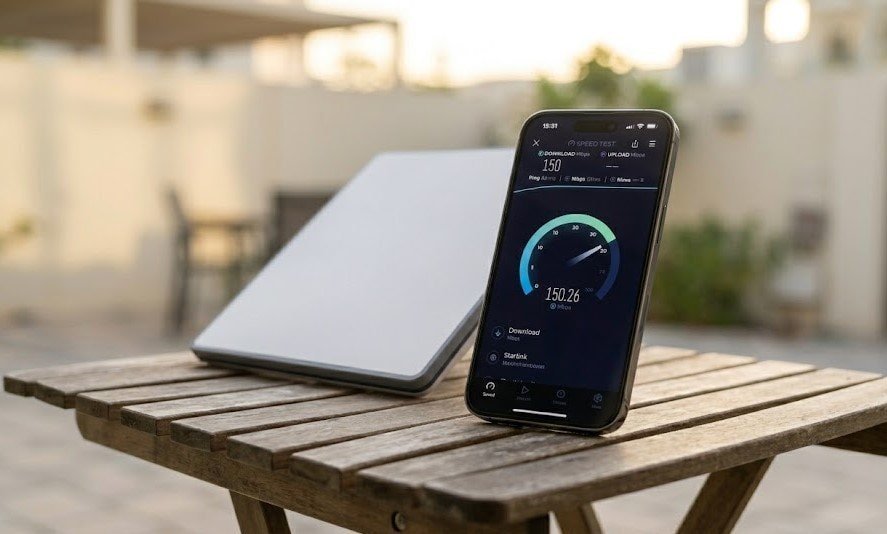
Note: The performance figures below are drawn from SpaceX’s published specifications, independent speed tests shared publicly online, and user reports from early Starlink Mini adopters. We have not conducted personal on-ground testing in the UAE, as the service only recently launched in the region.
SpaceX publishes the following performance expectations for the Starlink Mini on the Roam plan:
| Metric | SpaceX stated range |
|---|---|
| Download speed | 65 – 260 Mbps (Peaks often exceed 200 Mbps in UAE) |
| Upload speed | 15 – 35 Mbps (Real-world tests often hit 25+ Mbps) |
| Latency | 25 – 50 ms (Consistently lower due to 2026 network upgrades) |
Starlink Mini — download speed distribution
Frequency of test results per 20 Mbps speed bucket — based on PCMag & HighSpeedInternet.com published test datasets
Sources: HighSpeedInternet.com Mini review · SatelliteInternet.com 2026 · PCMag Starlink Mini review (2024)
In practice, user-reported speeds and independently published speed tests from early adopters tell a broadly consistent story. Day-to-day download speeds typically fall in the 15 to 30 Mbps range, which is sufficient for most practical tasks — video calls, web browsing, streaming at standard definition, and general remote work. On better days and in less congested areas, speeds can spike well above 100 Mbps. These peaks are real but inconsistent, and you should not count on them as a baseline.
Starlink Mini — performance consistency
Proportion of tests landing in each 20 Mbps speed band — download vs upload frequency distribution
Sources: PCMag 2024 Starlink testing (2-week dataset) · DigitalNomadLifestyle.com (20+ European locations) · Speedcast enterprise review
Upload performance is a pleasant surprise. Real-world upload speeds of 10 to 20 Mbps have been widely reported, consistently outperforming SpaceX’s conservative stated range of 2 to 10 Mbps. For users who regularly send large files, upload video content, or participate in video conferences where both directions of the connection matter, this is meaningful.
Latency is where the Starlink Mini performs most impressively relative to older satellite internet technology. Traditional geostationary satellite systems — the kind that have been available in parts of the Middle East for years — operate with latency well above 600 milliseconds, which makes real-time applications like video calls and online collaboration tools essentially unusable. Starlink’s low-Earth orbit constellation brings that figure down dramatically. In well-covered areas, users report latency of 20 to 40 milliseconds, which is comparable to a reasonable fixed broadband connection.
Starlink Mini — third-party ping (latency)
Average latency in milliseconds — lower is better
Sources: HighSpeedInternet.com (field-tested) · PCMag · Ftron.net maritime review · Ookla Speedtest Q1 2025
For users in the UAE and wider Gulf region, latency will likely sit a little higher — in the 40 to 90 millisecond range — due to the greater distance from Starlink’s ground stations. This is still entirely functional for video calls, remote work, and streaming. Competitive online gaming may occasionally be affected by latency spikes, but for the vast majority of everyday use cases, it is not a limiting factor.
One pattern that comes up consistently in user reports is speed variability. Unlike a fixed fibre connection, Starlink performance fluctuates depending on several factors: how many active users are sharing the same satellite coverage at a given time, local obstructions, atmospheric conditions, and the specific orbit of overhead satellites. You might measure 70 Mbps one morning and 12 Mbps the following evening from the exact same location. This variability is inherent to the current state of the Starlink network, and is something to factor into your expectations.
The good news for UAE users is that Starlink’s local network is still young and relatively uncongested. In markets like the United States and the UK, where Starlink has been live for several years and user numbers are much higher, speed variability is more pronounced. In the UAE today, with a smaller active user base, early adopters are likely seeing better-than-average performance for exactly this reason.
Prp Tip
Mini vs Residential Dish — Side by Side
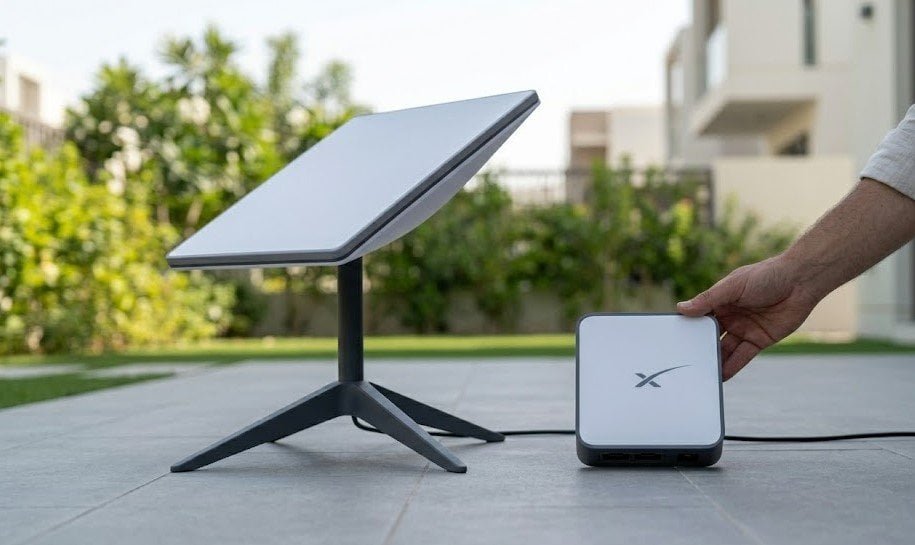
The performance difference between the Mini and the residential V4 dish is real and significant when it comes to raw download speeds. The residential dish delivers roughly five to ten times the average throughput. If you are using Starlink as your primary home internet connection for a family, a home office, or anything requiring consistent high-speed downloads, the residential setup is the right choice — no question.
| Metric | Starlink Mini (Roam/Portable) | Starlink V4 (Standard Residential) |
| Primary Use Case | Backpacking, camping, and remote work | Home, office, or fixed villa setup |
| Average Download | 100 to 180 Mbps | 200 to 300+ Mbps |
| Peak Download | Up to 210 Mbps | Up to 400 Mbps |
| Upload Speed | 15 to 25 Mbps | 20 to 40 Mbps |
| Latency (Local) | 25 to 50 ms | 20 to 35 ms |
| Power Draw | 20W – 40W (Ultra-efficient) | 75W – 100W (High-performance) |
| Portability | Tablet-sized; fits in a standard backpack | Large dish; requires dedicated storage |
| Weather Resistance | IP67 (Dust tight / water immersion) | IP67 (Dust tight / water immersion) |
| WiFi Generation | WiFi 5 (Integrated) | WiFi 6 (Separate Router) |
| Device Support | Up to 128 devices | Up to 235 devices |
| LAN Ports | 1x Ethernet port on dish | 2x Ethernet ports on router |
But here is the important nuance: latency, which governs the quality of real-time applications — video calls, cloud-based tools, online collaboration — is almost identical between the two. Both systems use the same satellite constellation and the same ground infrastructure. The Mini does not feel meaningfully worse for a Zoom call or a Google Meet session. The gap is primarily felt in download-heavy tasks like large file transfers, 4K streaming, or backing up data to the cloud.
Starlink Mini comparison — performance averages
Mini vs Standard vs legacy GEO satellite across key metrics
Sources: Speedcast Mini vs Standard 2025 · Ookla Speedtest Q1 2025 · HighSpeedInternet.com
If you are evaluating the Mini as an all-in-one solution — both a home connection and a travel device — it is worth being clear-eyed about that trade-off. For most people, the better approach is a residential dish at home and a Mini for when you are on the move. For those who move frequently enough that a fixed installation makes no sense, the Mini is the more practical single solution, with the speed compromise accepted.
A Note on Performance in the UAE Specifically
Since Starlink only recently launched in the UAE, there are a few local factors worth highlighting that differ from what international reviewers typically discuss.
First, network congestion is currently low. The UAE user base is small relative to mature markets, which means fewer people competing for bandwidth on the same satellites. This is a genuine advantage for early adopters, and likely contributes to the better-than-average speeds some users have reported in the region.
Second, the UAE’s climate and geography are broadly favourable for satellite internet. Clear skies are the norm for most of the year, and the flat topography of much of the country means obstructions are easier to avoid than in forested or mountainous regions. The two conditions most likely to cause temporary disruption are heavy sandstorms — which can affect signal quality during the most intense events — and the occasional dense cloud cover during the winter months in the northern emirates. Neither is frequent enough to be a consistent concern.
Third, for users planning to travel with the Mini beyond UAE borders — into Oman, Saudi Arabia, or further across the region — it is important to verify Starlink’s coverage map and service availability in each country before your trip. The Roam plan supports international use where Starlink is active, but coverage and regulatory status varies by country.
Verdict
The Starlink Mini is exactly what it sets out to be: a practical, portable satellite internet solution for people who need connectivity beyond the reach of conventional infrastructure. It is not the fastest dish Starlink makes, and it is not designed to be. What it is designed to be is easy to carry, quick to set up, rugged enough to handle real outdoor use, and capable enough to keep you genuinely connected — and on all of those counts, it delivers.
For UAE users specifically, the timing of this launch is well-suited to the country’s lifestyle. The appetite for desert camping, overlanding, remote retreats, and outdoor events is strong, and the gap between where people go and where reliable mobile coverage reaches is real. The Starlink Mini bridges that gap better than anything else currently available in the market.
It is not for everyone. If you need a fixed home connection with the best possible speeds, the residential Starlink V4 dish and Gen 3 router is the right answer. But if you are regularly venturing beyond the reach of the UAE’s fibre and 4G networks — or if you need a reliable internet solution that can be deployed anywhere at short notice — the Starlink Mini is the tool you have been waiting for.
Quick Buying Advice
Skip it if: You only stay within city limits or live in an apartment where a clear, unobstructed view of the sky is impossible to find.
Buy it if: You spend weekends off-grid, work remotely from the desert, or need a “go-bag” emergency internet solution.
Starlink vs. Local Providers (Etisalat & du)
While fiber remains the gold standard for city homes, Starlink fills a specific gap for those who need high-speed access where traditional cables or cellular towers don’t reach. It is important to view satellite internet not as a direct competitor to your home fiber, but as a specialized tool for connectivity beyond the urban grid.
| Feature | Starlink (Satellite) | Etisalat / du (Fiber & 5G) |
| Best For | Off-grid travel, remote farms, & mobile backup. | Permanent homes, heavy gaming, & urban offices. |
| Typical Speeds | 100 – 250 Mbps | 500 Mbps – 1 Gbps+ (Fiber) |
| Latency | 25 – 60 ms | 1 – 5 ms (Fiber) |
| Commitment | No contract. Pay month-to-month. | Usually 12–24 months for best rates. |
| Upfront Cost | Hardware must be purchased outright. | Usually included in the monthly plan. |
| Portability | High. Works anywhere with a clear sky view. | Low. Fixed to a villa or specific 5G tower. |
| Stability | Variable (Sensitive to heavy rain/dust). | Extremely High (Fiber is unaffected by weather). |
Key Comparison Points:
- The Infrastructure Gap: Etisalat and du rely on a world-class network of ground cables and towers. If you have fiber available, it will always be faster and more stable. Starlink’s strength is its independence; it doesn’t need a single wire on the ground to work, making it the only viable high-speed option for deep desert camps or remote agricultural land.
- Cost vs. Flexibility: Local providers often bundle a “free” router and installation, but they require a long-term commitment. With Starlink, you own the hardware outright. This allows you to pause your service during months when you aren’t traveling, which is a major advantage for seasonal users.
- Latency & Gaming: For competitive gaming or massive file transfers, Fiber remains the undisputed king. While Starlink’s latency is impressive for satellite, it cannot currently match the near-instant response times of a local fiber optic connection.

Starlink Mini
Looking for high-speed connectivity that fits in your backpack? The Starlink Mini offers a game-changing, ultra-portable solution for reliable internet across the UAE’s deserts and mountains.
Lear More
Starlink pricing, hardware availability, specs and UAE-specific regulations are subject to change without notice. We recommend checking the official Starlink website for the most up-to-date figures and local licensing terms before making a purchase. While the Starlink Mini is hardware-capable of mobile use, the authorities may restrict “in-motion on land” services. To avoid potential service blocks or regulatory issues, ensure you are stationary (at a campsite or parked) before powering on your dish. This content is provided for informational purposes only and does not constitute legal or regulatory advice. We are not affiliated with, endorsed by, or officially connected to Starlink or its parent company.