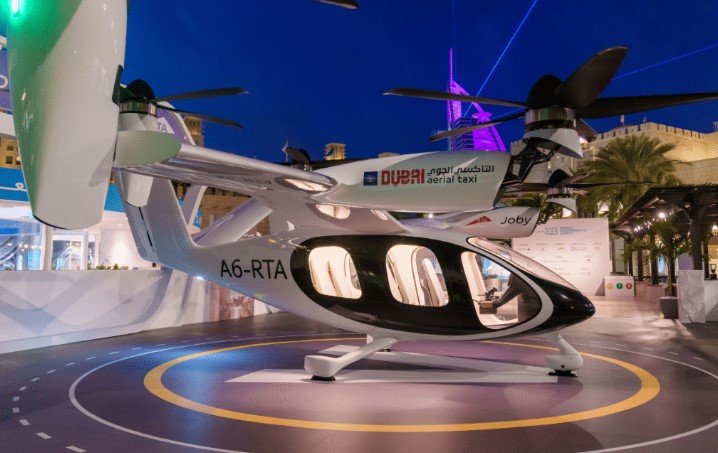
For decades, the image of “flying cars” ( aka Dubai Air Taxi ) was a staple of science fiction, usually reserved for the year 2000 or beyond. While we missed the turn of the millennium, Dubai is officially making good on that promise in 2026. As the city continues to lead the world in smart mobility, the Roads and Transport Authority (RTA) has confirmed that commercial air taxi services are set to launch by by the end of 2026.
The infrastructure behind this revolution isn’t just a series of helipads; they are Vertiports—sophisticated, multi-level terminals designed for electric Vertical Take-off and Landing (eVTOL) aircraft. In partnership with Joby Aviation and Skyports Infrastructure, Dubai is building a network that will turn a 45-minute cross-city crawl into a 10-minute aerial glide.
| ✈ KEY FACTS AT A GLANCE Launch target: 2026 (initial service launched from DXB vertiport) Aircraft operator: Joby Aviation ,Vertiport builder & operator: Skyports Infrastructure Initial confirmed vertiports: 4 (Dubai-only), with UAE-wide expansion planned Aircraft specs: Seats 1 pilot + 4 passengers | Top speed: 321 km/h | Zero operating emissions Expected fare: Comparable to an Uber Black — roughly a third of the journey time by car |
How Dubai’s Air Taxi Project Came Together
The groundwork for this ambitious project was laid in early 2024, when the RTA signed a landmark agreement with Joby Aviation, Skyports Infrastructure, the General Civil Aviation Authority (GCAA), and the Dubai Civil Aviation Authority (DCAA). Under that framework, Dubai would become the first city in the world to host a scheduled, point-to-point electric air taxi service operating over an urban area.
From the start, the approach was deliberate and systematic. Joby brought over 40,000 miles of pre-UAE flight test data to the table. The GCAA developed brand-new national Vertiport Regulations, fast-tracking design approvals for infrastructure that had never existed before anywhere. And in November 2025, Joby completed the UAE’s first crewed point-to-point eVTOL flight — a 17-minute piloted journey from the Margham test facility to Al Maktoum International Airport (Dubai World Central) — marking a pivotal moment at the Dubai Airshow 2025.
The Aircraft: Joby S4 eVTOL
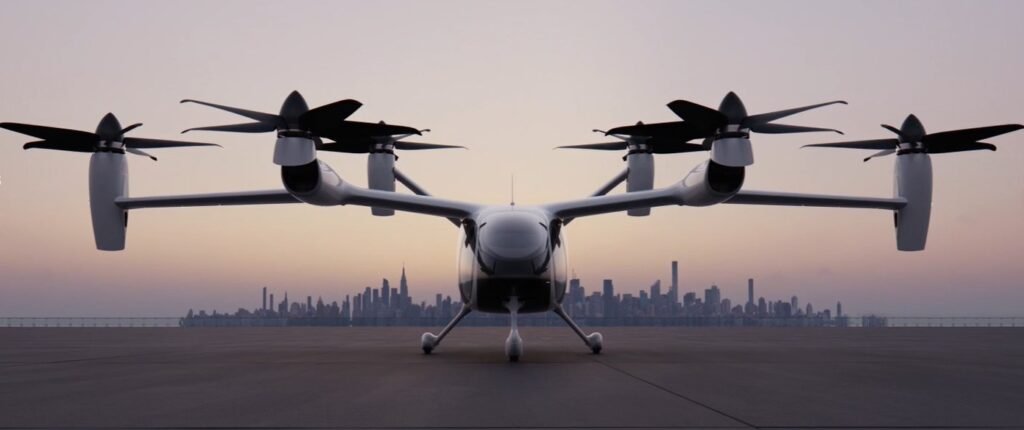
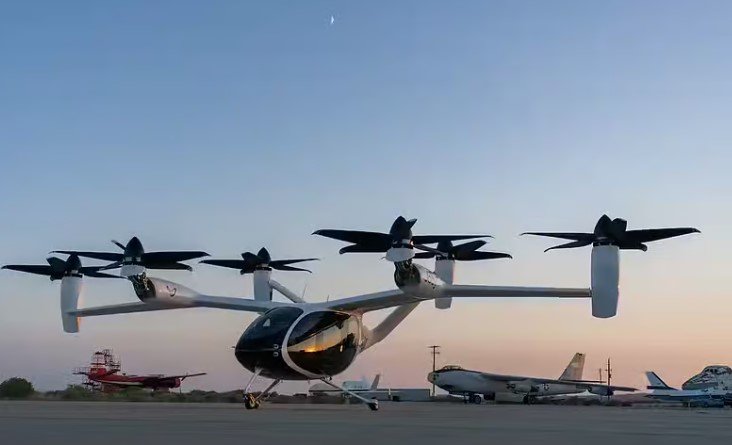
Before diving into the vertiports themselves, it’s worth understanding the aircraft. The Joby S4 is a fully electric, piloted vertical take-off and landing (eVTOL) aircraft specifically engineered for urban air mobility. Here is what sets it apart:
- Six electric tilt-rotors that transition from vertical lift to horizontal cruise flight
- Top cruising speed of 321 km/h (200 mph)
- Carries a pilot plus up to four passengers
- Range exceeding 200 kilometres on a single charge
- Approximately 100 times quieter than a conventional helicopter at take-off
- Zero operating emissions — fully electric
The aircraft’s near-silent operation is not just a luxury feature — it’s a practical requirement for flying over dense urban areas like Downtown Dubai and Palm Jumeirah. Learn more directly from Joby Aviation’s official website.
To ensure operational excellence at launch, the initial rollout is concentrated on four high-traffic strategic hubs, with plans to scale the network across the city as the infrastructure matures As of April 2026, the RTA and Joby Aviation have officially confirmed four vertiports for the initial network, with the DXB vertiport serving as the launch anchor point. The GCAA has indicated plans to convert over 70 existing helipads into hybrid infrastructure, which would dramatically expand the accessible network over time.
Vertiport 1: Dubai International Airport (DXV)
Location: Adjacent to Terminal area, near Emirates Airlines headquarters
| Developer | Skyports Infrastructure |
| Site Area | 3,100 square metres across four floors |
| Landing Pads | Two dedicated areas (eVTOL and helicopter compatible) |
| Annual Capacity | ~42,000 landings | ~170,000 passengers |
| Peak Throughput | Up to 10 aircraft movements per hour |
| Parking Integration | Ground parking by Parkin (Dubai’s public parking group) |
This is where the story begins. The Dubai International Vertiport (DXV) is the most structurally significant piece of aviation infrastructure to be built in the UAE in years — and arguably, in the world. It is the first purpose-built commercial vertiport to receive regulatory approval under any country’s formal eVTOL vertiport rules.
The four-storey facility sits adjacent to Dubai International Airport (DXB), one of the world’s busiest aviation hubs. Two levels are reserved for vehicle parking — the airport connection making this a genuinely intermodal hub. Above that sit the take-off and landing pads, aircraft charging bays, and a fully air-conditioned passenger terminal. According to the RTA’s official announcement, the vertiport is designed to handle approximately 42,000 aerial taxi landings per year, serving around 170,000 passengers annually.
Why It Matters
DXV is the launchpad for the entire global eVTOL industry. A flight from DXB to Palm Jumeirah that takes 45 minutes by car takes roughly 10 minutes by air taxi. For millions of international travellers arriving at one of the world’s busiest airports, that time saving is transformative. It also sets the technical and regulatory template that every other city in the world will look to when building their own vertiport network.
Update: The Skyports CEO previously noted in a Dubai Eye interview that the infrastructure for the first vertiport was targeted for completion by March 31, 2026. While this marks the official handover of the launch site at Dubai International (DXB), the RTA has clarified that full commercial passenger services are expected to roll out later in 2026 following final safety trials.
Related : Driverless Taxi in Dubai – Top 10 Things to Know
Vertiport 2: The Dubai Mall (Zabeel Parking Area)
Location: Zabeel Dubai Mall parking area, Downtown Dubai
The decision to place a vertiport at Dubai Mall — the world’s most visited shopping and entertainment destination, with nearly 111 million visitors in 2024 — is as commercially savvy as it is symbolically powerful. Developed in partnership with Emaar Properties, one of the world’s leading real estate and hospitality groups, this vertiport will sit within the Zabeel parking area, integrating seamlessly with an existing transit hub.
For visitors arriving by air taxi, this means stepping directly into the vicinity of the Burj Khalifa, the Dubai Fountain, and an area that sees tens of millions of tourists each year. For those departing, it offers a premium, stress-free escape from one of the city’s most congested zones.
Why It Matters
The Dubai Mall vertiport signals the commercialisation of air taxi travel as a lifestyle product, not just a transit tool. Emaar’s involvement brings world-class hospitality standards to the vertiport experience itself. Expect premium lounges, seamless booking integration, and the kind of refined passenger experience consistent with the brand that built the Burj Khalifa.
From a network perspective, this vertiport connects the most tourist-dense area of Dubai with the airport and Palm Jumeirah, completing a triangle of routes that will be the backbone of early commercial operations.
Vertiport 3: Atlantis The Royal, Palm Jumeirah — Luxury Meets Innovation
Location: Palm Jumeirah
Few addresses in the world carry the cachet of Atlantis The Royal — the ultra-luxury resort on the tip of Palm Jumeirah that redefined hotel experiences when it launched. Having a vertiport here is a statement of intent: Dubai’s air taxi service is positioning itself as a premium product from day one.
The Palm Jumeirah vertiport will be constructed within the Atlantis The Royal resort grounds. This places it in one of the most visually striking and logistically accessible spots in the city — surrounded by water on three sides, yet well-connected by monorail and road to the mainland.
Why It Matters
Palm Jumeirah is home to some of Dubai’s most expensive real estate and most celebrated hotels. A direct air taxi connection from Dubai International Airport to Palm Jumeirah — expected to take around 10 minutes — will be an extraordinary draw for high-end travellers and residents alike. What currently takes 45 minutes by car, crawling through tunnel and bridge traffic, becomes a seamless, scenic 10-minute journey over the Arabian Gulf.
This vertiport also anchors the southern end of Dubai’s initial route network, providing geographic balance to the DXB vertiport in the east and the Dubai Mall in central Downtown.
Vertiport 4: American University of Dubai (Dubai Marina) — Connecting the New Waterfront
Location: Dubai Marina parking zone, American University of Dubai campus
The fourth confirmed vertiport in Dubai’s initial network is located within the American University of Dubai (AUD) campus parking zone in Dubai Marina, developed in partnership with Wasl Asset Management Group. Dubai Marina is one of the fastest-growing residential and commercial districts in the emirate, home to hundreds of thousands of residents and a major hub for tourism, dining, and yachting.
From a travel-time perspective, the GCAA has confirmed that a journey from Dubai International Airport to Dubai Marina — which currently takes 45 minutes to an hour by road — can be completed in 15 to 18 minutes by eVTOL. For daily commuters and hotel guests, this is a genuinely life-changing reduction.
Why It Matters
Placing a vertiport in Dubai Marina extends air taxi access to a densely populated urban waterfront that is historically hard to reach quickly by road. The AUD campus location also introduces an interesting dimension: proximity to a university environment signals that air taxi travel is being designed for everyday urban life, not just the ultra-premium segment. As fares are expected to be comparable to an Uber Black, this democratisation of sky travel becomes a realistic near-term prospect.
For full technical details on these four sites and the RTA’s governance model, the Joby Aviation investor release from November 2025 is essential reading.
Beyond the Initial Four: Dubai’s Broader Vertiport Pipeline
The four confirmed sites represent Phase 1. But the RTA, GCAA, and their partners have been very clear: this is the beginning, not the destination. Here is what is on the horizon:
Al Maktoum International Airport (Dubai World Central)
DWC is already central to Dubai’s air taxi story — it was the landing site for Joby’s landmark November 2025 crewed test flight. As the emirate’s future aviation mega-hub (undergoing a Dhs128 billion redevelopment), a dedicated vertiport at DWC is a logical next step that will become increasingly critical as the airport grows into one of the world’s largest.
The 70+ Helipad Conversion Programme
Perhaps the most ambitious element of the entire UAE strategy is the GCAA’s plan to convert over 70 existing helipads across the country into hybrid landing infrastructure compatible with eVTOL aircraft. As Gulf News reported, this would dramatically expand the accessible network across Dubai, Abu Dhabi, and beyond — essentially creating a distributed grid of air taxi nodes throughout the UAE without the need to build entirely new structures at every site.
Downtown Dubai and Additional Pipeline Sites
RTA has consistently referenced Downtown Dubai and other key business districts as part of the expanded vertiport pipeline. While specific confirmed partners for these additional locations have not yet been publicly announced, the direction of travel — both literally and figuratively — is clear.
UAE-Wide: The Air Taxi Network Extends Beyond Dubai
Dubai is the launchpad, but the vision extends across the UAE:
Ras Al Khaimah (2027 Target)
In a partnership announced between RAKTA, Joby Aviation, and Skyports, Ras Al Khaimah is targeting a passenger air taxi service by 2027. The first RAK vertiport will be on Al Marjan Island — the location of the Wynn Al Marjan Island casino resort — with additional sites to follow. The journey from Dubai International Airport to Al Marjan Island, which can take well over an hour by car, is projected to take under 15 minutes by eVTOL. See the official Joby-RAKTA partnership announcement.
Abu Dhabi and Ajman
The Arabian Business and other regional outlets have reported that vertiports are being planned across Ras Al Khaimah, Dubai, Ajman, and potentially Abu Dhabi. Abu Dhabi has separately announced its own vertiport network with over 10 planned locations, signalling a coordinated UAE-wide approach to advanced air mobility rather than competing city programmes.
Intercity Ambitions
Dubai’s RTA has outlined a longer-term vision in which air taxis connect Dubai to Abu Dhabi, Ras Al Khaimah, and Fujairah — journeys that currently take one to two hours by car, completed in under 30 minutes by eVTOL. This would fundamentally reshape commuter patterns across the Northern Emirates.
How to Book a Dubai Air Taxi
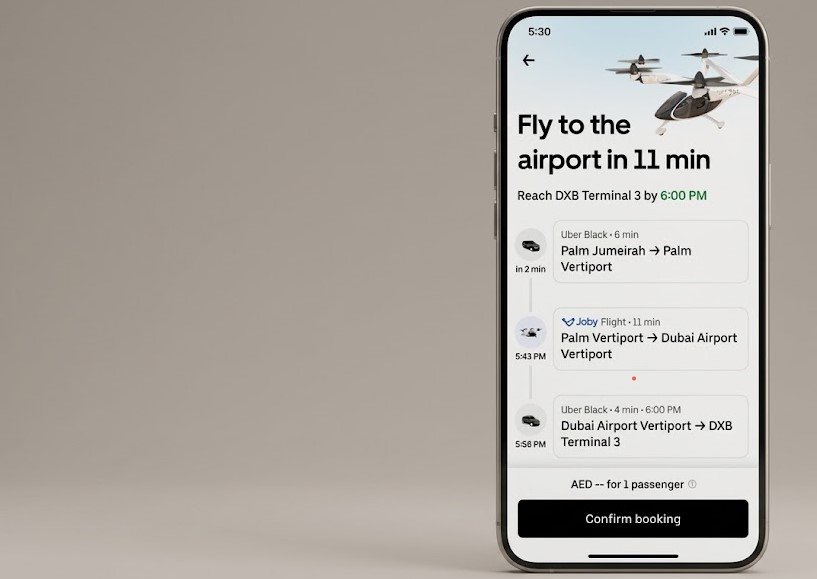
Booking is being designed for simplicity. The service is expected to integrate with the Uber platform — consistent with Joby’s global partnership with Uber — meaning many users will be able to book an air taxi through a familiar app interface. The service will initially operate on pre-booked, fixed routes using a scheduled model similar to a premium shuttle service.
The RTA has confirmed integration with other modes of Dubai public transport, so passengers can combine an air taxi hop with a Metro connection, an e-scooter rental, or a conventional taxi to complete a fully multimodal journey.
How Much Will a Dubai Air Taxi Cost?
Final pricing had not been officially confirmed as of publication. However, RTA officials and Joby representatives have consistently indicated that the target price point is comparable to an Uber Black — a premium but accessible tier that positions air taxis as a realistic upgrade for business travellers and frequent commuters, not merely a once-in-a-lifetime experience for the ultra-wealthy.
Context matters here: if a 45-minute car journey from DXB to Palm Jumeirah costs AED 100–200 in a standard taxi, and a 10-minute air taxi journey costs a comparable premium fare, the value equation for time-sensitive travellers becomes compelling quickly.
The Broader Impact: What This Means for Dubai’s Smart City Vision
Dubai’s air taxi programme is not simply a transport story — it is a central pillar of the emirate’s broader smart city and economic diversification strategy. Consider the intersecting impacts:
Tourism
Dubai attracted over 19.5 million international visitors in 2025 . Air taxis add an entirely new premium experience to the tourism offering — and shorten effective journey times between its most sought-after attractions. A visitor who might otherwise spend two hours in taxis between DXB, the Burj Khalifa, and Palm Jumeirah can now complete those journeys in under 30 minutes combined.
Congestion Relief
Sheikh Zayed Road and key arterials into Downtown Dubai and Dubai Marina are among the most congested in the region. Every air taxi passenger represents a vehicle removed from those roads. While the initial scale won’t transform traffic statistics overnight, the long-term potential — particularly with 70+ helipads converted — is genuinely significant.
Sustainability
The Joby S4 produces zero operating emissions. In a region actively diversifying away from a fossil fuel economy, zero-emission urban aviation aligns with the UAE’s Net Zero by 2050 commitment and sends a powerful signal about the viability of clean mobility at scale.
Economic Positioning
Being first matters enormously in aviation. Dubai’s six-year exclusive partnership with Joby ensures that the emirate becomes the global showcase — the place where every aviation regulator, city planner, and transport authority will come to observe, learn from, and potentially replicate. That visibility has compounding economic value far beyond the fare revenues of the initial routes.
Frequently Asked Questions (FAQ): Dubai Air Taxi & Vertiports
What is a vertiport?
A vertiport is a purpose-built facility for electric vertical take-off and landing (eVTOL) aircraft — essentially the equivalent of an airport or taxi rank for flying taxis. Vertiports include landing pads, passenger terminals, aircraft charging infrastructure, and parking. Dubai’s vertiports are being designed and built by Skyports Infrastructure.
When will Dubai’s flying taxis launch?
The initial commercial air taxi service launched from the Dubai International Airport (DXV) vertiport on March 31, 2026, making it the world’s first scheduled, commercial eVTOL air taxi service.
How many vertiports does Dubai have?
As of April 2026, Dubai has four confirmed vertiports forming its initial network: Dubai International Airport (DXV), Dubai Mall (Downtown), Atlantis The Royal (Palm Jumeirah), and the American University of Dubai (Dubai Marina). An extensive expansion — including conversion of 70+ existing helipads — is planned.
Who operates Dubai’s air taxis?
The air taxis are operated by Joby Aviation, a California-based company that has a six-year exclusive agreement with the RTA. Skyports Infrastructure designs, builds, and manages the vertiports, while the RTA oversees governance and integration with Dubai’s broader transport network.
How fast are the flying taxis?
The Joby S4 eVTOL has a top speed of 321 km/h (200 mph). In practical urban route terms, this translates to journey times of roughly 10 minutes from DXB to Palm Jumeirah and 15–18 minutes from DXB to Dubai Marina — compared to 45 minutes or more by car.
Will the air taxis be autonomous or piloted?
In the initial phase, all Joby air taxis will be piloted by a trained human pilot. The aircraft is designed to eventually support autonomous operations, but human pilots will be in command for the 2026 commercial launch.
Are the air taxis safe?
The Joby S4 has completed over 40,000 miles of test flights globally, plus extensive UAE-based testing in hot-weather conditions. The aircraft’s six-rotor design provides significant redundancy. The vertiports meet the highest international safety standards and all operations are governed by the GCAA and DCAA.
Can tourists use the air taxi service?
Yes — the service is open to residents and visitors alike. The pre-booking system and Uber integration are specifically designed to make air taxi travel accessible to international travellers unfamiliar with Dubai’s transport network.
Conclusion: Dubai Is Writing the Rulebook for Urban Air Mobility
The launch of commercial air taxi services in Dubai in 2026 is not merely a local transport milestone. It is a moment that reshapes what cities can be. For the first time in history, a major global metropolis is offering its residents and visitors the ability to routinely travel above the traffic — quietly, cleanly, and affordably.
The four confirmed vertiports at Dubai International Airport, Dubai Mall, Atlantis The Royal, and the American University of Dubai represent the foundational infrastructure for what will become a much larger network. The GCAA’s helipad conversion programme, the RAK expansion, and the intercity route ambitions signal that this is a decade-long transformation, not a single-year experiment.
Dubai has earned its reputation as a city that builds the future before the rest of the world finishes debating it. With the world’s first commercial eVTOL vertiport operational and its air taxi service carrying paying passengers, that reputation just got its most compelling chapter yet.