Every time Dubai has opened a new Metro line, the same pattern has played out — not immediately, not dramatically, but steadily and measurably. Developers hold stock. Landlords raise rents. Investors who bought three years before opening tell stories about returns that feel almost accidental in retrospect, because the logic was obvious and the opportunity was sitting in plain sight.
The Blue Line is the third chapter of that story.
Officially approved in November 2023, construction began in April 2025 and is targeting an opening date of 9 September 2029. The route is 30 kilometres long, with 14 stations — nine elevated and five underground — connecting communities across eastern and north-eastern Dubai that have historically had one significant disadvantage: you needed a car to live there. That disadvantage is being removed.
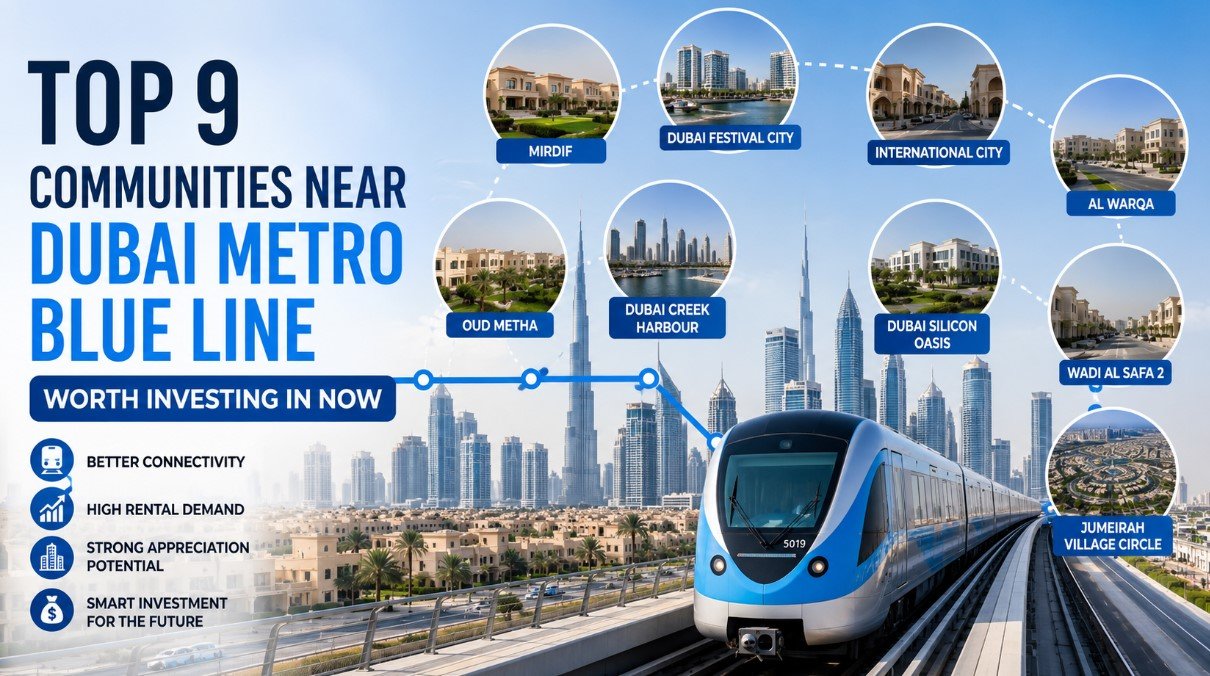
The communities along this corridor are not all equal. Some are prestige plays with world-record infrastructure attached. Some are yield markets — high-return, lower entry point, slower to gentrify. Some are genuine long-term bets tied to population projections that are already being validated by current rental data. All nine are worth understanding before the construction cranes become operational trains.
Here’s a community-by-community breakdown of what the Blue Line means for buyers and investors — with real numbers, honest caveats, and none of the overselling that tends to accompany infrastructure announcements in this market.
| ⚠️ Important context: The Blue Line opens in September 2029. Construction is at approximately 10% as of May 2026. All property data reflects current 2026 market conditions, not projected post-opening values. Price appreciation timelines are medium-term (3–5 years). Consult a licensed Dubai Land Department-registered broker before any investment decision. |
Why the Blue Line Is Different From What Came Before
The Red Line opened in 2009, connecting the airport to Dubai Marina. The Green Line followed in 2011, linking Bur Dubai and Deira. Both had a transformative effect on the communities they passed through — Dubai Marina and JLT saw long-term value growth that became the textbook example of metro-led appreciation in this market.
The Blue Line’s structural argument is actually stronger. Where the Red Line connected already-developing areas, the Blue Line is reaching communities that are completely road-dependent today — a larger transformation. Silicon Oasis, Academic City, and International City already house over 80,000 residents and workers between them, with no existing metro access. That’s a large captive population waiting for the infrastructure to catch up with where they already live.
The RTA has set a capacity target of 350,000 passengers daily once the line is operational. By 2029, an estimated 50,000 university students from Academic City alone are expected to use the Blue Line. The price movement has already started: rental data tracked by Betterhomes and Property Monitor shows that Academic City recorded a 43% rise in studio apartment rents since November 2023 — the month Sheikh Mohammed approved the project. That’s the market pricing in an announcement. The actual line is still three years away.
| 43% Rise in Academic City studio rents since the Blue Line was approved — Betterhomes & Property Monitor, 2026 |
Communities Near Dubai Metro Blue Line
1. Dubai Creek Harbour — The Prestige Play
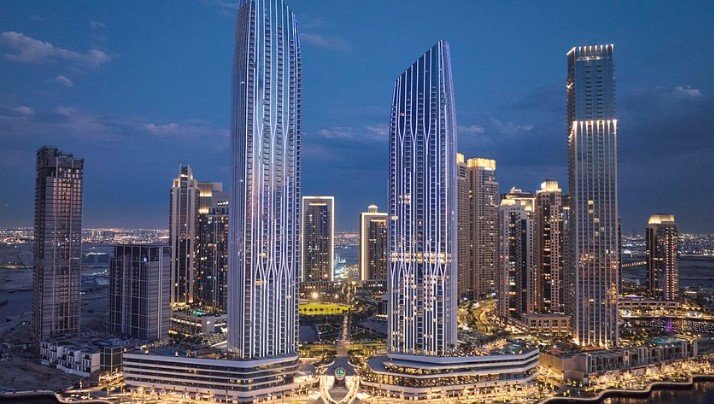
Of all the communities on the Blue Line route, Dubai Creek Harbour has the most to gain from a pure perception standpoint — and its numbers already reflect that. The station being built here isn’t just a transport node. At 74 metres above ground, it will be the world’s tallest metro station, a landmark in its own right and one that Emaar has been using as a marketing anchor since the announcement.
Property values here were already climbing before the Blue Line entered the conversation. Apartments are currently listing at AED 1.5 million to AED 2 million for a one-bedroom, with rents above AED 100,000 annually for the same unit. The Blue Line adds a direct connection to the Green Line interchange at Creek Station — meaningful because it puts Dubai Creek Harbour residents within one transfer of virtually any point in central Dubai. Property market analysts have modelled an additional 25–30% value uplift for properties closest to the station once the line opens, on top of gains already built into current pricing.
This is not a yield market. Entry prices are high and current rental returns are compressed relative to the capital required. Dubai Creek Harbour is a long-term capital appreciation play — buy for 2030, not for 2026 yield. The investor who held here since Emaar’s original masterplan announcement has already done well. The investor buying today is still early relative to a post-Blue Line valuation, but the entry point is steep.
| Investment Snapshot — Dubai Creek Harbour Station type: Elevated (world’s tallest at 74 metres) 1BR sale price (2026): AED 1.5M–2M 1BR annual rent: AED 100,000+ Projected uplift post-2029: 25–30% (near-station premium) Best for: Capital appreciation, long-term hold, premium buyers |
2. Dubai Silicon Oasis — The Biggest Structural Change
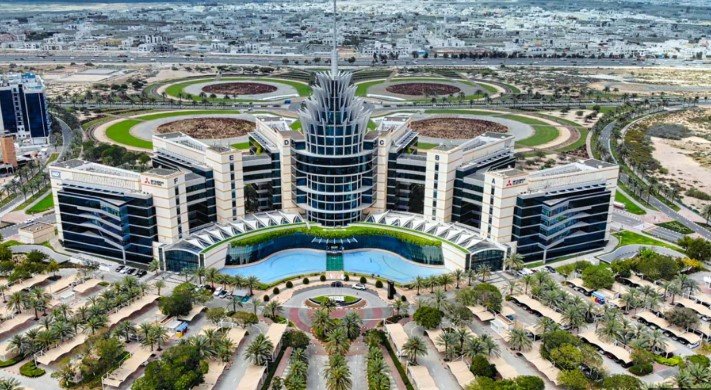
If one area’s daily life changes more than any other when the Blue Line opens, it’s Dubai Silicon Oasis. DSO is a self-contained community with a free zone, residential towers, a technology park, good schools, supermarkets, and restaurants. It is also, right now, entirely car-dependent for anyone who needs to go anywhere outside its boundaries.
That’s the problem the Blue Line solves. The moment metro access arrives, DSO stops being “the tech hub that’s a bit out of the way” and becomes a connected community with reasonable commuting options to central Dubai. The market has already started pricing this in: apartment prices gained 50% in the 12 months following the Blue Line announcement, and existing investors have reportedly been pulling listings rather than selling — holding for what they expect to happen between now and 2029.
Current entry points for a one-bedroom apartment start around AED 700,000 in the secondary market, with rents ranging from AED 50,000 to AED 70,000 annually. Yields at current pricing run between 6–8%, which is competitive by Dubai standards. The technology free zone provides a stable base of professional tenants with employment contracts — the kind of tenant a landlord actually wants.
The risk worth naming: DSO already saw significant appreciation in 2023–2024. Some of the Blue Line premium is priced in. The question is how much is left, and the answer depends on whether you believe the market is pricing 2029 correctly — which it almost certainly isn’t, based on how previous Dubai Metro openings played out.
| Investment Snapshot — Dubai Silicon Oasis Station type: Elevated 1BR sale price (2026): AED 700K–1.2M 1BR annual rent: AED 50,000–70,000 Current gross yield: 6–8% Projected uplift post-2029: 20–28% (Urban Terrace research, March 2026) Best for: Yield-focused investors, mid-term hold, technology sector tenants |
Related : Dubai Metro Gold Line : Everything You Need to Know
3. Academic City
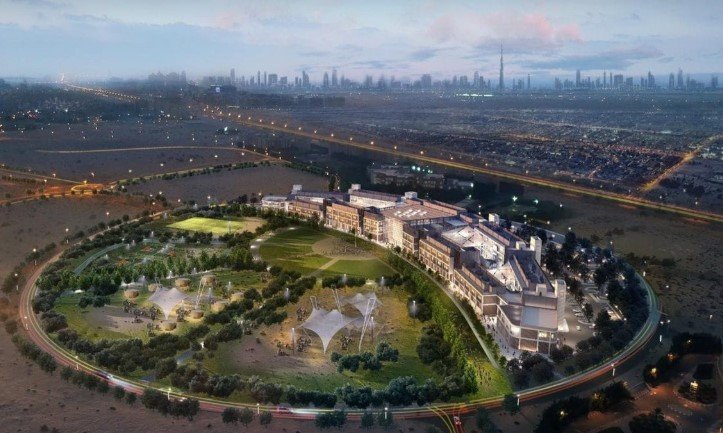
Academic City is one of Dubai’s more unusual investment propositions. It houses over 27 universities and colleges, with a combined student population above 27,500 and growing. The demographic profile of the area is entirely shaped by that — young, transient, economically active, and perpetually in need of rental housing.
The problem has always been getting there. Academic City sits in the far east of Dubai with limited public transport options, which means students and faculty overwhelmingly need cars or face expensive daily taxi costs. The Blue Line changes that completely. The station connects Academic City directly to the Metro network for the first time, and the RTA projects 50,000 daily users from this area alone by 2029 — a number that signals the scale of pent-up demand.
Studio rents here have risen from AED 42,000 to AED 60,000 annually since November 2023 — a 43% increase driven entirely by announcement effect and demand from the student population already present. The entry price for studios and one-beds in the secondary market remains among the most accessible on the Blue Line corridor, making it one of the stronger yield plays for investors who want strong rental demand without the capital exposure of Creek Harbour or Festival City.
| Investment Snapshot — Academic City Station type: Elevated (terminus of the Blue Line) Studio rent (2026): AED 60,000/year (up from AED 42,000 in Nov 2023) Student population: 27,500+ across 27+ universities RTA projected daily users: 50,000 by 2029 Best for: High-yield rental investors, student accommodation demand |
4. International City — The Yield Market With Infrastructure Upside
International City has long been Dubai’s most accessible investment entry point. Studios and one-bedroom apartments are available from AED 300,000 to AED 450,000 — prices that exist almost nowhere else in the emirate — and rental yields have historically been among the highest in the city, running between 8–10% gross in the current market. The trade-off has always been connectivity. International City has no metro access. The Blue Line changes that in a significant way — not just with one station, but with an underground interchange station that makes it the Y-junction where both branches of the line merge.
Rents jumped 22% following the Blue Line announcement and have continued climbing. For a community this established — it already houses tens of thousands of residents with a stable, affordable-rental ecosystem — metro access doesn’t just drive marginal improvement. It removes the single biggest objection a quality tenant has to living there.
The risk is specific: International City is primarily a lower-mid market area, and its price ceiling is limited by demographics. Uplift will be meaningful but probably more concentrated in rents than in capital values. For investors whose primary goal is income rather than asset appreciation, this is likely the strongest near-term option on the entire Blue Line corridor.
| Investment Snapshot — International City Station type: Underground interchange (Blue Line Y-junction) Studio sale price: AED 300K–450K 1BR annual rent: AED 30,000–45,000 Current gross yield: 8–10% Rent increase since Blue Line approval: ~22% Best for: Yield investors, accessible entry, income-first strategy |
5. Dubai Festival City — Established and About to Get More Connected
Dubai Festival City doesn’t need the Blue Line to be a desirable place to live. With direct views over Dubai Creek, a massive shopping and entertainment complex, hotel and residential towers, and an established creekside promenade, it’s one of Dubai’s more complete communities. Over 50,000 people already live there. The infrastructure is mature.
What the Blue Line adds is something Festival City has been missing: direct metro connectivity. The planned station here becomes an interchange point for the route, linking it to the Green Line corridor and putting residents within straightforward reach of central Dubai without driving. For a community already attracting young professionals and families, transit access upgrades the proposition in ways that are difficult to quantify but easy to feel.
One-bedroom apartments currently list between AED 1.2 million and AED 1.8 million for sale, with rental rates at AED 80,000 to AED 100,000 annually. The projected appreciation here is 10–25% above current values post-2029, driven less by transformation (the community is already well-established) and more by demand concentration — more people willing to pay more for a fully-connected, mature waterfront community.
| Investment Snapshot — Dubai Festival City Station type: Elevated (interchange station) 1BR sale price (2026): AED 1.2M–1.8M 1BR annual rent: AED 80,000–100,000 Residents: 50,000+ | Community type: Mixed-use, established Best for: Mid-to-premium buyers, family-oriented tenants, stable demand |
6. Mirdif — Family Suburb With Renewed Momentum
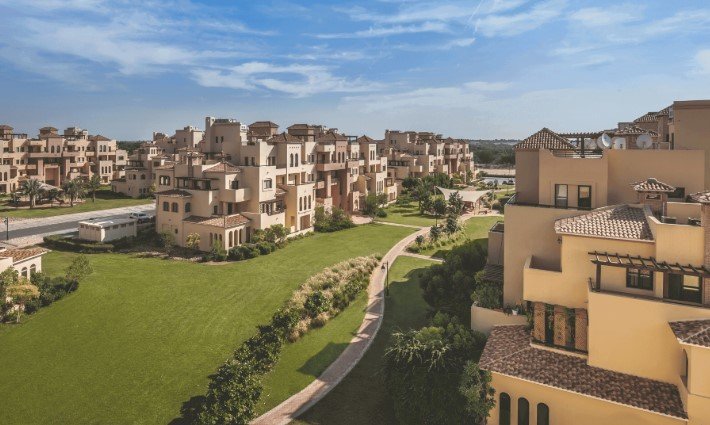
Mirdif is one of Dubai’s most consistently underestimated residential communities. It’s quiet, heavily residential, close to Dubai International Airport, and popular with Emirati families and long-term expatriate residents who prioritise quality of life over proximity to the CBD. It has parks, low-rise buildings, genuine neighbourhood character, and rents that remain meaningfully below comparable areas closer to the city centre.
The Blue Line station here — alongside the nearby Centrepoint/Al Rashidiya interchange connecting to the existing Red Line — gives Mirdif its first proper metro access and opens the area to a significantly wider renter profile. One-bedroom apartments in the secondary market are priced between AED 700,000 and AED 1 million, with annual rents from AED 45,000 to AED 65,000. The projected appreciation sits at 10–25% above current values, which makes Mirdif one of the more balanced options on the corridor — not spectacular upside, but solid fundamentals and a community that doesn’t need to transform to become more attractive.
The family-villa segment of Mirdif is less directly affected — detached and semi-detached homes here are not typically rented by metro commuters. The investment case is strongest for apartment buyers targeting professional tenants for whom metro access is a primary consideration.
| Investment Snapshot — Mirdif Station type: Elevated 1BR sale price (2026): AED 700K–1M 1BR annual rent: AED 45,000–65,000 Community character: Family suburb, low-rise, airport proximity Best for: Long-term holds, family tenants, mid-market apartment buyers |
7. Al Warqa — Affordable Entry, Significant Upside
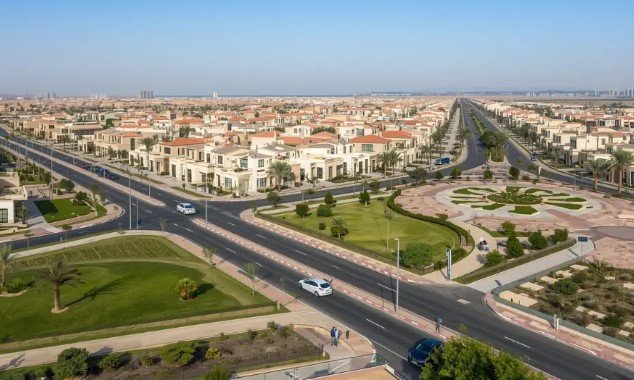
Al Warqa sits adjacent to Mirdif and shares much of its character — residential, family-oriented, lower-density than central Dubai. Where it differs is price. Average rents here start from AED 53,000 annually for apartments, with average prices around AED 83,000, making it one of the most affordable residential areas in the eastern Dubai corridor.
The Blue Line gives Al Warqa something it hasn’t previously had: a reason for younger professional renters to consider it seriously. Connected Dubai communities command rent premiums over disconnected ones, and Al Warqa has been squarely in the disconnected category until now. The projected 10–25% value rise applies here, and from a lower base — which means the percentage improvement translates to meaningful absolute gains for investors who entered at today’s prices.
Al Warqa is the kind of area that property investors often overlook precisely because it doesn’t generate headlines. It’s stable, affordable, near the airport, and about to become significantly more connected. Those three qualities together are more unusual than they sound.
| Investment Snapshot — Al Warqa Station type: Elevated Avg annual rent (apartments, 2026): AED 53,000–84,000 Price per sqft avg: AED 86 Projected uplift: 10–25% above current values post-2029 Best for: Budget investors, long-hold strategy, affordable entry point |
8. Ras Al Khor — Industrial Area Turning Residential
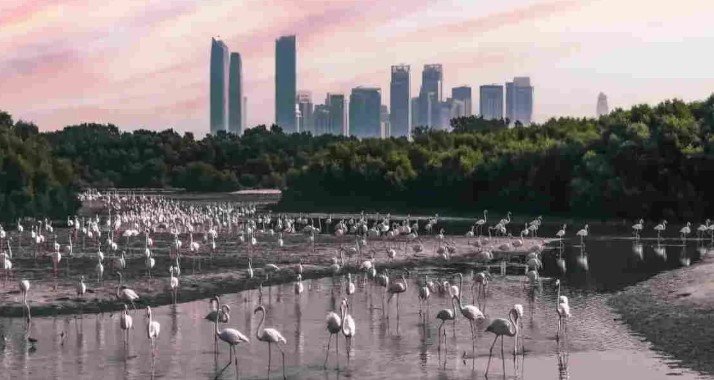
Ras Al Khor is the most transitional area on the Blue Line route. It’s currently known primarily as an industrial zone — warehousing, light manufacturing, logistics — and as the location of the famous flamingo wildlife sanctuary. Neither of those has historically translated into residential investment appeal.
The Blue Line station here, alongside Emaar’s confirmed investment in the area and the broader push from the Dubai 2040 Urban Master Plan to convert industrial corridors into mixed-use communities, begins to tell a different story. Properties near the station are currently listing in the AED 1 million to AED 1.5 million range for one-bed units, with rents between AED 60,000 and AED 80,000 annually.
The real play at Ras Al Khor isn’t the existing residential market — it’s the land that will be converted. The pattern of industrial areas near transport infrastructure transitioning to mixed-use development is well established globally, and Dubai has run the same playbook in several communities already.
| Investment Snapshot — Ras Al Khor Station type: Elevated Nearby 1BR sale price: AED 1M–1.5M Annual rent: AED 60,000–80,000 Character: Industrial to mixed-use transition zone Best for: Longer-horizon investors, land plays, speculative buyers |
9. Dubailand Residence Complex (DLRC) — The Sleeper Pick
DLRC doesn’t get the same column inches as Dubai Creek Harbour or Silicon Oasis, but its case is quietly compelling. Located in the broader Dubailand area, it sits close enough to the Blue Line corridor to benefit from improved connectivity while remaining underpriced relative to communities that have already absorbed the announcement premium. Sands of Wealth’s property forecast specifically named DLRC as “one of the areas that could surprise with higher-than-expected growth” as the Blue Line transforms previously car-dependent communities into accessible ones.
Entry prices here remain among the most accessible in the region — below AED 600,000 for a one-bedroom in many developments — and rental yields are competitive. The community is newer than International City and less established than DSO, which means both the upside and the execution risk are higher. It’s the entry on this list that requires the most research and the most patience.
What makes DLRC worth including is the asymmetry: if the Blue Line performs as the Red and Green Lines did, areas that entered at pre-announcement prices in communities like this generated the highest percentage returns. That window existed in 2023 for International City and DSO. It may still exist in DLRC in 2026.
| Investment Snapshot — DLRC Proximity to Blue Line: Adjacent corridor (indirect beneficiary) 1BR entry price: Below AED 600K in several developments Character: Newer community, lower density, greenfield development Risk level: Higher (less established, longer conversion timeline) Best for: Speculative long-hold, highest-upside/highest-risk profile |
The Timing Question: Is Now Still Early Enough?
The most common question around Blue Line investment is whether the market has already moved too far to make entering now worthwhile. The honest answer is: partly, and it depends where you look.
The property intelligence tracked by LYM Real Estate’s March 2026 analysis — one of the more thorough independent assessments of the Blue Line corridor — describes the current moment as the “early-to-mid transition phase.” That means some communities (notably Silicon Oasis and Academic City) have already absorbed a meaningful portion of the announcement premium, while others (Al Warqa, DLRC, Ras Al Khor) are still in earlier pricing stages. The typical price premium for properties near completed metro infrastructure in Dubai has historically been 15–25% above comparable units in less connected areas — a range that, in most of these communities, is not yet fully reflected in current pricing.
The Red Line analogy is instructive. Investors who bought near Dubai Marina and JLT during Red Line construction saw gains that played out over five to seven years, not overnight. Anyone applying that same patience to Blue Line communities in 2026 is working with a comparable timeline — and the construction is 10% complete, which by most measures is still early.
| 15–25% Historical price premium for Dubai properties near completed Metro stations vs. non-connected equivalents — Sands of Wealth, 2026 |
Three Things Every Investor Should Monitor
Construction milestones
RTA provides periodic updates on Blue Line progress. Each significant milestone — viaduct completions, tunnelling progress, station structure completions — tends to coincide with small upward price movements in adjacent communities. Tracking these gives a forward indicator of when the next announcement-driven uptick is likely.
Supply pipeline
Several of these communities, particularly International City and DSO, have significant new supply in the off-plan market. New delivery volumes between now and 2029 will affect how much of the demand increase from metro access actually translates to rental growth versus being absorbed by new units. Check the Dubai Land Department’s quarterly reports for supply forecasts by area before committing.
Feeder network
The Blue Line’s usefulness to daily commuters depends partly on what happens at each end of every journey. RTA’s planned bus feeder routes and the integration with the existing Red and Green Lines will determine how much of the potential daily ridership actually materialises. The September 2029 opening is the target, but transport projects of this scale in Dubai have historically launched close to their stated dates. Following the RTA’s official communications is the most reliable way to track this.
The Bottom Line for Investors
The communities along the Dubai Metro Blue Line are not equal investments, and they’re not all at the same stage of the appreciation cycle. Dubai Creek Harbour is a premium play that requires significant capital and rewards patience over income. International City and Academic City are yield markets with infrastructure tailwinds. Silicon Oasis sits somewhere in between — transformed by the announcement, with more transformation still to come. Mirdif, Al Warqa, and DLRC offer accessible entry points with meaningful upside for investors with longer time horizons.
What’s consistent across all nine is the underlying logic: metro connectivity changes how a community functions in daily life, and markets price that change in. Dubai has done this twice before. The investors who understood that during Red Line and Green Line construction made returns that would have seemed implausible at the time.
Construction is at 10%. The line opens in 2029. On any historical reading of how this city’s property market responds to transit infrastructure, the window is still open — though it is narrowing, one completed viaduct at a time.
Quick Reference: All 9 Communities at a Glance
| Community | Entry Price (1BR) | Annual Rent | Yield Profile | Best For |
| Dubai Creek Harbour | AED 1.5M–2M | AED 100K+ | Low yield / High capital upside | Premium long-term hold |
| Dubai Silicon Oasis | AED 700K–1.2M | AED 50–70K | 6–8% gross | Yield + appreciation |
| Academic City | AED 400–650K | AED 60K (studio) | 7–9% gross | Yield / student demand |
| International City | AED 300–450K | AED 30–45K | 8–10% gross | High yield / low entry |
| Dubai Festival City | AED 1.2M–1.8M | AED 80–100K | 5–7% gross | Established / stable |
| Mirdif | AED 700K–1M | AED 45–65K | 6–8% gross | Family tenants / mid market |
| Al Warqa | AED 500–800K | AED 53–84K | 7–9% gross | Affordable entry / upside |
| Ras Al Khor | AED 1M–1.5M | AED 60–80K | 5–7% gross | Transitional / speculative |
| DLRC | Below AED 600K | Competitive | High risk / high upside | Long-hold / speculative |
This article is intended for informational and educational purposes only and should not be considered financial, legal, or investment advice. Readers are advised to consult a licensed, DLD-registered real estate professional or financial advisor before making any property investment decisions. All prices, figures, projections, and market data mentioned are subject to change without prior notice and may vary based on market conditions and developer updates.