
There is no question in UAE business setup that gets more emails than this one. Freezone or mainland — which is cheaper, which is better, which one should you pick? The honest answer, is that neither is universally better. They’re structurally different tools, and the one that costs you less over three years depends almost entirely on what your business actually does and who your customers are.
That said, the comparison has changed meaningfully in the past few years in ways that most older guides don’t reflect. The UAE’s 2021 reform to Federal Commercial Companies Law (Federal Decree-Law No. 32 of 2021) eliminated the longstanding requirement that a UAE national hold 51% of any mainland company — removing one of the main reasons founders defaulted to freezones. Then came corporate tax in June 2023, which changed the tax calculus for freezone entities. And the freezone ecosystem itself has expanded to over 30 designated zones in Dubai alone, with pricing and positioning that varies dramatically.
Disclaimer: All figures are approximate and reflect publicly available pricing . Costs vary between service providers, business activities, and zones. This article is for general information only and does not constitute legal, tax, or regulatory advice. Consult a licensed UAE business adviser before making structural decisions.
Freezone vs Mainland UAE
First: What’s Different Compared to Previous Years
Anyone who set up a UAE company before 2021 learned the landscape under a fundamentally different rulebook. Three changes have reshaped the freezone vs mainland decision more than any other:
1. Mainland 100% foreign ownership is now standard
For decades, the freezone’s defining advantage was that you could own your company entirely — no local partner required. Mainland setups forced foreign investors into a 51/49 split, ceding majority control to a UAE national who was often a passive ‘sponsor’ rather than an operating partner. That structure added cost, complexity, and risk.
Federal Decree-Law No. 32 of 2021 changed that. The vast majority of commercial, industrial, and professional activities on the mainland now permit 100% foreign ownership. The old 51/49 rule is gone for most sectors. Strategic industries — petroleum exploration, defence, certain telecom activities — retain ownership restrictions, but for the typical SME, trader, or service business, the mainland is now as accessible as any freezone from an ownership standpoint.
The implication: ownership is no longer a reason to automatically choose a freezone. That decision now rests almost entirely on market access, tax position, and cost structure.
2. Corporate tax changed the freezone maths
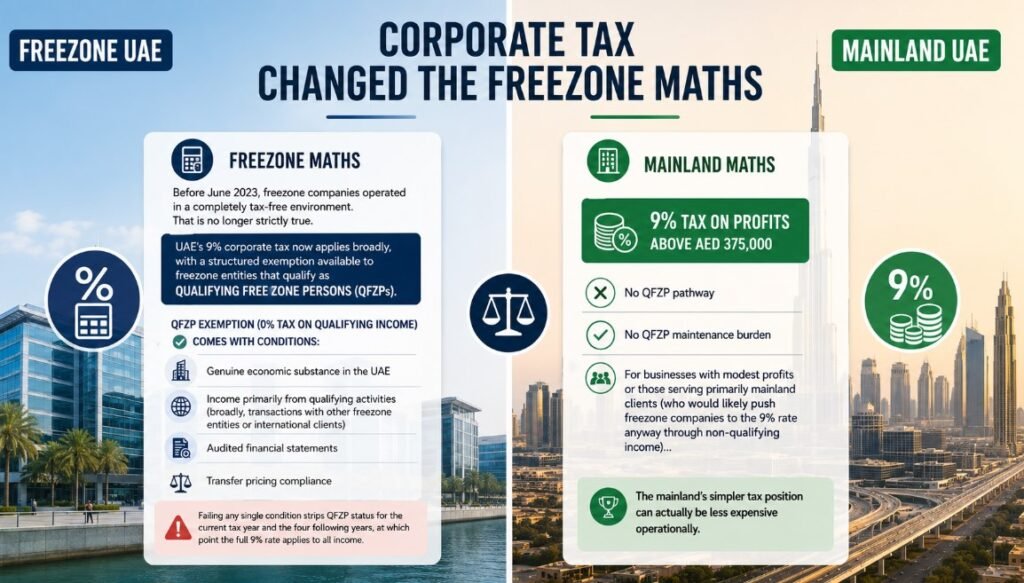
Before June 2023, freezone companies operated in a completely tax-free environment. That is no longer strictly true. The UAE’s 9% corporate tax now applies broadly, with a structured exemption available to freezone entities that qualify as Qualifying Free Zone Persons (QFZPs).
The QFZP exemption — which allows 0% tax on qualifying income — is real and substantial, but it comes with conditions: genuine economic substance in the UAE, income primarily from qualifying activities (broadly, transactions with other freezone entities or international clients), audited financial statements, and transfer pricing compliance. Failing any single condition strips QFZP status for the current tax year and the four following years, at which point the full 9% rate applies to all income.
Mainland companies pay 9% on profits above AED 375,000. There’s no QFZP pathway, but there’s also no QFZP maintenance burden. For a business with modest profits or one that primarily serves mainland clients (who would likely push freezone companies to the 9% rate anyway through non-qualifying income), the mainland’s simpler tax position can actually be less expensive operationally.
3. The freezone ecosystem is vastly more varied
‘Freezone’ is not a single category any more. Dubai alone has over 30 designated freezone jurisdictions with drastically different pricing, credibility, banking relationships, and activity catalogues. The gap between setting up at IFZA (starting around AED 12,200) and DIFC (AED 50,000 and above) is so large that comparing ‘freezone cost’ as a single number is essentially meaningless. The mainland has its own variation, but it’s more consistent — you’re always working with the same DET framework.
Read Also : How to Set Up a Business in Dubai Freezone
Head-to-Head: Freezone vs Mainland UAE — Key Differences
Before the cost numbers, it helps to understand what each structure actually allows. This table captures the primary decision factors as they stand:
| Factor | Freezone | Mainland |
| Foreign Ownership | 100% (all zones) | 100% (most sectors, since 2021) |
| Trade in UAE mainland | ❌ Not directly — distributor or separate entity needed | ✅ Unrestricted across all seven emirates |
| Corporate Tax (on qualifying income) | 0% (if QFZP criteria met) | 9% on profits above AED 375,000 |
| Licence Cost (entry-level) | AED 5,750 – 20,000/yr | AED 12,000 – 25,000+/yr |
| Office Requirement | Flexi-desk accepted in most zones | Physical office with Ejari registration required |
| Visa Quota | Linked to office package (typically 1–6 to start) | Linked to office size (scalable, no fixed ceiling) |
| Government Tenders | ❌ Generally not eligible | ✅ Eligible |
| Setup Timeline | 3–10 business days (most zones) | 2–4 weeks; 6–8 weeks for regulated activities |
| Share Capital Requirement | None (most zones); AED 50,000 (DMCC) | None for most; AED 150,000–300,000 for some LLC setups |
| Audit Requirement | Annual audited accounts (mandatory for most) | Required if revenue exceeds AED 50 million (or public company) |
| Local Service Agent | Not required | Required for some professional licences (no equity, ~AED 10,000–25,000/yr) |
| Banking Ease | Varies by zone — DMCC easiest, IFZA/Meydan more conservative | Generally straightforward; some scrutiny for cash-heavy activities |
| Import/Export Duties | Customs exemptions within designated zone | Standard UAE import duties apply |
The most important row in that table: Market access. If you need to sell directly to UAE consumers, retail clients, or local businesses without an intermediary, a freezone licence cannot do that legally. This single factor rules out the freezone option for an entire category of business.
Freezone Setup Costs: What You’ll Actually Pay
The figures below are based on publicly available freezone authority fee schedules and estimated market rates at the time of writing. They are intended as a general guide to help founders anticipate potential year-one expenses—including structural costs that may not always be prominently detailed upfront—but actual prices vary by consultant and specific business activities. All figures should be verified directly with the respective authorities or a certified expert before making any financial commitments.
| Cost Item | Amount (AED) | Notes |
| Trade licence (IFZA / Meydan) | AED 12,200–13,000 | Annual, includes flexi-desk in most base packages |
| Trade licence (DMCC) | AED 25,000–35,000+ | Annual; requires AED 50,000 share capital |
| Trade licence (DIFC) | AED 50,000+ | Annual; financial services, regulated entity |
| Flexi-desk (if not bundled) | AED 0–3,000 | Often included; check your package |
| Investor visa × 1 | AED 3,500–5,000 | Medical test, Emirates ID, visa stamp |
| Registration & admin fees | AED 1,000–2,500 | Includes knowledge/innovation fees |
| Corporate bank account | Varies | EMI: free to AED 500. Tier-1 bank: min. balance AED 10,000–50,000 |
| First-year total (lean setup) | AED 18,000–25,000 | Service/consulting, 1 visa, IFZA or Meydan |
| First-year total (DMCC setup) | AED 40,000–60,000+ | Trading/premium credibility, 1–2 visas |
The Hidden Costs Freezone Websites Don’t Advertise
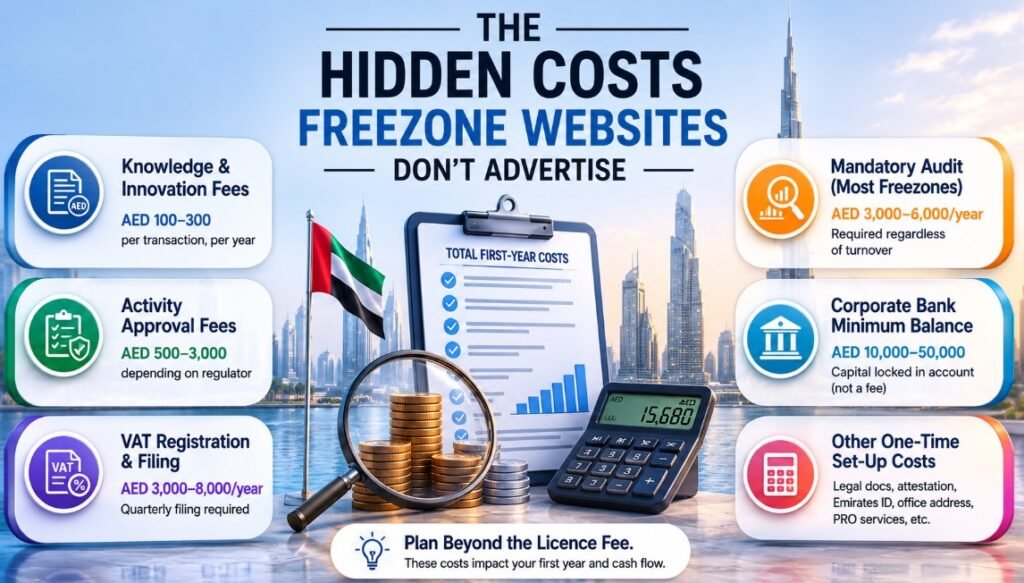
The headline licence fee is rarely the full story. Several recurring or one-time costs add meaningfully to first-year spend:
- Knowledge and innovation fees: Added on top of most freezone licence fees by Dubai government — typically AED 100–300 per transaction, per year. Small individually, they add up across all interactions.
- Activity approval fees: Regulated sectors (health, food, education, financial services) require external authority approval before licence issuance. Budget AED 500–3,000 depending on the regulator.
- VAT registration: Mandatory once your taxable turnover exceeds AED 375,000. VAT filing is quarterly and requires either in-house accounting or an outsourced accountant — typically AED 3,000–8,000/year.
- Mandatory audit (most freezones): Unlike mainland companies (where the audit threshold is AED 50 million revenue), most freezone authorities require annual audited accounts regardless of turnover. A basic audit from a UAE-registered firm starts around AED 3,000–6,000.
- Corporate bank account minimum balance: Tier-one UAE banks typically require AED 10,000–50,000 minimum average balance for freezone companies. This is capital locked in the account, not a fee — but it affects your operating cash flow.
Audit reality check: If you’re setting up in a freezone and expecting to avoid accounting costs, plan for at least AED 3,000–6,000/year for a basic audit even if your business is small. This is a recurring annual cost that’s separate from your licence renewal.
Mainland Setup Costs: What You’ll Actually Pay
Mainland costs have more moving parts than freezone costs, primarily because the office requirement is real — not a virtual address or flexi-desk — and because the market fee (charged as a percentage of your office rent) creates a cost that scales with your premises.
| Cost Item | Amount (AED) | Notes |
| DED trade licence — professional | AED 10,000–15,000 | Service/consultancy, single activity |
| DED trade licence — trading (LLC) | AED 15,000–22,000 | Commercial activity; additional activity fees may apply |
| DED trade licence — general trading | AED 18,000–25,000+ | Multiple product categories; higher activity fee |
| Market fee | 5% of annual rent | Charged on top of Ejari — often overlooked |
| Ejari registration | AED 177–220 | Mandatory tenancy registration with DLD |
| MOA notarisation (LLC) | AED 1,500–5,000 | Multi-shareholder setups; one-time cost |
| Office rent (desk/shared) | AED 15,000–30,000/yr | Business centres; meets Ejari requirement |
| Office rent (private — Business Bay) | AED 60,000–120,000+/yr | Dedicated private office, prime location |
| Local Service Agent (if required) | AED 10,000–25,000/yr | Some professional licences; no equity stake |
| Investor visa × 1 | AED 4,000–7,000 | Medical, Emirates ID, visa stamping |
| Establishment card (immigration file) | AED 1,000–2,000 | One-time; needed before employee visas |
| First-year total (standard setup) | AED 25,000–45,000 | Physical office, 1 visa, professional licence |
| First-year total (general trading LLC) | AED 38,000–55,000 | Includes Chamber of Commerce, Ejari, office |
The Hidden Costs Mainland Guides Gloss Over
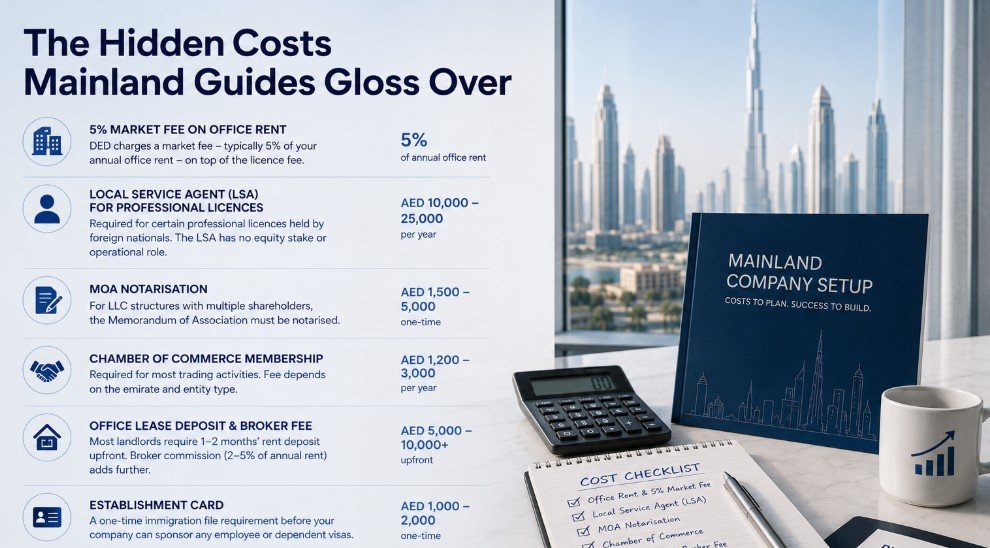
- The 5% market fee on office rent: This is one of the most consistently overlooked mainland costs. DED charges a market fee — typically 5% of your annual office rent — on top of the licence fee. If your Business Bay office costs AED 100,000/year, add AED 5,000 to your annual government bill.
- Local Service Agent (LSA) for professional licences: Not all mainland setups require this — but professional licences held by foreign nationals in certain activities still need a UAE national LSA for administrative purposes. The LSA has no equity stake or operational role, but their annual fee typically runs AED 10,000–25,000, making it a material recurring cost.
- MOA notarisation: For LLC structures with multiple shareholders, the Memorandum of Association must be notarised. Budget AED 1,500–5,000 depending on complexity — a one-time cost that’s easy to overlook.
- Chamber of Commerce membership: Required for most trading activities. Annual fee ranges from AED 1,200–3,000 depending on the emirate and entity type.
- Office lease deposit: Most commercial landlords in the UAE require a one-to-two month rent deposit upfront. On a AED 60,000/year office, that’s AED 5,000–10,000 tied up before you open. Broker commission (2–5% of annual rent) adds further.
- Establishment card: A one-time AED 1,000–2,000 immigration file requirement before your company can sponsor any employee or dependent visas.
DED Instant Licence note: Dubai’s DED Instant Licence scheme allows you to register a mainland company without a physical office for the first 12 months. After that, you must provide a valid Ejari-registered tenancy. It’s a useful option to defer office costs while testing the market — but it’s not a permanent solution.
Annual Renewal Costs: Year Two and Beyond
First-year setup includes one-time charges — MOA notarisation, establishment cards, initial visa processing — that don’t recur. But renewal costs are still substantial, and many founders budget for year one without fully costing year two.
| Entity Type | Annual Renewal Cost | Notes |
| Freezone licence (IFZA/Meydan) | AED 11,000–13,000 | Similar to first year; minus one-time setup fees |
| Freezone licence (DMCC) | AED 20,000–30,000+ | Includes annual fee, visa renewal, office |
| Mainland licence (professional) | AED 8,000–15,000 | Includes market fee, knowledge fees, Ejari renewal |
| Mainland licence (general trading) | AED 12,500–20,000+ | Licence + DED activity fee + Chamber of Commerce |
| Visa renewal (per person) | AED 2,500–4,000 | Medical, Emirates ID, visa stamp (biennial cycle) |
Annual renewal fees for mainland LLC businesses typically range from AED 8,000 to AED 15,000 — and that’s before the market fee on your office rent and the Ejari renewal. Freezone renewals are often slightly lower in absolute terms, but the difference narrows once you account for the mandatory audit cost that most freezone companies carry.
Renewal deadline: Missing the annual licence renewal triggers government fines. UAE mainland late renewal fines range from AED 1,000–3,000. Most freezone authorities have similar penalty structures. Set a calendar reminder well in advance — ideally 60 days before expiry.
Corporate Tax : The Real Comparison
Tax is where the freezone vs mainland comparison gets most complicated — and where the most misleading content still circulates. Let’s be direct about what the current framework actually means for a typical business.
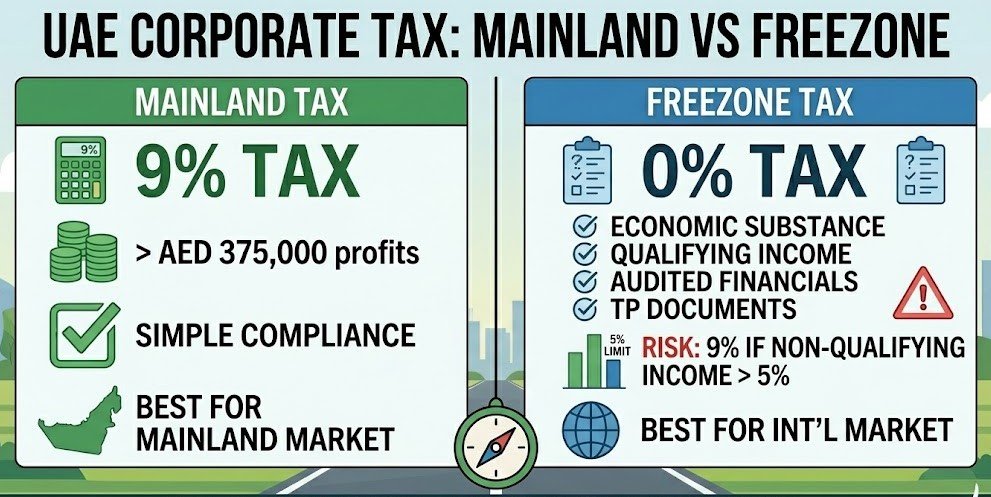
Mainland: Straightforward 9% above AED 375,000
Mainland companies pay 9% corporate tax on taxable profits above AED 375,000 (approximately USD 102,000). Below that threshold, profits are tax-free. There’s a Small Business Relief provision that allows companies with revenue at or below AED 3 million to elect for full tax relief — but only through December 2026, and only if the company is not part of a multinational group subject to BEPS Pillar Two rules.
The mainland’s tax position is simple. There’s no QFZP maintenance regime, no qualifying income test, no de minimis calculation. You know what you owe, you file annually, and you move on. For a business that primarily serves the UAE market — where most of its income would be non-qualifying under the freezone framework anyway — the mainland’s 9% rate is often lower in effective cost than the compliance overhead of maintaining freezone QFZP status.
Freezone: 0% possible, but conditional
Freezone companies can access a 0% tax rate on qualifying income — but only if they meet all the QFZP conditions simultaneously. To qualify, the business must maintain genuine economic substance in the UAE, earn primarily qualifying income (transactions with other freezone entities or international clients), pass the de minimis test (non-qualifying income cannot exceed 5% of total revenue or AED 5 million, whichever is lower), hold audited financial statements, and comply with transfer pricing documentation requirements.
The ‘qualifying income’ definition is the critical clause for most businesses. If your freezone company sells services to UAE mainland clients, that income is likely non-qualifying. Push it above the de minimis threshold and you lose QFZP status — and pay 9% on everything. For a UAE-market-focused business operating from a freezone, the effective tax rate can end up the same as (or higher than) the mainland, with the additional burden of QFZP compliance overhead.
The 0% rate is genuinely valuable for businesses serving international markets, holding companies, and e-commerce operations where mainland UAE clients make up a small share of revenue. For everyone else, run the numbers carefully before assuming freezone = lower tax.
🔑 Key takeaway: Freezone tax advantages are real — but they’re conditional. A business that earns more than 5% of its revenue from mainland UAE clients risks losing QFZP status entirely. Model your actual client base before assuming you’ll benefit from the 0% rate.
Which Should You Choose? The Honest Decision Framework
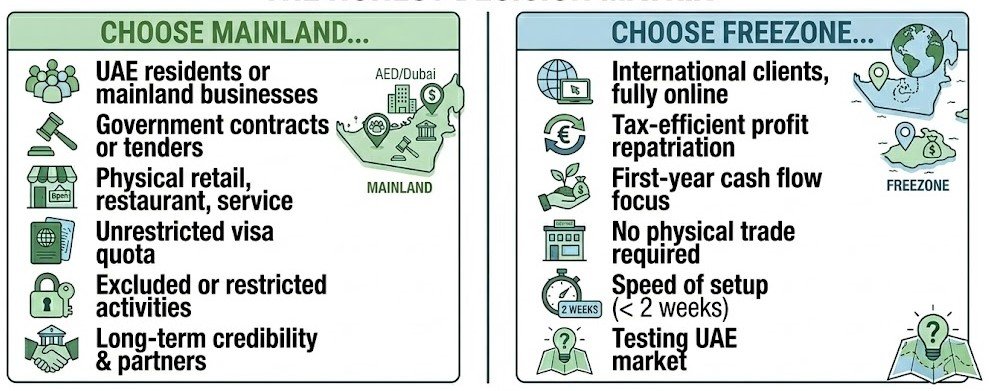
The right answer depends on three things: who your customers are, what activities you need to conduct, and what your three-year cost and growth trajectory looks like. Here’s the decision matrix stripped of the promotional framing:
| Choose FREEZONE if… | Choose MAINLAND if… |
| • You serve international clients or work fully online | • Your customers are primarily UAE residents or businesses on the mainland |
| • Your primary goal is tax-efficient profit repatriation | • You want to bid for government contracts or tenders |
| • You’re a startup or solo founder watching first-year cash flow | • You’re opening a physical retail outlet, restaurant, or service location |
| • You don’t need to physically trade across UAE streets, malls, or local B2B | • You need an unrestricted visa quota as you scale your team |
| • Speed of setup matters — you need to be operational in under two weeks | • Your activity is excluded or restricted in most freezone activity lists |
| • You’re testing the UAE market before committing to a larger structure | • You plan long-term UAE-market operations where credibility with local banks and partners matters |
Real Scenarios: How the Numbers Actually Play Out
Scenario A: Digital consultancy serving international clients
A solo founder running a marketing consultancy serving clients in Europe and the US, operating from Dubai. Revenue: AED 600,000/year. No UAE mainland clients. This is the cleanest freezone case. An IFZA or Meydan licence at AED 12,200–13,000, a flexi-desk, one investor visa at AED 4,000, and QFZP-qualifying income means 0% corporate tax. First-year total: around AED 20,000. Year-two renewal: AED 15,000–17,000 including audit. The freezone wins clearly.
Scenario B: Trading company selling to UAE retailers
A general trading business importing goods and selling directly to UAE retail chains. Revenue: AED 2,000,000/year, all from mainland UAE clients. A freezone licence is technically possible, but selling directly to mainland retailers requires either a distributor (losing margin and control) or a separate mainland entity (double the cost). The freezone income is non-qualifying for QFZP, so 9% tax applies. A mainland LLC with a general trading licence — AED 38,000–55,000 first year — is the operationally correct and overall cheaper option once you factor in what the freezone workaround actually costs.
Scenario C: Tech startup planning UAE and international revenue
A startup with mixed revenue — 40% UAE mainland clients, 60% international. Revenue growing toward AED 1,500,000. The 40% UAE mainland revenue almost certainly pushes it above the QFZP de minimis threshold, meaning QFZP status is at risk. A freezone setup could start lean and cheap, but the tax planning complexity — and the cost of getting it wrong — grows quickly. Many founders in this position eventually set up a dual structure: freezone for international operations, mainland entity for UAE-market activities. That adds cost but solves the problem cleanly.
The dual structure is a real and legal approach. It’s not ideal for year one on a tight budget, but for businesses with genuinely mixed revenue streams, it removes the compliance risk of trying to force a single entity to serve both markets.
Banking: The Practical Difference No One Talks About Enough
Corporate banking is where the freezone vs mainland decision plays out in day-to-day business life — and it’s consistently the friction point that founders wish they’d thought about more carefully upfront.
Mainland companies generally have a more straightforward banking experience with UAE tier-one banks. The DED licence is a familiar, well-understood document. Banks know what activities are permitted, the credit narrative is cleaner, and the account opening process, while never trivial in the UAE, tends to move faster.
Freezone companies face more variable reception. A DMCC company is received very differently by a UAE bank than an IFZA or Meydan entity — even if the underlying business is identical. Banks form their own judgements about freezone credibility, and those judgements correlate closely with the zone’s established reputation. If banking is critical to your business from day one, the freezone you choose matters as much as the fact that you chose a freezone.
- DMCC: Strongest banking relationships among standard freezones. Tier-one banks typically onboard with fewer complications.
- IFZA / Meydan: Broadly accepted, but banks can be more conservative. Preparation and clear business documentation matters more.
- DIFC: Universally strong banking acceptance. The regulatory credibility carries weight.
- Mainland DET: Generally smooth across most UAE banks for standard commercial and professional activities.
Electronic Money Institutions (EMIs) like Wise Business, Airwallex, and Wio Bank are available to both freezone and mainland companies, offer faster onboarding, and handle multi-currency needs well. They’re a practical interim or complementary option while primary bank account processing is underway.
The Most Expensive Mistakes People Make in This Decision
Choosing the structure based on year-one licence cost alone
The freezone licence is often cheaper in year one. But if your business model requires mainland market access and you realise that six months in, you’re not just paying for a second setup — you’re paying for restructuring costs, lost time, and potentially a period of operating in a grey zone. The year-one cost is the least important variable in this decision.
Assuming freezone means zero tax
It does not. The 0% rate applies to qualifying income for qualifying entities under conditions that require active maintenance. Model your client base honestly. If more than 5% of revenue comes from mainland UAE clients, your QFZP status is at risk.
Underestimating the mainland office cost
‘I’ll just get a cheap co-working space’ is a common assumption. But the 5% market fee on office rent is charged on whatever you register with Ejari — and some business activities require more substantial premises, which banks, clients, and regulators will check. A AED 15,000/year business centre desk is often the genuine minimum, not a guaranteed option for every activity type.
Not planning the banking conversation before setup
Banking takes longer than setup. A corporate bank account can take two to four weeks to open after your licence is issued — sometimes significantly longer for complex structures or activities. Founders who set up in a budget freezone to save on licence fees and then struggle with banking for three months often wish they’d paid more for a zone with stronger bank relationships.
The Bottom Line
Freezone is cheaper and faster to set up. Mainland is operationally broader and strategically stronger for businesses that need real UAE market access. Neither is universally the right answer — and both have become more nuanced since the ownership reforms and corporate tax introduction changed the landscape.
The question to ask is not ‘which is cheaper?’ but ‘which structure fits my actual business model for the next three years?’ A freezone company that can’t serve its target market without a workaround is not cheaper than a mainland company that can. A mainland company paying 9% tax on income that would have qualified for the freezone 0% rate is not better structured.
Map your revenue sources, check your activity requirements, model the tax position honestly, and think about the banking conversation before you sign anything. Those four steps make the freezone vs mainland decision straightforward in most cases — and they protect you from the restructuring cost that catches founders who chose quickly and regretted it slowly.
Sources & Legal References
- UAE Government u.ae/en/information-and-services/business/doing-business-on-the-mainland
- UAE Federal Tax Authority — Corporate Tax Law: tax.gov.ae
- Dubai DET (Department of Economy and Tourism): det.gov.ae
- DMCC: dmcc.ae
- IFZA: ifza.com
- DIFC: difc.ae