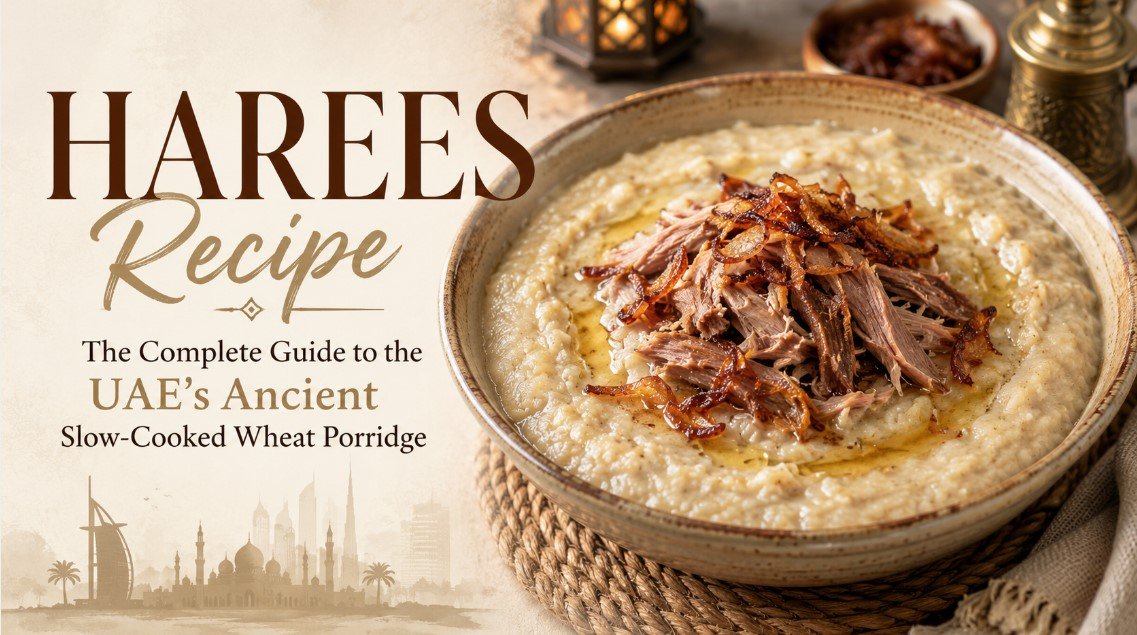
Harees Recipe: The Complete Guide to the UAE’s Traditional Slow-Cooked Wheat and Meat Porridge
| ⏱ Prep Time 15 min + soak | 🔥 Cook Time 3–4 hours | 🍽 Serves 6–8 | 📊 Difficulty Patient |
Of all the dishes that define Emirati identity, harees may be the most honest. No elaborate spice blend. No presentation fuss. Just wheat, meat, water, salt, and time — enormous amounts of time. The result is a porridge of unassuming appearance but profound depth, with a silky, almost elastic texture that comes entirely from hours of patient stirring and slow heat. It is the food Emirati grandmothers made in clay pots buried in desert embers, and it is still the centrepiece of every serious Ramadan iftar table in Dubai.
The name is believed to derive from the Arabic root meaning ‘to scratch’ or ‘to scrape’ — a reference to the vigorous beating that transforms cooked wheat and meat into a unified, smooth mass. This beating step, done with a wooden paddle or an immersion blender, is what separates a properly made harees from a simple wheat stew. The goal is a consistency somewhere between very thick porridge and a light dough — smooth, cohesive, and deeply savoury.
| Cultural Significance Harees appears in the UAE at its most meaningful moments: Ramadan iftars, Eid morning tables, weddings, and communal gatherings. In traditional Emirati neighbourhoods, enormous pots of harees are still made communally and distributed to neighbours — an act of generosity that connects the dish to the Bedouin values of sharing and hospitality it has always embodied. |
History: A Dish from the Abbasid Era
Harees is ancient. Versions of this slow-cooked wheat and meat dish appear in Arabic culinary manuscripts dating to the 10th-century Abbasid period, making it one of the oldest continuously prepared dishes in the Arab world. In medieval Baghdad it was called harisa and was considered a dish of substance and sustenance — food that built strength for labourers, warriors, and pilgrims. The dish spread through Persian and Arab trade routes and took root in every Gulf nation, each developing its own slight variation.
The Emirati version is distinguished by its minimalism. Where some Gulf versions add warm spices — cinnamon, cardamom, cloves — the UAE approach is restrained: wheat, meat, salt, and a generous finish of ghee. This simplicity is not poverty of imagination; it is a deliberate statement that the wheat and meat should speak without interference. The dish is also traditionally prepared in a dafna — a clay cooking vessel buried in hot coals — a technique that still occasionally appears at Emirati cultural events in Dubai.
| 🍮 Harees vs. Harisa Though the names are similar, Emirati harees and the Levantine harissa (a spiced meat paste) are distinct dishes with separate lineages. Harees is always wheat-and-meat based. Lebanese or Syrian harissa uses the same concept but with different spice profiles. In the UAE, harees always means the Gulf wheat porridge. |
Related : Authentic Karak Chai Recipe: Dubai’s Beloved Tea Tradition (5 STEPS)
Harees Recipe : Ingredients
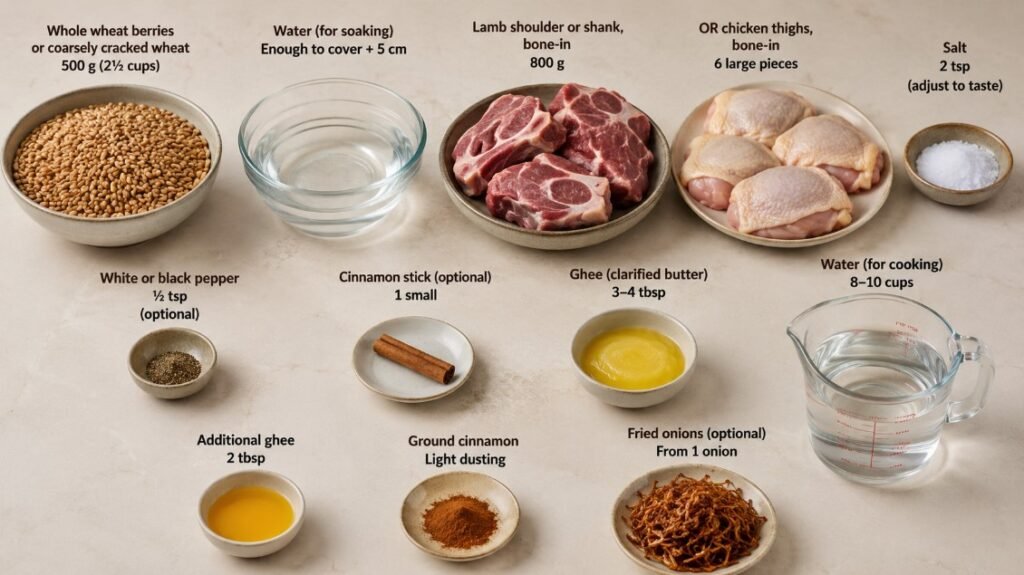
The ingredient list is genuinely short. Quality matters more than complexity — the wheat should be whole or coarsely cracked (not fine semolina), the meat should be on the bone, and the ghee used for finishing should be real, not substituted with butter.
| Ingredient | Quantity | Notes |
| THE WHEAT | ||
| Whole wheat berries or coarsely cracked wheat | 500 g (2½ cups) | Soak overnight; whole berries give the best texture |
| Water (for soaking) | Enough to cover + 5 cm | Change water once during soak for cleaner flavour |
| THE MEAT | ||
| Lamb shoulder or shank, bone-in | 800 g | Bone-in gives collagen to the stock; essential for richness |
| OR chicken thighs, bone-in | 6 large pieces | Faster-cooking alternative; still use bone-in |
| THE SEASONING & FINISH | ||
| Salt | 2 tsp (adjust to taste) | Added early; the only seasoning in the authentic version |
| White or black pepper | ½ tsp | Optional; some Emirati families omit entirely |
| Cinnamon stick (optional) | 1 small | Some families add for subtle warmth; remove before blending |
| Ghee (clarified butter) | 3–4 tbsp | The essential finishing element; drizzled generously at serving |
| Water (for cooking) | 8–10 cups | Added gradually as the wheat absorbs liquid during cooking |
| GARNISH | ||
| Additional ghee | 2 tbsp | Pooled in the centre of each serving bowl |
| Ground cinnamon | Light dusting | Sprinkled at table; traditional garnish |
| Fried onions (optional) | From 1 onion | Sliced thin and fried until deep gold; scattered over top |
Method: The Four-Hour Process
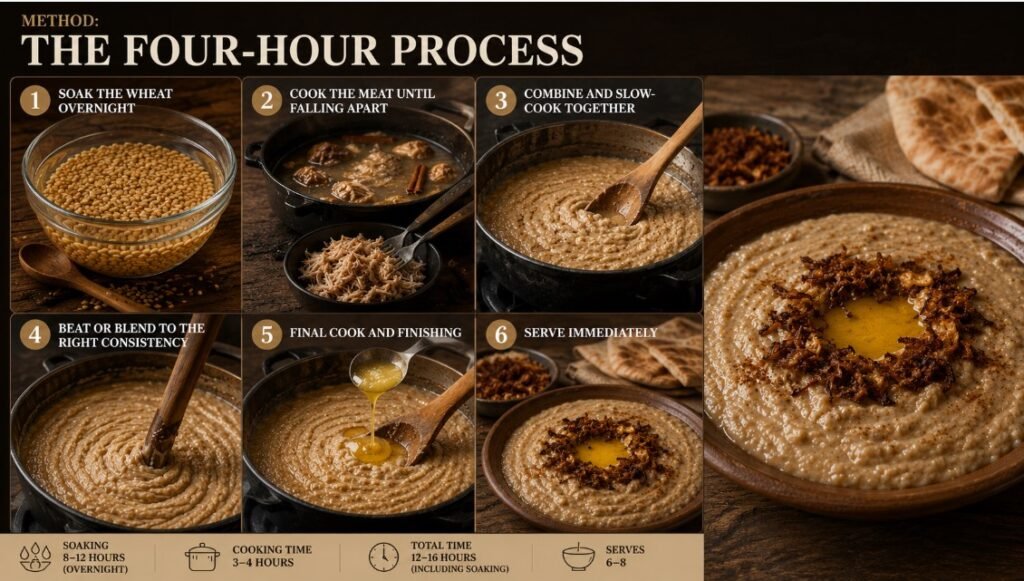
Harees is not a weeknight dish. The process requires 3–4 hours of actual cooking time, plus overnight soaking. Start the day before you plan to serve it. The reward is a dish that cannot be rushed and cannot be faked.
| 1 | Soak the Wheat Overnight Rinse the wheat berries under cold water until the water runs clear. Place in a large bowl and cover with cold water by at least 5 cm. Leave to soak for 8–12 hours or overnight. The wheat will swell to nearly double its original size. This soaking is mandatory — unsoaked wheat takes significantly longer to cook and can develop an unpleasant chalky texture. Drain and rinse again before cooking. |
| 2 | Cook the Meat Until Falling Apart Place the meat in a large heavy-bottomed pot (ideally cast iron or stainless steel). Add enough cold water to cover by 5 cm. Bring to a boil over medium-high heat and skim any grey foam from the surface. Reduce heat to a steady simmer. Add salt and the cinnamon stick if using. Cook until the meat is completely tender and falling from the bone — 45 minutes for chicken, 1.5–2 hours for lamb. Remove the meat, shred finely with two forks discarding bones and excess fat, and reserve the cooking broth. |
| 3 | Combine and Slow-Cook Together Add the drained soaked wheat to the reserved meat broth in the same pot. Bring to a boil, then reduce to the lowest possible heat. Add enough water to ensure the mixture is loose and soupy — it will thicken significantly during cooking. Add the shredded meat back in. Cook uncovered, stirring every 15–20 minutes, for 1.5–2 hours. The wheat grains will gradually break down and merge with the meat. The mixture should slowly thicken from a thin soup to a dense porridge. Prevent sticking by scraping the bottom of the pot with a wooden spoon every time you stir. |
| 4 | Beat or Blend to the Right Consistency Once the wheat has fully broken down and the mixture is thick and homogeneous, remove from heat. Using a traditional harees paddle (a long wooden stick), beat the mixture vigorously for 10–15 minutes — this is the traditional method and produces a slightly elastic, satisfying texture. Alternatively, use an immersion blender in short pulses — blend until smooth but still with some texture, not completely pureed. The correct consistency is thick enough to hold its shape when spooned, but loose enough to drizzle ghee over. If too thick, add warm water a ladleful at a time. |
| 5 | Final Cook and Finishing Return the pot to very low heat. Stir continuously for a further 15–20 minutes — this final cooking melds the wheat and meat into a fully unified texture and eliminates any raw starchy taste. The harees is ready when it comes away cleanly from the sides of the pot as you stir. Add the ghee and stir it in completely. Taste and adjust salt. |
| 6 | Serve Immediately Spoon into wide, shallow bowls. Create a well in the centre and pour in an additional tablespoon of ghee — it should pool visibly. Dust with a light pinch of cinnamon if desired. Scatter fried onions over the top if using. Serve immediately with Arabic bread on the side. Harees does not hold well — it continues to thicken and becomes difficult to reheat properly. Make it and serve it within 30 minutes. |
Technique: Why Harees Fails and How to Prevent It
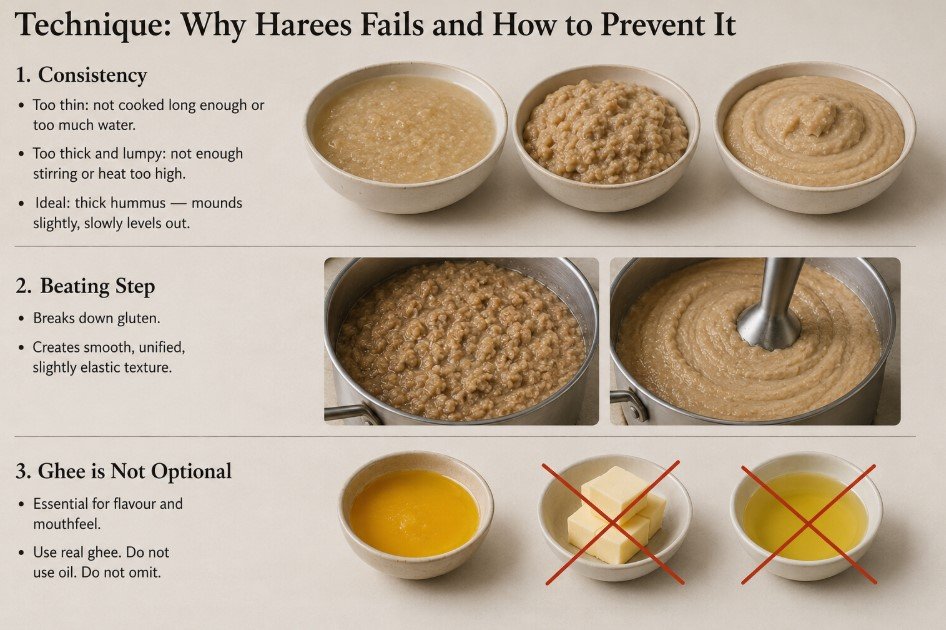
The Consistency Problem
The most common failure in home harees is achieving the wrong final consistency. Too thin: the wheat was not cooked long enough or too much water was added at once. Too thick and lumpy: not enough stirring, or the heat was too high causing the bottom to catch. The ideal harees has the consistency of very thick hummus — it mounds slightly on a spoon but slowly levels out. Add warm water gradually if too thick; continue cooking and stirring if too thin.
The Beating Step Cannot Be Skipped
Some recipes suggest simply stirring and cooking the harees until the wheat breaks down naturally. This produces an acceptable result but not an authentic one. The beating step — whether by traditional paddle or immersion blender — breaks down the gluten structure in the wheat and creates the characteristic slightly elastic, unified texture. Without it, the wheat and meat remain distinguishable rather than melded into one cohesive dish.
Ghee is Not Optional
The ghee does not just add richness at serving — it is structurally important to the dish’s flavour. The fat from the ghee coats the palate and carries the savoury depth of the wheat and meat forward after each bite. Substituting butter works but changes the flavour profile. Do not use oil. Do not omit the ghee in the name of health — a dish with 3–4 hours of cooking time is not designed as diet food.
| 🔥 The Ramadan Timing Secret Professional harees makers in Dubai begin cooking at midnight for 6am suhoor service, or at midday for sunset iftar. The extended cooking time is intentional — harees that has cooked for 4+ hours develops a complexity that 2-hour harees simply does not have. If time allows, always choose the longer cook. |
Harees Recipe : Variations
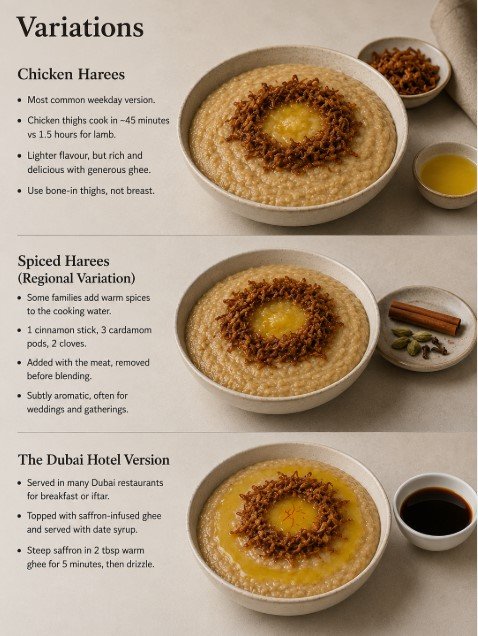
Chicken Harees
The most common weekday version. Chicken thighs cook significantly faster than lamb (45 minutes vs 1.5 hours), making this more practical for home cooks. The flavour is lighter and less unctuous than lamb harees, but properly made chicken harees with generous ghee is genuinely delicious. Use bone-in thighs rather than breast — the darker meat holds up better during the long beating phase.
Spiced Harees (Regional Variation)
Some Emirati families, particularly those with roots in southern Gulf regions, add a blend of warm spices to the cooking water: 1 cinnamon stick, 3 cardamom pods, and 2 whole cloves. These are added at the beginning with the meat and removed before blending. The result is subtly aromatic rather than spiced. This version is often prepared for weddings and large gatherings where a more distinctive flavour is preferred.
The Dubai Hotel Version
Restaurants across Dubai — from Al Fanar in Festival City to Logma in Box Park — serve harees as part of their Emirati breakfast or iftar menus. The hotel version often adds a drizzle of saffron-infused ghee and serves it with a small side of date syrup, creating a sweet-savoury combination that works surprisingly well. If you want to replicate this, steep a pinch of saffron in 2 tablespoons of warm ghee for 5 minutes, then drizzle over the serving bowl.
Serving, Pairing and Storage
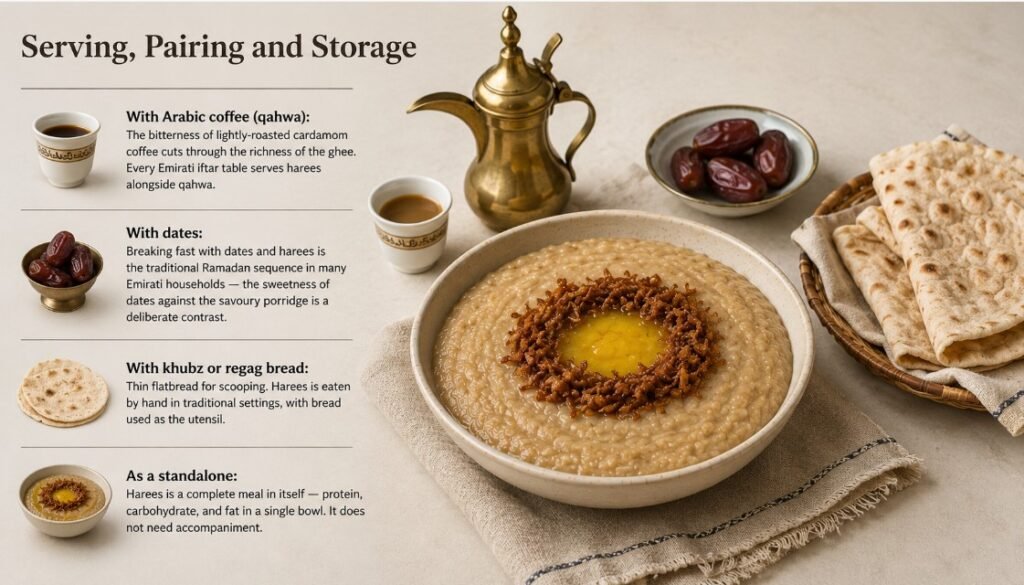
- With Arabic coffee (qahwa): The bitterness of lightly-roasted cardamom coffee cuts through the richness of the ghee. Every Emirati iftar table serves harees alongside qahwa.
- With dates: Breaking fast with dates and harees is the traditional Ramadan sequence in many Emirati households — the sweetness of dates against the savoury porridge is a deliberate contrast.
- With khubz or regag bread: Thin flatbread for scooping. Harees is eaten by hand in traditional settings, with bread used as the utensil.
- As a standalone: Harees is a complete meal in itself — protein, carbohydrate, and fat in a single bowl. It does not need accompaniment.
📱 Storage Note Harees thickens dramatically as it cools and does not reheat easily without significant water addition and vigorous stirring. For best results, make only as much as will be eaten immediately. If storing leftovers, refrigerate for up to 2 days and reheat slowly over very low heat with ¼–½ cup warm water added, stirring constantly.
★ Harees teaches patience in a way few dishes do. The four hours, the constant stirring, the gradual surrender of wheat and meat into something unified and smooth — these are not inconveniences. They are the point. In Dubai’s fastest-moving city, harees asks you to slow down. That is why it has lasted a thousand years, and why no restaurant shortcut has ever fully replaced the version made in a home kitchen by someone who understands what the dish is asking of them.
Related : Chicken Machboos Recipe – The 6 Step Guide to the UAE’s National Dish