Guide to Oman Tourist Visa for UAE Residents: How to apply, what it costs, who qualifies, and what to sort before you reach the border — whether you’re flying or driving.
| Visa fees and eligibility rules are set by the Royal Oman Police and can change without notice. Confirm all details at evisa.rop.gov.om before applying. This guide is informational only and not a substitute for official sources. |
Oman is one of the most popular short trips from the UAE. Muscat is under two hours by air, and by road the drive through the Hajar Mountains is among the better road trips available from Dubai. The visa process is also, for most people, genuinely straightforward — but it works differently depending on whether you’re a UAE national, what your profession is, and how long you plan to stay. Getting those three questions right before you travel saves a lot of time at the border.
This guide covers every visa route currently available: who needs one, who doesn’t, how to apply online, what the fees are, and what to check before a road crossing. Fees and profession eligibility are set by the Royal Oman Police and do change periodically, so treat the figures here as a current reference and verify on the official portal before you book.
Guide to Oman Tourist Visa for UAE Residents
Do You Actually Need a Visa?
It depends on your passport, not just where you live.
UAE nationals — Emirati passport holders — do not need a visa to enter Oman. They can travel on a valid UAE passport and stay for up to 30 days without any prior arrangement, extendable once. Other GCC nationals (Saudi, Kuwaiti, Bahraini, Qatari) also enter visa-free under the GCC mutual access agreement.
Everyone else living in the UAE — regardless of how long they’ve been here — needs an Oman visa. What’s available to you, and at what cost, comes down primarily to two things: your passport nationality and the profession listed on your Emirates ID.
The short version
The Profession Rule: Why This Matters Before You Book
For UAE residents who aren’t GCC nationals, the cheapest and fastest route into Oman — visa on arrival or the unsponsored GCC Resident eVisa — is only available to people whose profession on their Emirates ID falls on Oman’s approved list ( enter the details to see the approved the list). Check the back of your Emirates ID: the occupation printed there is what Oman’s immigration officers and the eVisa system use to verify eligibility.
The approved list runs to over 130 occupations. It’s broad — engineers, doctors, teachers, pharmacists, accountants, IT professionals, managers, HR roles, architects, lawyers and many others are included. The Royal Oman Police publishes and updates the full list on the eVisa portal at evisa.rop.gov.om. If your job title doesn’t appear there, you’re not necessarily blocked from visiting Oman — you just need to apply via a different route, either through a standard sponsored tourist visa, a travel agent or the Oman Embassy.
One practical note: if your profession on your Emirates ID is outdated or no longer reflects your actual role, updating it before travel avoids problems. Officers check the ID, not what you say you do.
The Main Visa Options
1. GCC Resident Tourist Visa (Type 29A) — most common for UAE residents
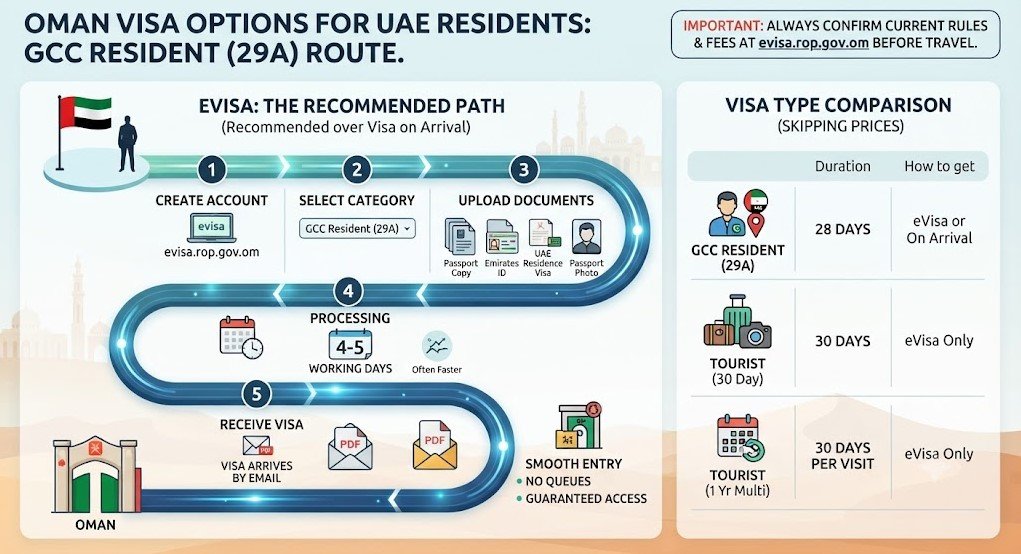
This is the standard route for UAE residents with an approved profession. It can be obtained as a pre-approved eVisa online, or as a visa on arrival at airports and certain land border crossings. Both cost OMR 5 (approximately AED 48) and are valid for 28 days. The eVisa is strongly recommended over visa on arrival, particularly for road trips, since it eliminates queuing at the border and removes any uncertainty about whether on-arrival processing is available at a specific crossing.
To apply online, create an account on evisa.rop.gov.om, select the GCC Resident (29A) visa category, and upload your passport copy, Emirates ID, UAE residence visa and a passport photo. Processing typically takes four to five working days, though many applications come back faster. The visa arrives as a PDF by email.
| Visa type | Stay | Cost | How to get it |
| GCC Resident Visa (29A) | 28 days | OMR 5 (~AED 48) | eVisa online or on arrival |
| Standard tourist eVisa – 30 days | 30 days | OMR 20 (~AED 77) | eVisa online only |
| Standard tourist eVisa – 1 year multi-entry | 30 days per visit | OMR 50 (~AED 193) | eVisa online only |
| Family/companion visa (28B) | 28 days | Free | Linked to main GCC applicant |
| Fees shown are based on Royal Oman Police rates current at time of writing. They can change. Always confirm at evisa.rop.gov.om before paying. |
2. Standard Tourist eVisa — for residents whose profession isn’t on the approved list
If your profession doesn’t qualify for the 29A route, the standard tourist eVisa is the route available. A single-entry 30-day visa costs OMR 20 (approximately AED 77), while a one-year multiple-entry visa costs OMR 50 (approximately AED 193). Applications go through the same ROP portal. Processing time can vary and may take longer than the GCC resident route, so apply at least a week before you travel.
For some nationalities and travel purposes, a sponsored visa arranged through an Omani company, hotel or family member may also be an option. Travel agencies based in the UAE that are familiar with the Oman visa process can handle this on your behalf, though it adds time and cost.
3. Visa on arrival
Available at major entry points including airports and certain land border crossings, visa on arrival applies to eligible professions on the approved list and costs OMR 5 for a 28-day stay. It’s a usable option for spontaneous trips but comes with the obvious disadvantage of having to queue and process at the border itself. At busy crossings like Hatta-Al Wajajah during weekends or public holidays, that queue can stretch to several hours. If you already know you’re going, the eVisa is a better use of everyone’s time.
4. Travelling with family
Companions of an eligible GCC resident can often travel on a joint 28B visa, which is free of charge when applied alongside the primary applicant’s 29A visa. Children under 21 can be included on a joint family visa application. Verify the specific requirements for your nationality and family composition on the portal before applying, since rules around joint applications have specific conditions.
Documents You’ll Need
For the GCC Resident eVisa application online, you’ll need:
- Passport — valid for at least six months from your intended date of arrival in Oman
- UAE residence visa — valid, with at least three months remaining (six months is the recommended minimum)
- Emirates ID
- Passport-sized photo — plain white or off-white background, face centred, taken recently
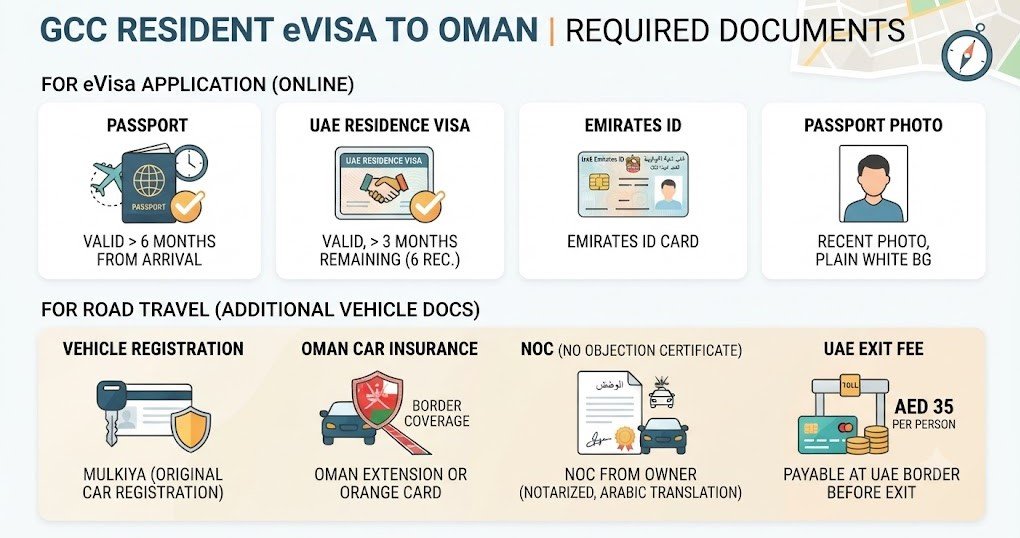
For road travel specifically, add the following vehicle documents:
- Vehicle registration card (Mulkiya) — original, not a copy
- Oman car insurance — your standard UAE policy almost certainly doesn’t extend into Oman; you’ll need cover that crosses the border, either an Oman extension on your existing policy or a separate Orange Card, available at most border crossings and from insurance providers in the UAE for around AED 106 and above depending on duration and vehicle
- No Objection Certificate (NOC) — required if the vehicle is financed, leased or registered in someone else’s name; must be notarised and ideally translated into Arabic, clearly stating the owner’s permission and the car’s chassis and registration details
- UAE exit fee — AED 35 per person, paid on the UAE side before crossing
| Driving a rental car to Oman: not all companies permit this. Confirm before you book. The rental company must provide an NOC, valid Oman insurance and the original registration card. If you’re driving a car still under a bank loan or mortgage, you do not need additional permission from the bank — but you do need the original registration card. |
How to Apply Online: Step by Step
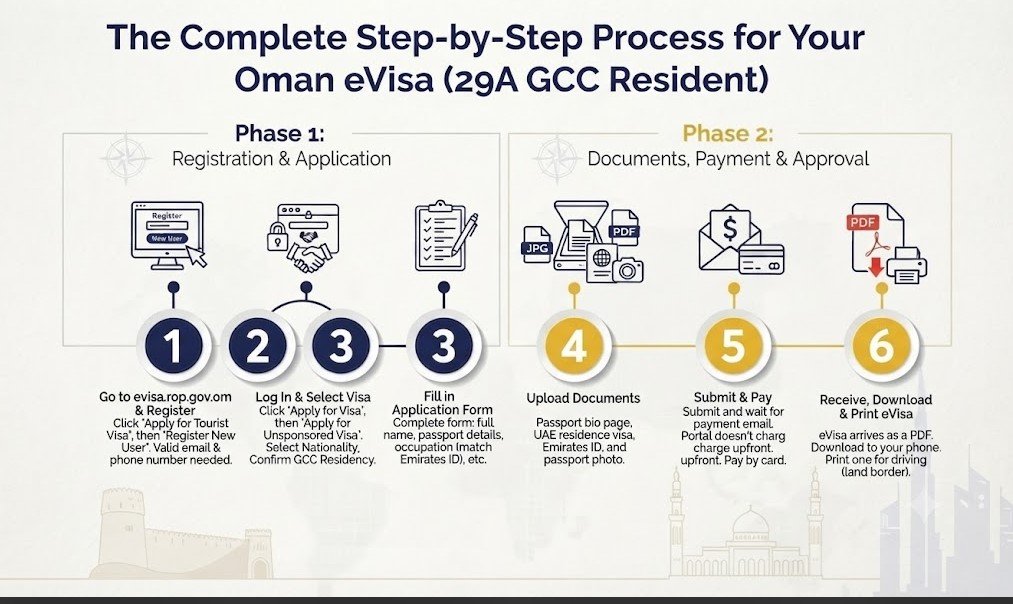
The Royal Oman Police eVisa portal is at evisa.rop.gov.om. The process is fully online and doesn’t require a visit to an embassy or consulate.
- Go to evisa.rop.gov.om and click Apply for Tourist Visa, then Register New User. You’ll need a valid email address and phone number to complete registration.
- Once logged in, click Apply for Visa, then Apply for Unsponsored Visa. Select your nationality, confirm your GCC residency and scroll to the 29A GCC Resident Visa option.
- Fill in the application form — full name, passport details, occupation, nationality, date of birth, marital status and mother’s name. Make sure the occupation field matches exactly what appears on your Emirates ID.
- Upload your documents: passport bio page, UAE residence visa, Emirates ID and passport photo. Files should be in JPG or PDF format, clear and within the size limits shown on screen. Blurry or dark photos are the most common reason for delays.
- Submit and wait for the payment email. The portal doesn’t charge upfront — an email with payment instructions is sent once the application is reviewed. Pay by card.
- Once approved, the eVisa arrives as a PDF. Download it and keep a copy on your phone. Print one as well if you’re driving — officers at land borders often ask for a physical copy.
The portal advises allowing four to five working days, but GCC resident applications frequently come back faster. That said, apply at least five days before your travel date to avoid any stress if there’s a delay.
Border Crossings for Road Travel
There are six land crossings between the UAE and Oman that are open to all residents and tourists, not just GCC nationals. Which one makes sense depends on where you’re starting from and where you’re heading in Oman.
| Border crossing | Good for | Notes |
| Hatta – Al Wajajah | Dubai to Muscat and northern Oman | Busiest crossing; open 24/7; scenic mountain approach; allow extra time on weekends |
| Khatam Al Shikla (Al Ain) | Al Ain to Sohar, Muscat or Buraimi | Good alternative to Hatta for Abu Dhabi and Al Ain residents |
| Mezyad – Hafeet (Al Ain) | Al Ain to Nizwa and Salalah via Road 31 | Quieter than Hatta; convenient for the interior |
| Khatmat Malaha (Kalba) | East coast of Sharjah to northern Oman | Quick crossing; roughly 20 minutes when quiet |
| Al Dhara – Khasab (Musandam) | Access to Khasab via RAK and Ras Al Khaimah | Coastal mountain route; specific to Musandam |
| Dibba checkpoint | East coast access to Musandam | Requires prior hotel or tour booking to obtain entry permit |
A note on Hatta specifically: the crossing operates 24 hours, but Al Wajajah on the Omani side has occasional maintenance windows. The road between the two control posts is also technically Omani territory, and Oman car insurance must be valid before you enter that stretch — not just from the Omani immigration hall. If you don’t have it already, kiosks at the border sell short-stay cover.
Weekends, Eid and school holidays push Hatta to one to four hours of waiting time. Driving Thursday evenings or Friday mornings will cost you more time than the trip itself. Tuesday or Wednesday mornings are typically the smoothest.
Travelling by Air
Direct flights to Oman operate from Dubai, Abu Dhabi, Sharjah, Ras Al Khaimah and Fujairah to Muscat, Salalah and Sohar. Flight time to Muscat is around an hour from most UAE airports. Visa on arrival is available at Muscat International Airport for eligible professions, but having a pre-approved eVisa is faster and removes any risk of being turned away at the gate.
If you’re flying, keep a digital copy of your eVisa on your phone and your passport readily accessible at check-in. Some airlines ask for proof of visa at check-in before they issue a boarding pass, so don’t bury it in your bag.
Visa Extensions and Overstays
The 29A GCC Resident Visa can generally be extended once, adding another 28 days before the initial period expires. Extensions must be applied for through the eVisa portal before the current visa runs out — not after.
Overstaying carries a fine of approximately OMR 10 per day. Beyond the financial cost, repeated overstays can affect future visa applications. If your plans change and you need more time, the extension route is straightforward enough that there’s no real reason to overstay.
What Trips People Up at the Border
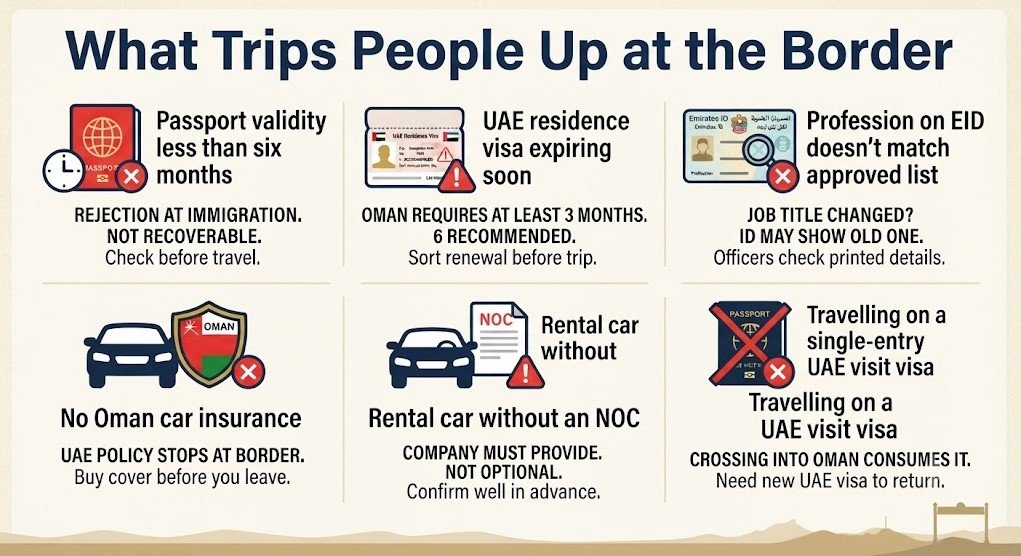
- Passport valid for less than six months — this is a rejection at immigration, not a recoverable situation on the day. Check your passport before you travel.
- UAE residence visa expiring soon — Oman requires at least three months remaining; authorities recommend six. If renewal is overdue, sort it before the trip.
- Profession on Emirates ID doesn’t match the approved list — if your job title changed recently, the ID may still show the old one. Officers check what’s printed, not what you say.
- No Oman car insurance — your UAE policy almost certainly stops at the border. Buy cover before you leave, not at the crossing.
- Rental car without an NOC — the company has to provide this; it’s not optional. Confirm well in advance, not on the day.
- Travelling on a single-entry UAE visit visa — crossing into Oman consumes it. You will need a new UAE visa to return. This catches tourists on short UAE stays who decide to add an Oman day trip.
Useful Contacts and Sources
All Oman visa applications and eligibility checks go through the Royal Oman Police. For anything requiring confirmation, use official sources rather than third-party agents:
- Oman eVisa portal: evisa.rop.gov.om
- ROP eVisa call centre (inside Oman): 800 80011
- ROP eVisa call centre (outside Oman): +968 2284 8200
- Email: Info-OmaneVisa@rop.gov.om
- Office hours: 07:00–21:00 Gulf time (GMT+4)
For Etihad Rail travel from Abu Dhabi to Fujairah — the east coast city closest to the Omani border — the Etihad Rail app and website handle ticket booking. The new Abu Dhabi-Fujairah service runs six daily services and cuts the journey to one hour and 45 minutes, which makes a combined rail-and-drive trip into Oman a practical option from a Fujairah base rather than a full drive from Dubai.
For most UAE residents with an approved profession, the Oman visa is a quick, cheap and entirely online process. The main risk isn’t the application — it’s showing up without having checked your Emirates ID profession, your passport validity, or your car insurance. Sort those three things before you go and the rest is straightforward.