
First Month in Dubai: Everything you need to do before you can drive, bank, rent, get paid, and call a doctor — in the order it actually needs to happen.
First Month in Dubai List
The essential order: Residency visa → Emirates ID → tenancy contract + Ejari → DEWA utilities → bank account → UAE SIM → health insurance → driving licence conversion. Each step unlocks the next. You cannot open a bank account without an Emirates ID. You cannot get DEWA without Ejari. You cannot get Ejari without a signed lease. Start with the visa; everything else follows.
The first month in Dubai lands on most people the same way: an overwhelming cluster of government portals, deposit cheques, app downloads, and acronyms — Ejari, DEWA, Mulkiya, EID, ICP, RTA — that nobody explained in the offer letter. The process isn’t actually complicated once you understand the dependencies, but those dependencies are real. Do things in the wrong order and you’ll end up making the same trip twice.
This guide organises everything into a sequence that works. It’s written for employment-visa holders moving into a rented apartment, which covers the majority of new Dubai residents. If your situation is different — investor visa, freelance permit, sponsored family member — the core sequence still applies, with some variations in who initiates which step.
Relalted : Moving to Dubai Checklist- The Complete Expat Guide
The Full Checklist at a Glance
Here’s the complete sequence. Detailed explanations follow below.
| Task | What you need / notes | When |
| Medical fitness test | Required before visa stamping — employer arranges; HAAD/DHA approved centre | Before arrival or Week 1 |
| Residency visa stamped | Employment visa + entry permit; passport returned with residency stamp | Week 1 |
| Emirates ID collected | Biometrics done at ICP/typing centre; card issued 3–7 working days | Week 1–2 |
| UAE Pass activated | Digital identity app — links to Emirates ID; needed for most govt services | Week 2 |
| Tenancy contract signed | Get VIN/title deed, confirm RERA index rent, negotiate cheques | Week 2–3 |
| Ejari registered | Dubai REST app (AED 100) or typing centre (AED 220); same-day processing | Same day as contract |
| DEWA account opened | Ejari number + 9-digit premises number; deposit ~AED 2,000; live in 24 hrs | Day after Ejari |
| UAE bank account opened | Digital: Wio/Liv (same day). Traditional: Emirates NBD/ADCB (3–7 days) | Week 2–3 |
| UAE SIM registered | Etisalat (e&) or du; Emirates ID required; same-day activation | Week 1 (do early) |
| Health insurance confirmed | Employer must provide before visa; check coverage network and limits | Before/during Week 1 |
| Driving licence converted | Eye test (AED 100–150) + RTA visit; eligible country = no driving test | Week 3–4 |
| Car registered (if buying) | Dealer handles new car; used car = inspection + Mulkiya transfer | Month 1–2 |
| Salik account set up | Dubai’s toll system; register at salik.ae or RTA app before first drive | Before first Dubai drive |
| NOL card (if using Metro) | AED 25 card from any Metro station; works on Metro, buses, water taxis | Week 1–2 |
| School enrolment (if kids) | Ejari required; confirm curriculum, KHDA rating, transport options early | Month 1, before term |
Step 1–2: Residency Visa and Emirates ID
The residency visa is the foundation of everything. Without it, you cannot open a bank account, sign a tenancy contract, get a local driving licence, register a SIM card, or access most government services. Your employer’s PRO (Public Relations Officer) handles the process for employment visa holders — your main job is to be available for a medical fitness test at a DHA-approved centre (blood test and chest X-ray for tuberculosis) and biometric registration.
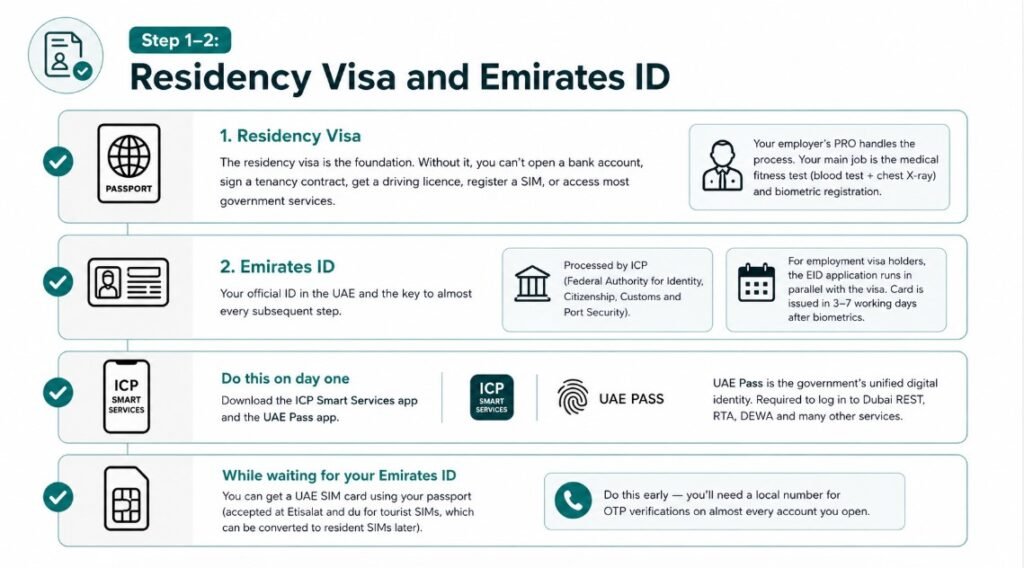
The Emirates ID (EID) is your official identity document in the UAE and the key that unlocks almost every subsequent step. It’s processed through the Federal Authority for Identity, Citizenship, Customs and Port Security (ICP). For employment visa holders, the Emirates ID application usually runs in parallel with the visa; your PRO handles the submission and biometrics appointment. The physical card is issued 3–7 working days after biometrics.
Do this on day one: Download the ICP Smart Services app and the UAE Pass app. UAE Pass is the government’s unified digital identity system and is required to log into the Dubai REST app, the RTA portal, DEWA online, and dozens of other services. Set it up the moment your Emirates ID is issued.
While waiting for your Emirates ID, you can still get a UAE SIM card using your passport (pre-Emirates ID is accepted at Etisalat and du for tourist SIMs, which can be converted to resident SIMs later). Do this early — you’ll need a local number for OTP verifications on almost every account you open.
Step 3: Renting a Flat and Getting Ejari
Before you sign anything
Dubai has a government rental index — maintained by RERA (Real Estate Regulatory Agency) — that caps how much your landlord can increase rent at renewal. Before agreeing to any rent figure, check your intended area against the RERA Rental Index on the DLD website. If the listing price is above the index for comparable properties, you have grounds to negotiate. This single step can save thousands of dirhams annually.
Understand the cheque situation before committing. Most Dubai landlords require 2–4 post-dated cheques per year rather than monthly bank transfers. Some accept 12 cheques (monthly equivalent), which is easier to manage. A chequebook requires a current bank account, which requires your Emirates ID — so plan the timing: you typically sign the tenancy contract before your bank account is fully open, but your employer may be willing to issue early cheques on your behalf, or you may negotiate a short delay with the landlord.
Ejari: the step most people underestimate
Ejari is the mandatory government registration of your tenancy contract with the Dubai Land Department. It is not optional and it is not a formality. Without an active Ejari certificate you cannot: connect DEWA utilities, apply for family or domestic worker residence visas, enrol children in school, or access the Rental Dispute Centre if something goes wrong with your landlord.
Registration is fast. The Dubai REST app processes Ejari online for AED 100, typically within a few hours. Typing centres charge AED 220 but can sometimes resolve issues with complex documents faster. You need: the signed tenancy contract, the landlord’s title deed copy, your Emirates ID, your passport copy, and the 9-digit DEWA premises number (usually on the building directory or available from building management).
Watch for this: If the previous tenant didn’t cancel their Ejari, yours cannot be created. The landlord must cancel the old contract first. Confirm this is done before you sign — it’s a surprisingly common delay that pushes back your DEWA connection and everything that follows.
Step 4: Connecting DEWA (Electricity and Water)
DEWA — the Dubai Electricity and Water Authority — is your utility provider for the entire emirate, no matter where you live in Dubai. You cannot move into most apartments before a DEWA account is active.
Once your Ejari is registered, DEWA automatically receives your tenancy data through its integration with the DLD system. The process then is: log into the DEWA app or dewa.gov.ae, select ‘New Customer in Dubai’, enter your Ejari number and 9-digit premises number, upload your Emirates ID, and pay the security deposit. Electricity and water are typically connected within 15 working hours of payment.
Security deposit and housing fee
The refundable security deposit is around AED 2,000 for most standard apartments. You’ll also pay a one-time non-refundable connection fee of around AED 100–130. Both are paid online during setup.
The item that surprises most new residents is the housing fee — a 5% charge on your annual registered rent, collected monthly through your DEWA bill on behalf of Dubai Municipality. On an AED 80,000/year apartment, this adds AED 333 to every DEWA bill regardless of how much electricity you actually use. UAE nationals are exempt; expats are not. Factor it into your monthly cost planning.
DEWA in summer: From June through September, Dubai’s heat means your air conditioning runs continuously. DEWA bills in these months can be 3–4 times higher than winter bills. If your apartment is not well-insulated or the AC unit is old, budget accordingly. Checking the AC system before you sign the lease is worth doing.
Step 5: Opening a Bank Account
You need a UAE bank account for your salary (required under the UAE’s Wage Protection System), for rent cheques, for DEWA direct debit, and for the dozens of recurring expenses that make up life here. Getting this right early saves a lot of friction.
Digital banks: the fastest route for most people
If you have your Emirates ID, digital banks like Wio and Liv (Emirates NBD’s digital arm) let you open an account in minutes through the app — scan your ID, complete a short onboarding, and you’re done. These are zero minimum-balance accounts with no branch visit required. For day-to-day spending and receiving salary, they work perfectly.
The limitation: digital accounts generally don’t issue chequebooks. If your landlord requires post-dated cheques — and most do — you’ll need a current account at a traditional bank.
Traditional banks: required for chequebooks
Emirates NBD, ADCB, Mashreq, and First Abu Dhabi Bank (FAB) are the main options. Most require: passport, Emirates ID, residence visa, proof of address (Ejari certificate or DEWA bill), and a salary certificate or employment letter. Processing takes 1–3 working days. Minimum balances on current accounts typically run AED 3,000–5,000; falling below this triggers monthly fees of around AED 25–50.
Practical sequence: Open a Wio or Liv account immediately after getting your Emirates ID — use it while the traditional account is being processed. Give your employer the traditional account number for salary once it’s open. Most large companies’ payroll departments need at least two weeks’ notice to update bank details.
Before opening an account, be aware that while bouncing a cheque is now primarily a civil matter, it remains a severe legal issue. A returned cheque serves as an “executive instrument,” allowing beneficiaries to immediately seize assets or impose travel bans. In cases involving bad faith or fraud, it can still be treated as a criminal offence. Always ensure you have sufficient funds before issuing any cheque.
Step 6: Getting a UAE SIM Card
This sounds simple and mostly is. The UAE has two telecom providers: Etisalat (rebranded to e&) and du. Both have stores at the airport, malls, and dedicated service centres. You’ll need your passport and Emirates ID (or a passport alone for a tourist SIM that can be converted later).
Prepaid plans start around AED 50/month and cover data, calls, and UAE-wide roaming. Post-paid plans start around AED 100–150/month and offer more data and often include international calls. Both networks have strong 5G coverage across Dubai.
Do this in Week 1: A UAE phone number is required as your registered contact for UAE Pass, most bank OTP systems, government apps, and building access codes. The longer you operate without a UAE SIM, the more accounts you’ll need to update later. Get the SIM on your first or second day.
Note that VoIP calls (WhatsApp voice, FaceTime audio/video, Skype calls) are permitted in the UAE as of 2023 policy changes, which lifted a previous restriction that frustrated many expats. This is now a non-issue.
Step 7: Health Insurance
Health insurance is legally mandatory for all residents in Dubai, and since January 2025, across all seven UAE emirates. Your employer is legally required to provide a DHA-compliant policy before your residency visa is processed — so if you’re on an employment visa, you should already have coverage by the time you land.
What your employer’s plan likely covers
Most standard employer plans are built around the Dubai Health Authority’s Essential Benefits Plan (EBP), which covers inpatient and outpatient care, emergency treatment, ambulance services, and basic diagnostics up to AED 150,000 per year. The EBP costs between AED 320–725 per year for employees (employers pay this, not deducted from salary). For lower-income employees (monthly salary under AED 4,000), the EBP is the mandated minimum.
Higher-income employees and those at larger companies typically receive enhanced plans with broader hospital networks, lower co-payments, and higher annual limits. Check your specific policy document, not just what HR tells you verbally.
Upgrading or buying individual cover
If your employer’s basic plan has a limited hospital network or high co-payments, individual top-up plans are available from AED 700–8,500 per year depending on your age and the level of coverage. Insurers operating in Dubai include Sukoon (formerly Oman Insurance), Orient, Cigna, and others. All must be DHA-licensed to be valid in Dubai.
Pre-existing conditions: Since 2024, DHA rules prevent insurers from refusing coverage for chronic pre-existing conditions. They can apply a 10–25% premium loading or short waiting periods, but outright rejection is no longer permitted. Declare your conditions fully; non-disclosure can void a claim.
Step 8: Converting Your Driving Licence
If you hold a driving licence from one of the 57 countries currently on the RTA’s eligible list, you can convert it to a Dubai licence without taking theory exams or practical driving tests. The RTA confirmed 57 eligible countries in early 2026, spanning all GCC states, 38 European nations, the US, Canada, Australia, New Zealand, South Korea, Japan, and others.
If your country is not on the list — India, Pakistan, Egypt, and many others are not — you must complete a driving course at an RTA-approved institute and pass both a theory and road test. The Golden Chance Initiative offers a reduced-course option for experienced drivers; check with the institute.
For eligible countries: the conversion process
- Eye test — AED 100–150 at any RTA-approved optical centre (Al Jaber, Yateem, Grand Optics all qualify). Results upload automatically to the RTA system. If your foreign licence is not in Arabic or English, also get a certified legal translation.
- RTA appointment — book via the RTA Dubai app or rta.ae. You can upload documents in advance. Al Manara and Umm Ramool are the main service centres.
- Documents to bring — Emirates ID, original foreign driving licence (which will be surrendered), passport, eye test result, and a translation if applicable.
- Pay fees — total cost approximately AED 950–1,100 including all RTA charges.
- Collect licence — usually same day; you’ll receive an SMS within 1–2 hours of submission.
Your original licence will be taken permanently. Make a certified copy before you hand it over if you need it for reference in your home country. Once surrendered to the RTA, you cannot get it back.
Step 9: Salik, NOL, and Getting Around
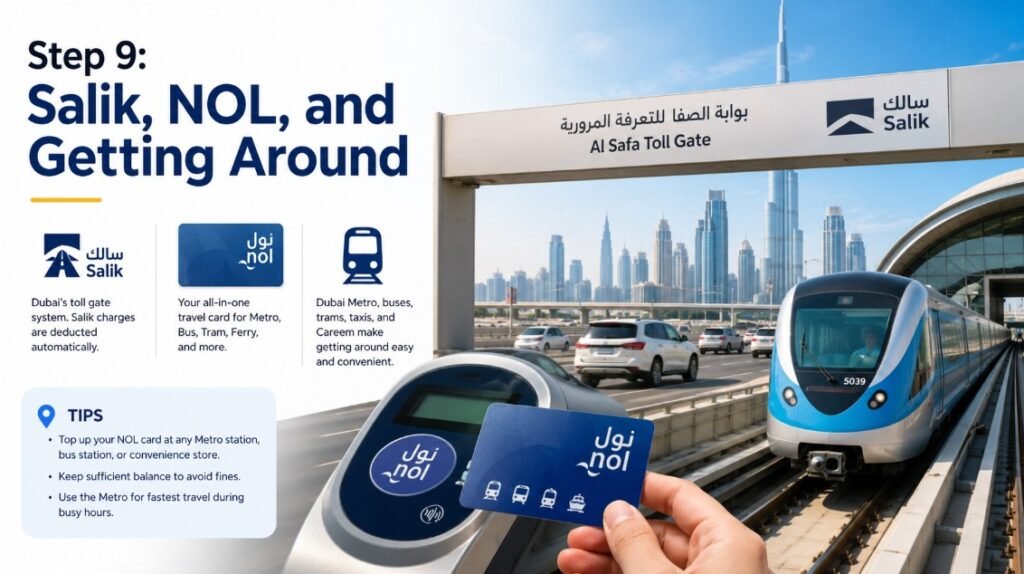
Salik (road tolls)
Salik is Dubai’s electronic road toll system. Toll gates are positioned at busy points across the city — Al Garhoud Bridge, Al Maktoum Bridge, Safa, Al Mamzar — and charge AED 4 per gate automatically when your car passes through. You need a Salik tag fitted to your windscreen and a funded account before you drive on Dubai roads.
Register at salik.ae or through the Salik app. The tag is AED 50 (one-time) and you top up your account online, via the app, or at most petrol stations. If your car is already registered in Dubai, it may have an existing Salik account from the previous owner — set up a new one in your name when you complete the Mulkiya transfer.
NOL card (public transport)
If you’re using the Metro, buses, trams, or water taxis, the NOL card is how you pay. Cards cost AED 25 from any Metro station and work across all RTA public transport in Dubai. The Dubai Metro is clean, reliable, air-conditioned, and one of the better systems in the region — worth using even if you have a car, particularly for routes into DIFC and downtown.
Step 10: School Enrolment (If You Have Children)
School enrolment in Dubai requires an Ejari certificate — which links your residential address to the school’s records and is needed for KHDA (Knowledge and Human Development Authority) processes. This is another reason to complete your Ejari as early as possible.
Dubai’s private school landscape is large and varied: British, American, IB, Indian (CBSE/ICSE), French, German curricula are all available. The KHDA rates every private school annually (Outstanding, Good, Acceptable, Weak) and publishes the ratings publicly at khda.gov.ae. Check a school’s current rating rather than relying on word of mouth or older reviews; school quality shifts over time.
Start early: Good-rated schools in popular areas (Jumeirah, Al Barsha, Arabian Ranches) routinely have waitlists. If your move date is known months in advance, apply before you arrive. The Ejari can be substituted with a tenancy contract at the application stage — most schools understand this sequence.
First-Month Cost Summary
The table below covers the government fees and deposits you’ll encounter during setup. It excludes rent, furniture, and living costs — those vary too widely by lifestyle to generalise.
| Setup Item | Typical Cost (AED) | One-off or Recurring? |
| Emirates ID (govt fee) | ~100 (employer usually covers) | One-off |
| Ejari registration | AED 100 (Dubai REST app) / AED 220 (typing centre) | Annual |
| DEWA security deposit (tenant) | AED 2,000 typical (refundable) | One-off (refunded on exit) |
| DEWA connection fee | AED 100–130 | One-off |
| DEWA housing fee (monthly) | 5% of annual rent ÷ 12 | Monthly (on DEWA bill) |
| SIM card + first month plan | AED 50–200 | Monthly |
| Bank account (digital/Wio/Liv) | AED 0 minimum balance | Free to open |
| Bank account (traditional) | AED 3,000–5,000 min. balance | Ongoing requirement |
| Driving licence conversion (eligible country) | ~AED 950–1,100 total | One-off |
| Eye test (for licence) | AED 100–150 | One-off |
| Health insurance (basic EBP/employer plan) | AED 320–725/year | Annual (employer covers for employees) |
| Health insurance (individual, mid-range) | AED 700–8,500/year | Annual |
Figures are indicative mid-2026 rates. Always verify current fees at official sources before payment. Government fees are subject to revision.
A Realistic Timeline
Most residents who arrive with a job offer, a clear employer PRO process, and a sense of what to do can be fully set up — lease, DEWA, bank account, SIM, insurance, and driving licence — within three to four weeks. Here’s how that usually maps out:
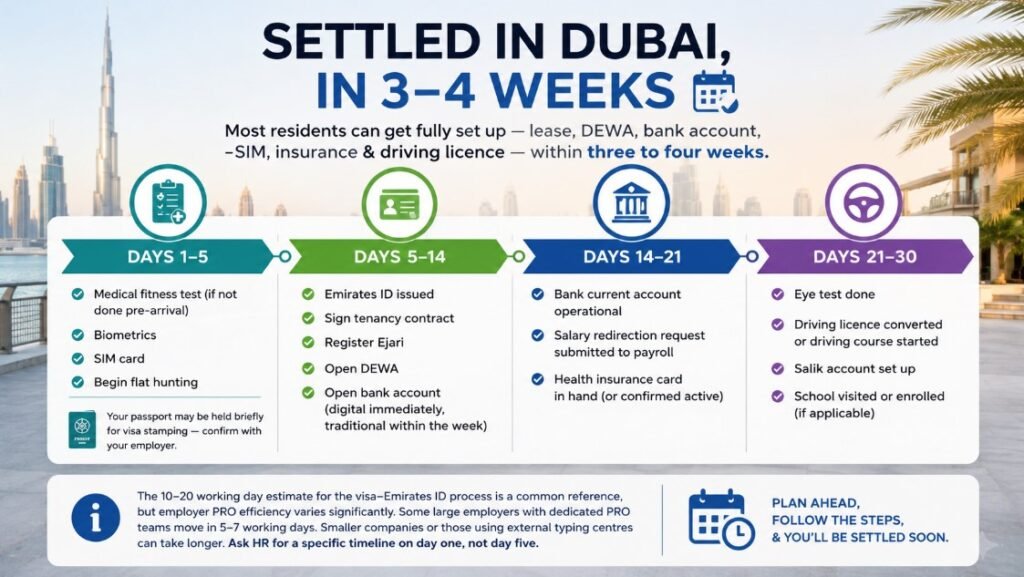
- Days 1–5: Medical fitness test (if not done pre-arrival), biometrics, SIM card, begin flat hunting. Your passport may be held briefly for visa stamping — confirm with your employer.
- Days 5–14: Emirates ID issued. Sign tenancy contract. Register Ejari. Open DEWA. Open bank account (digital immediately, traditional within the week).
- Days 14–21: Bank current account operational. Salary redirection request submitted to payroll. Health insurance card in hand (or confirmed active).
- Days 21–30: Eye test done. Driving licence converted or driving course started. Salik account set up. School visited or enrolled (if applicable).
The 10–20 working day estimate for the visa–Emirates ID process is a common reference, but employer PRO efficiency varies significantly. Some large employers with dedicated PRO teams move in 5–7 working days. Smaller companies or those using external typing centres can take longer. Ask HR for a specific timeline on day one, not day five.
Seven Mistakes That Cost New Residents Time
- Getting a SIM card last. You need a UAE number for bank OTPs, UAE Pass, and every government app login. Get it on day one, even on a tourist SIM.
- Signing a tenancy contract before checking the RERA index. An overpriced rent locks you in; the cap on future increases is only useful if you start at the right level.
- Not confirming the previous tenant cancelled their Ejari. This blocks your own Ejari registration and delays DEWA by days or weeks.
- Opening only a digital bank account. You’ll need a chequebook for rent. Most landlords won’t accept bank transfers. A traditional current account is non-negotiable.
- Waiting until the licence is surrendered to get copies. If you’re from an eligible country, the RTA keeps your original foreign licence permanently. Take certified copies first.
- Not reading the health insurance policy document. Network restrictions, co-payment percentages, and exclusions vary widely between plans at the same price point.
- Assuming the employer’s PRO has everything under control. Ask for a written timeline and check in weekly. Government portals have queues; your file can sit quietly without anyone flagging it to you.
The Bottom Line
Dubai’s bureaucratic setup process is genuinely more organised than many new arrivals expect. Most steps are digital, most fees are reasonable, and the dependencies between steps are logical once you see the structure. The two things that trip people up most are trying to do things out of order (banking before Emirates ID, DEWA before Ejari) and underestimating the cheque situation.
Print this checklist. Tick things off in sequence. The first month is administrative; everything after it is actually living here.
Note : Government procedures, fees, and eligible-country lists are subject to change. Verify current requirements at icp.gov.ae, rta.ae, dewa.gov.ae, and dubailand.gov.ae before acting.




[…] Related : First Month in Dubai: The Complete Setup 10 Checklist […]