The first thing most people say when you mention a budget in Dubai is “impossible.” The second thing they say is usually about someone they know who spends AED 30,000 a month and still feels stretched. Both responses are understandable. Dubai has a talent for making even comfortable incomes feel inadequate, partly because of how it presents itself and partly because of the company you keep. The city makes it easy to spend without noticing, and harder to notice when you don’t.
But Dubai on AED 8000 a month is not impossible. Tens of thousands of residents live on it — teachers, junior professionals, early-career expats, people who moved here precisely because the tax-free salary goes further than it looks on a spreadsheet.
The honest truth is that AED 8,000 is enough to rent your own place in a decent neighbourhood, eat well, move around comfortably, and save something meaningful every month. It just requires knowing which decisions actually matter and which ones are negotiable.
This guide walks through each major cost category , gives you a practical monthly budget template, and shares the specific moves that make the biggest difference on a tight income in Dubai.
Related : Dubai Cost of Living Calculator
Dubai on AED 8000 a Month
First, the Honest Answer
Average monthly living costs in Dubai for a single person range from AED 4,000 to AED 12,000 depending on lifestyle and location. That figure excludes rent. Add your housing cost on top and the range for a solo expat living a reasonable life runs from roughly AED 7,000 at the budget end to AED 16,000-plus for a comfortable city-centre existence.
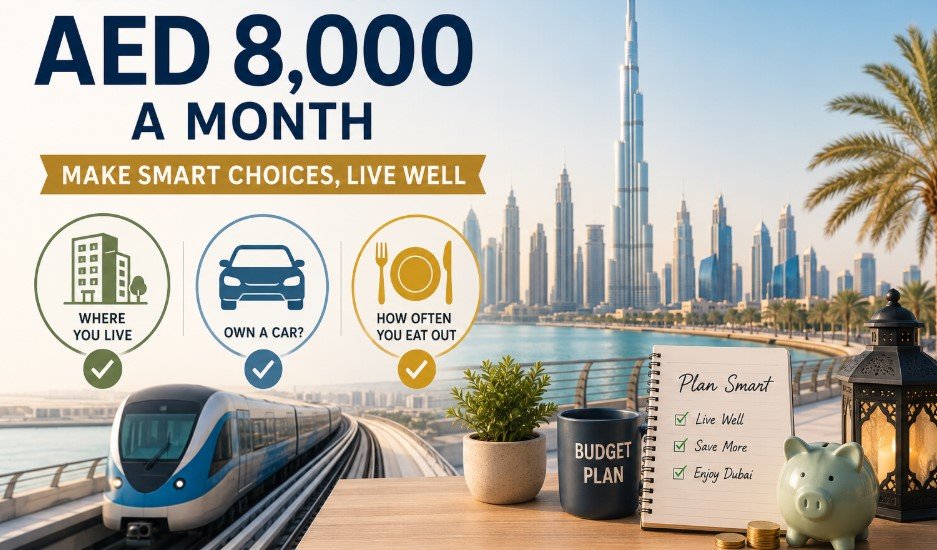
AED 8,000 sits right at the lower edge of that scale. It works — but it works because of specific choices you make, not by accident. The three decisions that matter most are where you live, whether you own a car, and how often you eat out. Get all three right and AED 8,000 is genuinely comfortable. Get one wrong — particularly the car — and you will find yourself running short before the month ends.
One important note before we go any further: if you have children in an international school, this budget does not apply to your family. School fees in Dubai start around AED 15,000 per year and reach AED 100,000-plus at the top end. With even one child in school, AED 8,000 is not a livable household income in Dubai. The guide below is written for singles and couples without school-age children.
Housing — The Decision That Determines Everything
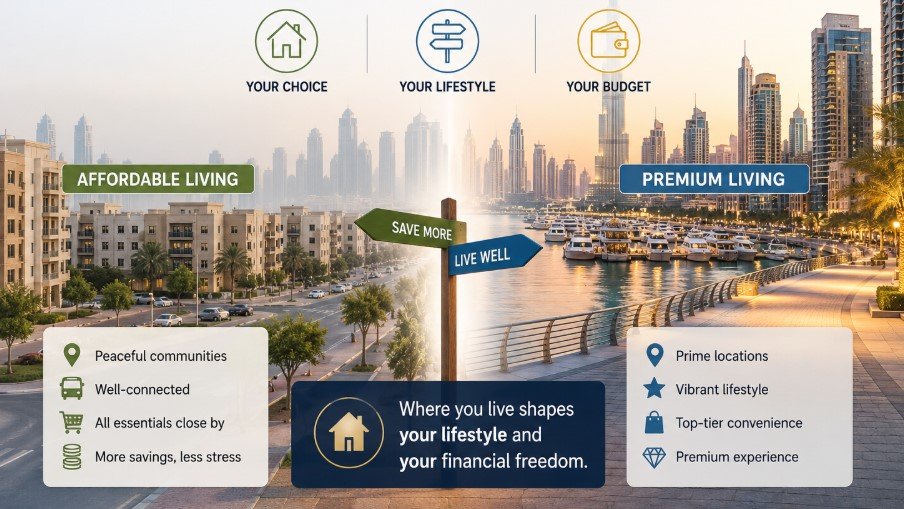
When you are living in Dubai on an AED 8,000 monthly budget, your choice of housing isn’t just a lifestyle preference—it is the single financial lever that dictates whether you thrive or drown. Put simply, if you miscalculate your rent, you lose the budget game before you’ve bought a single meal.
The gap between Dubai’s budget-friendly hubs and its premium waterfront communities is staggering. A standard studio apartment in an affordable, mid-market hub like International City starts at roughly AED 32,000 to AED 35,000 per year. Move that exact same footprint to Dubai Marina, and you are looking at a baseline of AED 80,000 to AED 110,000 annually.
When you break those figures down into a monthly reality, the contrast becomes even sharper:
- The Budget Route (International City): ~AED 2,700 per month
- The Premium Route (Dubai Marina): AED 7,500 to AED 9,000 per month
If your total income is AED 8,000, choosing a premium location like the Marina is a mathematical impossibility—it would swallow up to 112% of your entire paycheck. On the flip side, anchoring yourself in an established, cost-effective community keeps your housing costs at roughly 33% of your income. This leaves you with a comfortable AED 5,300 buffer every month to cover utilities, transport, groceries, and savings.
Living well on a budget in this city is entirely possible, but it requires prioritizing financial breathing room over a specific postcode.
The areas that work at this budget
If you are trying to make an AED 8,000 paycheck work in Dubai, you need to look past the flashy coastal skylines dominating Instagram and focus on communities built for real life.
To make your choice easier, the best budget-friendly areas in the city generally fall into two distinct buckets: The Transit Savers (where you can easily ditch the expense of a car) and The Lifestyle Swaps (where you get a newer building with a pool and gym, but will likely need wheels to get around).
Category 1: The Transit Savers (Best for Living Car-Free)
Skipping the cost of car payments, insurance, and fuel is the ultimate budget lifehack in Dubai. These three neighborhoods keep your rent low while placing you directly on the Dubai Metro grid.
1. Discovery Gardens
This community has been a budget favorite for a long time, and for good reason. Unlike the concrete high-rises that dominate most of Dubai, Discovery Gardens is full of low-rise, walkable apartment blocks surrounded by actual lawns and mature trees.
Driven by high demand along the transit line, studio prices currently hover between AED 36,000 and AED 45,000 per year, while one-bedrooms generally sit right around AED 50,000 to AED 55,000.
The absolute killer feature here is the Metro access. Having the Discovery Gardens and Ibn Battuta stations right on the Red Line changes everything. If your goal is to live comfortably without the overhead costs of maintaining a vehicle, this area should be at the absolute top of your list.
2. Al Karama / Al Mankhool (Old Dubai)
We can’t talk about living on a budget without mentioning the soul of Old Dubai. For a single professional or a young couple starting out, Al Karama offers an unmatched level of urban convenience.
Studios in older buildings start around AED 32,000 to AED 38,000, while older one-bedrooms can be snapped up for AED 45,000 to AED 55,000.
Let’s be honest—the buildings won’t give you that shiny, glass-tower aesthetic, and you will probably have to compromise on an in-house gym or a pool. But what you lose in modern amenities, you completely make up for in daily lifestyle savings. You are right on the intersection of the Red and Green Metro lines, and Karama is the undisputed capital of cheap, incredible street food. You can dine out here for a fraction of what you’d spend in New Dubai.
3. Al Nahda (Dubai Side)
If your workplace is anywhere near the older commercial heart of the city—like Deira, Bur Dubai, or DXB Airport—Al Nahda is a massive spatial value play.
Market data shows studios clustering between AED 36,000 and AED 42,000 annually, while spacious one-bedrooms sit comfortably between AED 45,000 and AED 52,000. You get significantly more square footage for your money here compared to suburban hubs. It’s an established, family-centric neighborhood packed with massive hypermarkets and local eateries, and parts of it are served beautifully by the Green Line Metro.
Just keep in mind that it sits right on the Sharjah border. If your office is on the far west side of the city, the daily rush-hour bottleneck on Ittihad Road will make you regret every single dirham you saved on rent.
Category 2: The Lifestyle Swaps (Best if You Own a Car)
If you already own a car or your job requires you to drive, you can trade Metro proximity for newer construction, modern community layouts, and excellent road connectivity.
4. Jumeirah Village Circle (JVC)
JVC is usually the default pick for young professionals who want an affordable rent check but aren’t willing to give up a trendy lifestyle. Walk into almost any building here, and you’re going to get a clean layout, a solid gym, and a rooftop pool.
Studios here generally hover between AED 35,000 and AED 45,000 a year (roughly AED 2,900 to AED 3,750 a month). You can find one-bedrooms too, but at AED 50,000 to AED 65,000, you are pushing right against the absolute mathematical ceiling of an AED 8,000 budget.
The neighborhood itself is totally self-contained—you’ve got the Circle Mall, plenty of cafes, and a massive Carrefour for groceries. The catch is that there is no Metro station. If you don’t own a car, relying on daily RTA feeder buses or taxis will quickly wipe out whatever money you thought you were saving on rent.
5. Dubai Sports City
Think of Sports City as JVC’s slightly more relaxed, athletic next-door neighbor. If you love the geographic location of JVC but find that the prices there are creeping up a bit too fast, this is where you look.
Market indexes show functional studios starting right around AED 35,000 to AED 40,000, while standard one-bedrooms stay mostly under the AED 55,000 mark. It shares a lot of the same pros and cons as JVC—excellent access to Hessa Street and Mohammad Bin Zayed Road, but a total lack of rail transit. The vibe here is a bit more open and less frantic, featuring the Els Club golf course, running paths, and plenty of sports academies. It’s perfect if you want a clean, modern aesthetic without paying a premium postcode price tag.
6. Dubai Silicon Oasis (DSO)
Moving further inland along the Dubai-Al Ain road hits Dubai Silicon Oasis. It’s a quiet, highly organized tech suburb that offers some of the most genuine value-for-money rental contracts in the city right now.
Real estate benchmark data shows studios starting cleanly around AED 36,000, while spacious one-bedrooms sit comfortably between AED 45,000 and AED 60,000 annually. It’s a fantastic, highly functional area with local clinics, parks, and the Silicon Central mall right at your doorstep. The only real drawback is how far inland it sits.
It feels removed from the coast, and if you have to drive into Downtown or DIFC every single day during the peak morning rush hour, it requires a lot of highway patience.
7. International City
If your primary goal is to aggressively compress your living expenses so you can maximize your savings, send money home, or pay off debt, International City is the absolute pricing floor for brick-and-mortar housing in Dubai.
Basic studios here trade between AED 28,000 and AED 35,000 annually—translating to a highly manageable AED 2,300 to AED 2,900 a month. The savings come with heavy trade-offs. The neighborhood sits on the far eastern edge of the city, meaning an office commute to central Dubai can easily take 45 to 60 minutes each way in heavy traffic.
It also lacks the polished infrastructure and lifestyle feel of places like JVC or DSO. If you work entirely from home or right nearby, it is a brilliant financial move. But if you have to travel across the city every day, the toll on your time and transport costs will eventually erase the cheap rent.
If you want to maximize your AED 8,000 budget, Discovery Gardens or Al Karama give you the absolute best financial runway because they let you eliminate car expenses entirely. If you already have wheels and care about having a modern apartment with a pool and gym, target a studio in JVC or Sports City—just make sure to factor the cost of fuel into your monthly math.
Utilities — Budget for the Summer Spike
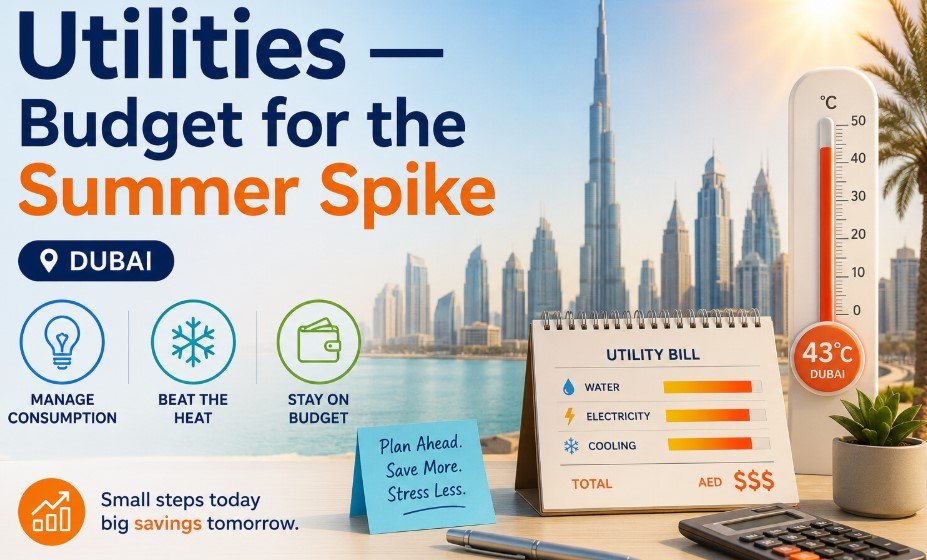
Utilities in Dubai aren’t an optional extra—and because summer temperatures easily cross 40°C, your AC will be working overtime. The biggest mistake newcomers make is budgeting for winter consumption, only to get a reality check when the July bill hits.
Because usage fluctuates wildly between seasons, exact numbers are hard to pin down. For a studio or one-bedroom, you can generally expect your standard DEWA (electricity and water) bill to hover around AED 400 to AED 600 in the winter, easily jumping by 50% or more during peak summer.
Two things will heavily dictate your final monthly costs:
- The Cooling System: Always ask if a building uses standard split-unit AC (billed directly through DEWA) or District Cooling (Empower/Emicool). District cooling means a lower DEWA bill, but a separate, often pricier monthly bill from a cooling provider that includes fixed capacity charges.
- The Housing Fee: Dubai municipality tacks a 5% housing fee onto your DEWA bill, calculated from your annual rent and divided over 12 months. If your rent is AED 40,000, expect an extra AED 167 baked right into your monthly statement automatically.
For connectivity, a decent home internet fiber plan from e& or du sits around AED 250 to AED 300 a month, while basic mobile plans can be found for under AED 100.
The Bottom Line: To be safe, look at utilities as a package deal. Budgeting a combined AED 800 to AED 1,200 a month for DEWA, the housing fee, and internet will keep you comfortably covered year-round without any nasty surprises.
Transport — The Budget-Maker or Budget-Breaker
Outside of rent, how you choose to get around is the single biggest factor in your monthly budget. While the temptation to buy a car in Dubai is real, doing so on an AED 8,000 salary forces you into some incredibly tight math.
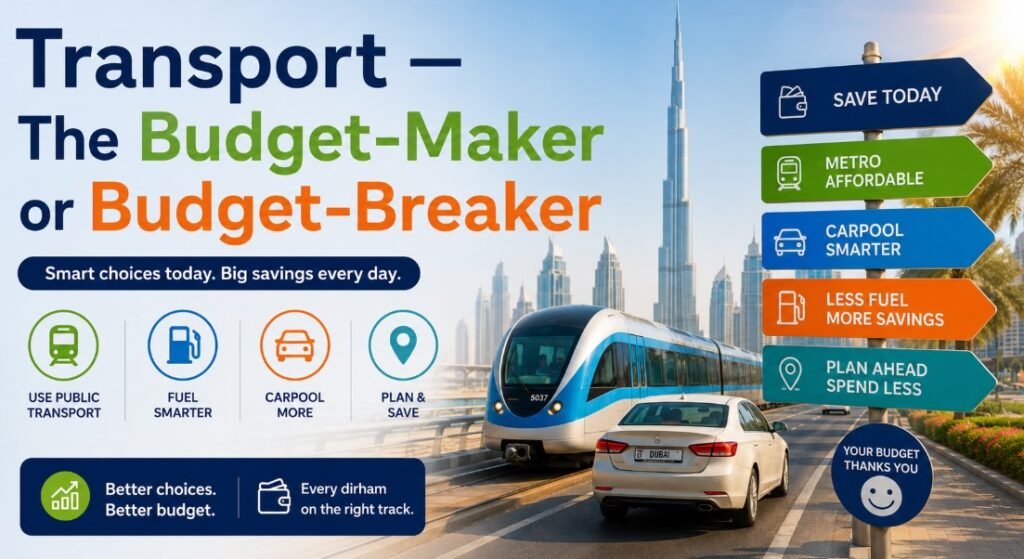
Owning a car isn’t just about the monthly payment. Once you layer on insurance, maintenance, Salik (toll gates), parking, and fuel, even a modest secondhand sedan will easily eat up a massive chunk of your take-home pay. Unless you absolutely need a vehicle for your job, jumping into car ownership right away makes a tight budget almost unforgiving.
If your office is anywhere near a Metro station, using public transport is the easiest way to save thousands of Dirhams.
- The Cost: A monthly all-zones Nol pass costs AED 350 for unlimited rides on the Metro, buses, and trams. If your commute only spans two zones, it drops to AED 230.
- The Strategy: Even if you factor in the occasional taxi or Careem ride for places the tracks don’t reach, an all-in public transport budget will rarely cross AED 500 to AED 700 a month.
The takeaway here is simple: position your life around the tracks. When hunting for an apartment, prioritize neighborhoods with solid Metro connectivity—like Al Nahda, Al Qusais, or areas along the commuter belt—to keep your fixed costs incredibly low.
If public transport isn’t an option for your job, try to avoid financing. Taking out a car loan adds a heavy, fixed monthly burden. Instead, saving up to buy a reliable, secondhand Japanese sedan (like a Toyota Corolla or Nissan Sunny) outright eliminates the monthly installment entirely, leaving you to only worry about fuel and basic upkeep.
Food — Where Dubai Surprises Expats
Dubai has a reputation as an expensive dining destination, and for high-end restaurants it absolutely is. But the everyday food reality for residents is considerably more nuanced. The city’s enormous South Asian and Southeast Asian population means there is a parallel economy of genuinely affordable food that most Western expats either do not discover or take months to find.

Groceries
Look, if you’ve lived here long enough, you know that grocery shopping in Dubai can either be incredibly cheap or completely blow holes in your budget. There’s no need to rely on arbitrary surveys or data—anyone who actually handles their own cooking here knows a single person can easily eat well for AED 700 to AED 1,000 a month without feeling like they’re sacrificing a thing. It all comes down to knowing exactly where to shop and what to look for.
The quickest way to double your grocery bill is doing your weekly shop at Spinneys or Waitrose. They’re great for a specific imported treat or a nice piece of meat, but for your everyday staples, you’re paying a massive premium.
If you want your money to stretch, you need to understand the real Dubai grocery ecosystem:
- The Hard Discounters (Viva): If you haven’t been to Viva yet, make it your first stop. It’s essentially the Aldi of the UAE. For pantry staples like canned goods, pasta, frozen food, and basic household items, it is completely unmatched on price. You’ll be buying private-label brands you’ve never heard of, but the savings are massive.
- The Budget Giants (Nesto & Ramez): This is where the real street-smart budget shopping happens. Places like Nesto Hypermarket and Ramez are absolute goldmines for bulk shopping, poultry, spices, and everyday essentials. Their mid-week “Super Deals” are legendary among residents for slashing prices to the absolute floor.
- The Mid-Tier (Lulu & Union Coop): Use these strategically. Lulu is fantastic for a massive variety of fresh foods and international ingredients without breaking the bank, while Union Coop is great if you download their app and strictly play their loyalty points and cashback game.
Insider Hacks to Keep Costs Low
- Look for the “Local” Tag: When you’re in the produce aisle, skip the pristine, imported vegetables from Europe. Grab the UAE-grown or Oman-grown tomatoes, cucumbers, and greens instead. They are usually half the price, and honestly, because they didn’t spend days on a plane, they’re often much fresher.
- Mid-Week Promos: Don’t just shop on weekends when everyone else is there. Most major chains drop their biggest weekly deals and fresh stock discounts on Tuesdays or Wednesdays.
The Ultimate Budget Hack: If you have a car (or a friend with one) and don’t mind a bit of a trek, head out to the Al Aweer Fruit and Vegetable Market. It’s a bit of an adventure, but you can load up your trunk with fresh produce for a fraction of what you’d pay at any supermarket.
Eating out
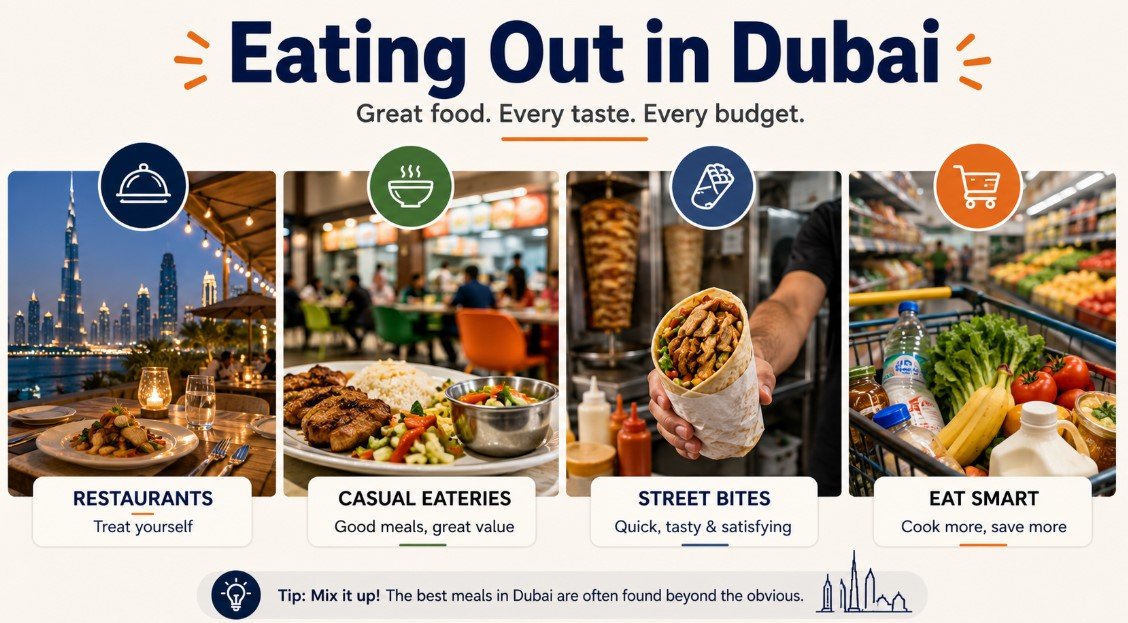
This is where Dubai’s food landscape splits dramatically. A meal at a Western-style restaurant in a mall or a beachside venue easily runs AED 80-150 per person.
Do that three times a week and food becomes the biggest item in the budget after rent. But the same city has Pakistani dhabas in Satwa and Karama charging AED 15-25 for a full plate, Filipino canteens with set lunches for AED 20, and shawarma from AED 8-15 at spots that residents eat at daily. Budget-conscious expats who build these into their weekly routine — rather than treating them as occasional adventures — can eat out regularly for AED 500-700 per month total on restaurant meals.
A practical approach that works for many residents: cook at home five or six days a week, use the office canteen or nearby budget spots for weekday lunches, and allow one or two proper restaurant dinners per month as a deliberate choice rather than a default habit. On this pattern, a combined groceries-plus-eating-out food budget of AED 1,200-1,500 per month is realistic and sustainable.
Health Insurance — Non-Negotiable and Non-Trivial
Dubai mandates health insurance for all residents. If your employer provides it, this cost is handled. If you are self-employed, on a freelance visa, or your employer’s policy has significant gaps, you will be purchasing your own coverage.
Basic compliant health insurance for a healthy adult under 40 starts around AED 500-700 per year at the absolute minimum, but these plans have narrow networks and meaningful co-pay structures. A mid-tier plan with reasonable hospital access and lower co-pays runs AED 2,000-4,000 per year — or AED 167-333 per month. Budget AED 200-300 per month for health insurance if you are buying your own, or confirm your employer’s coverage includes outpatient, dental basics, and emergency care before assuming it is sufficient.
Phone and Internet
Dubai has two main telecoms providers: e& (formerly Etisalat) and du. Which one you use depends on which provider serves your building — you generally cannot choose. Basic home fibre internet starts at AED 229 per month for 100 Mbps from either provider. Mobile plans start from around AED 55 per month for prepaid data and calls, rising to AED 150-200 for a proper postpaid contract with sufficient data for daily use. Budget AED 350-450 per month combined for home internet and mobile phone.
The Complete AED 8,000 Monthly Budget Breakdown
Let’s be completely honest: nobody can give you a penny-perfect budget for Dubai because your lifestyle, your exact building, and the scorching summer heat will always cause numbers to fluctuate. However, if you are smart about your choices, an AED 8,000 monthly salary is absolutely workable.
To give you a realistic baseline of how the month shakes out, here is a practical estimation of what your fixed and variable costs look like. This blueprint is built around the most sustainable strategy for this income tier: renting a budget-friendly studio or sharing a space in a mid-range neighborhood, prioritizing the Metro for your commute, and leaning heavily on home cooking and smart grocery shopping.
| Category | Monthly (AED) |
| Rent (studio, JVC or DSO) | 2,900 – 3,500 |
| DEWA + utilities | 600 – 800 |
| Internet + mobile | 350 – 450 |
| Transport (Metro pass + occasional Careem) | 500 – 700 |
| Groceries | 700 – 900 |
| Eating out (budget spots + 1 restaurant) | 400 – 600 |
| Health insurance (own policy) | 200 – 300 |
| Personal care + household items | 200 – 300 |
| Entertainment + subscriptions | 200 – 300 |
| Buffer / savings | 550 – 1,050 |
| TOTAL | AED 7,600 – 8,900 |
Note: This assumes employer-provided health insurance is not available and you are covering your own. If your employer provides insurance, redirect that AED 200-300 to savings or the buffer.
Where to Find Breathing Room
AED 8,000 is workable, but it does not leave much margin for surprises. A few specific habits and choices expand what is possible within the same income:
Share accommodation — the fastest lever
Sharing a two-bedroom apartment between two people in JVC, DSO, or Discovery Gardens brings your housing cost down to AED 1,800-2,500 per month while giving you more space than a solo studio. This immediately frees AED 600-1,000 in the monthly budget. The flatmate dynamic is not for everyone, but from a pure numbers perspective it is the most impactful single change available.
Use free and low-cost activities
Dubai has far more free and genuinely enjoyable activities than its luxury-focused reputation suggests. This Guide covers 26 options including Al Quoz’s Alserkal Avenue gallery scene, the Al Fahidi Historical District, public beaches, Ras Al Khor Wildlife Sanctuary, and the souks of Deira. Outdoor community running clubs, free fitness classes in parks, and the RTA cycle tracks also contribute meaningfully to quality of life at zero cost.
Time your big purchases
Dubai Shopping Festival (DSF) in December-January and Summer Surprises deals in July-August offer genuine discounts on electronics, furniture, and household goods. Buying a TV, mattress, or kitchen equipment during DSF rather than on arrival can save AED 300-800 per item. If you are setting up a new apartment, staggering your purchases rather than buying everything in the first month reduces the financial shock significantly.
Use Noon and Talabat deals strategically
Delivery apps in Dubai — Talabat, Noon Food, and Careem — run genuine promotional deals, particularly on weekends and during slower periods. New user discounts of AED 20-50 off first orders are standard. Regular users with a Talabat Pro or Noon VIP subscription often save more on each order than the subscription costs. If you order two or three deliveries a week, the maths is worth checking.
Bank with a zero-fee digital account
Traditional banks in Dubai often charge a monthly maintenance fee of AED 25 to AED 100 if your account falls below a strict minimum balance. On an AED 8,000 salary, that is a completely unnecessary drain on your hard-earned money—your bank should not be costing you money just to hold it.
Instead, look into the growing number of digital-first banks and zero-minimum-balance accounts available in the UAE. Many of these modern platforms require no monthly fees and no minimum salary threshold, while still offering fully regulated accounts, free debit cards, and highly competitive rates for international transfers. Shifting away from legacy branch banking to a fee-free digital account is an instant, effortless win for your monthly budget.
What This Budget Cannot Cover — Be Honest With Yourself
Being realistic about the limits of AED 8,000 is as important as knowing what it can achieve. Some things simply do not fit and pretending otherwise creates financial stress rather than resolve:
- Frequent flying home. Return flights to Europe, South Asia, or East Asia typically cost AED 1,500-4,000. Two or three trips per year is AED 3,000-12,000 that is not in the monthly budget. This needs separate planning and saving.
- Premium gym memberships. A GymNation membership starts from around AED 99 per month and is budget-compatible. Pure Gym, Fitness First, and luxury hotel gyms run AED 400-800 per month and are not compatible with this budget.
- Regular fine dining or nightlife. A single evening out at a mid-tier restaurant with drinks easily costs AED 200-400. Weekly, that is AED 800-1,600 per month on top of everything else. Not compatible.
- Large savings goals. AED 8,000 with discipline allows saving AED 500-1,000 per month, which is meaningful over time. AED 2,000-3,000 per month in savings requires a higher income.
- A new car. As covered above, car finance on a new or recent used vehicle genuinely stretches this budget to breaking point.
Growing Beyond AED 8,000
Many residents start at this level and build. Dubai’s tax-free salary means that a AED 12,000-15,000 income feels substantially more expansive than the same nominal figure in a taxed economy. The moves that tend to increase income fastest in Dubai’s market include developing high-demand skills in technology, finance, or digital marketing and building visibility in your professional community. The city rewards people who show up, build relationships, and stay long enough to be known.
The AED 8,000 phase, approached with discipline, is also an opportunity to build savings while lifestyle costs are lower. A resident who saves AED 600 per month for two years has AED 14,400 as a foundation — which is the basis of a deposit on a car purchase, a contribution toward a property down payment, or an emergency fund that changes your financial resilience materially. Living frugally in the early years is a common thread among Dubai residents who later build significant financial cushions.
The Honest Bottom Line
An AED 8,000 monthly salary in Dubai is completely livable for a single professional, provided you make smart, honest choices about housing, transport, and cooking at home. It isn’t a life of luxury, but it is far from a life of deprivation.
The financial stress in this city rarely comes from the baseline cost of living—it comes from trying to match a luxury lifestyle on a modest budget. By accepting the real parameters of your income from day one and avoiding the trap of trying to keep up with appearances, you can easily save money, live comfortably, and genuinely enjoy everything Dubai has to offer.
Related reading
- Moving to Dubai Checklist — the complete expat setup guide
- Tips to Save Money on Dubai Rent — RERA negotiation guide
- Top 15 Apps Every Dubai Resident Needs
- 26 Free Things to Do in Dubai
- Best Food Apps in Dubai — delivery platform comparison
- 10 Smart Ways to Use Your Emirates ID
Note: All costs are approximate and vary by individual lifestyle, location, and circumstances. Rental prices in particular change frequently. Always verify current figures before making financial decisions.