
Costly UAE Corporate Tax Errors :The corporate tax mistakes costing Dubai small businesses real money — and why “we don’t owe anything” is the assumption that gets founders audited
Ask a managing director why their company hasn’t registered for corporate tax and the answer is almost always some version of the same sentence: we’re under the threshold, so it doesn’t apply to us. That sentence is the single most expensive misunderstanding in UAE corporate tax right now, and it has nothing to do with how much profit the business actually makes.
Registration and payment are two different obligations. A company can legitimately owe zero tax and still be sitting on an AED 10,000 penalty simply because nobody filed the paperwork that says so.
The Federal Tax Authority has spent the past two years moving from awareness campaigns to active enforcement, and it now cross-references corporate tax filings against trade licence data, VAT records, and customs information to find exactly this gap. Below are the seven mistakes doing the most damage to small businesses and startups right now, in order of how often they actually show up in an FTA notice.
Top UAE Corporate Tax Errors Every Business Must Avoid
1. Assuming “We Owe No Tax” Means “We Don’t Need to Register”
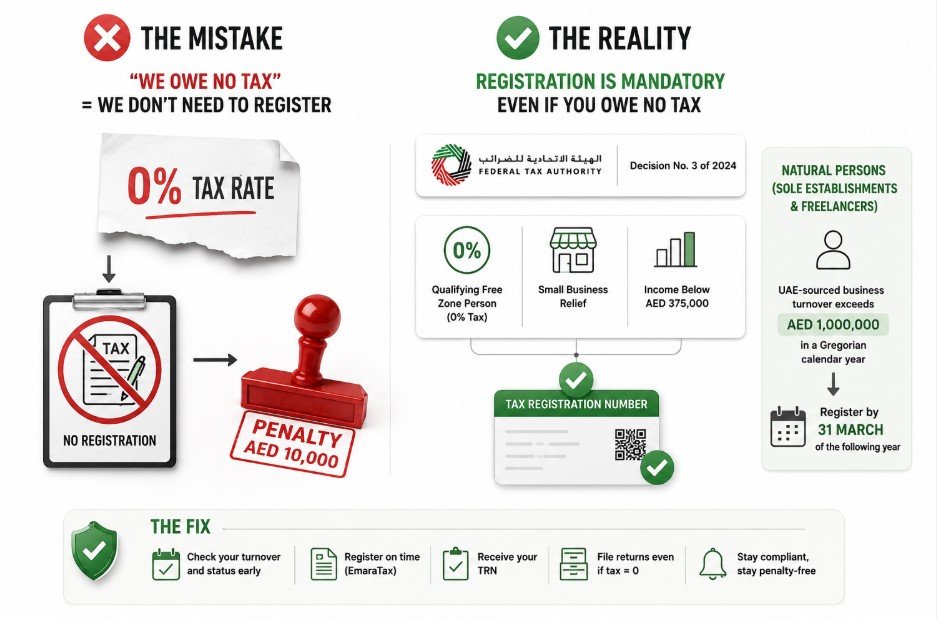
This is the mistake behind most of the AED 10,000 penalties the FTA has issued so far. Registration and tax liability are two separate legal obligations, and the AED 375,000 threshold sets the tax rate, not the duty to register. A business earning nothing above that threshold, a Qualifying Free Zone Person taxed at 0 percent, and a small business electing Small Business Relief are all still required to hold a Tax Registration Number, according to FTA Decision No. 3 of 2024. Founders who read “0% tax rate” and stop there are the ones the FTA finds first.
The same logic trips up sole establishments and freelancers. Once a natural person’s UAE-sourced business turnover exceeds AED 1,000,000 in a Gregorian calendar year, registration becomes mandatory by 31 March of the following year — a rule bookkeepers managing multiple small trade licences for one owner need to track per person, not per licence.
The fix
Treat registration as a compliance milestone that is completely independent from whether a tax bill is expected. If a trade licence exists, assume registration is required until an accountant confirms otherwise in writing — not the other way around.
2. Missing the Registration Window Tied to Licence Issuance
The second-most common trigger is timing. Companies incorporated from 1 March 2024 onward must register within three months of incorporation, while entities formed earlier were assigned staggered deadlines based on their trade licence issuance month. Under Cabinet Decision No. 10 of 2024, missing that window carries a fixed AED 10,000 administrative penalty — the same fine whether the business missed the deadline by one week or one year.
To incentivize timely compliance, the FTA offers a penalty relief window: businesses that missed their initial Corporate Tax registration deadline can still have the AED 10,000 penalty waived or refunded. The key requirement is filing the first Corporate Tax return within seven months from the end of the first tax period (e.g., by 31 July for a December 31 fiscal year-end, or by 31 January for a June 30 year-end). Moving early ensures entities secure this relief before the shortened filing window closes
| Deadline math bookkeepers should diarise Calendar-year business, financial year ending 31 December 2025: standard corporate tax return and payment due 30 September 2026 (nine months after year-end). Same business qualifies for the late-registration penalty waiver only if it filed by 31 July 2026 — two months earlier than the standard deadline. New incorporations from March 2024 onward: registration due within three months of the incorporation date, independent of the tax-period deadline. |
3. Treating Free Zone Status as an Automatic Tax Shield
A 0 percent rate under the Qualifying Free Zone Person (QFZP) regime only applies to Qualifying Income, not to every dirham the company earns. Income from mainland UAE clients, and revenue that fails the qualifying-activity test, is generally taxed at the standard 9 percent rate even while the company otherwise holds QFZP status. QFZP status itself requires five conditions to hold simultaneously, every tax period: juridical-person registration in a free zone, adequate substance, qualifying income from qualifying activities, staying inside the de minimis threshold for non-qualifying revenue, and compliant transfer pricing.
Related: Freezone vs Mainland UAE – The Real Cost Breakdown
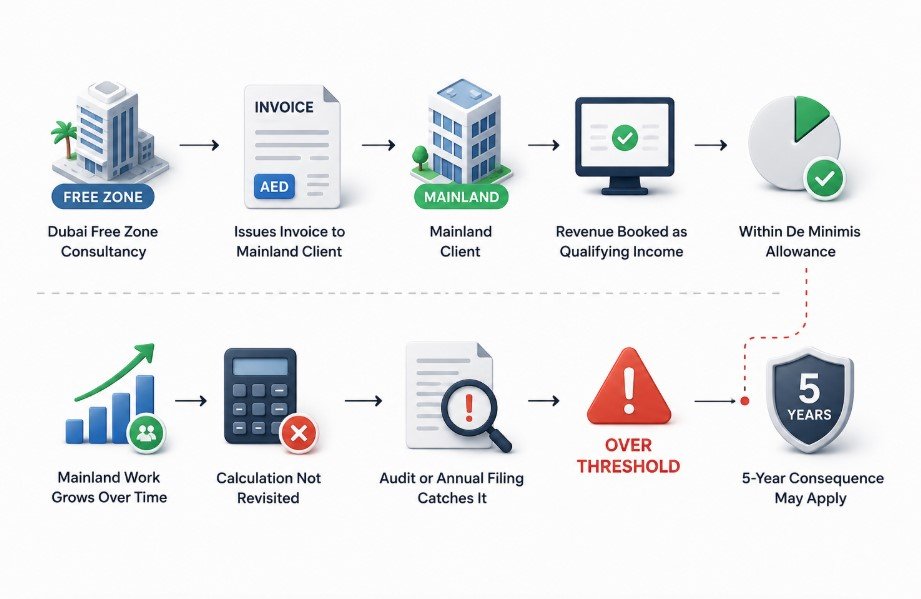
Fail any single condition and the consequence is not a one-year adjustment. The company loses QFZP status for that tax period and the following four — a five-year lockout at the standard rate on all income, even if the underlying issue is corrected the very next year. A management-fee invoice sent to a mainland affiliate, or a founder assuming a free zone licence alone guarantees 0 percent, is a common way this gets triggered without anyone noticing until an audit.
A typical version of this in practice: a Dubai-based free zone consultancy invoices a mainland client for a project, and that revenue is booked the same way as its qualifying free zone income without anyone flagging it separately in the accounts. On its own that single invoice might sit comfortably inside the de minimis allowance for non-qualifying revenue. The risk builds when mainland work becomes a growing share of the business and nobody revisits the calculation — by the time an audit or annual filing catches it, the company may already be over the threshold for the period, with the five-year consequence attached.
4. Believing “Nil Tax” Means “No Return to File”
The FTA has been explicit on this point: every taxable person files a full corporate tax return regardless of income level. A business with taxable income below AED 375,000 files at a 0 percent rate. A business electing Small Business Relief on revenue of AED 3 million or less still files, and must actively make the relief election inside the return each tax period — the relief is not automatic and does not carry over from a prior year without being re-elected.
Small Business Relief itself has a shelf life worth flagging to any client relying on it long-term: it currently applies only to tax periods ending on or before 31 December 2026, with no renewal confirmed at time of writing. A small business that has been comfortably filing at zero tax under the relief needs a plan for what happens once that window closes.
5. Weak Documentation Behind Claimed Expenses
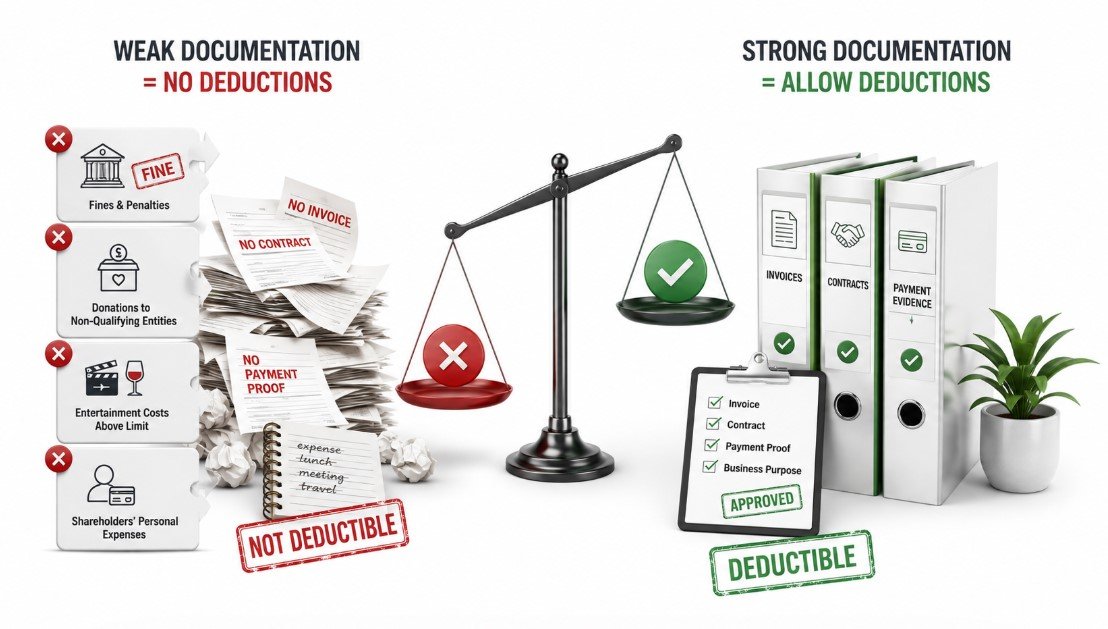
Deductions need a paper trail, not just a bookkeeping entry. Fines and penalties from UAE authorities, donations to non-qualifying entities, entertainment costs above the prescribed limit, and shareholders’ personal expenses run through the company are all non-deductible outright, and even legitimate business expenses are disallowed without invoices, contracts, and payment evidence connecting them to the claim.
Record-keeping failures carry their own penalty track, separate from any tax adjustment: AED 10,000 for a first violation and AED 20,000 for a repeat within 24 months — and critically, that fine applies per category of failure, not per audit. Missing transfer pricing files, incomplete expense receipts, and unreconciled intercompany transactions found in the same audit can stack into five-figure penalties from a single review. Records must be retained for at least seven years.
6. Ignoring Transfer Pricing on Local, Related-Party Transactions
Transfer pricing rules are widely misread as a multinational-only concern. They apply equally to transactions between related UAE companies — a holding company charging a subsidiary a management fee, or two commonly owned entities trading services, both need arm’s-length pricing support. Businesses above the revenue thresholds for cross-border related-party dealings must additionally prepare a Transfer Pricing Disclosure Form, and Master File and Local File documentation, which must be ready within 30 days of an FTA request even if not submitted with the return.
The FTA has clarified that a company will not automatically lose QFZP status purely because its financial statements did not reflect arm’s-length pricing, provided the correction is made through a proper transfer pricing adjustment in the return itself. That is a meaningful concession, but it only helps a business that catches the gap and documents the fix — it does not help one that never checked in the first place.
For a bookkeeper managing a small group structure, the practical habit worth building is simple: any time money moves between two commonly owned UAE entities — a loan, a shared service, a rent recharge, an intercompany sale — write down what an unrelated third party would have charged for the same arrangement, and keep that note with the transaction. It does not need to be a formal Master File for a small group below the disclosure thresholds, but an informal, contemporaneous record is the difference between a five-minute explanation during an audit and a drawn-out reconstruction of pricing logic from memory months or years later.
7. Filing Before the Numbers Are Actually Settled
A sequencing error shows up often enough to be its own category: companies file their corporate tax return before the audit of their financial statements is complete, then discover during the audit that income was misclassified between qualifying and non-qualifying, or that a deduction should not have been claimed. Audited financial statements are mandatory for QFZPs and for any taxable person outside a tax group with revenue above AED 50 million, and those audited accounts are the FTA’s primary evidence when it tests the de minimis threshold and income classification.
Errors caught after filing are not free to fix. A voluntary disclosure submitted before the FTA finds the issue carries interest of 1 percent per month on the tax difference from the original due date — cheaper than waiting to be caught, but still a real cost. Filing on time but paying late triggers a separate 14 percent annual late-payment charge, applied monthly on the outstanding balance, and a late-filed return accrues AED 500 for each of the first twelve months, rising to AED 1,000 a month after that.
What the Penalties Actually Add Up To
| Mistake | Typical FTA penalty |
| Late corporate tax registration | AED 10,000 fixed (waivable if first return filed within 7 months) |
| Late filing of return | AED 500/month, rising to AED 1,000/month after 12 months |
| Late payment of tax due | 14% per year, applied monthly on the unpaid balance |
| Record-keeping failure | AED 10,000 first violation; AED 20,000 per repeat within 24 months |
| Loss of QFZP status | 9% on all income for the current period plus the next four |
| Voluntary disclosure of an error | 1% per month on the tax difference from the original due date |
A Practical Checklist for MDs and Bookkeepers
- Confirm the company’s Tax Registration Number exists — even if the expected liability is zero.
- Diarise the registration deadline against the incorporation or licence-issuance date, not the tax-filing deadline.
- If Small Business Relief is being used, re-confirm the election inside every period’s return and plan for its 31 December 2026 expiry.
- Map free zone revenue by source — mainland versus free zone client — before assuming any of it qualifies for 0 percent.
- Keep invoices, contracts, and payment evidence filed against every claimed deduction for a minimum of seven years.
- Document related-party pricing on domestic transactions, not only cross-border ones.
- Wait for finalised, audited figures before filing where an audit is mandatory — do not file on estimates and correct later.
Frequently Asked Questions
Do I need to register for corporate tax if my business made no profit?
Yes. Registration is tied to holding a UAE trade licence or meeting the natural-person turnover threshold, not to whether the business turned a profit. A loss-making company, a company taxed at 0 percent below AED 375,000, and a company electing Small Business Relief are all still required to register and obtain a Tax Registration Number.
Can Small Business Relief be claimed automatically once revenue drops under AED 3 million?
No. The relief must be actively elected inside the corporate tax return for each tax period it applies to, and the business must still register and file even while claiming it. It is also currently scheduled to apply only to tax periods ending on or before 31 December 2026, so businesses relying on it should not assume it continues unchanged past that date.
Does a free zone licence guarantee a 0 percent tax rate?
No. Only income that meets the definition of Qualifying Income, earned through Qualifying Activities, by a company that satisfies all five Qualifying Free Zone Person conditions in that tax period, is taxed at 0 percent. Income from mainland clients or activities outside the qualifying list is generally taxed at 9 percent even for an otherwise compliant free zone company.
What happens if a mistake is found after the return has already been filed?
A voluntary disclosure filed before the FTA identifies the error carries a lower interest charge — 1 percent per month on the tax difference — than waiting for the FTA to find it during an audit, where penalties escalate further and can include the record-keeping and QFZP consequences described above. Correcting early is consistently the cheaper path.
The Bottom Line for Small Business Owners
None of these seven mistakes come from businesses trying to avoid tax. Almost every one traces back to the same root cause: treating a 0 percent rate, a relief scheme, or a free zone licence as the end of the compliance conversation rather than the start of it. The FTA’s own guidance is consistent on this point — registration, filing, and documentation are owed regardless of what the final tax bill turns out to be.
For a managing director or founder without an in-house tax specialist, the cheapest insurance is a short annual review with a UAE-licensed accountant before each filing deadline, not after a penalty notice arrives. Given how quickly a single missed registration or an undocumented management fee can compound into a five-figure penalty, that review pays for itself the first time it catches something.
Disclaimer: This article is for informational purposes only and does not constitute formal tax, legal, or financial advice. UAE tax regulations and FTA guidelines are subject to change. Always consult a qualified tax advisor or registered tax agent for specific guidance regarding your business.
Related : Free Dubai Freezone Finder + Guide to Picking the Right Zone