For the better part of two decades, getting between Abu Dhabi and Dubai has meant one thing: sitting in a car on Sheikh Zayed Road, checking your mirror, and accepting that the 140-kilometre drive is going to take somewhere between 60 minutes and two hours depending on the day, the hour, and your general relationship with traffic.
That is about to change.
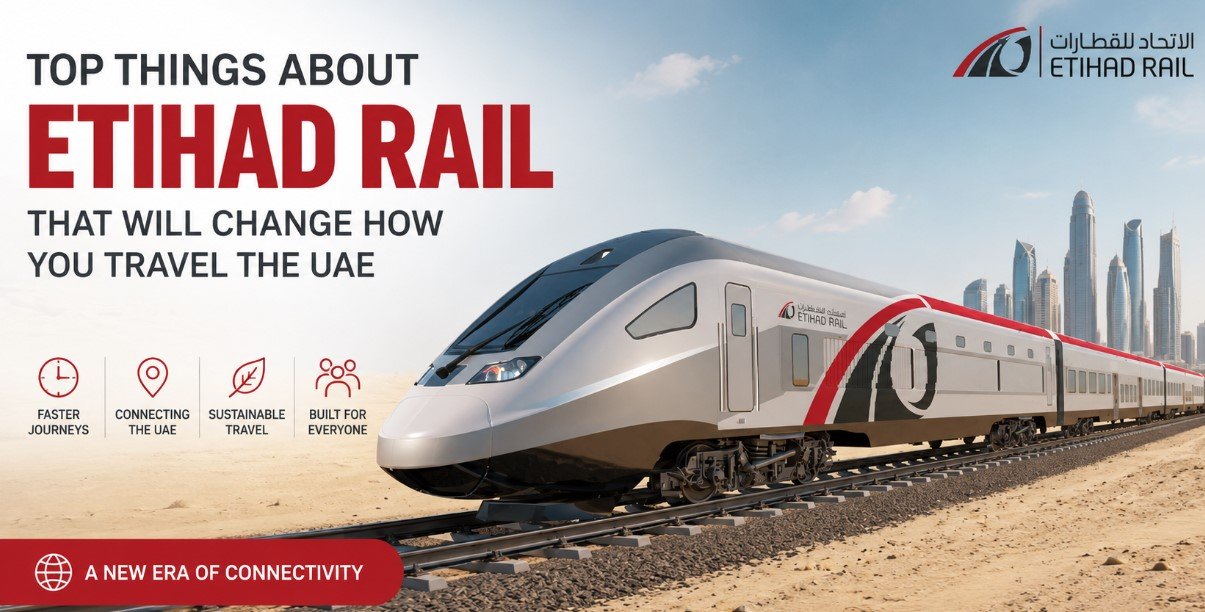
Etihad Rail’s passenger service is launching in 2026. The network has been in planning and construction since 2009, the freight side has been operational since 2023, and the passenger phase — the part that will actually affect the daily lives of residents and the travel decisions of tourists — is finally coming. Stations have been completed, trains have been tested, and an operating agreement has been signed with global transport firm Keolis.
This isn’t the kind of story that’s easy to summarise in a headline. The implications run from the obvious (faster journeys, no parking) to the genuinely unexpected (mountain tunnels, luxury rail cruises, property price shifts near stations).
Related: Etihad Rail Guide: The Complete Guide to Tickets and Routes
Top 10 Things About Etihad Rail
Here are ten things about Etihad Rail that will actually change how you travel in the UAE — not as a press release, but as a practical guide to what’s happening and why it matters.
1. Dubai to Abu Dhabi in 57 Minutes — Not 90
The flagship number is 57 minutes. That’s the confirmed travel time between Dubai and Abu Dhabi on the Etihad Rail passenger service, with trains operating at up to 200 km/h. For context, Khaleej Times’ in-depth route breakdown confirmed these timings alongside the onboard experience details following a media preview in May 2026.
Most people who drive between the two cities regularly know that 57 minutes is faster than almost any real-world road journey between the two city centres — without a traffic event. On a bad day, the same trip takes 2 hours. The train doesn’t have bad days. It runs on a fixed schedule, at a fixed speed, with no school traffic, no accidents in the fast lane, and no Salik charges stacking up along the way.
Abu Dhabi to Fujairah sits at 105 minutes by rail. Abu Dhabi to Al Ruwais in the west takes approximately 70 minutes. Sharjah to Dubai — a stretch that residents know can take anything from 20 minutes to well over an hour — drops to roughly 15 minutes. For anyone who commutes between emirates for work, these numbers represent a real shift in how mornings and evenings look.
| Journey Times at a Glance (Phase 1) Dubai → Abu Dhabi: 57 minutes Abu Dhabi → Fujairah: 105 minutes Abu Dhabi → Al Ruwais: ~70 minutes Sharjah → Dubai: ~15 minutes All routes: up to 200 km/h | Time saving vs. driving: 30–40% |
2. The Network Covers All Seven Emirates — Eventually
Phase 1 — launching in 2026 — connects Abu Dhabi, Dubai, and Fujairah, with the first confirmed station locations in Mohammed Bin Zayed City (Abu Dhabi), Jumeirah Golf Estates (Dubai), University City (Sharjah), and the Al Hilal area of Fujairah. Dubai’s station location report from May 2026, additional stations at Al Sila’, Al Dhannah, Al Mirfa, Madinat Zayed, Mezaira’a, Al Faya, and Al Dhaid are planned for phased opening.
The full network spans 900 kilometres, stretching from Al Ghuweifat on the Saudi border all the way east to Fujairah on the Arabian Sea coast. Once complete, it will link 11 cities across all seven emirates — a genuine national transport backbone, not a single-corridor service.
For residents of areas that have historically been car-dependent for any inter-emirate journey, this is significant. University City in Sharjah getting a station is a particular example: it puts tens of thousands of students and staff within direct rail access of both Dubai and Abu Dhabi, without a car.
3. Three Travel Classes — Including a Proper First Class
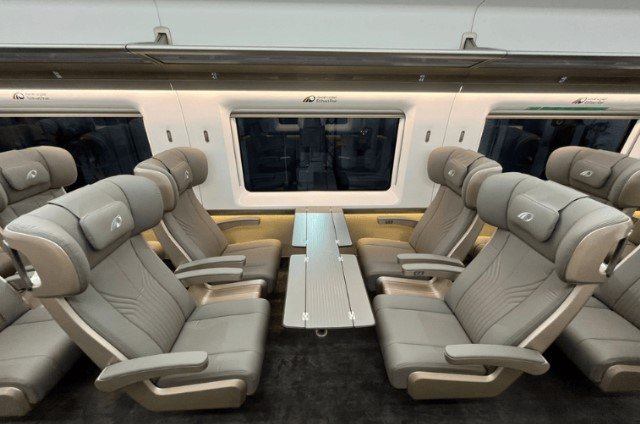
The train isn’t a single-class commuter service. The passenger trains confirmed three travel classes: Economy, Family, and First Class.
Economy class features compact dark-grey seats arranged for everyday commuters — functional, with charging ports and foldable tray tables. Family class takes a different approach: opposing seats around a shared table, designed specifically for groups travelling together. First class offers wider, reclining seats with additional legroom, overhead storage, and a more separated cabin feel.
All seats across every class include charging ports and power outlets. Onboard Wi-Fi is confirmed throughout. There will be onboard dining carriages, and the stations themselves will feature retail spaces, VIP lounges, and family-friendly amenities. Stations are being designed with Emirati heritage influences — the architecture, at least at the Fujairah station, reflects the surrounding landscape rather than the generic transit-hub aesthetic that could have easily been the default.
The presence of a genuine First Class option also signals the pricing ambition: this isn’t being positioned as a budget alternative to driving, but as a premium travel choice that competes with the experience of the journey, not just the destination.
4. Nine Mountain Tunnels and a 40-Metre Bridge
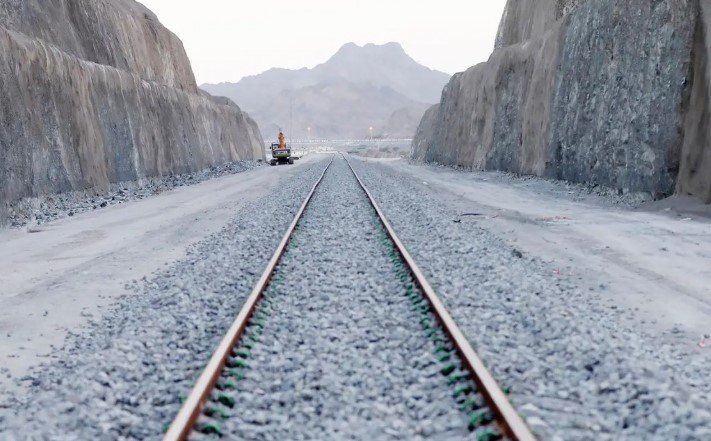
The Fujairah route does something no other public transport link in the UAE currently offers: it cuts through the Hajar Mountains. Nine tunnels passing through the mountains with a combined length of 6.9 kilometres — the longest tunnel series of its kind in the region.
The visual experience along this stretch includes sweeping views of the Hajar range, the Sheikh Zayed Mosque in Fujairah, Al-Bithnah Fort, and rolling farmland and date palm groves in the valleys between towns. For anyone who has only ever seen Fujairah by road — which involves a flat highway until the mountains appear abruptly — the rail perspective is genuinely different.
The Al Bithnah Bridge is the headline engineering feature: 40 metres tall and more than 600 metres long, it’s the highest structure in the entire Etihad Rail network. During the media preview, the train paused on the bridge to let journalists take in the view. That single detail says something about how the operators are thinking about the journey, not just the destination.
| Engineering Highlights Network length: 900+ kilometres (full build-out) 9 mountain tunnels through the Hajar range (cumulative 6.9 km) Al Bithnah Bridge: 40 metres tall, 600+ metres long — highest structure in the network Train capacity: 400 passengers per train 13 trains in fleet (10 delivered and certified as of May 2026) Operator: Keolis (signed agreement 2025) |
5. The Freight Side Has Already Removed 340,000 Truck Journeys
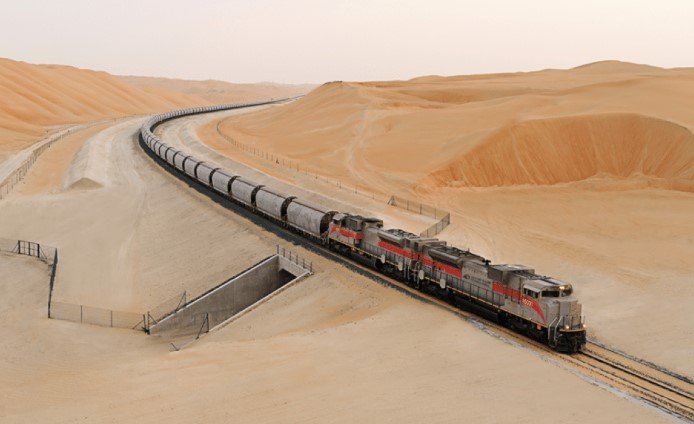
Most coverage of Etihad Rail focuses on the upcoming passenger service, which is understandable. But the freight operation that has been running since 2023 gives a useful preview of what the network can actually do at scale — and the numbers are striking.
According to statements made at Make it in the Emirates 2026 by Adhraa Almansoori, Director of Public Policy and Sustainability at Etihad Rail, the network has transported 1.8 million tonnes of sulphur, more than 4 million tonnes of aggregates, and over 129,000 containers in 2026 alone. More significantly for road users: it has eliminated more than 340,000 truck journeys from UAE roads in the process.
Each freight train effectively replaces up to 300 trucks per journey. For anyone who has driven the Abu Dhabi-Dubai highway and watched the endless line of heavy goods vehicles in the right lane, the reduction in freight traffic on the road network is something that will eventually be felt even by those who never board a passenger train.
The freight network is directly connected to Khalifa Port, Jebel Ali Port, and the Industrial City of Abu Dhabi (ICAD), as well as 11 logistics stations including four major ports. The infrastructure is built. The passenger service is joining a network that is already in active daily use.
6. Carbon Emissions Cut by 70–80% Per Trip vs. Driving
The UAE has committed to net zero by 2050. Etihad Rail is one of the more tangible pieces of that plan.Every customer that has shifted freight from road to rail has reported 70 to 80 per cent reductions in CO₂ emissions per trip.
Scaled up across the whole network, the long-term projection is a 21 per cent reduction in CO₂ emissions from the UAE’s land transport sector by 2050 — equivalent to removing approximately 8.2 million tonnes of carbon per year from the atmosphere. For individual passengers, this translates simply: taking the train from Dubai to Abu Dhabi instead of driving has roughly the same environmental logic as it does in any country with mature rail infrastructure.
Etihad Rail has gone further than most operators on this. The company launched the region’s first Carbon Emission Avoidance and Reduction Certificates, powered by the globally recognised EcoTransIT measurement tool, allowing businesses using freight services to formally quantify and report their emissions savings. For corporate travel policies increasingly shaped by ESG requirements, the passenger equivalent of this will eventually matter.
Seventy per cent of construction materials used in developing the network were sourced locally through 97 domestic suppliers — a figure that matters both for the sustainability argument and for the national economic story the project is designed to tell.
| 70–80% CO₂ emission reduction per trip vs. road — confirmed by Etihad Rail freight customers |
7. A Luxury Rail Cruise Experience Is Coming — Through the Liwa Desert
Alongside the standard passenger service, there’s a second track — literally and figuratively. In 2023, Italian luxury hospitality company Arsenale signed an agreement with Etihad Rail to operate what will be one of the first luxury rail cruise experiences in the world on the UAE network.
The luxury train is expected to feature 15 coaches with interiors produced in specialised factories in Puglia and Sicily in southern Italy. The route will travel through Abu Dhabi, Dubai, and Fujairah — and eventually extend to Oman — passing through the Liwa Desert with dune views, mountain landscapes, and seascapes along the way.
This is a different product category from the standard inter-emirate commuter service. It’s designed for travellers who want the journey to be the experience — not the most efficient way to get from one place to another, but a considered, slow, visually immersive trip through terrain that most people in the UAE only ever see from a car window at 120 km/h. In a region where luxury hospitality is deeply understood, a rail product pitched at that same audience makes obvious commercial sense.
No launch date has been announced for this element specifically. But the agreement is signed, the design direction is confirmed, and the infrastructure it needs is the same network launching for standard passengers this year.
8. A Separate 30-Minute High-Speed Line Between Abu Dhabi and Dubai
There’s a second, faster project sitting alongside the main network — and it changes the math entirely for the Abu Dhabi-Dubai corridor.
In January 2026, at the Al Faya Depot in Abu Dhabi, Sheikh Khaled bin Mohamed bin Zayed Al Nahyan and Sheikh Hamdan bin Mohammed bin Rashid Al Maktoum jointly announced a new high-speed train project that will connect Abu Dhabi and Dubai in 30 minutes, operating at up to 350 km/h. Tenders for project contracts have been issued and network designs have been approved.
The standard Etihad Rail service running at 200 km/h brings the journey down to 57 minutes. This dedicated high-speed corridor, once built, would cut it to 30 minutes — a figure that genuinely changes the calculus for living in one emirate and working in the other. Abu Dhabi residents accessing Dubai Media City or Business Bay in under 40 minutes door-to-door becomes a realistic daily scenario. The same for Dubai residents heading to Abu Dhabi’s financial district.
This project is separate from the 2026 passenger launch and doesn’t yet have a confirmed completion date. But the announcement at that level, with tenders already moving, places it firmly in the “happening” rather than “aspirational” category.
9. Integrated With Metro, Buses, and Flying Taxis
A train network in isolation solves only part of the inter-emirate travel problem. The Etihad Rail team has been public about the “first and last mile” challenge — getting people from where they live to the station, and from the station to where they’re actually going.
The confirmed plan is for stations to integrate with metro lines, RTA bus feeder routes, and taxi connections across all connected cities. Dubai’s station at Jumeirah Golf Estates will connect to the metro network. Sharjah’s station at University City sits within an existing transit corridor.
More ambitiously, Digital Dubai’s transport integration briefing referenced skyports — dedicated flying taxi landing pads — being planned at major rail stations as part of the 2026 mobility rollout. If that materialises, the combination of a rail station and an air taxi skyport in the same location would represent a level of transport integration that most developed cities are still working toward.
None of this is seamless on day one. Integration of any kind takes time to bed in, and feeder routes will develop as ridership patterns become clear. But the design intent is multimodal from the ground up — not an add-on to an existing train project.
10. Property Prices Near Stations Are Already Shifting
This one is worth paying attention to whether you’re a buyer, a renter, or simply someone watching how Dubai’s neighbourhoods are evolving.
The station at Jumeirah Golf Estates in Dubai has already attracted investor attention. Properties within proximity to Etihad Rail stations are broadly expected to see 10–25% appreciation over the medium term. The pattern is consistent with every major rail launch globally: areas that gain direct connectivity to employment and commercial centres see land and property values adjust upward, often well before trains start running.
For renters, the implication is slightly different. Neighbourhoods that were previously undervalued due to their distance from city centres — particularly in areas like Al Dhaid in Sharjah, or communities along the Abu Dhabi western corridor — become more practically liveable once rail access exists. That tends to increase demand, which increases rents. The areas absorbing the most new interest right now are those where the station locations have been confirmed but development hasn’t yet followed.
For anyone making housing decisions in 2026 and beyond, proximity to an Etihad Rail station has entered the same conversation as proximity to a Dubai Metro stop — an infrastructure factor with real, measurable influence on how a location functions in daily life.
So What Should You Actually Do with This Information?
A few practical things worth knowing as the passenger service gets closer to launch.
Tickets and schedules
As of late May 2026, ticket pricing and timetables have not been publicly confirmed. Etihad Rail’s Executive Director of Commercial, Adhraa Al Mansoori, told media during the Fujairah station preview that travel schedules will be announced through official channels closer to the operational launch date. The official Etihad Rail website and app will be the first source. Watch those, not third-party resellers.
Where Dubai’s station actually is
The Dubai station is confirmed at Jumeirah Golf Estates — not in the city centre. That location is deliberate (proximity to a large residential community with metro access), but it means the station isn’t a short walk from Business Bay or Downtown. Plan for an interchange with the metro or a short taxi ride for the final leg into central Dubai.
The commuter case
If you currently commute between Abu Dhabi and Dubai by car — particularly on the Sheikh Zayed corridor — the 57-minute service is worth doing the maths on. Add up the monthly Salik charges, parking fees, fuel, and the actual time cost of driving. The train removes all three. Monthly pass pricing hasn’t been confirmed, but the operating model strongly suggests there will be one.
Tourists
The most underappreciated angle for visitors to the UAE is that Etihad Rail makes the country genuinely navigable without a car hire. Dubai, Abu Dhabi, and Fujairah — three meaningfully different destinations covering beach, desert, and mountain — become a manageable multi-city trip on a single network. That’s a different kind of UAE itinerary from the one most travel guides currently describe.
The Bigger Picture
The UAE built its modern identity on the car. The highway was the artery, the interchange the centrepiece, and driving culture so embedded that most residents have never seriously considered any other way to get between Abu Dhabi and Dubai. Etihad Rail doesn’t dismantle that — the roads aren’t going anywhere — but it adds an alternative that, for the first time, is competitive on time, more comfortable on most metrics, and substantially better on environmental cost.
That’s a quiet kind of shift. It doesn’t arrive with fanfare on a single day. It starts with a train running between three cities, and it accumulates — in commuting habits, in property choices, in the kinds of weekend trips people decide are worth making. The rail opens in phases, the network grows in phases, and the change in how people navigate the UAE follows the same rhythm.
But it starts in 2026. And that’s close enough to start paying attention now.
Quick Reference: The 10 Things at a Glance
| # | Topic | The key fact |
| 1 | Journey times | Dubai → Abu Dhabi in 57 min. Sharjah → Dubai in ~15 min. |
| 2 | Network scale | 11 cities, all 7 emirates, 900 km from Al Ghuweifat to Fujairah |
| 3 | Travel classes | Economy, Family, and First Class — all with Wi-Fi and charging |
| 4 | Mountain tunnels | 9 tunnels, 6.9 km total length. Al Bithnah Bridge: 40 m high |
| 5 | Freight already running | 340,000+ truck journeys eliminated; 129,000+ containers moved in 2026 |
| 6 | Carbon savings | 70–80% CO₂ reduction per trip vs. driving. 8.2M tonnes/yr by 2050 |
| 7 | Luxury rail cruise | Arsenale (Italy) luxury train: Liwa Desert to Oman. 15 coaches |
| 8 | High-speed future line | 30-min Abu Dhabi–Dubai corridor at 350 km/h. Tenders issued Jan 2026 |
| 9 | Transport integration | Metro, RTA buses, taxis, and flying taxi skyports at stations |
| 10 | Property impact | Stations already shifting investor interest; 10–25% appreciation expected |
📌 Disclaimer: The Etihad Rail passenger network is scheduled to launch its initial phases later this year (2026). The routes, station locations, and travel times listed below are based on the latest official announcements from Etihad Rail and are subject to change as the network transitions from testing to full public operations.