| ⏱ Prep Time 5 minutes | ☕ Brew Time 15–20 min | 🍵 Yield 4–6 small cups | 📊 Difficulty Easy |
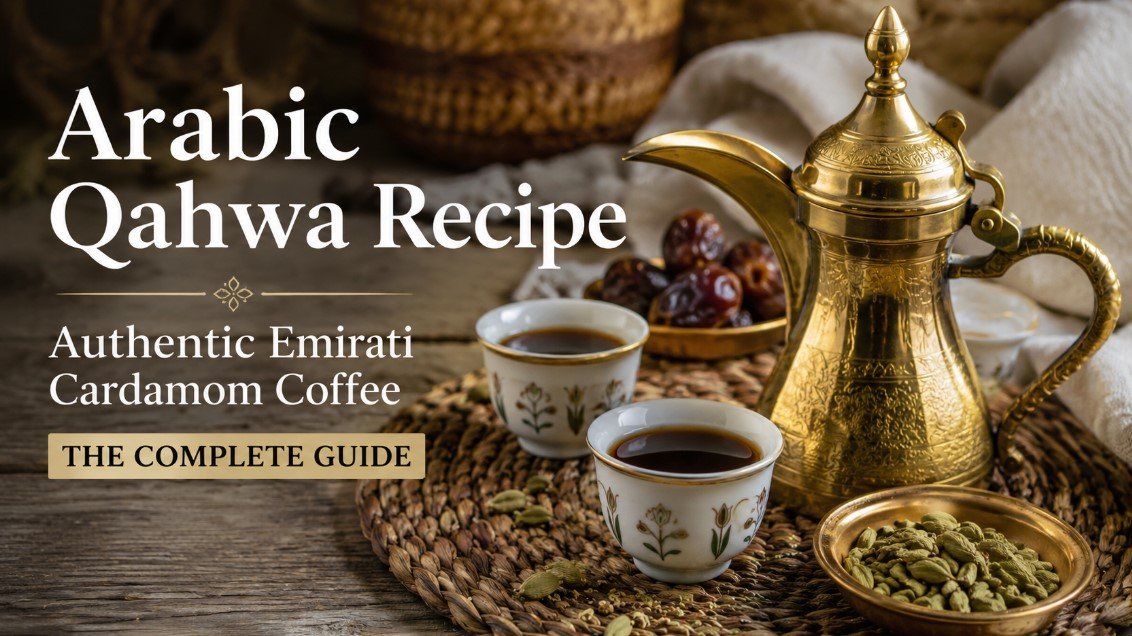
There is a ritual before the ritual in every Emirati gathering. Before the machboos is served, before the dates are passed, before the conversation settles into something unhurried — qahwa arrives. It comes in a dallah, the long-spouted brass or steel pot that has been the symbol of Gulf hospitality for centuries, and it is poured into small, handle-less cups called finjaan. You drink it in two or three sips. You hold the cup out when you want more. You cover it with a gentle shake when you’ve had enough. None of this is explained to guests — it is simply understood.
Qahwa — the Arabic word for coffee itself — is not the thick, dark brew that most Western coffee drinkers imagine when they hear ‘Arabic coffee.’ It is pale gold, almost translucent, lightly roasted and deliberately delicate. The flavour comes from cardamom primarily, with saffron adding colour and a floral whisper, and rose water (when used) softening the finish into something genuinely beautiful. It contains no sugar and no milk. The culture of qahwa preparation and serving was inscribed on the UNESCO Intangible Cultural Heritage list in 2015, recognising it as a shared practice across the UAE, Saudi Arabia, Qatar, Oman, Kuwait, and Bahrain.
This recipe makes the Emirati version specifically — distinguished from the Saudi style by its lighter hand with spices and its omission of cloves, and from the Yemeni version by the absence of ginger. The method takes 20 minutes. The patience and intention behind it take a lifetime to understand fully, but a first attempt made with quality ingredients and genuine attention will produce something worth serving.
| 🏺 The Dallah — What It Is and Whether You Need One A dallah is a traditional long-spouted coffee pot used across the Gulf. It is not required for making excellent qahwa — a small saucepan and a fine strainer produce identical results. But if you want to serve qahwa properly, pouring from a dallah into finjaan cups (small, handle-less cups) is the correct presentation. Both are available at the Deira Gold Souk and in kitchenware shops across Dubai for AED 30–150. |
A Brief History of Qahwa in the Gulf
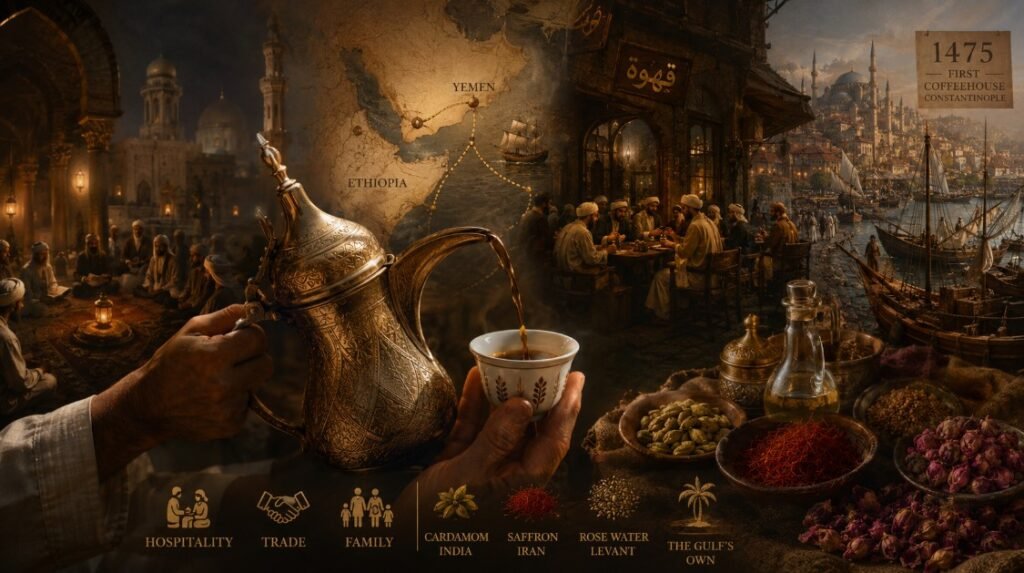
Coffee reached the Arabian Peninsula from Ethiopia via Yemen in the 15th century, and for the first two hundred years of its presence in the Arab world it was associated primarily with Sufi religious practice — a stimulant that helped devotees maintain the long nighttime prayers that were central to their tradition. By the 16th century it had spread into the public sphere: the world’s first coffeehouse is generally traced to Constantinople in 1475, but coffeehouses had been operating in Mecca and Medina for decades before that.
In the Gulf specifically, qahwa became formalised as a language of hospitality that transcended tribal and class boundaries. A ruler who received a visitor offered qahwa. A merchant sealing a trade deal offered qahwa. A family welcoming a stranger offered qahwa. The act of pouring it — always with the left hand supporting the dallah, always filling the cup only one-third full to signal that refills are expected — became as ritualised as the coffee itself.
The UAE’s version evolved over the same centuries of trade that brought Persian, Indian, and East African influences into the Gulf. Cardamom arrived via the Indian Ocean spice trade. Saffron came overland from Iran and Afghanistan. Rose water — distilled from the Damascus rose — reached the Gulf through Levantine merchants. Each addition was absorbed and made Emirati, and the version that exists today is neither fully Persian, nor Indian, nor Arab in origin. It is the Gulf’s own.
Arabic Qahwa Recipe Ingredients
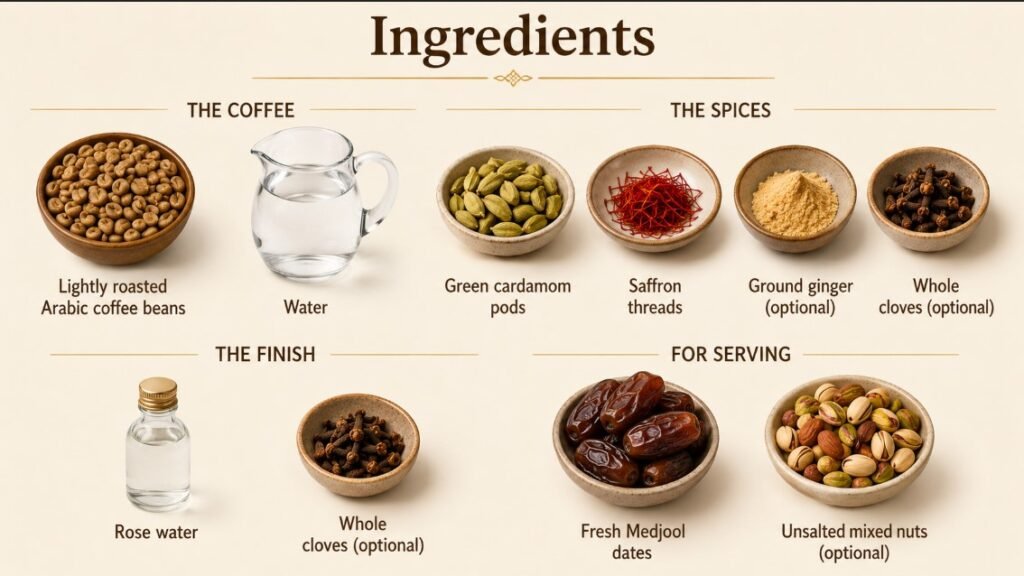
Qahwa is made from very few ingredients. The quality of each one is disproportionately important. The coffee bean choice especially — which I cover in detail below — determines the character of the entire brew.
| Ingredient | Quantity | Notes — Why It Matters |
| THE COFFEE | ||
| Lightly roasted Arabic coffee beans | 3 tbsp (ground coarse) | The defining ingredient. Use Yemeni Arabica or pre-ground Arabic coffee (look for the pale gold packaging in UAE supermarkets). Do not substitute with dark espresso roast — it produces a bitter, heavy result completely unlike qahwa. |
| Water | 3 cups (750 ml) | Use filtered or bottled water if your tap water is heavily chlorinated — the delicacy of qahwa means the water base is more noticeable than in stronger coffees. |
| THE SPICES | ||
| Green cardamom pods | 8–10 pods, lightly crushed | The non-negotiable spice of Emirati qahwa. Crush just enough to crack open the pod and release the seeds. Freshly crushed gives a floral, citrus quality that pre-ground powder cannot match. |
| Saffron threads | 10–15 threads | Steeped separately in 1 tbsp warm water for 5 minutes before adding. Gives the qahwa its characteristic golden colour and a subtle floral depth. Use real saffron — artificial versions add colour without flavour. |
| Ground ginger (optional) | ¼ tsp | Not traditional in the Emirati version but common in Yemeni-influenced households in the UAE. Adds a gentle warmth. Omit for the purist Emirati style. |
| THE FINISH | ||
| Rose water | 1 tsp | Added off the heat only — rose water aromatics vanish with heat. Persian brands are most fragrant. Optional but recommended for the full Emirati experience. |
| Whole cloves | 2 (optional) | Omitted in the authentic Emirati version but used in Saudi qahwa. Include if you prefer a more assertive spice profile. |
| FOR SERVING | ||
| Fresh Medjool dates | 6–8 | The only appropriate accompaniment for qahwa. The sweetness of the date is the “sugar” of this drink — you do not sweeten the coffee itself. |
| Unsalted mixed nuts (optional) | Small bowl | Offered alongside qahwa at formal gatherings — pistachios, almonds, pine nuts. |
☕ On the Coffee Beans The most important thing about qahwa beans is the roast level — it must be light to medium, never dark. Traditional Arabic coffee is made from beans roasted to a pale gold-green colour that would horrify a European barista.
This light roast preserves the bean’s natural floral and fruity qualities and produces a clean, gentle flavour rather than the bitter robustness of espresso. In the UAE, look for pre-ground Alwazah, Najjar, or Nescafé Arabic Coffee — all widely available at Carrefour, Spinneys, and Lulu Hypermarket. Alternatively, buy lightly roasted Yemeni Arabica beans from specialty coffee shops in Al Quoz or Alserkal Avenue and grind them coarsely at home.
Method: Step by Step
The process for qahwa is simpler than most recipes suggest. There is no specialist equipment required beyond a small saucepan, a fine strainer, and ideally a dallah or small teapot to pour from. The entire brew takes under 20 minutes from cold water to cup.
| 1 | Bloom the Saffron Combine the saffron threads with one tablespoon of warm water in a small cup. Set aside for five minutes. The water will turn a rich amber-gold and the threads will soften. This separate blooming step ensures the saffron colour and flavour distributes evenly through the qahwa rather than sitting in a concentrated patch near where the threads were added. Do not skip this step — adding dry saffron threads directly to the pot produces uneven colour and wastes the spice. |
| 2 | Bring the Water to a Gentle Boil Pour the water into a small, heavy-bottomed saucepan. Bring to a full boil over medium heat. The moment it reaches a rolling boil, reduce the heat to low. You want a steady simmer — small bubbles breaking the surface — not an aggressive boil, which drives off the aromatic compounds you are about to add and makes the coffee taste thin and flat. |
| 3 | Add the Coffee and Cardamom Add the coarsely ground coffee and the crushed cardamom pods to the simmering water. Stir once with a wooden spoon — never metal, which can react with the coffee oils and add an unpleasant metallic note. Allow to simmer uncovered on the lowest heat for 10 minutes. Do not let it return to a full boil. The qahwa should deepen in colour from pale yellow to a warm amber-gold as the coffee and cardamom infuse. The kitchen will smell extraordinary within the first three minutes. |
| 4 | Add the Saffron Bloom and Rest Pour the saffron-steeped water (including the softened threads) directly into the simmering qahwa. Stir gently. Continue simmering for a further three minutes — the saffron needs gentle heat to release its full colour and flavour but should never be boiled hard. Remove from heat. Allow the qahwa to rest undisturbed for two minutes. The coffee grounds and cardamom pods will settle to the bottom during this rest, making straining cleaner and producing a clearer cup. |
| 5 | Strain and Add Rose Water Pour the qahwa through a fine mesh strainer into your dallah or serving pot, pressing gently on the grounds to extract any remaining liquid. Discard the grounds and cardamom pods. Add the rose water now, directly into the strained coffee. Stir once. The rose water is added off the heat specifically because its aromatic compounds — geraniol, citronellol — are highly volatile and evaporate at temperatures above 60°C. Adding it cold to the hot strained coffee preserves the floral note that makes qahwa taste distinctly Emirati rather than simply spiced coffee. |
| 6 | Serve Immediately Pour into small finjaan cups, filling each only one-third full. This is not stinginess — it is the signal that refills are forthcoming and expected. Place a small dish of Medjool dates alongside. In traditional Emirati hospitality, qahwa is poured by the host and refilled silently whenever a guest’s cup is empty. A guest who has had enough covers the cup with their fingers or gives it a small shake — this gesture (called takhfif in Arabic) signals politely to the host that no more is needed. |
Technique: What Separates Good Qahwa from Great Qahwa
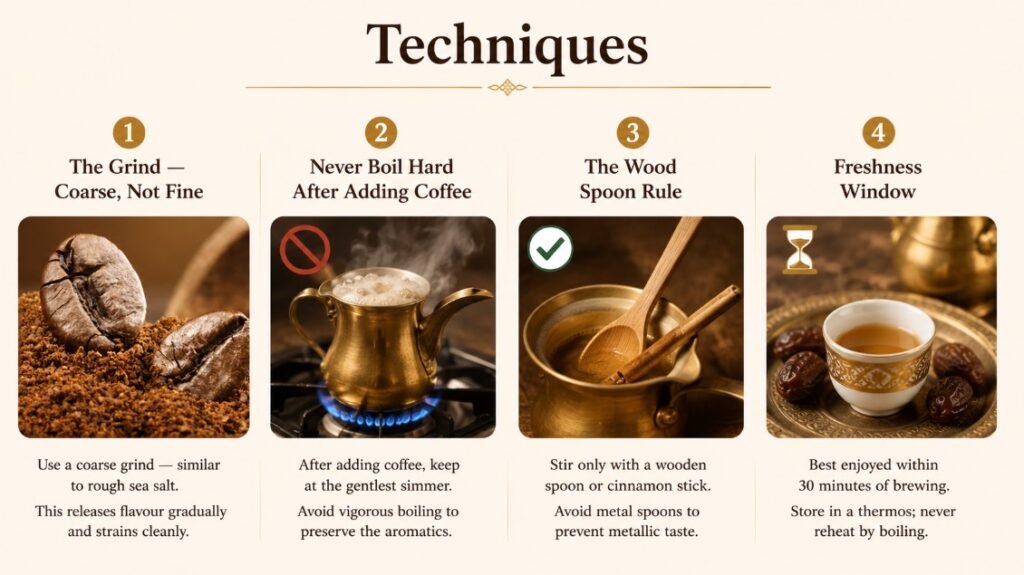
The Grind — Coarse, Not Fine
Arabic coffee is brewed by simmering, not filtering under pressure. A fine grind produces a murky, over-extracted result with a powdery residue that straining cannot fully remove. The correct grind is coarse — similar to rough sea salt or coarsely ground black pepper. At this size, the grounds release their flavour gradually during the simmer, producing a clean, clear brew that strains easily. If buying pre-ground Arabic coffee, this is already calibrated correctly.
Never Boil Hard After Adding Coffee
The most common mistake in home qahwa preparation is maintaining a hard boil after the coffee is added. Vigorous boiling drives off the volatile aromatic compounds in both the cardamom and the coffee itself — compounds that cannot be replaced and that are the entire point of the brew. Once the coffee enters the pot, the heat must drop to the gentlest possible simmer. This is not instinctive for people used to making strong coffee, but it is non-negotiable for qahwa.
The Wood Spoon Rule
Stir qahwa only with a wooden spoon or a cinnamon stick. Metal spoons — particularly stainless steel — can impart a subtle metallic flavour when in contact with coffee’s natural acids. The difference is small but perceptible in a beverage as delicate as qahwa. Wooden spoons are available everywhere; cinnamon sticks are in every UAE spice drawer. There is no reason to use metal.
Freshness Window
Qahwa is at its best in the 30 minutes after brewing. Beyond that, the saffron colour begins to deepen towards orange-red and the rose water note fades entirely. If you need to hold it longer, transfer to a thermos — the insulation maintains temperature and slows oxidation. Qahwa should never be reheated in the saucepan, which re-boils the liquid and destroys what remains of the aromatics. If reheating is necessary, warm very gently in a bain-marie or microwave at 50% power.
| 🇦🇪 How to Serve Qahwa at a Gathering In Emirati tradition, qahwa is always served before food, not after. The host pours from the dallah with their right hand, holding the pot with three fingers and supporting it from below with the left hand. The guest receives the finjaan with the right hand. The cup is filled only one-third full — never to the brim. When a guest has had enough, they cover the cup with their palm or give a small shake. This exchange is one of the most recognisable social codes in Gulf culture and is practised identically whether the setting is a formal majlis or a family kitchen. |
Related : Dubai Chocolate Bar Recipe – The Complete Homemade Guide
Variations Across the UAE and Gulf
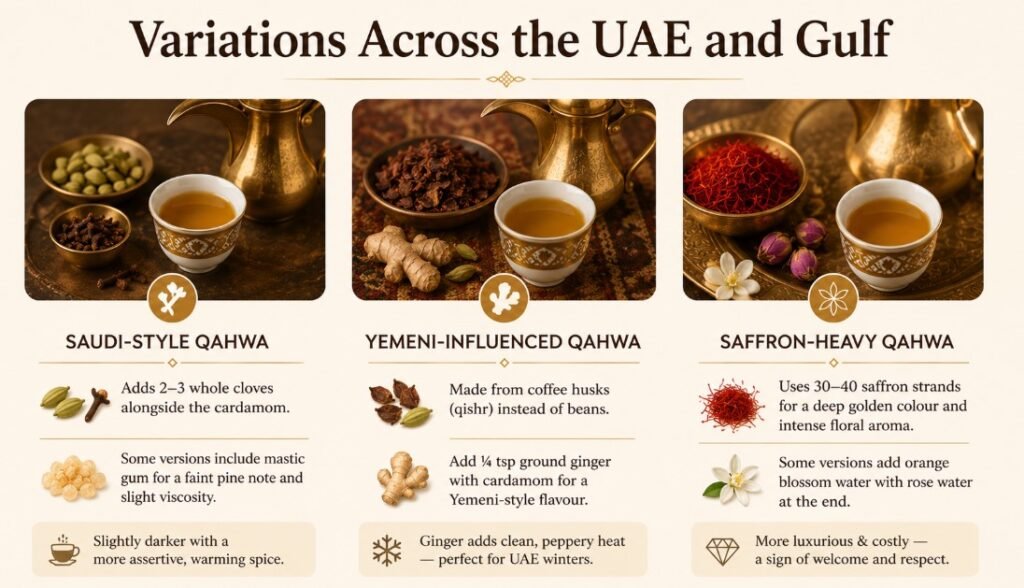
Saudi-Style Qahwa
Saudi qahwa adds 2–3 whole cloves alongside the cardamom, which gives it a more assertive, warming spice character. Some Saudi versions also include a small piece of mastic gum (Pistacia lentiscus resin), which adds a faint pine note and slight viscosity to the brew. This version is slightly darker than the Emirati style. If you have Saudi guests, including the cloves is a gesture of cultural recognition they will notice.
Yemeni-Influenced Qahwa
Yemeni communities in Deira and Bur Dubai brew a related drink called qishr, made from coffee husks (the dried skins of the coffee cherry) rather than the beans themselves. Add ¼ tsp of ground ginger alongside the cardamom for a version closer to what you will find in Yemen-influenced cafés in Deira’s Al Ras district. The ginger adds a clean, peppery heat that works particularly well in the cooler UAE winter months.
Saffron-Heavy Qahwa
For weddings, Eid gatherings, and significant occasions, the saffron quantity is increased substantially — up to 30–40 strands rather than the everyday 10–15. The result is a deeply golden brew with a pronounced floral character that is visually striking in the finjaan. Some formal versions also add a small amount of orange blossom water alongside the rose water at the end. This version is noticeably more expensive to produce (quality saffron is costly) and is understood by Emirati guests as a statement of welcome and respect.
Troubleshooting
| Problem | Likely Cause | The Fix |
| Qahwa tastes bitter | Water too hot; over-extracted | Keep heat at lowest simmer after adding coffee; reduce brew to 8 min |
| No colour — pale and flat-looking | Saffron not properly bloomed; too few threads | Bloom in warm water for 5 full min; increase to 15 threads |
| Tastes flat — no floral note | Rose water added while still boiling | Add rose water only to the strained, off-heat coffee |
| Cloudy / grainy texture | Grind too fine; insufficient rest before straining | Use coarse grind; rest 2 min after heat-off before straining |
| Cardamom overpowers everything | Too many pods or over-crushed | Use 8 pods max; crack lightly — seeds stay inside the pod |
| No aroma on first sip | Coffee beans are stale or too dark a roast | Buy fresh, lightly roasted Arabic coffee; store sealed away from light |
Serving, Pairing and Storage
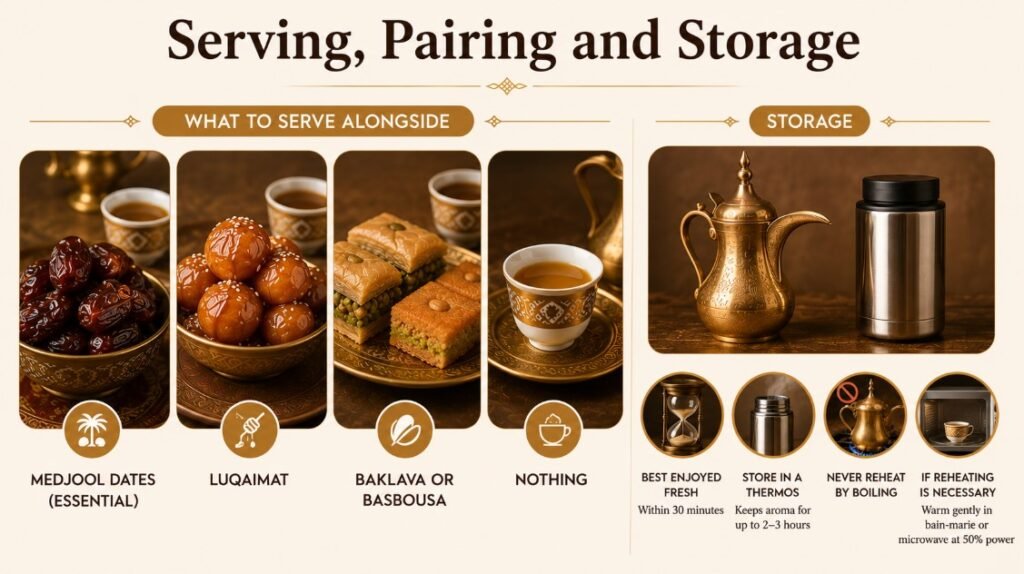
What to Serve Alongside
- Medjool dates (essential): The natural sugar of the date is the sweetener for qahwa. Eat one bite of date between sips. The interplay of the date’s richness against the coffee’s gentle bitterness is what the drink is designed around.
- Luqaimat: The crispy sweet dumplings served with date syrup pair beautifully — their richness needs the clean, unsweetened qahwa as a counterpoint.
- Baklava or basbousa: Nut-filled pastries and semolina cakes are common at Emirati gatherings where qahwa is served. The sweetness of the pastry and the bitterness of the coffee follow the same date logic.
- Nothing: At its best, qahwa needs no accompaniment at all. A small cup, thoughtfully prepared, is complete on its own.
Storage
Qahwa should ideally be made fresh for each occasion. If storing, transfer immediately to a thermos and consume within two hours. The saffron colour will deepen and the rose water note will fade, but the coffee remains drinkable. Do not refrigerate — cold temperatures cause the coffee oils to separate and congeal, producing an unpleasant film on reheating. Do not freeze.
| ✦ Qahwa is the shortest conversation the Gulf has with strangers — offered before names are exchanged, before business is discussed, before anything is asked of anyone. It is the physical embodiment of the assumption that whoever has arrived deserves welcome. Learning to make it well is learning to extend that assumption yourself. |
Relatedd : Authentic Karak Chai Recipe: Dubai’s Beloved Tea Tradition (5 STEPS)