Let’s be direct: if your UAE startup is still tracking leave requests in a shared Google Sheet, processing salaries through manual bank transfers, and chasing visa renewals via WhatsApp reminders — you are bleeding time, money, and talent. Now, that is not just inefficient. In the UAE, where the Wage Protection System (WPS) mandates timely, compliant salary payments and Federal Decree-Law No. 33 of 2021 governs employment contracts, operating without proper HR software is a compliance liability that can attract MOHRE fines and damage your employer brand before your first funding round.
The good news? The UAE’s HR tech ecosystem has matured dramatically. Whether you are a five-person fintech in DIFC, a 50-person logistics startup in Dubai South, or a 200-person scale-up eyeing Saudi Arabia, there is a platform built for exactly your stage. The challenge is choosing the right one from a crowded field of global giants and sharp regional players.
We have researched, compared, and ranked the top HR software tools available to UAE startups in 2026 — evaluating each on UAE payroll compliance, ease of implementation, startup-friendliness, pricing transparency, and real user feedback. No fluff, no sponsored rankings. Just honest editorial judgment.
Why HR Software in the UAE Is Different
Before diving into the list, it is worth understanding what separates HR software for UAE startups from generic global platforms. The UAE has a set of compliance obligations that most international tools simply were not built to handle out of the box:
- WPS Compliance — Salaries must be paid through MOHRE-approved channels on time or your trade licence is at risk.
- End-of-Service Gratuity — Every employee is entitled to a statutory gratuity upon leaving, calculated on tenure and base salary. Manual errors here create financial liability that compounds silently.
- Emiratisation (Nafis) — Certain businesses must meet UAE national hiring quotas, with penalties for non-compliance. Some HR platforms now track this automatically.
- Multi-nationality Workforce — The UAE workforce spans 100+ nationalities. Arabic-English bilingual interfaces, multi-currency payroll, and multi-country compliance are not nice-to-haves.
- Visa and Document Management — Employee visa renewals, Emirates ID tracking, and labour card management are core HR tasks in the UAE, not optional add-ons.
Any platform on this list either handles these natively or has strong integrations that address them. If a tool cannot check at least three of these boxes, it did not make the cut.
The Top 10 HR Softwares in UAE
1. Bayzat — The UAE-Born All-in-One Platform
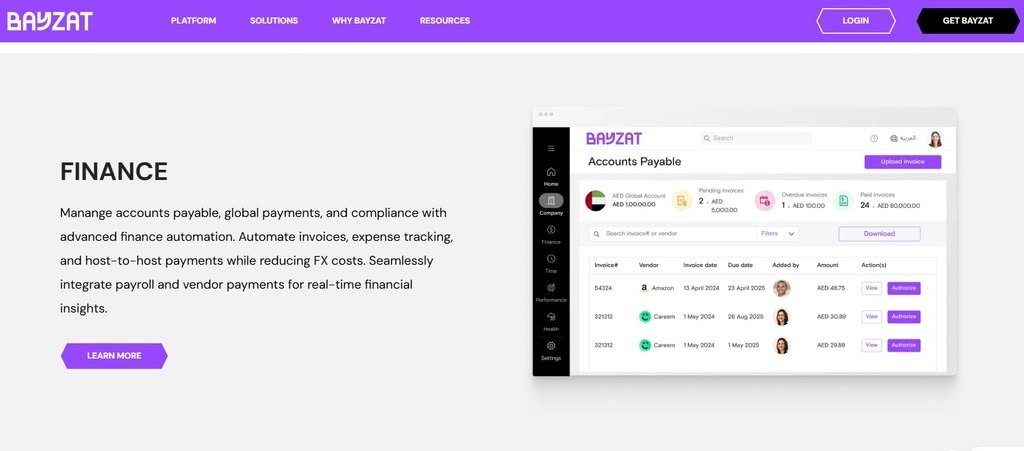
Bayzat is arguably the most well-known HR and payroll platform built specifically for the UAE market. Founded in Dubai in 2012 and backed by more than $60 million in venture funding, it serves over 3,000 companies across the Emirates — including names like Careem, Deliveroo, and DMCC. What truly sets Bayzat apart is its unique three-in-one proposition: HR management, fully automated UAE payroll, and health insurance, all within a single app.
For a UAE startup trying to consolidate tools and reduce vendor sprawl, this is genuinely compelling. The platform has a polished mobile experience, strong employee self-service functionality, and automated WPS processing that removes the most stressful compliance task from your HR team’s plate.
Best for: UAE-based SMEs and growing startups (10–500 employees) that want HR, payroll, and health insurance in one platform
Key Features
- Fully automated UAE payroll with WPS compliance
- Integrated health insurance comparison and management
- Visa renewal tracking and document management
- Attendance, leave, and shift scheduling
- Emiratisation tracking and reporting
- Mobile-first employee self-service app
- Performance management and goal tracking
- Integrations with major accounting platforms
Pricing
Custom pricing — estimated AED 55–95+ per employee per month depending on modules and team size. Health insurance is priced separately. Contact Bayzat directly for a tailored quote.
Pros
- Responsive local support team
- Purpose-built for the UAE — deep local compliance baked in
- Rare combination of HR + payroll + insurance in one platform
- Strong mobile app with high employee adoption rates
- Trusted by well-known UAE brands at scale
Cons
- Enterprise-grade depth may be overkill for micro-startups
- Pricing can feel steep for very early-stage startups (sub-15 employees)
- Some users report limited customisation for niche workflows
2. Zoho People
If you are a UAE startup watching every dirham and need something live in a week, Zoho People deserves serious attention. It sits within the broader Zoho ecosystem — which already includes Zoho Books for accounting, Zoho CRM, and Zoho Projects — making it a natural fit for founders who have built their operational stack on Zoho.
The free tier accommodates up to five employees, which covers a meaningful slice of very early-stage teams. Paid plans start at just $1.50 per employee per month — an entry price that is genuinely hard to beat. While Zoho People is not as deeply localised for UAE compliance as Bayzat or Cercli, it covers core HR functions comprehensively and is highly customisable for teams willing to configure it.
Best for: Very early-stage startups (2–50 employees) on tight budgets, especially those already in the Zoho ecosystem
Key Features
- Free for up to 5 employees
- Leave and attendance management
- Employee self-service portal
- Performance reviews and goal-setting
- Custom workflows and form builder
- Timesheet management
- Integration with Zoho Books, Zoho CRM, and 50+ third-party apps
- Mobile app for iOS and Android
Pricing
Free for up to 5 employees. Paid plans: Essential HR at $1.50/employee/month, Professional at $2, Premium at $3, Enterprise at $4.50. All billed annually. One of the most affordable HR tools available.
Pros
- Incredibly cost-effective — unmatched at the budget tier
- Strong integration with the broader Zoho suite
- Highly customisable workflows and forms
- 30-day free trial, no credit card required
- Supports Arabic language interface
Cons
- UAE-specific compliance (WPS, gratuity) requires manual configuration or separate payroll tool
- Steeper initial learning curve than more opinionated platforms
- Support quality can vary — community forums often needed
3. Rippling
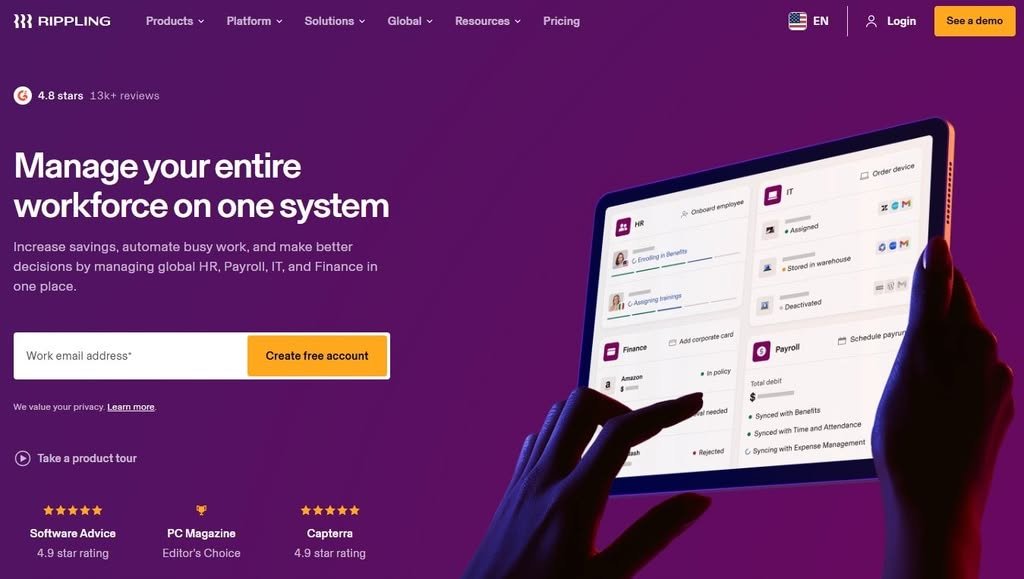
Rippling is not just HR software — it is a unified platform for HR, IT, and finance that has gained serious traction among technology-forward startups globally. It gained a strong following in the UAE’s tech and VC-backed startup scene, particularly for companies that are hiring internationally and need to provision laptops, software access, and payroll simultaneously.
When a new hire joins, Rippling can automatically set up their email, Slack account, HR records, and payroll in one automated workflow. For UAE-based startups hiring remote teams across multiple countries, or expanding into the GCC from a Dubai base, Rippling’s global payroll capabilities are hard to match. Pricing starts at $8 per user per month, with additional modules stacked on top.
Best for: Tech startups and VC-backed companies in the UAE with distributed or remote teams, or those scaling internationally
Key Features
- Unified HR, IT, and Finance management
- Automated onboarding including device and app provisioning
- Global payroll across 150+ countries
- Benefits administration
- Time and attendance tracking
- Automated offboarding (app access revocation, device tracking)
- Deep integration library (500+ apps)
- Workforce analytics and reporting
Pricing
Starts at $8 per user per month for the core platform. Additional modules (payroll, benefits, IT management, global EOR) are priced separately. Budget for $15–$30+ per employee per month for a full stack.
Pros
- Best-in-class automation — true single workflow for HR + IT
- Exceptional for international hiring and multi-country payroll
- Modern, clean interface with fast implementation
- Deep integration ecosystem
Cons
- ✖ Modular pricing means costs can escalate quickly with add-ons
- ✖ UAE-specific compliance features less developed than local-first tools
- ✖ May feel overengineered for sub-20-person startups
- ✖ Customer support response times can lag
4. BambooHR
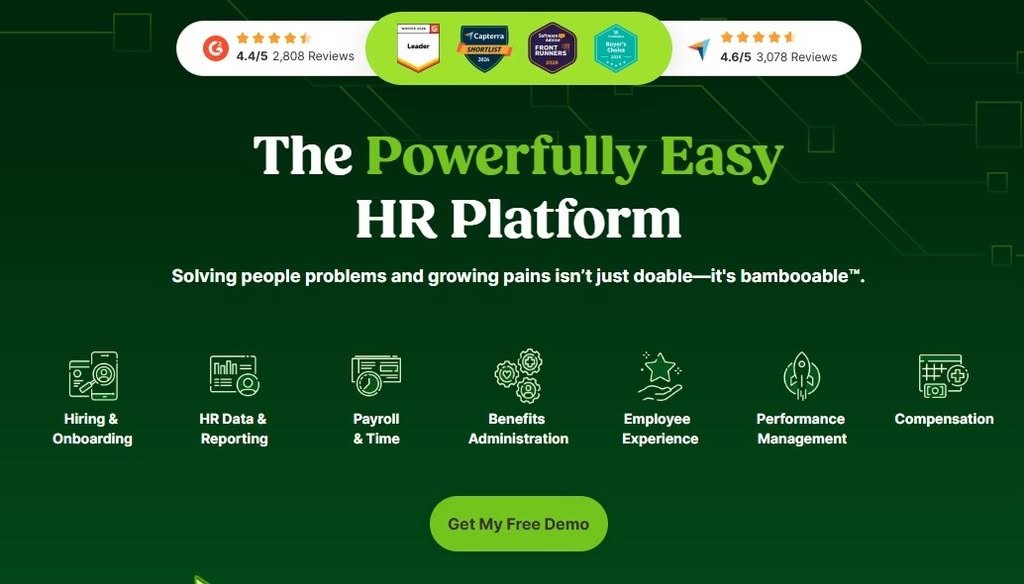
BambooHR has earned its reputation as one of the world’s most user-friendly HR platforms, and it remains a popular choice among UAE startups that prioritise employee experience and simplicity over deep local compliance. With a 92% ease-of-use score across thousands of verified G2 reviews and an average implementation time of two to four weeks, BambooHR gets teams up and running faster than most enterprise alternatives.
Its strength lies in people data management, onboarding workflows, performance management, and employee satisfaction tools. However, it lacks native WPS support and UAE-specific payroll features, so startups using BambooHR in the UAE typically pair it with a local payroll tool — which adds cost and complexity.
Best for: Culture-driven startups (25–500 employees) that prioritise employee experience and already have a separate payroll solution
Key Features
- Best-in-class onboarding workflows
- Performance management and 360-degree reviews
- Employee self-service portal with mobile app (4.8/5 App Store rating)
- Applicant tracking system (ATS) included
- Time-off management and approvals
- Employee satisfaction surveys and eNPS tracking
- E-signatures and document management
- 300+ third-party integrations
Pricing
Core plan starts at approximately $10 per employee per month, Pro at ~$17, Elite at ~$25. Custom pricing via sales — minimum billing of ~$250/month applies. Time tracking and payroll are paid add-ons.
Pros
- Industry-leading UX — fastest employee adoption in its class
- Strong performance and engagement tooling
- Broad integration ecosystem
- Excellent onboarding and customer success team
Cons
- No native WPS or UAE-specific payroll compliance
- Real cost with add-ons often 30–50% above base price
- Minimum billing threshold makes it less viable for sub-25 teams
- Not designed for MENA region — Arabic support is limited
5. Cercli
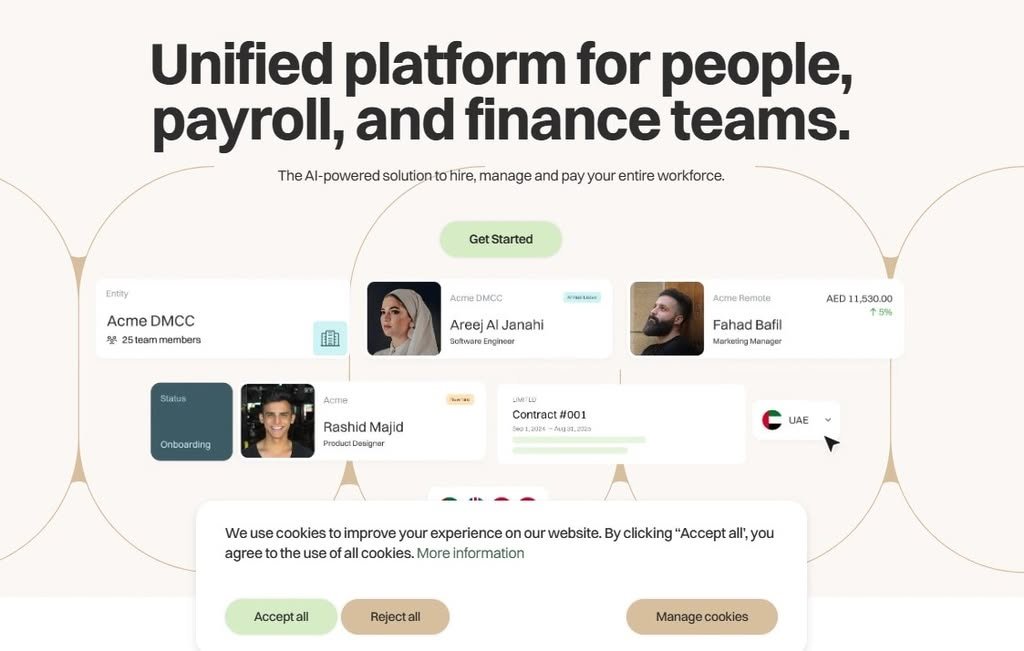
Cercli is the most exciting emerging name in UAE HR tech. A Dubai-born startup, Cercli was built from the ground up to address the specific gaps that global platforms leave in the MENA market. Its pitch is simple: a modern, unified platform to hire, manage, and pay your workforce across the region, with full compliance built in.
Unlike tools that bolt UAE compliance on as an afterthought, Cercli treats it as core architecture. It handles payroll across multiple MENA countries in minutes, manages onboarding, expenses, HR records, and compliance — all in one clean interface. For a UAE startup hiring across Dubai, Abu Dhabi, Saudi Arabia, or Egypt, Cercli is arguably the most forward-thinking regional option available.
Best for: UAE-native startups and scale-ups operating across MENA who want modern design and deep regional compliance
Key Features
- Multi-country payroll across the MENA region (UAE, KSA, Egypt, Jordan, and more)
- Full WPS compliance with automated processing
- Onboarding and employee lifecycle management
- Expense management
- HR records and organisational structure
- Compliance monitoring aligned to UAE Federal Labour Law
- Modern, clean UI with mobile access
- Built by a regional team that understands local nuances
Pricing
Custom pricing — request a demo directly from the Cercli website for a tailored quote based on team size and modules.
Pros
- Built specifically for MENA — most regionally native modern platform
- Handles multi-country payroll in the GCC without third-party workarounds
- Clean, modern interface that rivals global platforms
- Strong compliance architecture for UAE labour law
Cons
- Newer platform — less enterprise track record than established players
- Pricing not transparent without a demo
- Smaller integration library than global tools like Rippling or BambooHR
Related: Top 15 Apps Every Dubai Resident Needs on Their Phone
6. ZenHR
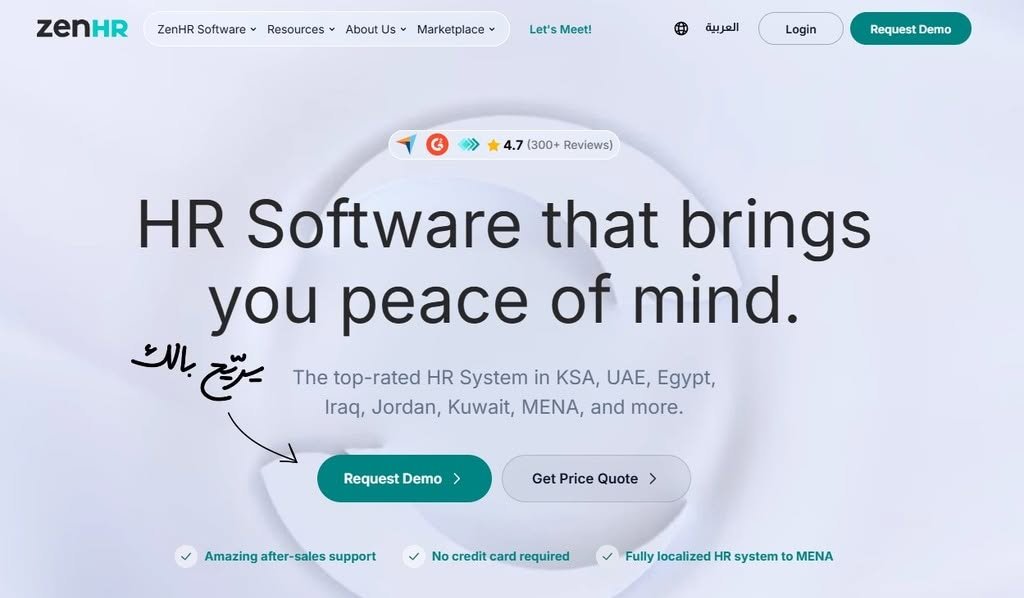
ZenHR was designed specifically for the Middle East and North Africa, and it shows. The platform supports labour law compliance and payroll rules across multiple MENA countries, making it a strong choice for UAE startups with regional ambitions.
Its fully bilingual Arabic-English interface is a genuine differentiator for teams with Emirati or Arabic-speaking staff. ZenHR covers the full employee lifecycle — from recruitment pipelines to exit formalities — with particular strength in employee self-service, leave management, and performance evaluation tools. Businesses like Al Jazera Markets, Jawaker, and Bespin Global use ZenHR to manage HR operations across the region.
Best for: UAE startups planning regional expansion into KSA, Jordan, Egypt, or other MENA markets who need multi-country compliance
Key Features
- UAE, KSA, Jordan, Egypt labour law compliance built in
- Fully bilingual Arabic-English interface
- Payroll processing with WPS support
- Recruitment management and ATS
- Performance evaluation and KPI tracking
- Employee self-service and manager portals
- Mobile apps for employees and managers
- Multi-entity and multi-country configuration
Pricing
Custom quote-based pricing. Contact ZenHR for a demo and pricing tailored to your team size and country coverage.
Pros
- Best Arabic-English UX in the market
- Genuine multi-country MENA compliance — not just UAE
- Strong regional support team
- Trusted by regional enterprise and SME brands
Cons
- Pricing lacks transparency — demo required before any cost clarity
- UX can feel slightly dated compared to newer entrants like Cercli
- Less relevant if you are UAE-only with no regional expansion plans
7. Darwinbox
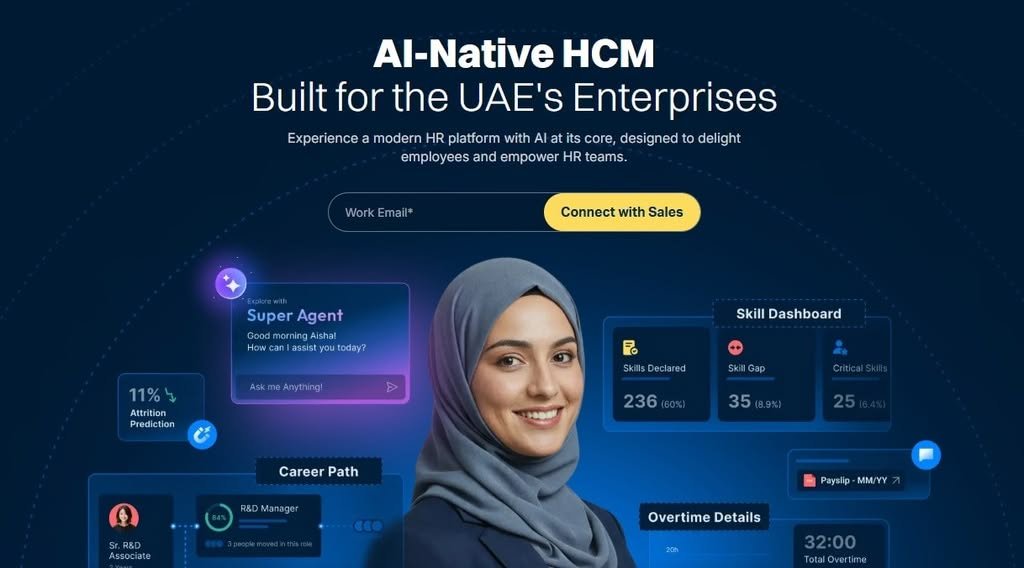
Darwinbox has emerged as a genuinely credible enterprise HR platform with strong traction in the Middle East. Built around a philosophy of Total Talent Management, it uses machine learning to help companies understand workforce skills, predict attrition, and optimise hiring decisions.
For UAE startups that have moved beyond the survival stage and are building towards Series B and beyond, Darwinbox offers the depth and sophistication that entry-level tools cannot match. Its platform covers the full employee lifecycle — from intelligent recruitment and structured onboarding through to succession planning and workforce analytics. It is not the easiest tool to implement, but for an ambitious 100–500-person team, the investment pays off.
Best for: Growth-stage UAE startups (100+ employees) that need enterprise-grade HR capabilities and advanced workforce analytics
Key Features
- AI-powered recruitment and candidate matching
- Skills and competency mapping
- Performance and OKR management
- Workforce analytics and attrition prediction
- Payroll and WPS compliance for the UAE
- Employee engagement and pulse surveys
- Mobile-first design
- Integration with leading ERP and finance tools
Pricing
Enterprise-tier custom pricing. Expect a significant investment for implementation and licensing — best suited for teams with a dedicated HR function.
Pros
- Sophisticated AI features that actually influence HR decisions
- Strong UAE and GCC compliance architecture
- Excellent for teams that have outgrown simpler tools
- Growing regional customer base and support presence
Cons
- Not built for early-stage startups — implementation is complex
- Premium pricing not viable without an HR team to manage the platform
- Onboarding time longer than simpler alternatives
8. Elate HRMS
Elate HRMS may not have the global brand recognition of BambooHR or the funding war chest of Bayzat, but it punches above its weight for UAE businesses that want a practical, locally grounded platform without the complexity tax. It integrates with MOHRE, supports WPS, calculates UAE-specific gratuity, and manages the full HR spectrum — payroll, attendance, leave, recruitment, and performance — in one system.
Crucially, Elate feels built for the realities of UAE business rather than retrofitted for them. For lean startup teams that want something that works from day one without months of configuration, Elate is a strong contender that is often overlooked in favour of louder brands.
Best for: Small to mid-size UAE businesses (10–150 employees) that want a locally-built HRMS without enterprise complexity
Key Features
- MOHRE integration and WPS-compliant payroll
- UAE-specific gratuity calculation
- Attendance, leave, and shift management
- Recruitment and onboarding modules
- Performance management and appraisals
- Employee self-service portal
- Arabic-English bilingual interface
- Cloud-based with mobile access
Pricing
Custom pricing based on company size and module selection. Contact Elate for a demo and quote — typically competitive for SME budgets.
Pros
- Deep UAE compliance without enterprise-tier complexity
- Practical, straightforward interface suited to non-HR specialists
- MOHRE integration is a genuine differentiator
- Good balance of features and affordability
Cons
- Less well-known brand — fewer public reviews and case studies
- Integration ecosystem smaller than global tools
- May need to scale to a different platform as headcount grows significantly
9. OrangeHRM
OrangeHRM holds an unusual position in the market: it started as an open-source HR platform and has evolved into a full commercial offering with an AI assistant (Citra) and modular architecture that lets businesses deploy exactly the capabilities they need.
For UAE startups with a technical team that wants control and customisation — or organisations wary of vendor lock-in — OrangeHRM’s modular design is appealing. It covers core HR, leave management, recruitment, performance, and time tracking, with regional compliance available through configuration. The Citra AI assistant adds intelligent workflow automation and insight generation that competes meaningfully with more expensive enterprise tools.
Best for: Tech-savvy UAE startups that value flexibility, modularity, and control over their HR stack
Key Features
- Open-source community edition available (free, self-hosted)
- Commercial cloud edition with full support
- Citra AI assistant for workflow automation and insights
- Modular architecture — deploy only what you need
- Recruitment management and ATS
- Leave, time, and attendance management
- Performance reviews and goal tracking
- UAE compliance configuration available
Pricing
Community (open-source) edition is free to self-host. Professional and Enterprise cloud plans are quote-based. A meaningful cost-saving option for technically capable teams.
Pros
- Open-source option gives unprecedented cost control
- Modular design prevents feature bloat
- Strong security and data sovereignty options
- Citra AI adds genuine enterprise intelligence
Cons
- Open-source edition requires technical setup and maintenance
- UAE-specific compliance features require configuration rather than being automatic
- Less intuitive onboarding experience than commercial-first platforms
10. SAP SuccessFactors
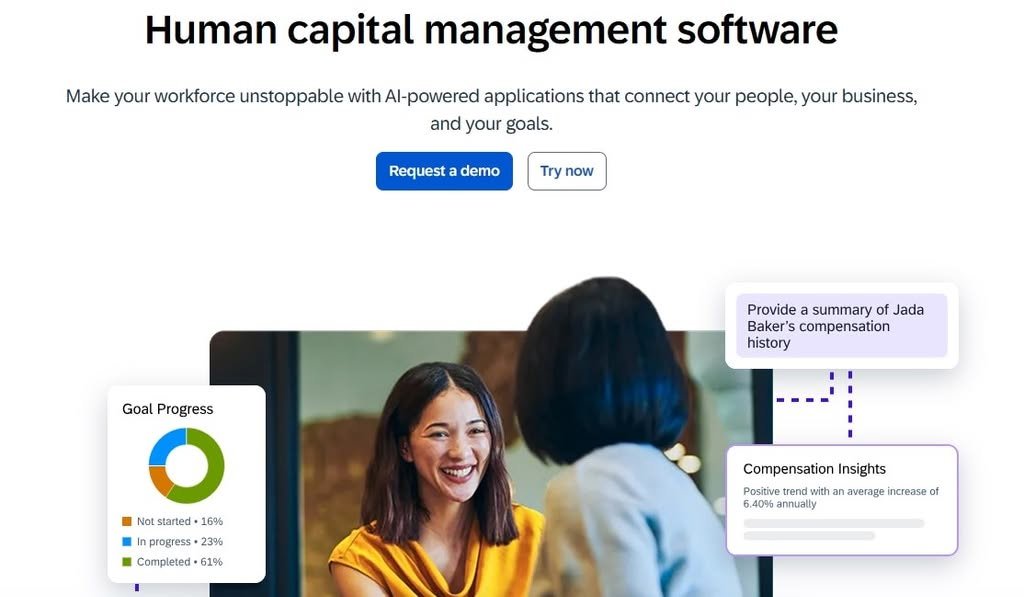
SAP SuccessFactors is in a different category to most tools on this list — it is an enterprise Human Capital Management (HCM) platform used by some of the world’s largest organisations and public sector bodies in the UAE and GCC.
The 2026 version has integrated Joule, SAP’s conversational AI copilot, which brings intelligent assistance to everything from manager queries to workforce planning. For UAE startups that have completed a significant growth phase and are managing 500+ employees, processing complex multi-entity payroll, or operating at the scale where workforce analytics genuinely influence board decisions, SuccessFactors is worth evaluating. For anyone smaller, it is expensive, complex, and likely overkill.
Best for: UAE scale-ups (500+ employees) and subsidiaries of multinationals that need global HCM with deep compliance and analytics
Key Features
- Global multi-country payroll with UAE WPS compliance
- Joule AI copilot for intelligent HR assistance
- Talent management and succession planning
- Advanced workforce analytics and reporting
- Learning and development management
- Compensation planning and benefits administration
- Integration with SAP ERP ecosystem
- Strong data security and compliance certifications
Pricing
Enterprise-tier custom pricing. Expect significant licensing and implementation costs — typically viable for well-funded scale-ups or subsidiaries with dedicated IT/HR implementation teams.
Pros
- The gold standard for enterprise HCM compliance and analytics
- Joule AI brings cutting-edge intelligence to complex workforce decisions
- Trusted by UAE government entities and large multinationals
- Unmatched integration with SAP finance and ERP systems
Cons
- Prohibitively expensive for startups under 500 employees
- Implementation timelines measured in months, not weeks
- Requires dedicated IT and HR professionals to administer
- Complex interface — steep learning curve for smaller teams
11. Paylite HRMS
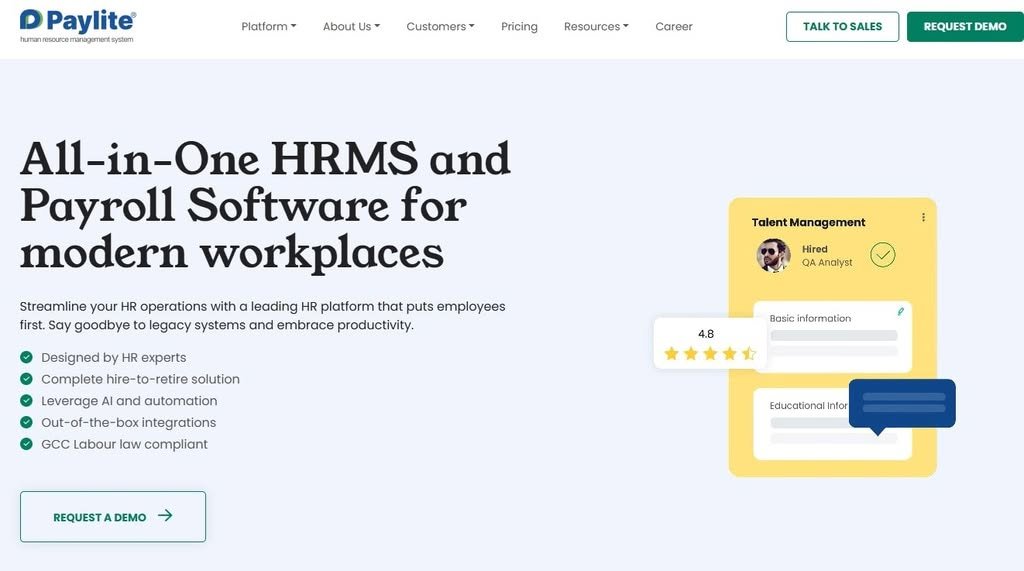
Paylite HRMS is a “tried and tested” veteran in the GCC region. While newer platforms focus on flashy aesthetics, Paylite has spent over a decade quietly becoming one of the most reliable engines for Middle Eastern payroll. It is particularly popular in Kuwait, Bahrain, and the UAE because it doesn’t just “support” local laws—it was essentially built around them. For companies that care more about “set it and forget it” reliability for their WPS (Wage Protection System) than a sleek Silicon Valley-style interface, Paylite is a heavy hitter.
Best for: Established mid-market companies (50–1000+ employees) that prioritize high-volume payroll accuracy and GCC-specific compliance over modern UI.
Key Features
- Full GCC-localized payroll (WPS, SIF file generation, GOSI, and PASI)
- Automated Gratuity (End of Service) calculations based on local labor laws
- Biometric integration for physical office attendance
- Centralized document management for visas and passports with expiry alerts
- Detailed appraisal and performance management modules
- Robust audit trails for finance and compliance teams
Pricing
Quote-based. Generally follows a traditional enterprise model—it’s often more cost-effective for larger teams but may have higher upfront implementation fees compared to “plug-and-play” SaaS apps.
Pros
- Rock-solid compliance; rarely misses a beat on UAE/GCC regulatory changes
- Exceptional at handling complex, multi-country GCC payroll in one place
- Strong integration with hardware (like office fingerprint scanners)
- Reliable local customer support with deep regional expertise
Cons
- The user interface (UI) feels dated compared to modern competitors
- The mobile app experience is functional but not as “pretty” or intuitive
- Higher learning curve for HR admins due to the depth of the settings
12. Keka HR
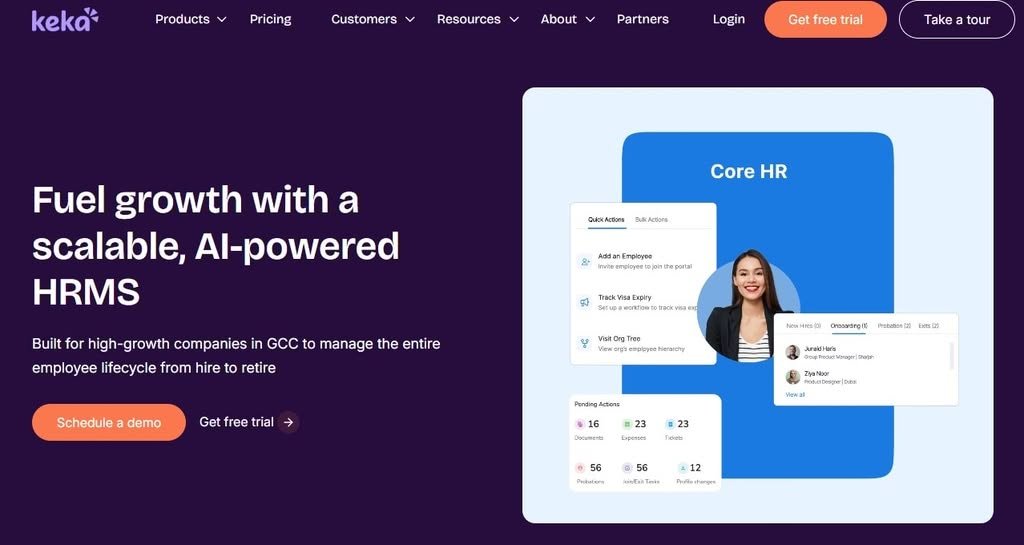
Keka HR is the “people-first” challenger that has quickly gained traction in the UAE for its incredible ease of use. While many HR tools feel like they were built for accountants, Keka feels like it was built for employees. It specializes in culture and engagement, making it a favorite for tech startups and modern agencies in Dubai and Abu Dhabi. It manages to balance “fun” features—like internal social feeds and polls—with the serious business of UAE payroll and attendance tracking.
Best for: Modern SMEs and fast-growing teams that want to improve company culture and employee engagement alongside standard HR tasks.
Key Features
- Intuitive “Wall” for company announcements, polls, and social engagement
- Automated UAE payroll with one-click WPS file generation
- Comprehensive Applicant Tracking System (ATS) for hiring
- Flexible “remote clock-in” with GPS tracking for field or hybrid staff
- Robust performance management with 360-degree feedback
- Asset inventory tracking (laptops, phones, and office equipment)
Pricing
Starts at roughly AED 20–40 per employee per month, but usually billed in “tiers” or bundles. They offer a transparent entry point, making it accessible for smaller teams.
Pros
- Arguably the best and most modern UI/UX in the current market
- Fast implementation—you can get a small team live in a matter of days
- Strong mobile app that employees actually enjoy using
- Great “all-in-one” value including recruitment and performance
Cons
- Customization is limited; if you have a very unique workflow, Keka might not bend to fit it
- Historically focused on the Indian market; while UAE features are strong, deep GCC-specific nuances (like specific Saudi or Omani laws) can feel secondary
- Recruitment emails sometimes lack deep integration with local mail clients
13. EmiratesHR
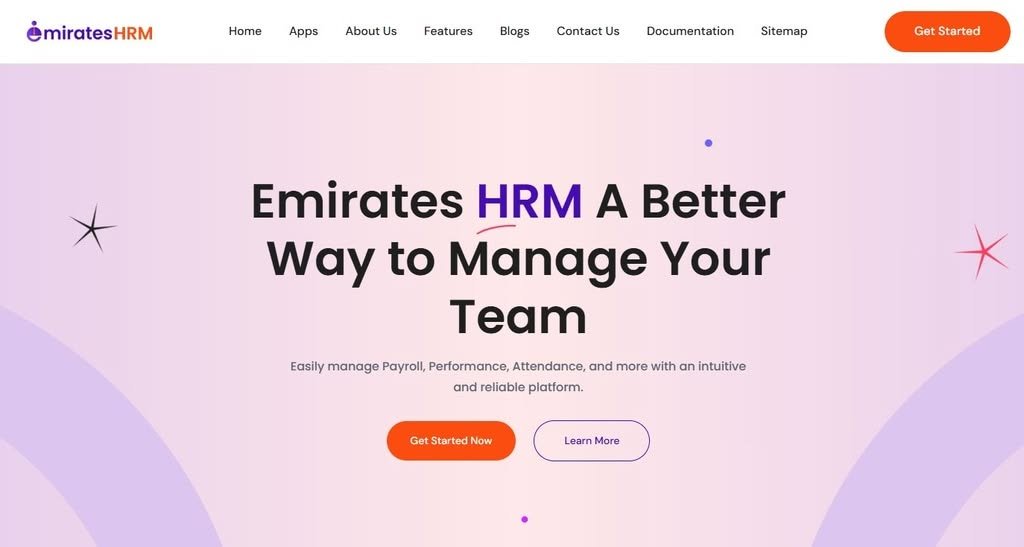
As the name suggests, EmiratesHR is a home-grown solution designed specifically for the UAE’s unique corporate environment. It sits comfortably between the “old school” reliability of Paylite and the “modernity” of Keka. It is a highly secure, cloud-based platform that excels at handling the logistical nightmare of UAE HR—specifically visa processing, document management, and benefits. It’s a “safe bet” for HR managers who want a professional, locally-supported platform that feels premium.
Best for: UAE-based corporations and professional service firms that need a secure, polished, and locally-hosted solution.
Key Features
- Advanced visa and document tracking (crucial for UAE PRO teams)
- Fully automated WPS-compliant payroll and Gratuity tracking
- Employee self-service portal for leave, letters, and reimbursements
- Organizational chart visualization and workforce planning tools
- Onboarding checklists and digital document signing
- Multi-language support (Arabic and English)
Pricing
Estimated at AED 35–70 per employee per month. It is positioned as a premium product, often requiring a demo and a custom quote based on the number of modules.
Pros
- Very intuitive and “clean” professional design
- Deep focus on UAE-specific logistics (visas, labor contracts, and Emirates ID)
- Highly responsive UAE-based support team
- Excellent reporting and analytics for executive leadership
Cons
- Occasional reports of slow loading times during high-traffic payroll periods
- Some users find the advanced reporting has a slight learning curve
- Premium pricing—usually more expensive than generic global SaaS tools
14. Peko
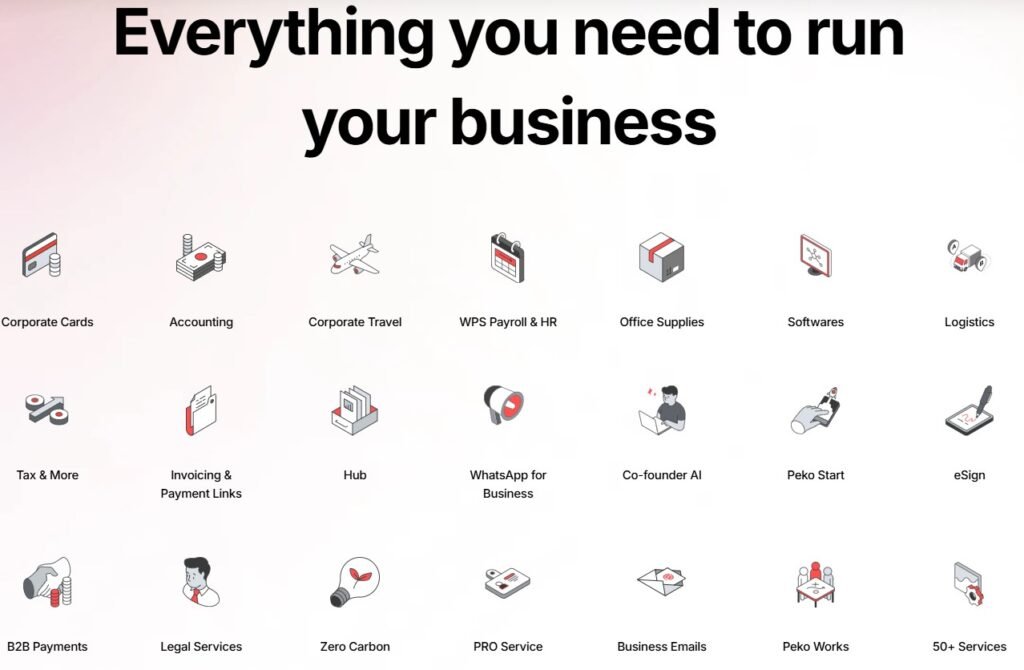
Peko is the operating system for modern businesses. From payments and expenses to payroll, compliance, invoicing, and beyond, everything a business needs to run and scale lives on one platform. It is a super app for businesses with 50+ services, built for the UAE, where HR, payroll, and WPS are not separate problems to solve with separate tools.
That single-platform model is exactly what most HR software on this list cannot offer. Global tools handle HR but bolt UAE payroll on as an afterthought. Local payroll tools handle WPS but stop at salaries. Peko consolidates payroll, WPS processing, employee management, leave tracking, documents, and end-of-service into the same login that already runs your corporate cards, accounting, invoicing, and bill payments. One platform. No vendor sprawl. No tool-stitching before your first funding round.
For a UAE startup or SME, this matters on day one. WPS-aligned salary disbursement, automated end-of-service calculation, leave and document management, and SIF file generation are core HR tasks in the UAE, not optional add-ons. Peko treats them as core architecture and keeps them inside one system your finance and ops teams already use.
Best for: UAE SMEs and startups (2 to 500 employees) that want WPS payroll, HR, and the rest of their financial operations consolidated on a single platform instead of stitching together a payroll tool, an HR tool, and a finance stack.
Key Features
- WPS-compliant payroll processing with workflows designed to support MOHRE alignment
- SIF file generation for structured salary records and documentation
- Automated calculations for salaries, overtime, bonuses, increments, reimbursements, deductions, and end-of-service
- Employee management with profiles, salary information, and centralised records
- Leave tracking and company calendar configuration for holidays and events
- Salary tracking with real-time visibility into submission and payment status
- Document and asset management to organise employee records in one place
- Announcements and alerts for internal team communication
- Native integration with Peko’s insurance, gift card, corporate cards, accounting, and invoicing services
- Mobile apps for iOS and Android
Pricing
Free to register and apply. Peko’s payroll and HR module sits inside the wider Peko platform, so businesses can start processing WPS payroll without paying for a standalone HR tool on top of their finance stack. AED 99.00 Monthly and AED 999.00 Annually
Pros
- Genuine all-in-one platform. Payroll, WPS, HR, corporate cards, accounting, invoicing, and 50+ services on one login
- Built for the UAE. WPS-aligned workflows, SIF files, and end-of-service automation baked in, not bolted on
- Removes vendor sprawl. No need to pair an international HR tool with a separate local payroll provider
- Automated end-of-service gratuity calculation, where manual errors normally create silent financial liability
- Free to get started, with responsive local UAE support (help@peko.one, +971 4 251 5354.
- Backed by IHC
Cons
- Newer to the dedicated HR-software category than long-established standalone players
- Custom setup means pricing is confirmed via signup or demo rather than a public per-seat table
- Best value is realised by businesses that want to consolidate multiple operations on one platform, not those seeking a single isolated HR module
Side-by-Side Comparison
Use this table as a quick reference when evaluating shortlisted platforms:
| Software | Best For | Pricing (approx.) | UAE Compliance (WPS / Gratuity / Labor Law) | Real-World Score |
| EmiratesHR | UAE-focused corporates | AED 35–70 / emp / mo | ★★★★★ (Native) | 9.2 / 10 |
| Bayzat | SMEs + insurance bundling | AED 55–95 / emp / mo | ★★★★★ (Native) | 9.0 / 10 |
| Peko | UAE SMEs, tech startups & spend management | Custom subscription (Bundled tools) | ★★★★★ (Native / WPS 2.0 Ready) | 8.9 / 10 |
| Cercli | MENA-native startups | Custom quote | ★★★★★ (Native) | 8.8 / 10 |
| Paylite HRMS | Established GCC mid-market | Custom quote | ★★★★★ (Native) | 8.5 / 10 |
| Elate HRMS | UAE-first lean teams | Custom quote | ★★★★☆ (Regional) | 8.2 / 10 |
| ZenHR | Multi-country MENA ops | Custom quote | ★★★★☆ (Regional) | 8.0 / 10 |
| Keka HR | Modern UX + engagement | AED 20–40 / emp / mo | ★★★★☆ (Adapted) | 7.8 / 10 |
| Zoho People | Budget-conscious startups | $1.50–$4.50 / emp / mo | ★★★☆☆ (Global-Lite) | 7.5 / 10 |
| Darwinbox | Growth-stage companies | Custom quote | ★★★☆☆ (Global-Lite) | 7.2 / 10 |
| Rippling | Fast-scaling tech startups | From $8 / user / mo | ★★★☆☆ (Global-Lite) | 6.8 / 10 |
| OrangeHRM | Open-source / modular | Free + paid tiers | ★★★☆☆ (Customized) | 6.5 / 10 |
| BambooHR | Culture-first SMBs | ~$10–$17 / emp / mo | ★★☆☆☆ (Limited) | 6.0 / 10 |
| SAP SuccessFactors | Enterprise / scale-ups | Custom enterprise | ★★★★★ (Requires Config) | 5.5 / 10 |
How to Choose the Right HR Software for a UAE Startup
There is no single right answer — but there are clear decision points that should guide your shortlist.
Step 1: Be Honest About Your Compliance Exposure
If you have more than five employees, WPS compliance and gratuity calculation are non-negotiable. If your tool does not handle these natively, you are adding manual overhead that defeats the point of having software at all. Start by filtering your options to those with genuine UAE payroll compliance.
Step 2: Match the Tool to Your Current Stage
Pre-seed to Seed (1–20 employees): Zoho People, OrangeHRM (free tier), or Elate HRMS. Keep costs minimal, get compliance sorted.
Series A to B (20–150 employees): Bayzat or Cercli are the standout choices. Both offer the UAE-native compliance you need with the product quality that growing teams deserve.
Growth stage (150–500 employees): Darwinbox, ZenHR (if multi-country), or BambooHR (if you already have a payroll solution) become relevant.
Scale-up (500+ employees): SAP SuccessFactors or Darwinbox. Invest in proper implementation — the analytics and compliance capabilities justify the cost at this scale.
Step 3: Run a Structured Evaluation
- Request a demo and free trial — most reputable platforms offer both
- Test the payroll module with your actual salary structure and WPS requirements
- Ask specifically about gratuity calculation, Emiratisation tracking, and MOHRE integration
- Evaluate mobile experience — your employees will use this daily
- Check integration capability with your accounting software (Xero, QuickBooks, Zoho Books)
- Negotiate annual pricing — most vendors will offer 15–20% discounts
Step 4: Don’t Forget the People Side
The best HR software is the one your team will actually use. A 10% better feature set is meaningless if adoption is low. Factor in implementation support, onboarding quality, and the vendor’s track record in the UAE market.
Frequently Asked Questions
Do UAE startups legally need HR software?
Strictly speaking, no law says you must use a specific software. However, the UAE government mandates that every private-sector company use the Wage Protection System (WPS) from the very first employee. Trying to manage WPS files, gratuity accruals, and visa expiries on a spreadsheet is a recipe for expensive fines. Software isn’t just a luxury; it’s your compliance insurance.
What is WPS and why is it such a big deal?
The Wage Protection System (WPS) is an electronic salary transfer system that allows the Central Bank of the UAE and MOHRE to monitor salary payments. If you don’t pay your staff on time through an approved SIF (Salary Information File), the government can automatically block your company license, stop you from getting new visas, and issue heavy fines.
Which HR software is the most budget-friendly for a new UAE startup?
Zoho People remains the price leader, offering a free tier for teams of up to 5 and very low monthly fees thereafter. However, keep in mind that the “base” price often doesn’t include deep UAE payroll automation. If you want a tool that “just does it all” for a small team, Keka or Bayzat offer better value-per-feature once you factor in the time saved on manual work.
Can I get away with using an international tool like Deel or Gusto?
You can, but it’s often more work than it’s worth. Most global tools don’t generate the specific .SIF file needed for UAE banks, nor do they calculate the complex End of Service (Gratuity) payments required by the UAE Labor Law. You’ll end up paying for a tool and still doing the hard work in Excel.
How long does it take to get a system up and running?
Modern SaaS platforms like Bayzat, Cercli, or Keka are “plug-and-play” and can be live in 48 to 72 hours. Larger enterprise systems like Darwinbox or SAP are a different beast—expect a 3 to 6-month implementation period involving consultants and heavy configuration.
Is Arabic language support a “must-have”?
It depends on your workforce. If you have a high percentage of Arabic-speaking staff or are focused on Emiratisation (Nafis), having a bilingual interface (like ZenHR or EmiratesHR) is a massive advantage for employee engagement. For tech-heavy startups where English is the primary language, it’s usually “nice to have” rather than a dealbreaker.
What is Gratuity, and how does the software help?
In the UAE, employees are entitled to a “lump sum” payment when they leave, based on their length of service. It’s a significant financial liability that grows every month. Local HR software calculates this accrual in real-time based on the latest UAE Labor Law, ensuring you aren’t hit with a massive, unexpected bill when a long-term employee resigns.
Our Final Recommendation by Startup Stage
If you need to make a quick, definitive call based on your current growth stage, here is the breakdown :
- Bootstrap / Pre-Seed: Zoho People The “no-brainer” for founders on a budget. Use the free tier for your first 5 hires to get out of spreadsheets early. It’s solid, reliable, and keeps your data organized until you’re ready for a more specialized UAE tool.
- Seed to Series A: Bayzat The gold standard for the “Dubai Startup” experience. It’s the only platform that effectively solves the “Insurance + Payroll + HR” puzzle in one click. If you want to offer your team a premium experience while keeping your overhead lean, this is it.
- Series B / Regional Expansion: Cercli or ZenHR Once you hire in Riyadh, Cairo, or Amman, you need a system that understands more than just the UAE. These platforms are built for the MENA-native reality, handling different currencies and labor laws without breaking the user experience.
- Tech-First / Global-Remote: Rippling If your engineering team is in Europe, your marketing is in Dubai, and your ops are in India, Rippling is the powerhouse. It treats HR and IT (device management/software access) as one, making onboarding a global employee a 90-second task.
- Scale-Up / 500+ Employees: Darwinbox or EmiratesHR When complexity becomes your biggest challenge, you need deep HCM (Human Capital Management). Darwinbox is great for heavy-duty performance and analytics, while EmiratesHR remains the premier choice for large-scale UAE corporate compliance and security.
Final Thought
The worst HR decision you can make in 2026 is “staying on the spreadsheet.” Every month spent manually calculating gratuity or formatting SIF files is a month of compounding risk. One compliance gap or a botched insurance renewal can cost more than a five-year software subscription.
Pick a platform that fits your headcount today but has the headroom for your ambitions tomorrow. Your HR function isn’t just overhead—it is the infrastructure that allows your team to scale without friction.
shorter dislcaimer
Disclaimer
Information is for informational purposes only and does not constitute legal, financial, or professional HR advice. While accurate at the time of writing, UAE labor laws (MOHRE), WPS regulations, and software pricing change frequently. Always request a live demo and consult with a legal or HR professional to ensure any platform meets your specific compliance and banking requirements before purchase.