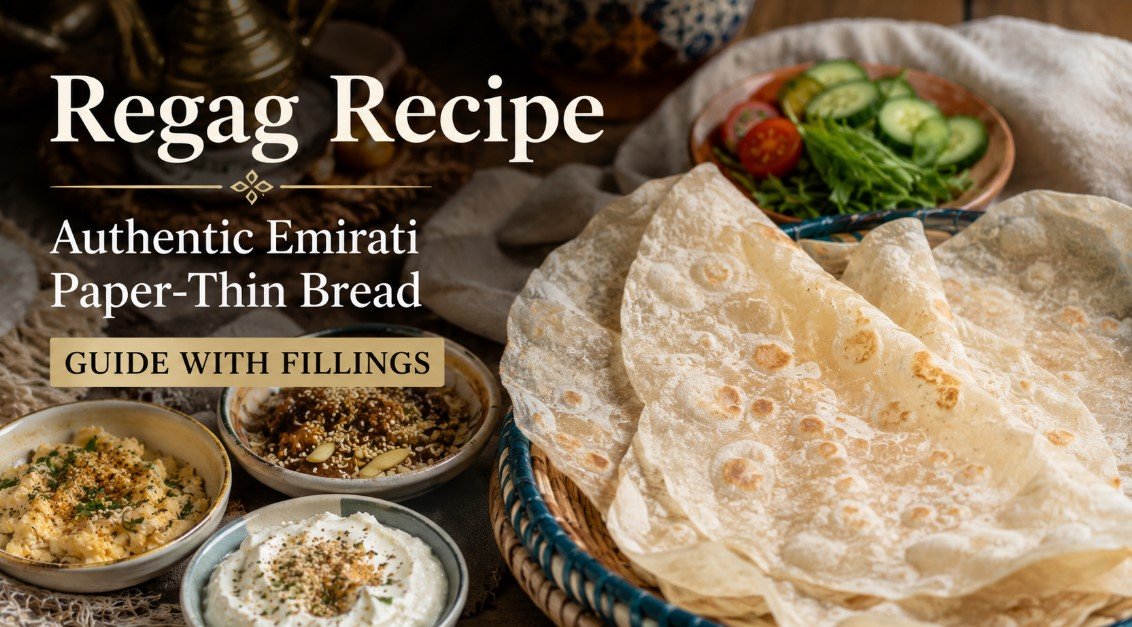
| ⏱ Prep Time 10 min + 1hr rest | 🔥 Cook Time 2 min per piece | 🫓 Yield 8–10 pieces | 📊 Difficulty Intermediate |
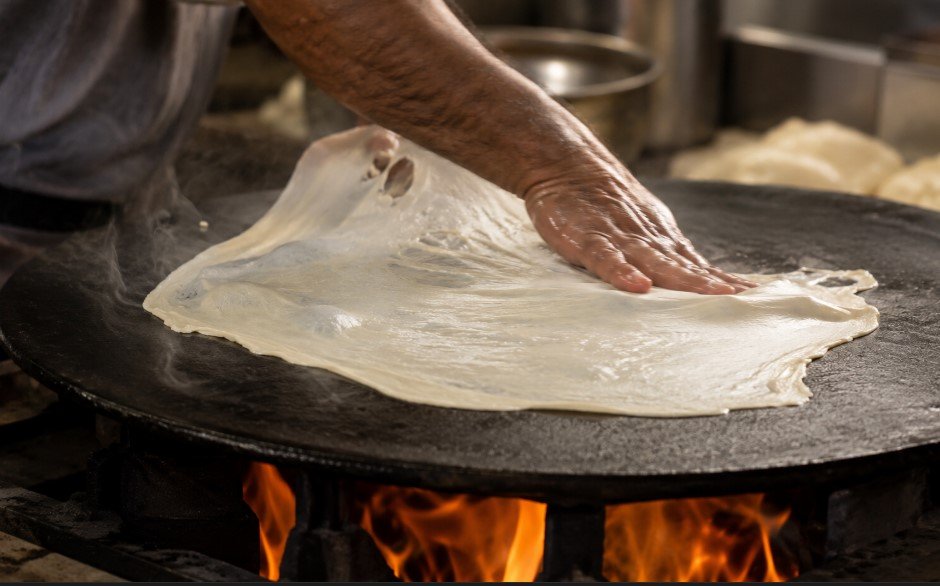
Watch someone make regag for the first time and your instinct is to ask if they’re going to hurt themselves. The baker takes a ball of soft, elastic dough, drops it directly onto a smoking-hot iron griddle called a tawa, and with their bare palm — flat, fast, utterly confident — spreads it across the surface in two or three sweeping strokes until it is as thin as a page of newspaper. The excess is peeled off in one motion. Thirty seconds later the edges are curling and the bread is done. The whole performance takes under a minute and the result is a crisp, slightly blistered, golden-edged flatbread so thin you can see light through the thicker sections.
Regag — the name comes from the Arabic raqeeq, meaning thin and delicate — is documented as one of the UAE’s oldest foods, with roots in Bedouin desert cooking where simplicity and portability were requirements, not aesthetic choices.
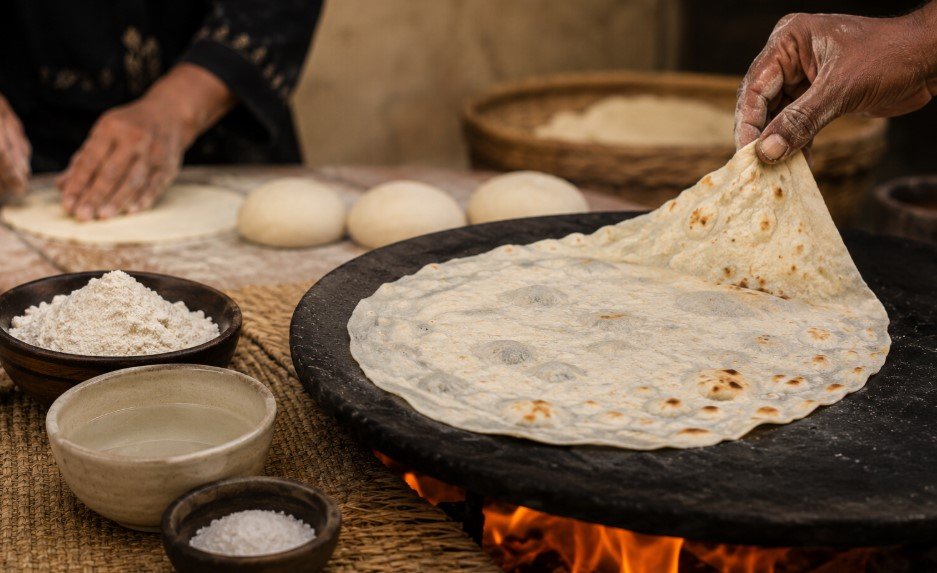
Three ingredients (flour, water, salt) produced a bread that cooked in seconds on a fire-heated metal plate, could be eaten with any filling the desert offered, and required nothing in the way of leavening, resting, or technique beyond the spreading skill that Emirati women developed and passed to daughters who passed it to theirs.
This recipe gives you two approaches: the traditional dough method — proper regag, elastic and hand-spreadable, with the characteristic slight chewiness — and a batter method that produces a thinner, crispier result closer to a crêpe, which is more achievable for first-time makers and produces excellent results for thareed (the dish where regag is soaked in lamb stew).
Both methods are given with full technique notes. Once you understand the heat control and spreading technique, regag becomes one of the most rewarding things you can make in a kitchen — fast, impressive, and deeply anchored in Emirati food culture.
Regag vs Markook vs Lavash These three paper-thin breads are often confused but are distinct in method and character. Markook (Lebanese/Syrian) and Iranian lavash are made from yeasted or sourdough batter and cooked on a convex dome-shaped pan. Regag uses an almost unleavened dough (or batter) spread on a flat tawa and produces a slightly denser, earthier result. Regag is also smaller — typically 25–30 cm across — and eaten fresh rather than dried and stored. In the UAE, it is used as a base for thareed, as breakfast bread with eggs and cheese, and as a street food wrapper. All three are worth knowing; regag is the Emirati original.
Related : Authentic Karak Chai Recipe: Dubai’s Beloved Tea Tradition (5 STEPS)
History and Cultural Significance
Regag’s origins are inseparable from Bedouin life on the Arabian Peninsula. The nomadic tribes of what is now the UAE needed bread that could be made from minimal, easily portable ingredients, cooked quickly on a fire-heated surface, and eaten immediately. Flour, water, and salt — carried in small cloth pouches — produced a dough that required no yeast, no rising time, and no oven. The tawa, a circular iron plate heated directly over fire, was one of the few cooking implements a Bedouin household would carry. Together, flour and tawa produced regag: the desert’s answer to bread.
As the UAE urbanised through the 20th century, regag moved from desert camps to city kitchens and eventually to street food stalls. Today it is sold at Emirati cultural festivals, at the Global Village in Dubai, and at traditional market stalls across the Northern Emirates, where watching a skilled maker spread dough with their bare hands on a smoking tawa remains one of the most hypnotic sights in Emirati food culture.
The art of regag-making was formally recognised as part of the UAE’s intangible cultural heritage. Master regag makers — predominantly women who learned the technique from their mothers and grandmothers — are increasingly teaching the skill in workshops and culinary schools as the traditional knowledge faces the same pressure every artisan food practice faces when the generation that carries it naturally moves on.
Regag Recipe – Ingredients
The ingredient list for regag is genuinely minimal. What makes the difference is the flour quality, the water temperature, and the resting time — each of which affects the dough’s elasticity and its spreadability on the hot tawa.
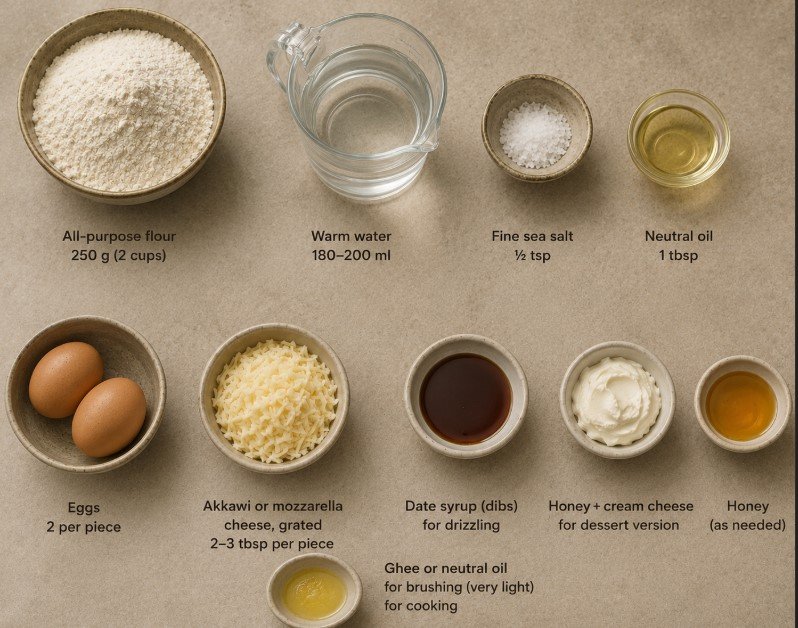
| Ingredient | Quantity | Notes — Why It Matters |
| THE TRADITIONAL DOUGH (Method A) | ||
| All-purpose flour | 250 g (2 cups) | Plain flour; bread flour gives too much elasticity and makes spreading harder. All-purpose is the correct choice. |
| Fine sea salt | ½ tsp | Strengthens the gluten network and adds baseline flavour to the otherwise neutral dough. |
| Warm water | 180–200 ml | Added gradually — the exact amount varies by flour absorption. The dough should be softer than bread dough but not sticky. |
| Neutral oil | 1 tbsp | Added to the dough for slight extensibility — makes spreading marginally easier without compromising the bread’s character. |
| THE BATTER METHOD (Method B — for beginners) | ||
| All-purpose flour | 250 g (2 cups) | Same flour as above. |
| Fine sea salt | ½ tsp | Essential. |
| Sugar | 1 tsp (optional) | Small amount aids browning; omit for completely savoury result. |
| Water | 350–380 ml | Much more water than the dough method — produces a pourable batter like thin crêpe batter. |
| Neutral oil | 1 tbsp | Helps prevent sticking and gives slight crispness to edges. |
| FOR COOKING | ||
| Ghee or neutral oil | For brushing (very light) | Used to lightly grease the tawa between pieces. Too much oil makes the bread greasy and prevents crisping. |
| CLASSIC FILLINGS | ||
| Eggs | 2 per piece | Whisked with salt and pepper; spread onto the regag before it is fully set, then flipped |
| Akkawi or mozzarella cheese, grated | 2–3 tbsp per piece | The traditional UAE pairing — melts perfectly in the 60 seconds of the second side’s cooking |
| Date syrup (dibs) | For drizzling | The dessert version — regag with date syrup and sesame seeds is a classic Emirati sweet breakfast |
| Honey + cream cheese | For dessert version | A more contemporary option; the cream cheese melts slightly and the honey provides sweetness |
🌡️ The Tawa — and What to Use Instead : A traditional regag tawa is a flat, heavy cast-iron or carbon steel disc, typically 40–45 cm across, heated directly over a gas flame. For home cooking, the best substitute is a large, heavy cast-iron skillet or flat griddle, 28–30 cm across, heated over medium-high heat for 3–4 minutes before the first piece. A non-stick pan works for the batter method but produces slightly less textured results. The key characteristic is thermal mass — the pan must be very hot and must retain heat when the dough touches it. Thin pans lose heat too fast and produce pale, soft regag.
Related : Chicken Machboos Recipe – The 6 Step Guide to the UAE’s National Dish
Method A: Traditional Dough Regag
This is proper regag — the version made by hand in Emirati homes. The spreading technique requires practice, but the dough is forgiving and the first piece, however imperfect, will be edible. By the fourth piece you will have the motion. By the eighth you will understand why this bread has survived unchanged for centuries.
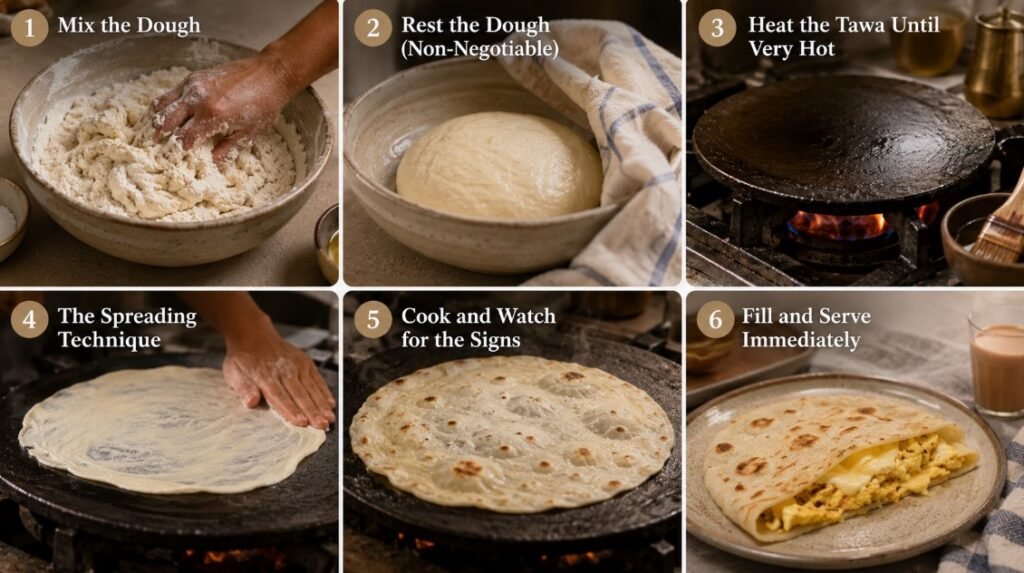
| 1 | Mix the Dough Combine the flour and salt in a large mixing bowl. Make a well in the centre. Add the oil, then add the warm water gradually — start with 160 ml and add more as needed. Mix with your hand, pulling the flour from the edges into the centre, until a dough forms. It should be significantly softer than bread dough — almost slightly sticky, but not so wet that it clings to the bowl. If it tears when you stretch it, add water one tablespoon at a time. If it is unmanageably sticky, add flour by the teaspoon. The ideal dough stretches easily without snapping back hard. |
| 2 | Rest the Dough (Non-Negotiable) Cover the bowl with a damp tea towel or cling film and rest at room temperature for 60 minutes. This is the most important step in traditional regag and it cannot be shortened. During the rest, the gluten network in the flour relaxes — tightening on contact with water at first, it gradually becomes extensible and cooperative. Dough rested for less than 45 minutes tears during spreading; dough rested for the full hour spreads in two strokes without resistance. In warm Dubai kitchens, 45 minutes may be sufficient. In air-conditioned environments below 22°C, extend to 75 minutes. |
| 3 | Heat the Tawa Until Very Hot Place your cast-iron skillet or griddle over medium-high heat. Heat for a full 3–4 minutes until the surface is very hot — a few drops of water should evaporate in under a second on contact. Brush very lightly with ghee or oil and wipe off any excess with a folded paper towel. The surface should look barely glistened, not pooled with fat. Too much oil prevents the dough from gripping the surface during spreading. |
| 4 | The Spreading Technique This is where regag becomes a skill. Tear a golf-ball sized piece of dough (approximately 60–70g). Drop it onto the centre of the hot tawa. Immediately, using the heel of your flat palm, push the dough outward in a single sweeping motion to about 25 cm across. Use two or three fast strokes — the dough cooks on contact with the hot surface and you have 10–15 seconds before it sets and can no longer be spread. Remove the excess uncooked dough around the edges with a quick pull. The spread bread should be roughly circular, visible thin in the centre, and slightly thicker at the edges where it crinkles naturally. |
| 5 | Cook and Watch for the Signs Cook the first side for 60–90 seconds. Watch for two signals that it is ready to flip: the edges will curl slightly away from the surface and the top surface will change from wet-looking to dry and slightly opaque. Do not rush this — a regag flipped too early tears. Use a wide, thin metal spatula to flip in one confident motion. Cook the second side for 30–45 seconds only. It will develop small golden spots but remain paler than the first side. Transfer immediately to a plate and cover loosely with a tea towel to keep warm and prevent excessive crispness. |
| 6 | Fill and Serve Immediately Regag must be filled and eaten while hot — the bread crisps as it cools and loses its characteristic slight pliability. For the egg and cheese version: while the first side is cooking, pour the whisked egg mixture onto the surface and spread quickly. Scatter grated cheese. When the egg is just set, fold the regag in half or into quarters and serve immediately. For the sweet version: drizzle with date syrup and sesame seeds directly onto the hot bread and fold. Serve with karak chai. |
Method B: The Batter Version (More Achievable)
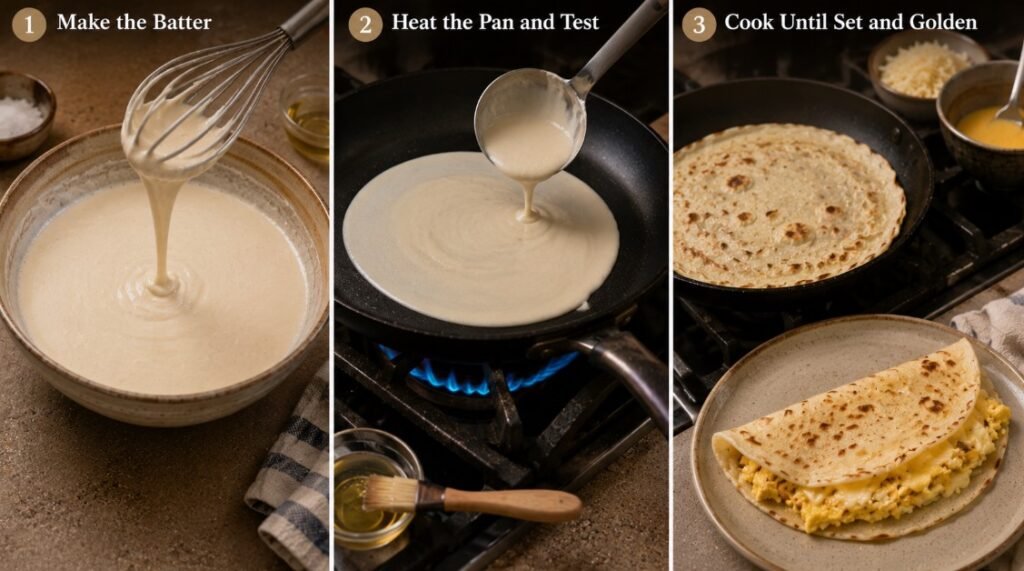
The batter method produces a slightly thinner, crispier result and is significantly more forgiving for first-time makers. It is the preferred method for making regag to use in thareed (lamb stew poured over the bread), where full crispness is actually desirable as the bread needs to absorb the stew without completely dissolving.
| 1 | Make the Batter Whisk together the flour, salt, sugar (if using), oil, and water until you have a completely smooth, lump-free batter the consistency of thin crêpe batter — it should pour in a slow, even ribbon from the whisk and coat the back of a spoon lightly. Cover and rest for 30 minutes at room temperature. This rest hydrates the flour fully and produces a more cohesive batter that spreads more evenly on the hot pan. |
| 2 | Heat the Pan and Test Heat a large non-stick or cast-iron pan over medium-high heat for 2 minutes. Test with a few drops of water — they should evaporate in under 2 seconds. Brush very lightly with oil. Pour approximately 80–90 ml of batter (about one-third of a cup) into the centre of the pan and immediately tilt and swirl to spread it as thin as possible, exactly as you would a crêpe. The batter should cover the entire base of the pan in a single thin layer. |
| 3 | Cook Until Set and Golden Cook over medium-high heat for 90 seconds until the surface is dry and the edges are golden. For the plain version (to use in thareed), remove now — the single side is sufficient and the bread will absorb the stew more evenly without a second side’s crust. For filled versions, add toppings while the surface is still slightly wet, then fold and cook 30 seconds more. The batter version is considerably crispier than the dough version and more brittle — handle gently when folding. |
Technique: The Spreading and Heat Control
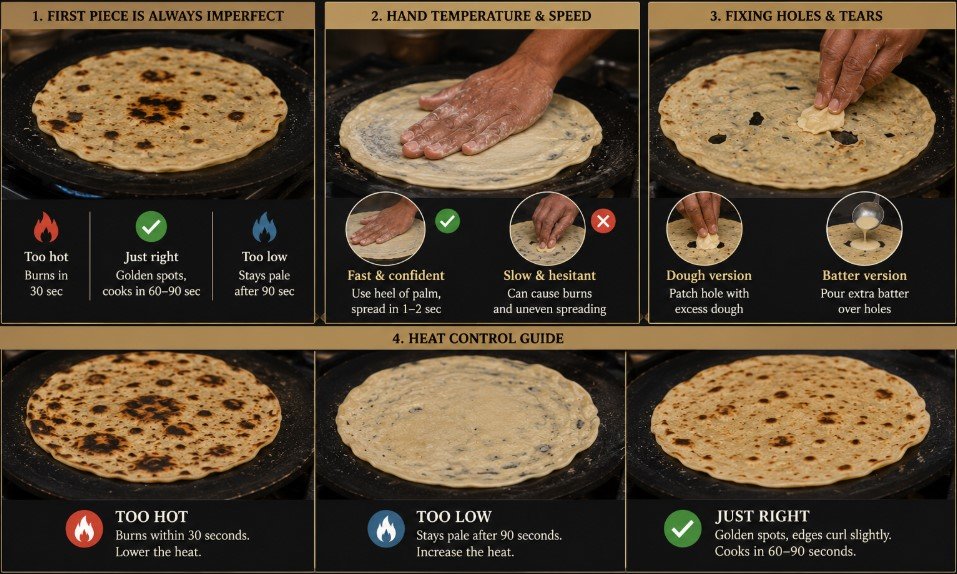
Why the First Piece Is Always Imperfect
Every experienced regag maker wastes their first piece. The initial piece conditions the pan — it absorbs any excess oil, stabilises the surface temperature, and shows you whether the heat is correctly calibrated. If the first piece burns within 30 seconds, the heat is too high. If it stays pale after 90 seconds, it is too low. Adjust, discard the first piece without judgement, and proceed from the second with calibrated confidence.
Hand Temperature and Speed
The most common fear in traditional regag making is touching the hot tawa with bare hands. In practice, the motion is fast enough that your palm is in contact with the surface for under two seconds per stroke — the insulating layer of cool dough between your hand and the metal surface protects your skin if the motion is confident and continuous. Hesitation — a slow, tentative spread — is what causes burns. Use the heel of your flat palm, not the fingers, and push outward rapidly. Beginners should use a palette knife or bench scraper to spread instead until they build confidence.
Fixing Holes and Tears
Holes in the regag are normal, particularly in the first few pieces. They have no effect on flavour and minimal effect on function. Professional Emirati regag makers accept holes in their bread without concern. If a hole appears during spreading, place a small piece of excess dough over it and press briefly — the heat will seal it within 10 seconds. For the batter version, simply pour a small amount of additional batter over any holes before the first side sets.
🎯 Practice Principle : Regag is fundamentally a motor skill, not a recipe. The mixing and ingredients can be memorised in five minutes; the spreading technique takes 10–15 pieces to internalise. Make a full batch specifically to practice the spreading motion — eat whatever you produce, regardless of how it looks. By the time the dough is finished, your hands will know what to do without being told. This is exactly how Emirati grandmothers taught their granddaughters, and it is the only approach that works.
Traditional Fillings and Serving Suggestions
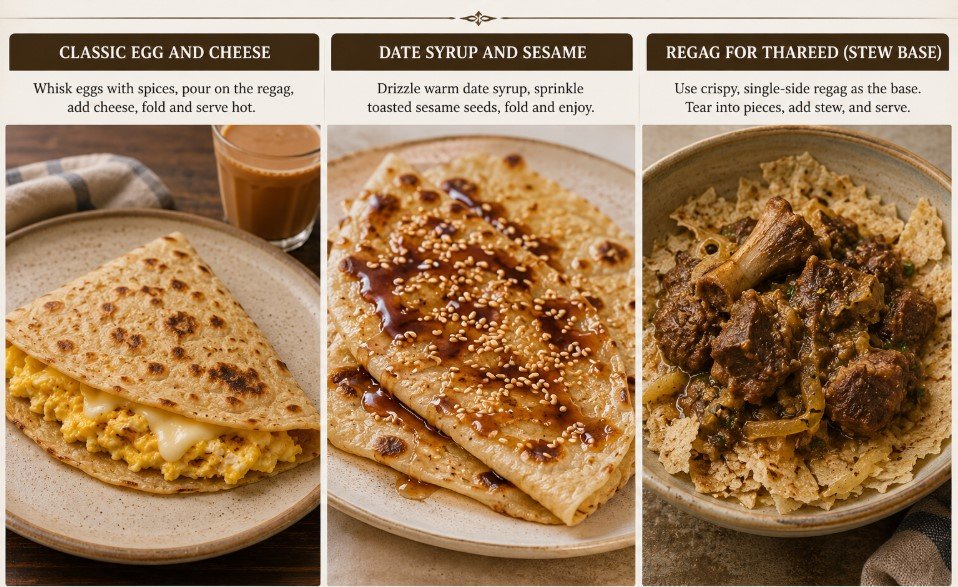
Classic Egg and Cheese
The most popular regag combination across the UAE: whisk 1–2 eggs with salt, pepper, and a pinch of turmeric for colour. While the first side of the regag is cooking, pour the egg mixture directly onto the surface and spread quickly. Scatter 2–3 tablespoons of grated akkawi cheese (or mozzarella) over the egg. When the egg is just set, fold the regag in half, then in half again to make a triangle. Press briefly. The cheese melts in the residual heat. Serve immediately with karak chai or laban.
Date Syrup and Sesame — The Sweet Breakfast Version
Drizzle 2 tablespoons of warm date syrup (dibs al-tamr) directly onto the hot, freshly made regag. Scatter 1 teaspoon of toasted sesame seeds. Fold in half and eat immediately. This version is less of a recipe and more of a habit — the kind of breakfast that Emirati families have made on weekday mornings for generations, requiring no equipment beyond the tawa and three pantry staples.
Regag for Thareed (Stew Base)
When making thareed, the regag is not filled but used as the dish’s base layer — torn into large pieces and placed in a wide serving bowl before the lamb stew is ladled over. For this application, make regag using Method B (batter, single side only) and cook until fully crispy. The crispier the bread, the longer it takes to fully absorb the stew and the more texture contrast the finished thareed has. Regag made specifically for thareed should be on the verge of overcooked — dark golden, shattering at the edges.
🏪 Where to Eat Reference Regag in Dubai Al Fanar Restaurant in Festival City Mall serves regag as part of their traditional Emirati breakfast. Arabian Tea House in Al Fahidi Historical Neighbourhood offers the egg and cheese version. The Global Village UAE food section (open October–April) has live regag stations where you can watch the traditional hand-spreading technique performed on large commercial tawas — the most educational context for understanding the bread before attempting it at home.
Troubleshooting
| Problem | Likely Cause | The Fix |
| Dough tears when spreading | Insufficient rest time | Rest the full 60 minutes; gluten must relax completely |
| Regag sticks to the pan | Pan not hot enough; too much oil | Heat 4 full minutes; wipe off all but the thinnest oil film |
| Bread is pale and soft — not crisping | Heat too low | Increase to medium-high; pan must be very hot before each piece |
| Burns before fully cooked | Heat too high | Reduce to medium; first piece always calibrates the temperature |
| Batter version too thick — doesn’t spread thin | Too little water | Add water 1 tbsp at a time until batter pours like cream |
| Holes throughout the bread | Dough spread too thin in patches; uneven technique | Accept them — holes are normal. Patch with extra dough if needed |
| Filling egg sets before spread across regag | Working too slowly | Whisk egg before starting; pour and spread in one fast motion while regag is freshly placed |
Storage Notes
Regag is entirely a fresh food. It is best eaten within 5 minutes of cooking — the texture difference between a regag eaten hot from the tawa and one eaten 20 minutes later is significant. For home gatherings, make regag to order rather than in advance.
- Short hold (under 30 min): Stack finished pieces and cover with a clean, dry tea towel. The residual heat keeps them warm and the towel prevents excessive crisping.
- Unfilled pieces (for thareed): Can be made an hour ahead and stored uncovered on a rack at room temperature. They will crisp completely — ideal for thareed use.
- Batter: Cover and refrigerate for up to 24 hours. Bring to room temperature 15 minutes before cooking. Stir well before using — the flour settles.
- Freeze: Not recommended. The texture degrades completely on thawing.
| ✦ Regag looks simple because it is simple — three ingredients, a hot surface, practiced hands. But there is a reason the spreading technique is taught person-to-person rather than from a book, and a reason professional regag makers at UAE cultural festivals draw crowds the way any skilled artisan does. The knowledge lives in the hands, not on the page. This recipe gives you the starting point. The rest is practice, patience, and the particular satisfaction of a bread that shatters slightly at the edges and holds everything it is given. |
Related : Camel Milk Ice Cream Recipe – Dubai’s Most Unique Dessert