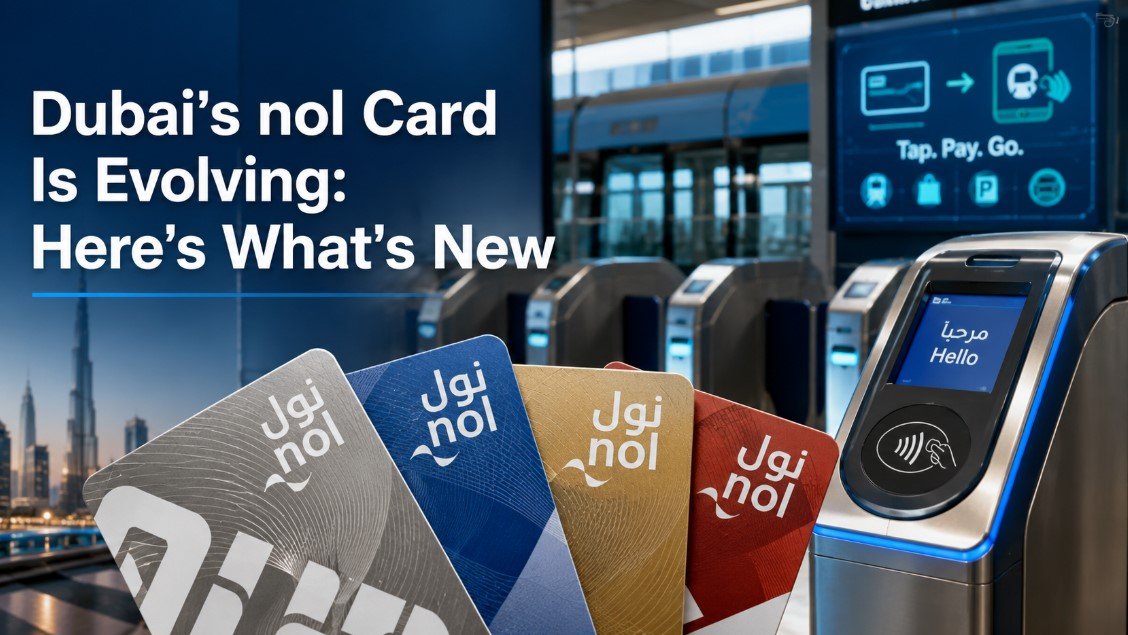
Dubai nol Card Upgrade: QR tickets, digital wallets, bank card payments and a new generation of nol cards — everything confirmed so far about the biggest overhaul to Dubai’s transit payment system since 2009.
The nol card has been Dubai’s transit companion since August 2009 — the same month the Metro opened. For fifteen years, the experience has been essentially the same: tap the card, pay the fare, top up when it runs low. The physical card, the chip inside it, the stored-value model where money sits on the plastic rather than in an account — all of it has remained unchanged while the rest of Dubai’s transport network expanded around it.
That’s about to change in a significant way. The Roads and Transport Authority (RTA) announced in early July 2026 that 72 percent of a full system overhaul is now complete, with the entire project on track for delivery by the end of Q1 2027. The budget for the project is AED 550 million, and the goal is to replace the existing card-based ticketing platform with an account-based ticketing system — a technology shift that changes not just how you pay, but what your nol card can actually do.
Here’s everything confirmed so far: what’s changing, when each part arrives and what it means in practice for daily commuters, families and tourists.
At a glance: Dubai nol Card Upgrade
- The existing card-based ticketing system is being replaced with account-based ticketing (ABT)
- QR code tickets, digital wallets and bank cards will all be accepted for public transport fares
- A new generation of nol cards will work like bank cards — for shopping as well as transit
- Families will be able to manage multiple nol cards from one account
- Automatic top-ups, daily transaction records and remote card blocking are all coming
- Full rollout: end of Q1 2027. Project is currently 72% complete.
Related : Etihad Rail Guide: The Complete Guide to Tickets and Routes
The Current nol System: A Quick Context
The nol card (the word means ‘fare’ in Arabic) was developed with Hong Kong-based Octopus Cards Limited — the same company behind Hong Kong’s Octopus card, one of the world’s most widely used transit payment systems. When it launched in 2009, it gave Dubai a unified way to pay across the entire public transport network: Metro, bus, tram, water bus and eventually the Palm Monorail too.
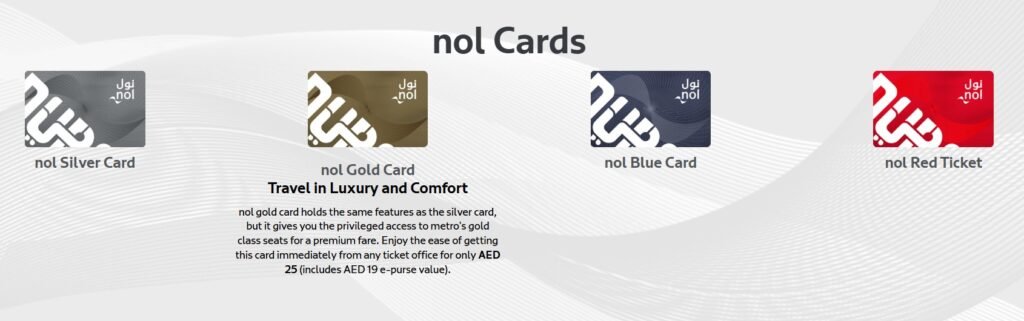
There are currently four types of nol card in circulation. The Silver card, priced at AED 25 with AED 19 in preloaded credit, is the most common and is aimed at everyday commuters and visitors. The Gold card costs the same but gives access to Gold Class cabins on the Metro and Tram, where fares run at roughly double the Silver rate.
The Blue card is a registered personal card offering a 50% fare discount, available to students, senior citizens and people of determination — it requires an RTA application and takes a few days to process. The Red card is a basic option costing AED 2, designed for tourists or occasional travellers, and can’t be topped up.
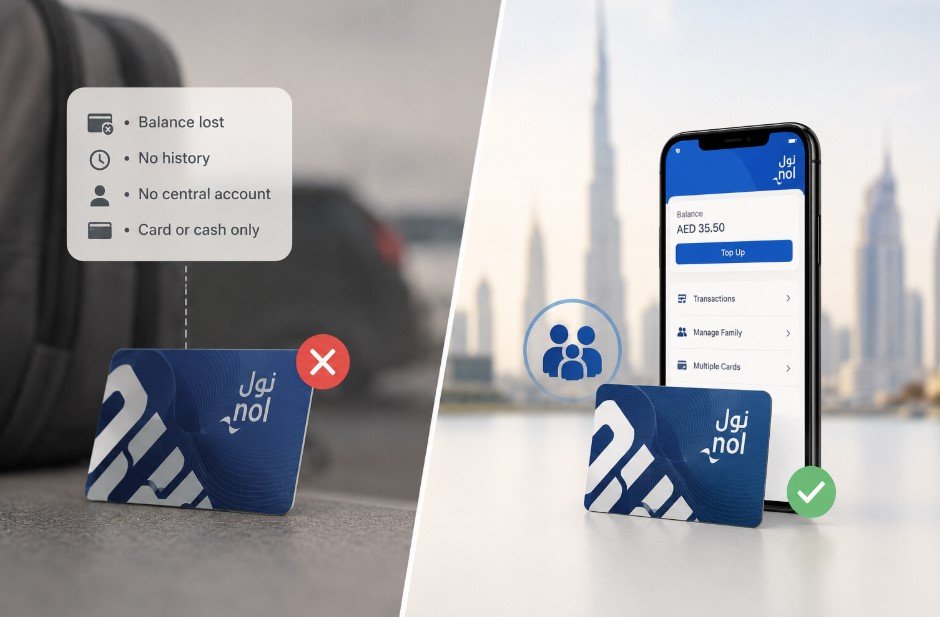
The fundamental limitation of all four is that the money and the travel data live on the card itself. If you lose the card, the balance is gone unless it was registered. There’s no central account, no transaction history you can access separately, no way to manage family members’ cards from one place, and no option to pay with anything other than the physical card or cash at top-up machines. That’s what the upgrade addresses.
The Three-Phase Rollout
RTA has divided the upgrade into three phases, each building on the previous one. The sequencing is deliberate — each phase works independently, so commuters gain new options as each stage goes live rather than waiting for the full system before anything changes.
Phase One: QR Code Ticketing
The first phase introduces the ability to buy and validate tickets using a QR code on your phone, without needing a physical nol card at all. This is the most immediately useful change for occasional users, tourists, and anyone who doesn’t want to maintain a physical card balance for infrequent trips.
In practice, it works the same way QR ticketing does on London’s Elizabeth line or Singapore’s MRT app — open the app, generate a ticket, scan at the gate. RTA says all existing card readers and gate systems across the network are being upgraded as part of the AED 550 million project to support the new payment technologies, so this isn’t a partial rollout at selected stations. The whole infrastructure is being overhauled.
For daily commuters who already have a nol card, Phase One doesn’t require any action. It runs alongside the existing system rather than replacing it.
Phase Two: A New Generation of nol Cards
The second phase is where the physical card gets its upgrade. New nol cards will be built on technology compatible with international banking card standards — meaning the card will function like a contactless bank card rather than a closed transit card. When a new card is purchased under the new system, it will automatically link to a digital account without requiring a separate registration step. The account linkage happens at the point of sale.
This is a significant change from the current model, where the Silver card in particular requires manual registration to activate account features like balance recovery. Under the new system, every card is account-linked from day one. Users will be able to see the card and its transaction history through an app, manage settings remotely, and control the balance without visiting a top-up machine.
The new cards will also work for retail shopping across digital channels and physical outlets across the UAE, in the same way a contactless bank card does. RTA has described this as turning the nol card from a transit-only instrument into an everyday payment tool .
Phase Three: Any Card, Any Wallet
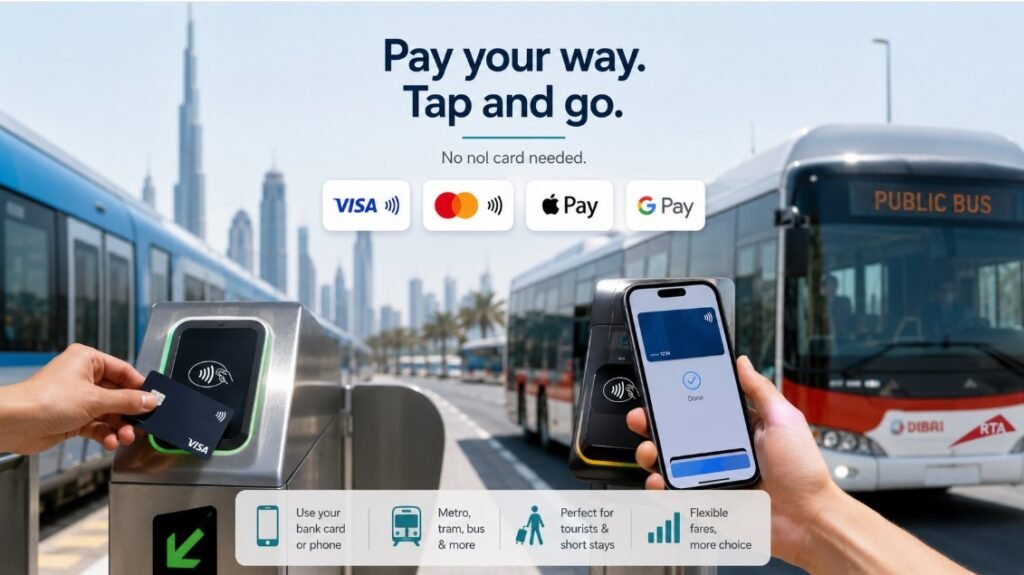
The final phase opens up public transport payment to bank cards and digital wallets directly — meaning users will eventually be able to tap their regular Visa or Mastercard, or pay via Apple Pay or Google Pay, at Metro gates and bus terminals without needing a nol card at all.
This is the most significant change from a user experience standpoint, particularly for tourists and short-term visitors who currently have to buy and load a nol card even for a single journey. Under the completed system, a visitor landing at the airport could take the Metro to their hotel and pay with the same contactless card or phone they’ve been using everywhere else, without any setup required.
RTA has confirmed flexible fares will also be introduced across different transport modes under the new system, though no new pricing has been announced. It’s worth being clear on this: no fare increases or fare reductions have been confirmed. Flexible fares in this context refers to the technical capability for different pricing structures on different route types — something the account-based model supports more easily than the existing stored-value system.
What You’ll Actually Be Able to Do: The Full Feature List
Beyond the three payment method changes, the upgrade brings a set of account management features that don’t exist at all in the current system. Here’s what RTA has confirmed will be available once the platform is fully live:
Account creation and card linking
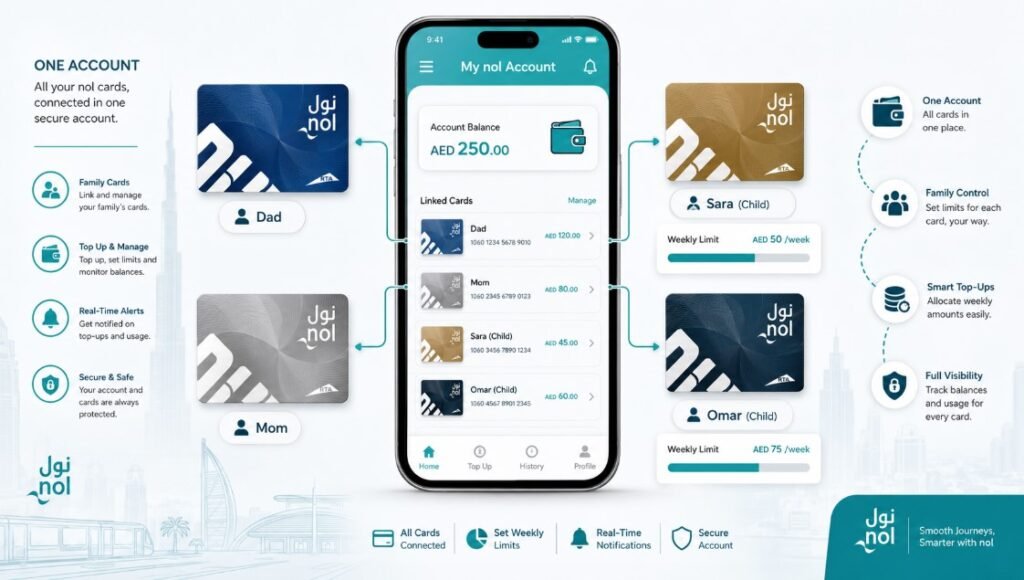
Users will be able to create a central nol account and link all their cards to it — their own and those of family members. This is particularly useful for parents managing children’s travel or couples sharing a household where multiple cards need to be topped up and monitored. Each linked card can have its own top-up allocation, so a parent can set a specific weekly amount for a child’s card rather than giving them open access to a shared balance.
Automatic top-ups
Once linked to a bank account, the nol system will support automatic balance replenishment when the card drops below a set threshold — similar to how most toll systems and prepaid phone plans work. Currently, forgetting to top up and being caught at a Metro gate with an insufficient balance is a common inconvenience. The automatic top-up removes it entirely for anyone who opts in.
Digital wallet integration
New nol cards will be addable to Apple Wallet and Google Wallet on a smartphone, removing the need to carry the physical card at all for users who prefer phone-based payments. Combined with QR ticketing, this means the entire transit journey can be handled from a phone for anyone who wants that option.
Transaction history and card management
Daily transaction statements will be available through the account, giving a clear record of every journey taken and every fare charged. Cards can be blocked remotely if lost or stolen, with the balance recoverable to a new card — solving the most significant vulnerability of the current system, where an unregistered Silver card carries a balance with no way to recover it if the card is lost.
The Timeline: Where Things Stand
The project has moved faster than its original target in some respects and slower in others. When RTA provided a progress update in March 2025, the system was 40 percent complete and the target completion date was Q3 2026. The July 2026 update puts completion at 72 percent with the deadline moved to Q1 2027. The shift is a common pattern in large-scale infrastructure technology projects — the scope of upgrading every gate reader, kiosk, ticketing terminal and smart device across the entire Dubai public transport network is genuinely significant, and a few months’ extension on a system this size isn’t unusual.
| Milestone | Date |
| nol system originally launched | August 2009 |
| Upgrade project announced | 2024 |
| 40% completion reported | March 2025 |
| 72% completion reported | July 5, 2026 |
| Full project completion target | End of Q1 2027 |
All three phases of the project are scheduled for completion by the end of Q1 2027, though RTA hasn’t specified the sequencing between phases in terms of exact launch dates. Based on the structure of the rollout and the current 72 percent completion figure, Phase One (QR ticketing) is most likely the closest to going live.
Where This Fits in Dubai’s Cashless Strategy
The nol upgrade is one piece of a broader ambition. Dubai’s Cashless Strategy, launched under the Smart Dubai initiative, targets a transition to fully digital payments across all government and commercial services in the emirate. The nol system sits at the intersection of transport infrastructure and everyday financial behaviour — the average Dubai Metro commuter uses the system multiple times a day, five days a week. Turning that touchpoint into a full account-based platform with retail payment capability extends the cashless economy into one of the highest-frequency interactions residents have with government services.
RTA has explicitly framed the upgrade this way, describing the new system as strengthening nol’s integration with economic and service sectors beyond transport. A nol card that works at a pharmacy, a supermarket or a parking meter across the UAE — which is the direction the Phase Two card capability points toward — sits closer to what Hong Kong’s Octopus card became over twenty years: a payments infrastructure that started in transit and gradually extended into daily commerce.
The AED 550 million investment also reflects the scale of physical infrastructure being upgraded across the network. Every gate, kiosk and ticketing terminal in the Dubai Metro, bus and tram system needs to support the new payment technologies — QR scanning, contactless bank card reading and digital wallet acceptance. That’s not a software update; it’s a hardware rollout across one of the busiest public transport systems in the Middle East.
What This Means If You Use nol Today
For current nol users, nothing changes immediately. The existing Silver, Gold, Blue and Red cards continue to work exactly as they do now throughout the upgrade period. RTA hasn’t announced any plans to phase out the existing card types before the new system is fully live, and the rollout is structured so the new options sit alongside the old ones during the transition rather than replacing them all at once.
The practical step worth taking now is making sure your existing nol card is registered to an account if it isn’t already. Registered cards already have some of the recovery and management capabilities that the new system is extending further — if your balance is lost, a registered card can be recovered more easily than an anonymous one. Registration takes a few minutes through the RTA website or Nol Pay app.
For the latest updates on the upgrade timeline and features as they’re confirmed: rta.ae · RTA’s official Twitter/X: @rta_dubai
When Phase One goes live, QR ticketing will be available through the Nol Pay app and potentially through other RTA digital channels. Existing cardholders won’t need to do anything to keep using the system — the new payment methods are additive, not mandatory replacements.