
Disclaimer: This article is for informational purposes only and does not constitute legal, tax, or HR advice. Employers should verify all requirements directly with MOHRE and qualified legal counsel.
If you operate a mainland business in the UAE with 50 or more employees, the Ministry of Human Resources and Emiratisation (MOHRE) has set 31 December 2026 as the deadline to achieve a 10% Emirati representation across skilled positions. This is the final milestone in the current four-year cycle, and understanding the requirements now can help businesses plan accordingly.
MOHRE has been actively urging companies to meet these targets ahead of schedule. Missing the deadline can result in significant monthly financial contributions, work permit restrictions, and potential audits.
This guide explains what the December 2026 deadline involves, who it applies to, how penalties are calculated, and how employers can use the Nafis programme to support their compliance efforts.
What Is Emiratisation?
Emiratisation is the UAE government’s policy to increase Emirati national participation in the private sector workforce. It is administered by MOHRE and supported by the federal Nafis programme, which offers salary subsidies, pension support, and training grants to employers who hire UAE nationals into skilled roles.
The policy has been in place since the 1990s, but enforcement has intensified since 2022. Targets have increased annually, and 2026 represents the final year of the current cycle before the next phase begins.
Related : 7 Costly UAE Corporate Tax Errors Every Business Must Avoid
Who Must Comply?
Compliance obligations depend on two factors: company size and jurisdiction (mainland versus free zone).
Companies with 50+ Employees on the Mainland
Mainland companies with 50 or more employees must achieve 10% Emirati representation across their skilled workforce by 31 December 2026. This follows a phased escalation:
| Year | Target Rate | Semi-Annual Checkpoint |
|---|---|---|
| 2023 | 2% | 1% by June, 1% by December |
| 2024 | 4% | 1% by June, 1% by December |
| 2025 | 6% | 1% by June, 1% by December |
| 2026 H1 | 8% | 30 June 2026 |
| 2026 H2 | 10% | 31 December 2026 |
The June 2026 checkpoint has already passed. Employers who missed the 8% target may have begun accruing penalties from 1 July 2026. The December deadline is the final opportunity to reach the 10% target before the current cycle concludes.
Companies with 20–49 Employees in 14 Targeted Sectors
Smaller companies in specific sectors were brought into the programme in 2024 under Ministerial Decision No. 455 of 2023. These companies face a fixed headcount requirement rather than a percentage:
- By end of 2024: At least 1 Emirati employee
- By end of 2025: At least 2 Emirati employees total
- 2026: Retain both employees
The 14 targeted sectors include Information & Communications, Financial & Insurance, Real Estate, Professional & Technical Services, Administrative & Support, Education, Healthcare, Arts & Entertainment, Mining, Manufacturing, Construction, Wholesale & Retail, Transport & Warehousing, and Hospitality.
Free Zone Exemption: Free zone companies (including DIFC, ADGM, DMCC, and others) are generally exempt from mandatory MOHRE Emiratisation quotas. However, this is a policy position rather than a statutory exemption, and some free zones are voluntarily aligning with mainland standards.
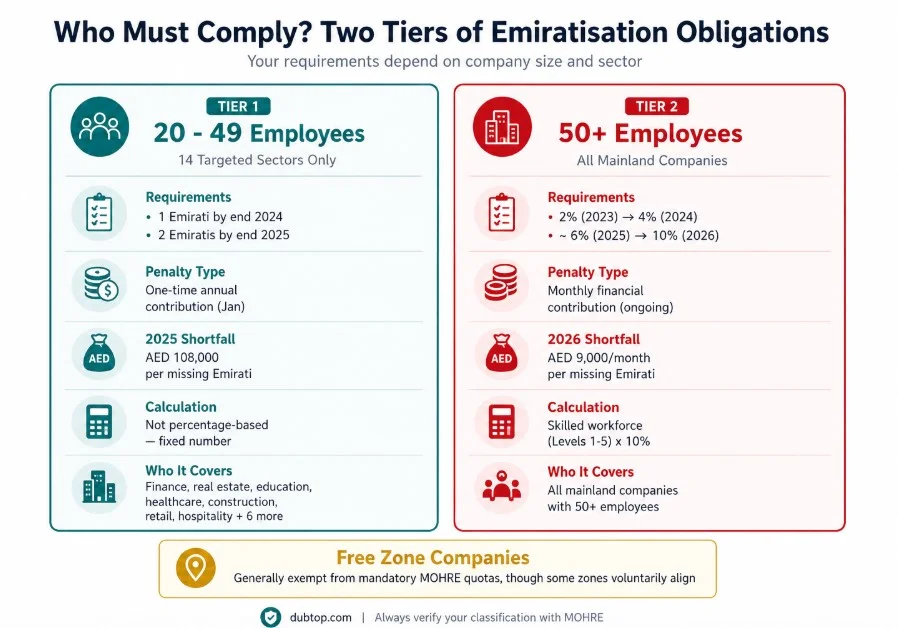
Free zone rules can change: Requirements may vary by authority and can be updated. Always confirm current national workforce rules with your free zone authority and MoHRE.
Penalties for Non-Compliance in 2026
Understanding the financial implications of non-compliance is essential for business planning.
Monthly Contributions for Companies with 50+ Employees
For every Emirati shortfall in a skilled position, MOHRE requires a monthly financial contribution:
- 2023: AED 6,000/month
- 2024: AED 7,000/month
- 2025: AED 8,000/month
- 2026:AED 9,000/month
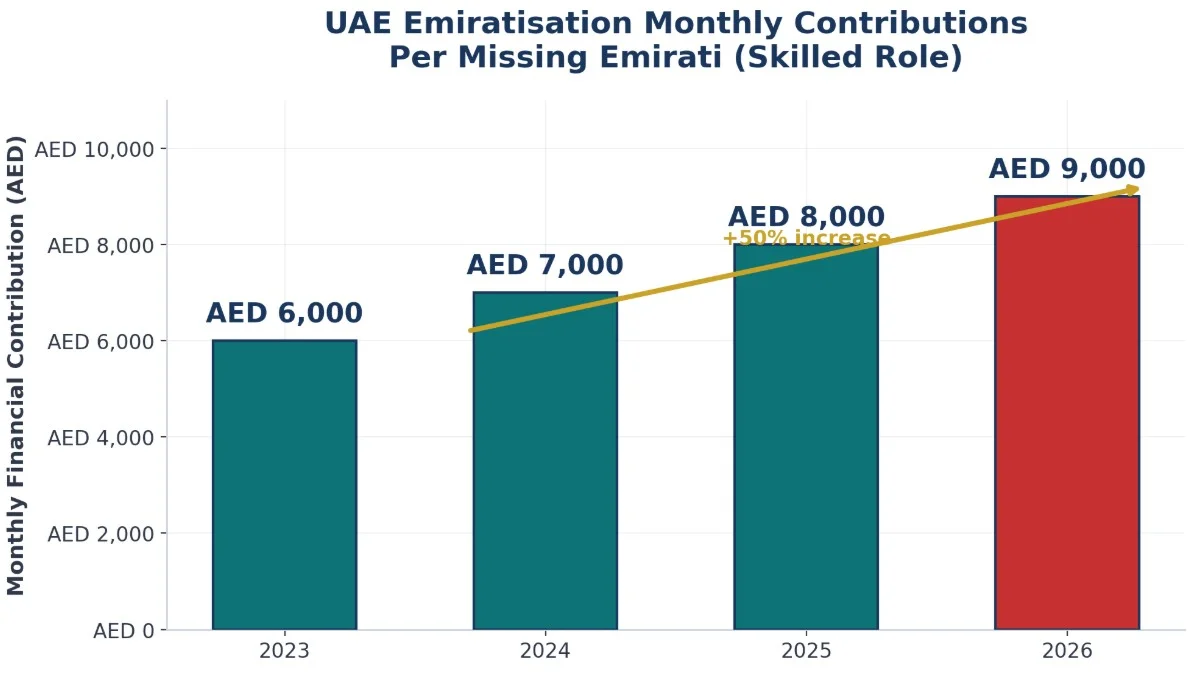
These contributions accrue monthly until the gap is closed.MOHRE calculates these automatically and issues financial contribution notices. Unpaid contributions can lead to suspension of work permit applications and renewals.
Example: A company with 160 skilled employees needs 16 Emiratis to meet the 10% target. If it currently employs 12, the shortfall is 4 positions. At AED 9,000 per position, the monthly contribution would be AED 36,000, or AED 432,000 annually.
Lump-Sum Contributions for Companies with 20–49 Employees
For smaller companies in the 14 targeted sectors, penalties are collected as a one-time annual contribution in January of the following year:
- 2024 shortfall: AED 96,000 per missing Emirati
- 2025 shortfall:AED 108,000 per missing Emirati (collected in January 2026)
- 2026 shortfall: Expected to follow a similar escalation pattern
Consequences of Non-Genuine Emiratisation
MOHRE has strengthened enforcement against non-compliant practices. Under Cabinet Decision No. 43 of 2025, employers found engaging in fraudulent Emiratisation practices may face:
- Fines ranging from AED 20,000 to AED 100,000 per instance
- Systematic violations: up to AED 500,000
- Repayment of any improperly obtained Nafis subsidies
- Referral to the Public Prosecution
- Potential suspension of business licences
Safeguard Global reports that MOHRE uses AI-powered monitoring through the Wage Protection System (WPS) to detect anomalies such as salary mismatches, absenteeism patterns, and duplicate registrations.
What Counts as a Skilled Role?
Only certain positions count toward the Emiratisation quota. A role must meet the following criteria:
- Classified under occupational levels 1–5 in the MOHRE professional classification system
- Require at least a diploma-level qualification
- Pay a minimum basic salary of AED 6,000 per month (effective 1 January 2026 for new permits; existing contracts must be updated by 30 June 2026)
- Be registered on both the MOHRE system and the Wage Protection System (WPS)
Emirati employees earning below AED 6,000 will not count toward the quota from July 2026 onwards. Additionally, companies that fail to meet this minimum may face suspension of new work permit applications.
The Nafis Programme: Supporting Compliant Hiring
Nafis (the National Programme for Emiratis in the Private Sector) is the government platform that connects employers with Emirati jobseekers and provides financial support to offset hiring costs.
Key Nafis Benefits
| Benefit | Details |
|---|---|
| Salary Support | Up to AED 8,000/month for up to 5 years (depending on qualification level) |
| Pension Contribution | Government covers the employee’s GPSSA pension contribution |
| Child Allowance | AED 800 per child (up to 4 children) for eligible employees |
| Unemployment Support | AED 1,000/month if the employee is terminated |
| Training Subsidies | Funded professional development programmes |
How to Access Nafis
- Register your company on the Nafis portal
- Post job vacancies directly on the platform
- Review matched Emirati candidates
- Hire through the platform and apply for subsidies
- Maintain compliance to retain benefits
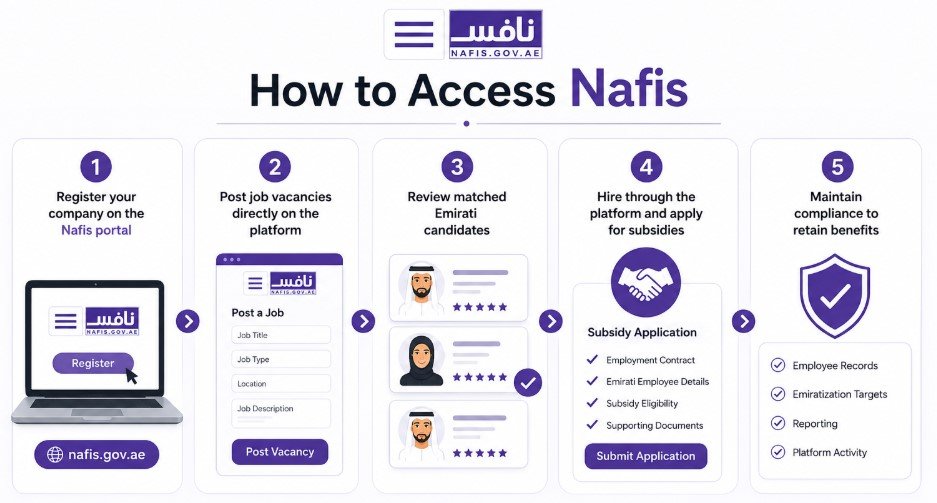
Nafis has been extended to 2040, though the current benefit structure may evolve. Employers considering hiring through Nafis are encouraged to act while the full subsidy package remains available.
How to Calculate Your Emiratisation Quota
MOHRE calculates the Emiratisation percentage as follows:
Emiratisation % = (Emirati Employees in Skilled Roles ÷ Total Skilled Workforce) × 100
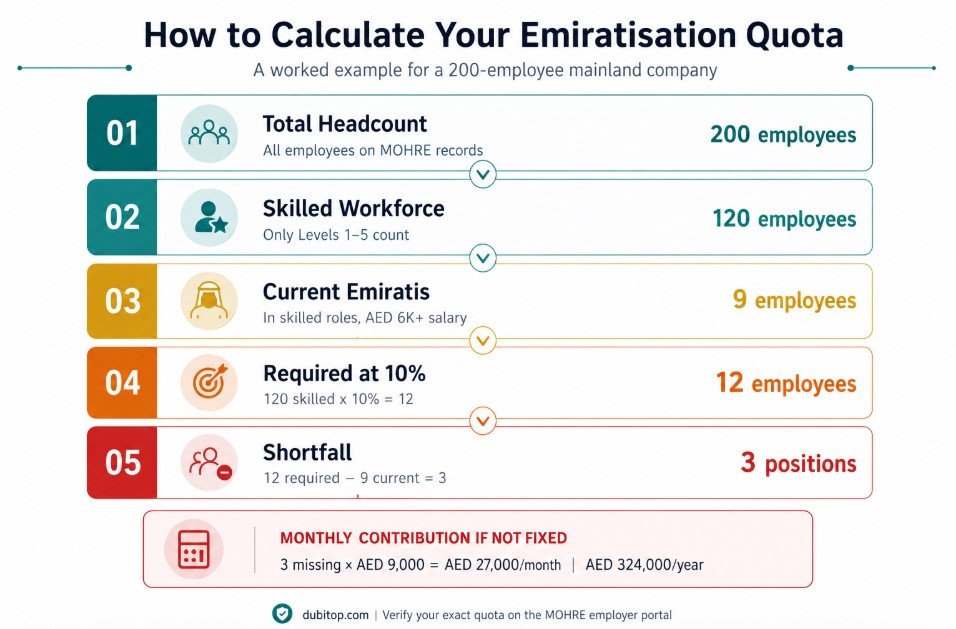
Worked Example:
Table
| Step | Figure |
|---|---|
| Total company headcount | 200 employees |
| Skilled employees (Levels 1–5) | 120 employees |
| Current Emirati count (skilled) | 9 employees |
| Required at 10% target | 12 Emiratis (120 × 10% = 12) |
| Shortfall | 3 positions |
| Monthly contribution | AED 27,000 (3 × AED 9,000) |
| Annual exposure | AED 324,000 |
If this company hires 3 qualified Emiratis before 31 December 2026, the financial contributions stop. Waiting until 2027 means continued monthly payments plus potential operational restrictions.
4-Month Compliance Checklist (August – December 2026)
August: Assess Your Current Position
- [ ] Run a headcount report filtered by MOHRE occupational levels 1–5
- [ ] Verify how many Emirati employees meet the AED 6,000 minimum salary requirement
- [ ] Log into MOHRE and Nafis to confirm your official Emiratisation rate
- [ ] Calculate your exact shortfall and monthly contribution exposure
September: Activate Recruitment Channels
- [ ] Register or update your company profile on the Nafis portal
- [ ] Post open skilled roles on Nafis before advertising elsewhere
- [ ] Contact UAE universities and vocational colleges for graduate pipelines
- [ ] Review job descriptions to ensure they appeal to Emirati candidates
October: Interview and Hire
- [ ] Shortlist Nafis-registered candidates
- [ ] Move quickly on offers — qualified Emirati talent is in high demand
- [ ] Ensure offer letters meet the AED 6,000 minimum and specify skilled role classifications
- [ ] Plan onboarding programmes that include mentorship and career progression
November – December: Verify and Document
- [ ] Confirm new hires are registered on WPS and MOHRE systems
- [ ] Double-check that all Emirati employees are classified under levels 1–5
- [ ] Update any existing Emirati contracts below AED 6,000 before the grace period expires
- [ ] Run a final compliance report and retain documentation for MOHRE review
Frequently Asked Questions
What happens if a company misses the 31 December 2026 deadline?
Monthly financial contributions of AED 9,000 per missing Emirati continue until compliance is achieved. MOHRE may also suspend work permit applications, downgrade establishment classifications, and prioritise the company for auditing.
Do free zone companies need to comply?
Most free zone companies are currently exempt from mandatory MOHRE Emiratisation quotas. However, this is a policy position, and future alignment with mainland requirements remains possible.
Is there a grace period if an Emirati employee resigns?
Yes. MOHRE allows a 2-month grace period to find a replacement. If a replacement is hired within this window, no additional contribution applies. From month three, the AED 9,000 monthly contribution begins.
Does the AED 6,000 minimum salary apply to all employees?
No. The AED 6,000 minimum applies specifically to Emirati employees in private sector skilled roles, effective 1 January 2026 for new permits and 30 June 2026 for existing contracts. It is a condition for them to count toward the Emiratisation quota.
How does MOHRE verify compliance?
MOHRE uses AI-powered analysis of WPS payroll data, field inspections, and cross-referencing with pension registrations. Employers are advised to maintain accurate records and ensure all employment relationships are genuine and documented.
Final Thoughts
The 31 December 2026 Emiratisation deadline is a significant compliance milestone for mainland employers. At AED 9,000 per month per unfilled skilled position, the cost of non-compliance adds up quickly. The Nafis programme offers meaningful support to offset hiring costs, but the recruitment process takes time.
Employers who treat Emiratisation as a strategic workforce initiative — rather than a last-minute administrative task — are better positioned to avoid penalties, maintain work permit privileges, and build a sustainable local talent pipeline.
If you are unsure about your current compliance status, the first step is to log into your MOHRE portal and run the numbers. From there, the Nafis platform provides a direct path to qualified Emirati candidates.
This guide was prepared based on publicly available information from MOHRE, Nafis, and reputable HR consultancies operating in the UAE. Policies and penalty structures are subject to change. Always verify current requirements with official government channels.