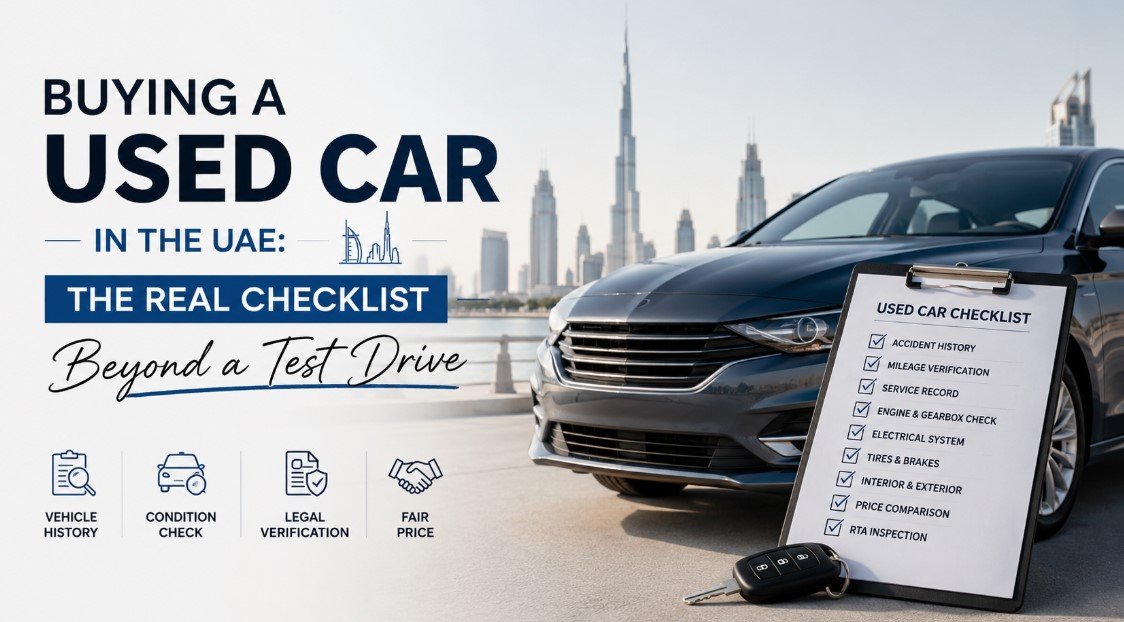
A practical, paperwork-first guide to what actually protects you when you buy a second-hand car in Dubai, Abu Dhabi, or the Northern Emirates — written from Ras Al Khaimah, where the cars are cheaper but the checks matter just as much.
A test drive tells you almost nothing. It tells you the gearbox shifts, the air conditioning still fights the August heat, and the seller is decent at small talk. It does not tell you whether the car was written off in Sharjah two years ago, whether someone is still quietly servicing a bank loan against it, or whether the dealer’s glossy six-month warranty is actually worth the paper it is printed on.
The UAE’s used car market moves fast, and most of the protection available to a buyer is bureaucratic rather than mechanical. It lives in government portals, chassis number lookups, and transfer paperwork — not in how the engine sounds at idle. This guide walks through what to check, in what order, and why each step matters, whether you are buying in Dubai, Abu Dhabi, or one of the Northern Emirates.
Buying a Used Car in the UAE
Start With the Chassis Number, Not the Listing Photos
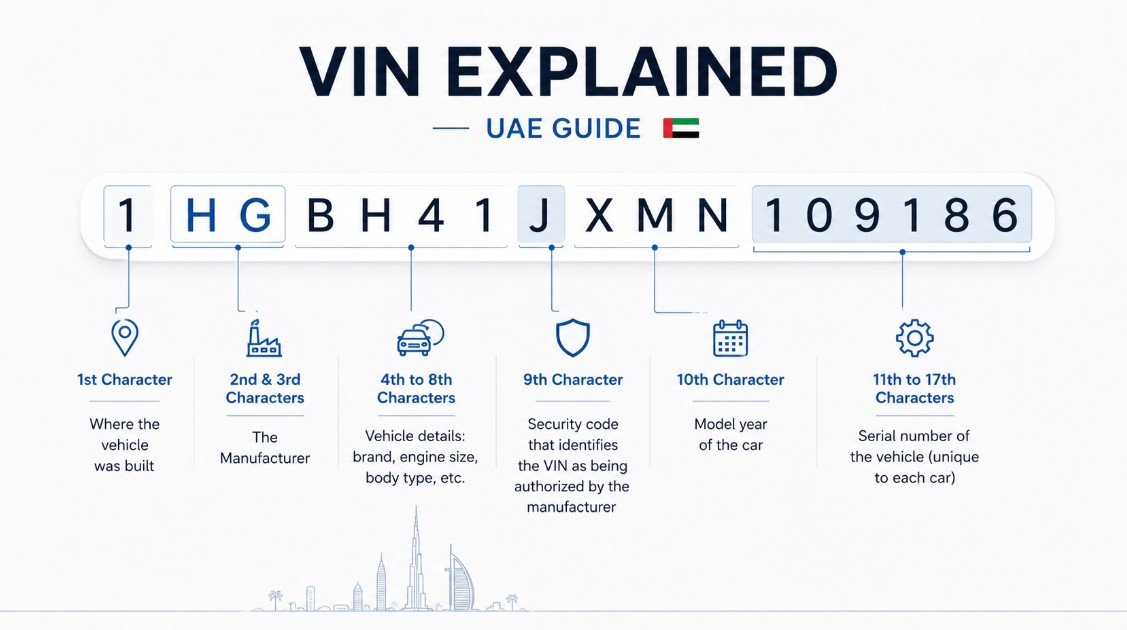
Every car has a 17-character chassis number, also called the Vehicle Identification Number or VIN, stamped on the dashboard, the driver’s door frame, and printed on the Mulkiya (the vehicle registration card). It is the one piece of information a seller cannot easily fake, and it unlocks almost every official check that follows. If a seller is reluctant to share it before you commit to viewing the car, that reluctance is itself worth noting.
Photograph the chassis number, the plate number, and the Mulkiya before you go any further. Everything from accident records to outstanding fines is searched against one of these three identifiers.
Related : How to Register a Car in Dubai: Complete Step-by-Step Guide
Pull the Vehicle’s Background Before You Get Attached
This is the step most buyers skip because it feels like overkill on a car that looks fine. It is also the step that catches the problems a test drive cannot reveal.
Accident history
Three official sources cover accident records, and which one applies depends on where the car has been registered. The Ministry of Interior’s accident inquiry service covers reported accidents nationwide and only needs the chassis number plus a captcha to return results.
Emirates Vehicle Gate pulls together police and insurance repair data for vehicles registered in Abu Dhabi, Sharjah, Ajman, Umm Al Quwain, Ras Al Khaimah, and Fujairah — useful if you are shopping in the Northern Emirates, though it specifically excludes Dubai-registered vehicles. For Abu Dhabi-registered cars, TAMM’s vehicle services give the most detailed breakdown, including report numbers and repair status.
Dubai sits outside EVG entirely. For a car registered there, RTA’s vehicle licensing services offer a Technical Vehicle Status Certificate that bundles accident history, insurance history, and past ownership into one paid report, typically priced around AED 120. It is a small cost against the alternative of discovering structural damage after the money has changed hands.
None of these systems are infallible. Older accidents from before full digitisation, privately settled repairs that never went through insurance, and damage sustained abroad before the car was imported can all sit outside the record. Treat a clean digital report as a strong signal, not a guarantee, and still arrange a physical inspection.
Outstanding fines and tolls
Unpaid traffic fines and toll charges travel with the car, not the person who incurred them, so anything unsettled becomes your problem the moment the transfer goes through. Dubai fines can be checked on the RTA app or Dubai Police’s fines inquiry service using the plate number; Abu Dhabi and the Northern Emirates route through their respective police portals. Either way, the rule is consistent across every emirate: no ownership transfer is processed while fines remain open. Confirm they are cleared before you hand over a deposit, not on transfer day.
Outstanding finance
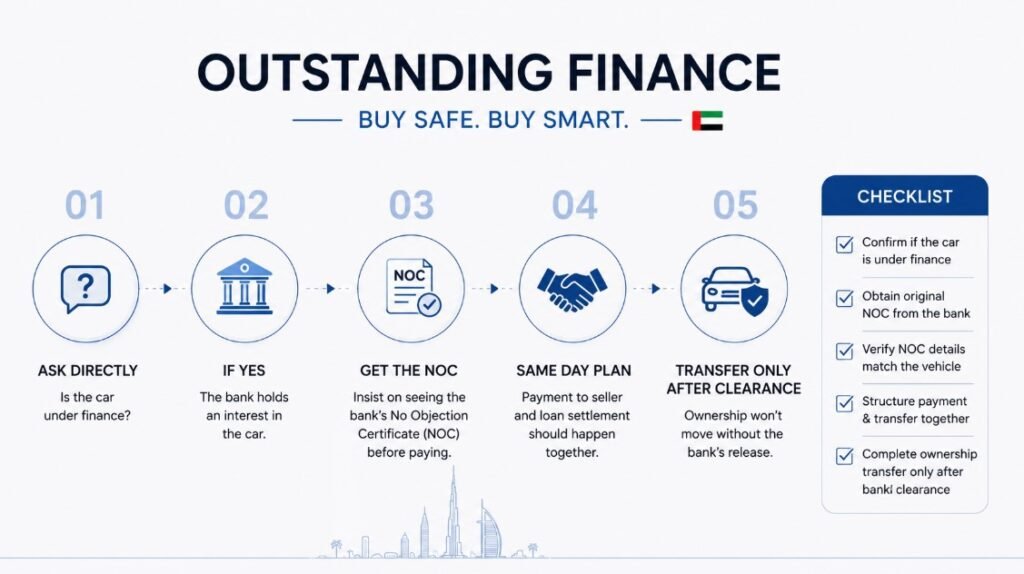
If the current owner financed the car, the bank technically holds an interest in it until the loan is settled, and the registration authority will not move ownership without a release. Ask directly whether the car is under finance, and if it is, insist on seeing the bank’s No Objection Certificate, or NOC, before any money changes hands.
Sellers sometimes plan to use your payment to close out the loan on the same day — workable in principle, but it means structuring the payment and the transfer appointment together, ideally with the bank’s clearance letter already in hand rather than promised.
The Inspection That Actually Matters
A pre-purchase mechanical inspection by an independent garage — not one recommended by the seller — is the closest thing to an objective second opinion you will get. Look past the test drive feel and have someone check panel gaps for unevenness, paint texture for overspray, and the engine bay and chassis rails for welding marks or filler, all classic signs of prior structural repair. Ask to see service records and compare odometer readings across them; a gap between what the dashboard shows and what old invoices recorded is one of the clearer signs of tampering.
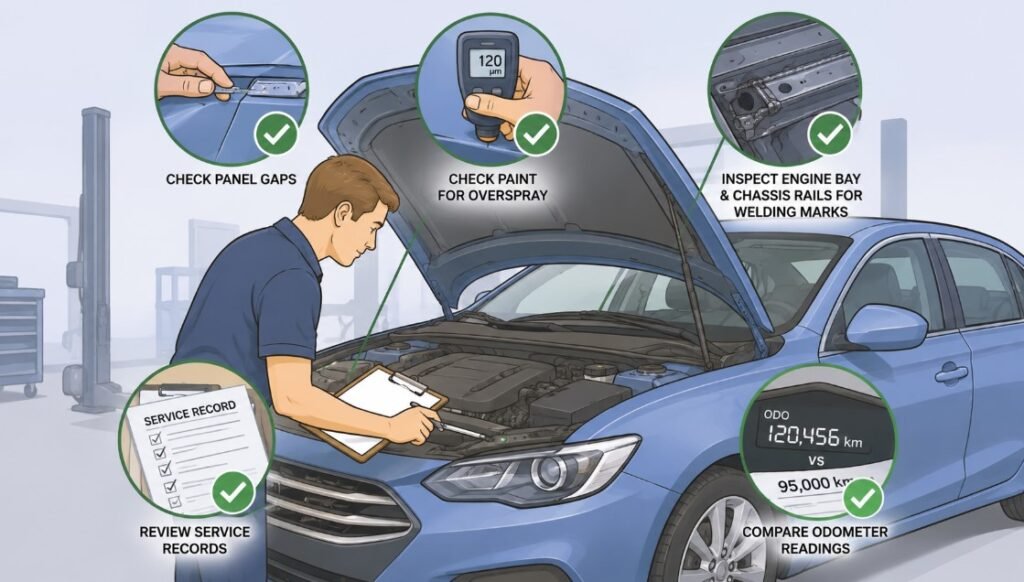
Vehicles older than three years also need to pass a government roadworthiness test before any ownership transfer can be registered — through Tasjeel or Al Mutakamela centres in Dubai, or ADNOC-affiliated and Tasjeel centres in Abu Dhabi. This test checks safety and emissions, not accident history, so passing it confirms the car is roadworthy today; it says nothing about what happened to it five years ago. Whoever currently holds an unexpired inspection certificate can usually skip re-testing, which is worth asking about before assuming the fee applies.
Make the Warranty Mean Something
If you are buying from a dealership rather than a private seller, the warranty offered is not a courtesy — it is a legal obligation under the UAE’s Consumer Protection Law, Federal Law No. 15 of 2020, later amended and given detailed executive rules through Cabinet Decision No. 66 of 2023. Dealers are required to describe the vehicle accurately and are barred from misleading claims about its condition or history; a buyer who can show the seller knew about and hid a defect has grounds to pursue compensation, and the Ministry of Economy has previously confirmed that selling a car with a concealed defect can carry administrative penalties running into six figures.
One detail worth knowing if you plan to maintain the car outside the selling dealer’s own service centre: a 2016 Ministry of Economy decision did away with the old requirement that vehicles be serviced exclusively at the dealer to keep the warranty valid. As long as servicing happens at a workshop carrying an ESMA quality rating, the warranty stands. If a dealer tells you otherwise, that claim is worth pushing back on.
Get the warranty terms in writing — duration, what it covers, and any conditions attached — before you sign anything. A verbal promise of “six months, anything mechanical” is not enforceable once the car is yours and the conversation has moved on.
Know What You’re Actually Paying
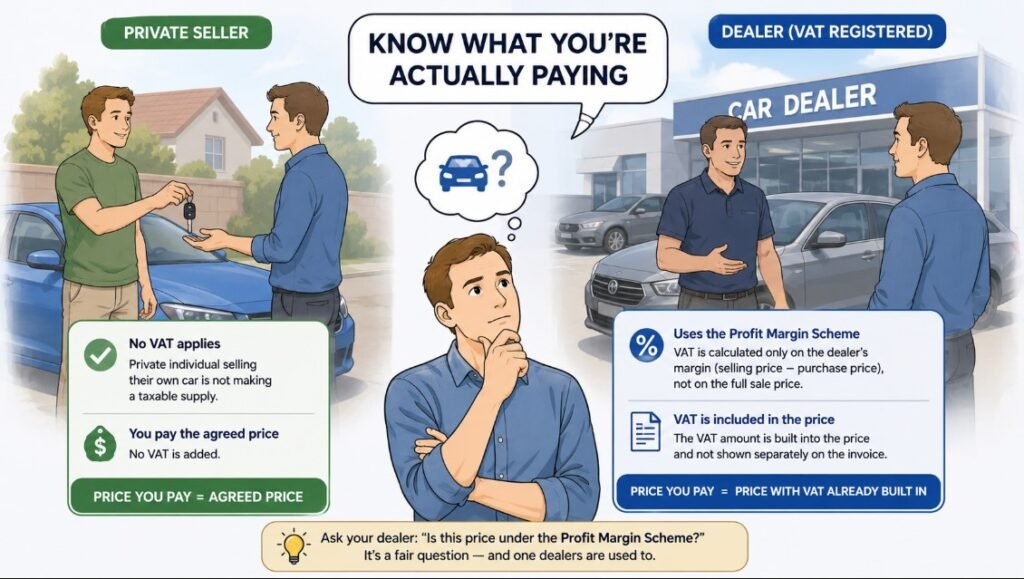
Price comparisons between a dealer and a private seller are not quite apples to apples, because VAT treatment differs. A private individual selling their own car is not making a taxable supply, so no VAT applies to that transaction at all. A VAT-registered dealer, by contrast, usually applies the Profit Margin Scheme to used stock: instead of charging 5% VAT on the full sale price, VAT is calculated only on the dealer’s margin between what they paid for the car and what they are selling it for, and that VAT amount is folded into the price rather than itemised separately on the invoice.
In practice this means a dealer’s asking price already has tax baked in even when the invoice does not show a VAT line — it is not being skipped, it is just calculated differently. It is a reasonable question to ask a dealer directly, and one most are used to answering.
The Ownership Transfer: What Each Emirate Actually Requires
This is the step that makes the sale real. Until the registration card, the Mulkiya, is reissued in your name, the car remains the seller’s legal responsibility — and, inconveniently, their fines, tolls, and insurance claims remain tied to a vehicle you are now driving.
Dubai
RTA handles transfers through Service 601 on its vehicle licensing platform, either via the Dubai Drive app, an RTA Customer Happiness Centre, or an approved typing centre. Both buyer and seller need to attend, or one party can act through a notarised power of attorney. The standard fee for a private light vehicle runs to roughly AED 350–400 plus a AED 20 knowledge fee, with the technical inspection — required for vehicles over three years old — adding around AED 170–220.
RTA’s official service page is explicit that the buyer needs active insurance in place before the transfer can be finalised, and that all fines, Salik balances, and any bank mortgage on the vehicle must be cleared first; these are treated as hard stops, not formalities. Once the transfer goes through, the buyer has fourteen days to complete any remaining licensing steps before the application lapses.
Abu Dhabi
The equivalent process runs through TAMM, Abu Dhabi’s government services platform, with the same underlying logic: clear fines first, obtain a bank NOC if the car is financed, pass the roadworthiness inspection at an approved centre, and have insurance ready under the buyer’s name. Most of the paperwork can be submitted online, but a final visit to a licensing centre is usually needed to complete identity verification and collect the new Mulkiya.
Ras Al Khaimah and the Northern Emirates
Sharjah, Ajman, Ras Al Khaimah, Umm Al Quwain, and Fujairah each run ownership transfers through their own traffic department rather than RTA or TAMM, but the structure is near-identical: settle fines, secure a finance clearance if applicable, pass inspection, and present a valid insurance certificate before the registration card changes hands.
The useful local detail is that these five emirates share the Emirates Vehicle Gate database for accident records, which makes cross-checking a car’s history within the Northern Emirates more straightforward than it is for a Dubai-registered vehicle. If you are buying in RAK and the car has spent its life in the Northern Emirates, that single portal often tells you most of what you need before you even arrange an inspection.
Moving a car between emirates
A car registered in one emirate cannot simply be re-registered in another by walking into the new emirate’s traffic department. The selling emirate first has to cancel the registration and issue an export or transfer certificate, after which the buyer registers it fresh in the receiving emirate. If you are buying a Dubai-registered car to drive home to RAK, build that extra step, and the day or two it can add, into your timeline.
If You’re Financing the Purchase
Most car purchases in the UAE involve a loan, and the bank’s first move is to pull your credit file from Al Etihad Credit Bureau, the federally owned credit bureau that scores residents from 300 to 900. It is worth requesting your own report before you start shopping rather than after a bank does — fixing an error or an old default takes time you do not want to lose once you have found the right car.
A score above 700 is generally treated as strong by lenders; below 600 tends to trigger rejection or less favourable terms. Banks also weigh your debt burden ratio, capping total monthly obligations — the new car payment included — at half of gross income, and most cap loan tenure at five years.
Used cars add one more variable: the bank will typically value the vehicle independently rather than simply financing whatever the asking price happens to be, and an older or higher-mileage car may be valued below what the seller wants. Knowing that gap before you fall in love with a specific car saves an awkward renegotiation later.
The Pre-Handover Checklist
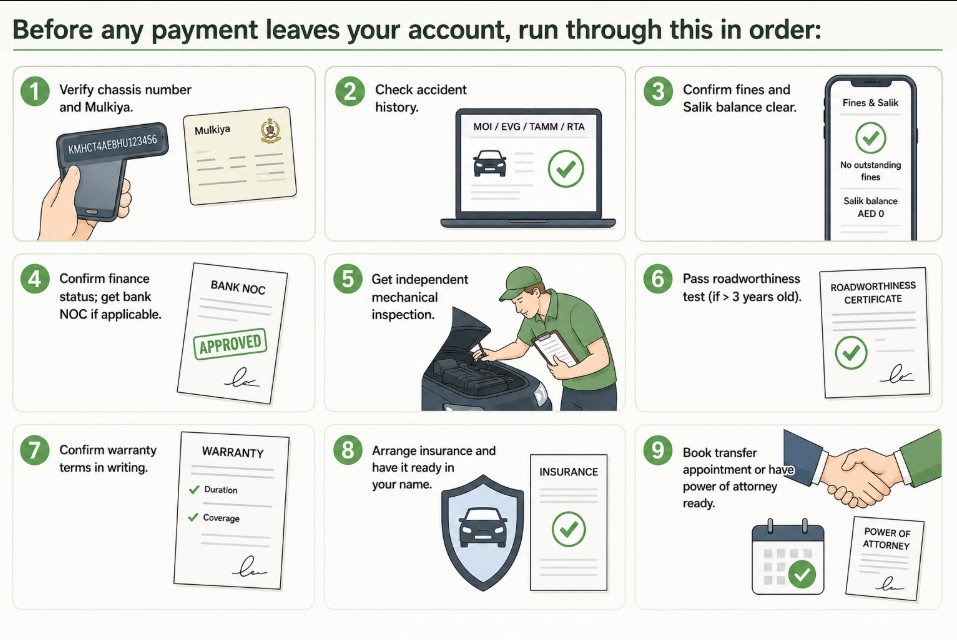
Before any payment leaves your account, run through this in order:
- Chassis number and Mulkiya photographed and verified against the seller’s documents.
- Accident history checked through MOI, and EVG or TAMM/RTA depending on where the car is registered.
- Outstanding fines and Salik balance confirmed clear.
- Finance status confirmed; bank NOC obtained in hand if the car was under a loan.
- Independent mechanical inspection completed, separate from any inspection the seller arranges.
- Roadworthiness test passed and certificate in hand, if the vehicle is over three years old.
- Warranty terms, if any, confirmed in writing with duration and coverage spelled out.
- Insurance arranged and ready to activate in your name before the transfer appointment.
- Transfer appointment booked with both parties present, or a notarised power of attorney ready.
The honest summary: the car that passes a test drive and fails the paperwork is the one that costs you money six months later. The car that does both is the one worth buying.
None of this is complicated once you know the sequence — it just front-loads the effort to before the deposit instead of after, which is exactly where it belongs.