The countdown is no longer theoretical. The UAE’s e-invoicing pilot opens on 1 July 2026 — days away as this guide was last updated — and the mandatory phases that follow it will reach a far wider slice of the economy than most business owners currently assume.
It isn’t simply emailing your invoices instead of printing them. The UAE is rolling out a structured, government-monitored system that changes how invoices are created, sent and reported — and depending on your industry, it can reach into procurement, warehousing, sales and logistics long before it ever touches your accountant’s desk.
A recent readiness survey put overall preparedness among more than 500 UAE finance leaders at just 57.5 per cent. In other words, a lot of businesses know this is coming and still haven’t worked out what it actually changes about how they invoice.
Here’s what it actually involves, the dates that matter, the industry-specific snags that rarely make it into a basic explainer, and what to do before your mandatory date arrives.
UAE E-Invoicing
What E-Invoicing Actually Means
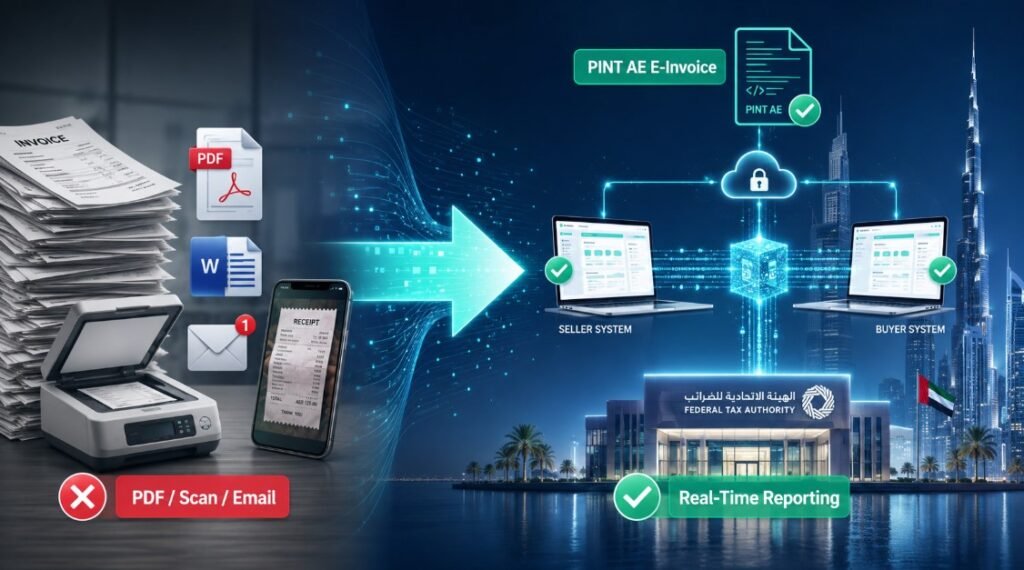
An e-invoice isn’t just a digital copy of a paper invoice. Under the UAE’s framework, it’s a structured, machine-readable data file, built to a format called PINT AE, that both the buyer’s and seller’s systems can process automatically without anyone re-typing numbers. It also gets reported to the Federal Tax Authority in near real time, rather than only showing up when a VAT return is filed.
The detail that surprises most people: a PDF, a Word document, a scanned copy, a photo of a receipt, or an invoice typed into the body of an email does not count as an e-invoice, no matter how complete the information on it is. Once a business is in its mandatory phase, those formats simply won’t satisfy the requirement for in-scope transactions.
Related : Dubai Is Going Cashless: Top 5 Things You Should Know
Why the UAE Is Rolling This Out
The push lines up with a few goals the Ministry of Finance has been fairly open about: moving toward a more digital, paperless economy; giving the Federal Tax Authority earlier visibility into transactions rather than relying only on periodic VAT filings; closing gaps where VAT goes uncollected, whether by accident or design; and putting businesses that already invoice digitally on a level footing with those that don’t.
It also follows a path several other countries have already taken, including a similar real-time invoicing mandate next door in Saudi Arabia — the UAE’s version is built on the same underlying international standard, called Peppol, adapted for local use.
The Rollout Timeline
The e-invoicing implementation runs in structured phases tied directly to business size and sector. It is important to note that the schedule has already evolved since its initial announcement to allow businesses more onboarding flexibility.
| Disclaimer: The dates below reflect the official e-invoicing guidance published in mid-2026. The large-business ASP deadline has previously been extended to 30 October 2026, and further adjustments remain possible as the implementation progresses. Use this timeline as a planning reference only, and always verify current deadlines on the official tax authority portal before making time-sensitive business decisions. |
| Milestone | Applies to | Date |
| Pilot / voluntary adoption opens | Any business, optional | 1 July 2026 |
| ASP appointment deadline | Large businesses, AED 50m+ revenue | 30 Oct 2026 |
| Mandatory go-live | Large businesses, AED 50m+ revenue | 1 Jan 2027 |
| ASP appointment deadline | Smaller businesses and government entities | 31 Mar 2027 |
| Mandatory go-live | Businesses under AED 50m revenue | 1 Jul 2027 |
| Mandatory go-live (B2G) | Government entities | 1 Oct 2027 |
| Transition period ends | Intra-group transactions | 1 Jan 2029 |
“ASP” here stands for Accredited Service Provider — covered in more detail further down. For the full picture straight from the source, the Ministry of Finance’s e-invoicing page and the UAE’s official digital invoicing service page are both kept current as the programme moves forward.
| Note: 1 July 2026 and 30 October 2026 mark two different things, not two competing deadlines. 1 July 2026 is simply when the system opens for voluntary testing — nothing is mandatory for anyone on that date. 30 October 2026 is the deadline only for large businesses (AED 50 million or more in annual revenue) to have appointed an Accredited Service Provider, which still sits ahead of that group’s actual mandatory go-live on 1 January 2027. Smaller businesses and government entities aren’t bound by either date — their own deadlines appear further down the table above. |
How the “Five-Corner” Model Works
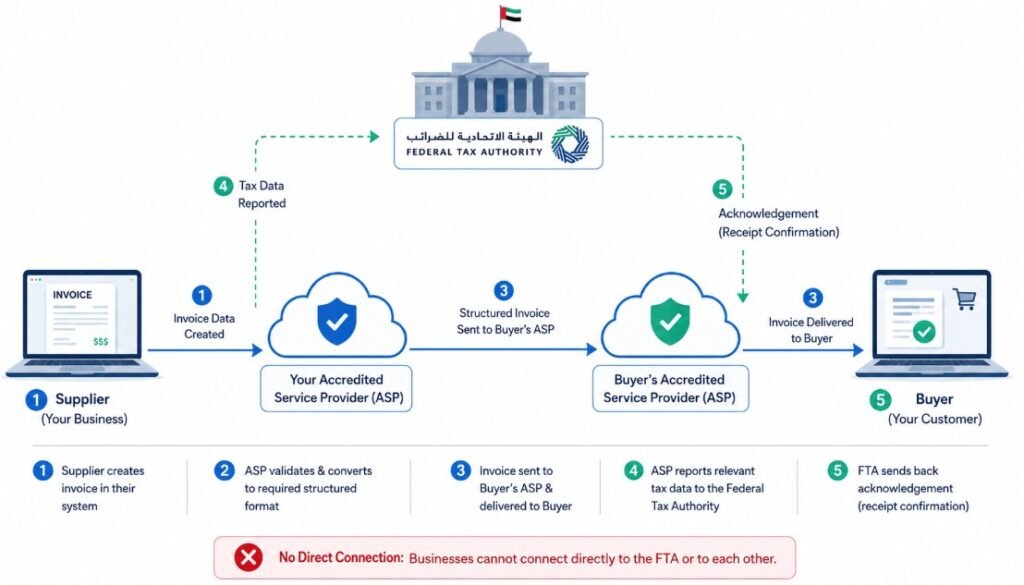
Rather than sending an invoice straight to a customer, the UAE’s system routes everything through accredited middlemen on both sides. In practice, it works like this:
- Your business (the supplier) generates the invoice data inside your normal accounting or billing software.
- Your Accredited Service Provider (ASP) validates that data and converts it into the required structured format.
- Your ASP passes the structured invoice to the buyer’s ASP, which runs its own checks before making it available to the buyer.
- At the same time, your ASP reports the relevant tax data to the Federal Tax Authority.
- The Federal Tax Authority sends back an acknowledgement of receipt, closing the loop.
The part that trips people up: a business cannot connect directly to the government’s side of this system. Everything has to go through an accredited provider, on both the sending and receiving end.
Who’s Actually in Scope
The scope here is broader than a lot of businesses assume:
- It covers business-to-business and business-to-government transactions. Business-to-consumer sales generally sit outside the mandatory scope for now, though that could expand later.
- VAT registration status doesn’t decide whether you’re in scope. The obligation is tied to issuing tax documents for business conducted in the UAE, which can include businesses that aren’t VAT-registered.
- Certain non-resident businesses can fall into scope too, if they’re required to issue UAE tax invoices.
- This reaches well beyond finance teams — real estate developers, professional services firms, retailers, logistics operators, and any business doing intercompany recharges are all realistic candidates for being affected.
If your business issues invoices to other businesses or to government entities in the UAE, the safer assumption is that you’re in scope until you’ve specifically confirmed otherwise, rather than the other way around.
Why This Reaches Far Beyond Finance
It’s tempting to file e-invoicing under “something the accounting team will sort out.” That’s the assumption advisers keep warning UAE businesses against. Because invoice data now has to be structured, validated and reported the moment it’s generated, the project ends up touching far more than one department:
- Procurement, since purchase terms agreed at the ordering stage end up as structured line items later.
- Warehouse and logistics teams, who confirm what was actually delivered and when, which the invoice timing depends on.
- Sales, since commercial terms negotiated with a customer have to translate cleanly into the new invoice fields.
- IT, who has to connect the accounting system to an external Accredited Service Provider in the first place.
Treat this as a pure finance or IT rollout, and the gaps tend to surface only once invoices start bouncing back rejected — usually close to the deadline, with little time left to fix the underlying process properly rather than patch around it.
Industry Complications Worth Knowing About
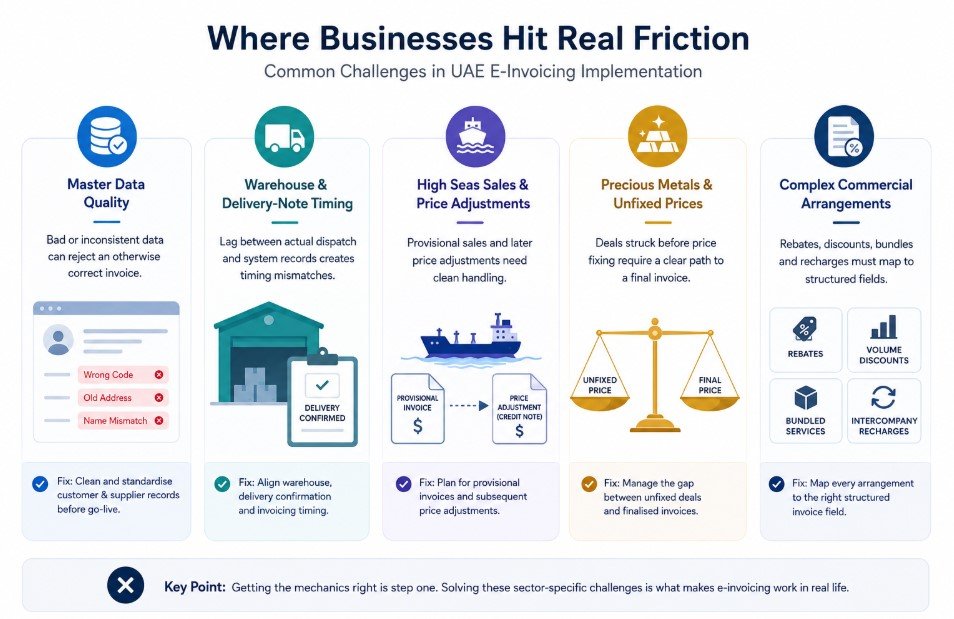
Most explainers stop at the general mechanics. A handful of sectors run into specific friction once they actually start mapping their transactions onto the new structured format:
- Master data quality — a mismatched product code, an outdated address, or an inconsistent customer name is enough to bounce an otherwise correct invoice. The fix isn’t complicated, but it does mean a genuine clean-up of customer and supplier records before going live, not just at the point something gets rejected.
- Warehouse and delivery-note timing — in businesses where invoicing is meant to follow confirmed delivery, a lag between what the warehouse has actually dispatched and what’s recorded in the system creates a mismatch between when a transaction happens and when the structured invoice is expected to be issued.
- High seas sales and price adjustments — common in commodity and shipping-heavy trade, where goods can be sold while still in transit and the final settlement price is only confirmed later. Fitting a provisional sale and a subsequent price adjustment cleanly into a structured invoice-and-credit-note model takes more planning than a standard transaction.
- Precious metals and unfixed-price transactions — relevant to Dubai’s gold and precious metals trade, where a deal is often struck before the price is finally fixed against a future market rate. Structured e-invoicing generally expects a settled amount, so businesses trading this way need a clear process for handling the gap between an unfixed deal and a finalised invoice.
- Complex commercial arrangements — rebates, volume discounts, bundled service agreements and intercompany recharges are often handled with manual adjustments in legacy systems. Each of those now needs a clean way to map onto a structured invoice field rather than a note in an email or a side spreadsheet.
None of these make e-invoicing unworkable for the sectors involved — they just mean a generic “turn on e-invoicing” project plan usually isn’t enough, and it’s worth flagging these scenarios to your Accredited Service Provider early rather than discovering them mid-transaction.
What the Latest Guidelines Changed
The Ministry of Finance’s most recent update to its e-invoicing guidelines, issued ahead of the pilot, clarified a few points that matter in practice:
- Advance payments — receiving an advance now requires its own e-invoice at the time of receipt, with the eventual final invoice covering only the remaining balance and linked back to the advance through a reference field, so the two stay traceable as one transaction.
- Milestone billing and retention — further detail was added for staged invoicing, relevant to construction, engineering and infrastructure projects where amounts are billed progressively over a contract’s life rather than all at once.
- Document retention — a business remains responsible for archiving and preserving its e-invoices even when that work is outsourced to an Accredited Service Provider. Using a provider doesn’t transfer that responsibility away, which is worth confirming explicitly in whatever agreement you sign with one.
Choosing an Accredited Service Provider
An ASP is a Ministry of Finance-accredited technology provider that validates, formats and transmits your invoice data on your behalf. You can’t skip this step or build a direct connection to the government system yourself — the entire model depends on going through one.
A growing list of providers are working through accreditation, and not every one will suit every business. Worth checking before committing: how the provider fits with your existing accounting or ERP software, what support they offer if something goes wrong with a transmission, and whether they have genuine experience running similar systems elsewhere, since several providers expanding into the UAE already went through an almost identical rollout in Saudi Arabia.
What Happens If You Don’t Comply
| Disclaimer: the figures below are drawn from publicly reported coverage . Tax penalty frameworks can be amended, and the exact application can depend on your specific circumstances. This is general information, not tax or legal advice — confirm anything specific to your business with a qualified tax advisor or directly with the Federal Tax Authority. |
As Khaleej Times has reported, the penalty structure introduced alongside the mandate is built around a few categories:
- A monthly penalty for failing to implement the system or appoint an ASP by the relevant deadline, applied for each month or part of a month the delay continues. ( AED 5,000/month (or part thereof) for missing the implementation/ASP deadline )
- A per-invoice penalty for any e-invoice not issued or transmitted within the required window, capped at a monthly maximum ( AED 100 per invoice, capped at AED 5,000/month)
- A similar per-document penalty for credit notes not processed correctly, with its own separate monthly cap. ( AED 100 per credit note, with its own separate AED 5,000/month cap)
- A daily penalty for failing to notify the relevant authority promptly about a system failure or a change to registered information. ( AED 1,000/day for failing to report a system failure or data change)
These penalties only start applying once a business has actually entered its mandatory phase — businesses testing the system voluntarily during the pilot window aren’t penalised for doing so.
Common Readiness Gaps Businesses Are Running Into
A 2026 readiness study by tax technology firm ClearTax, covered by Gulf Business, surveyed more than 500 finance leaders and found overall readiness sitting at a “developing” stage rather than a finished one. A majority hadn’t yet run a gap analysis on their accounting systems, a notable share said their current software couldn’t generate a compliant invoice in the required format, and most hadn’t yet built out the processes needed to handle responses, rejections and corrections once the system goes live.
None of this is really about awareness — most businesses already know the mandate is coming. The gap is in the unglamorous groundwork: checking whether existing software can actually do what’s required, and building the internal process for when something doesn’t go through cleanly the first time.
What to Do Before Your Mandatory Date Arrives
- Confirm your annual revenue bracket, since that’s what determines which deadline column applies to you.
- Run a gap analysis on your accounting or ERP system to see whether it can generate a compliant structured invoice today.
- Start evaluating Accredited Service Providers early — compatibility with your existing software matters as much as accreditation status.
- Clean up customer and supplier records: correct names, valid tax registration numbers, and consistent product or service descriptions.
- If your business uses advance payments, milestone billing or retention arrangements, map out how those will be linked and reported under the new rules.
- Train more than just the finance team — procurement, sales and operations staff often touch the invoicing process without realising it.
- Use the voluntary pilot window to actually test the system rather than waiting until your mandatory date to find out what breaks.
Quick Answers to Common Questions
Does e-invoicing replace VAT filing?
No. It runs alongside VAT obligations rather than replacing them — you’ll still register for VAT and file returns as before, but the Federal Tax Authority gets visibility into the underlying transactions much earlier in the process.
Do free zone companies need to comply?
Generally, yes, if they’re conducting business in the UAE and issuing tax documents under VAT rules. Free zone status on its own isn’t treated as an automatic exemption, so it’s worth checking your specific position rather than assuming.
What about small businesses or freelancers below the VAT threshold?
The scope language is wider than just VAT-registered entities, so it’s safer to check your position directly rather than assume being small or unregistered puts you outside the mandate.
Is my current accounting software enough on its own?
Possibly not. Most existing systems can produce a readable invoice, but generating the specific structured format required, and connecting to an Accredited Service Provider, is usually a genuine upgrade or integration project rather than a setting to switch on.
Will paper invoices disappear completely?
Not immediately for everyone. Business-to-consumer transactions currently sit outside the mandatory scope, and the rollout is phased by revenue band, so some businesses will keep working largely as they do today for a while longer.
Who’s responsible for keeping copies of e-invoices — us or our service provider?
You are. Outsourcing the technical side to an Accredited Service Provider doesn’t shift the responsibility for archiving and preserving those records, so it’s worth checking exactly what your provider’s agreement covers on this point.
What about businesses with unfixed pricing, like gold and precious metals trading?
These transactions need extra thought rather than a standard setup. Since structured e-invoicing generally expects a settled amount, businesses dealing in unfixed-price sales should work through the timing and adjustment process with their service provider well before their mandatory date, rather than assuming the default workflow will fit.
What if I’m not ready by my mandatory date?
Penalties begin accruing from that date onward, so the better move is reaching out to a service provider and reviewing your options as early as possible rather than waiting to see what happens.
Sum Up
E-invoicing is one of those changes that looks like a tax update on paper and turns out to be an operations project in practice. The businesses that handle it smoothly tend to be the ones that stopped treating it as a finance department checkbox early on and brought procurement, warehouse, sales and IT into the conversation from the start.
The phased rollout works in your favour here. A voluntary pilot, deadlines staggered by business size, and a growing field of accredited providers to choose from all add up to a genuine runway rather than a hard cutover. Businesses that use that window to run a proper gap analysis, clean up their master data, and test with a provider before they’re required to tend to go live with far fewer surprises than those that wait.
If there’s one takeaway worth carrying forward, it’s this: the requirements themselves are fairly fixed at this point, but how prepared you are when your date arrives is still entirely up to you. Start with the basics covered in this guide, confirm the details that matter most for your specific business and industry, and treat the months ahead as preparation time rather than a countdown.