If your visa situation is changing and you are already inside the UAE, the good news is that you do not always need to book a flight out and come back in. The authorities allow eligible residents and visitors to change their immigration status while remaining in the country. This is known as an in-country status amendment or change of status, and it can save you time, money, and the hassle of a border run.
However, the rules are strict, the timing is critical, and the process differs depending on whether your visa was issued in Dubai or one of the other emirates. Getting it wrong can lead to overstay fines, application rejections, or even a travel ban. Here is exactly how it works, what it costs, and what you need to watch out for.
What Is an In-Country Status Change?
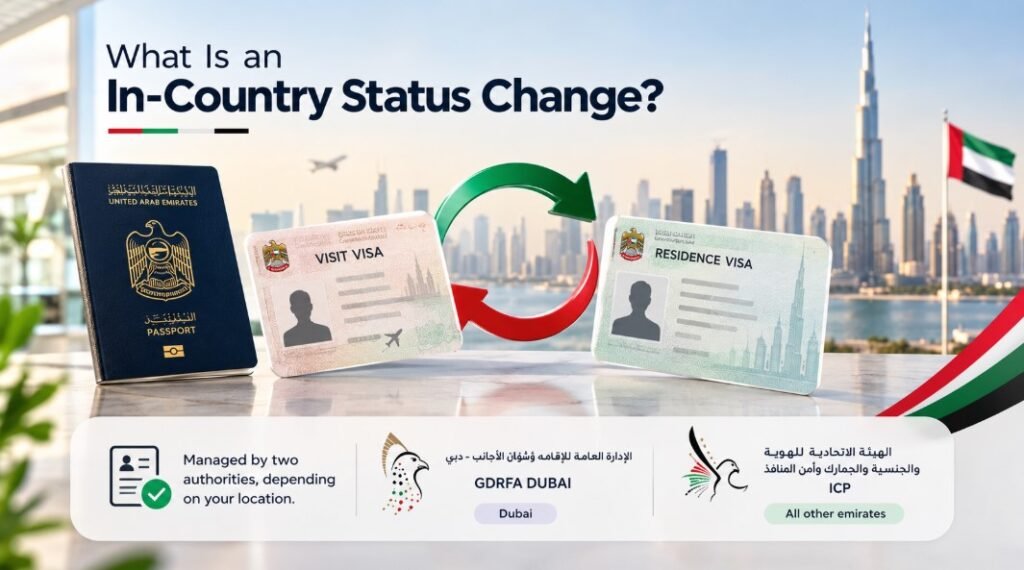
An in-country status change is the official process of switching from one visa category to another without exiting the UAE. The most common example is moving from a visit or tourist visa to an employment residence visa. Other examples include switching from a cancelled residence visa to a new tourist visa, or moving from one employment sponsor to another.
The process is managed by two different authorities depending on your location. Dubai visas are handled by the General Directorate of Residency and Foreigners Affairs, known as GDRFA Dubai. All other emirates fall under the Federal Authority for Identity, Citizenship, Customs and Port Security, known as ICP. The core rules are similar, but the portals, fees, and service centres differ.
Related: Top 10 Requirements for the UAE Digital Nomad Visa
Who Can Apply?
You can only switch status inside the UAE if you meet the requirements for the new visa category you want to move into. Simply wanting to stay longer is not enough. You need a valid reason and a valid sponsor or employer willing to file the paperwork.
For employment switches, you must have a confirmed job offer from a UAE-registered company. The employer must first obtain an initial work permit approval from the Ministry of Human Resources and Emiratisation, then file the change of status request through either ICP or GDRFA Dubai depending on the company’s location. Your current visa must still be valid at the time the application is submitted. If it has already expired, you cannot use the status change route until the overstay situation is resolved.
For visitors who want to extend their stay without working, there is also the option of applying for an in-country tourist visa. This is particularly useful if your residence visa was recently cancelled and you need time to either find a new job or settle your affairs before leaving. During your grace period after cancellation, you can apply for a 90-day in-country tourist visa through GDRFA or ICP without crossing any border.
Step-by-Step: How to Change Your UAE Visa Without Leaving the Country
The exact sequence depends on what you are switching to, but the general flow is consistent. Follow these steps in order. Skipping one or doing them out of sequence will cause delays or rejection.
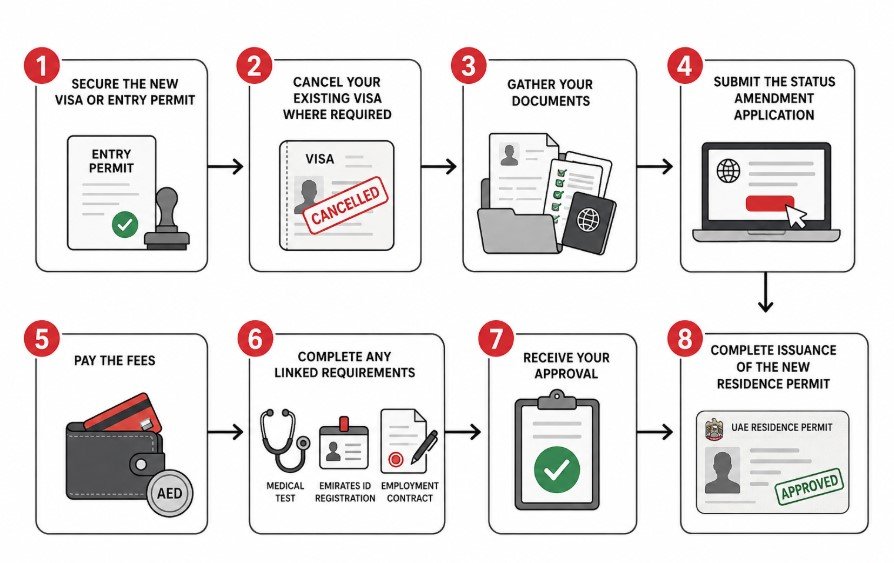
- Step 1: Secure the new visa or entry permit. Your sponsor or employer must first obtain the new entry permit for your next residence category. You cannot file a status change request without this document in hand. For employment, this means the work permit approval must come first, then the entry permit is issued.
- Step 2: Cancel your existing visa where required. If you are currently on a residence visa, it must be officially cancelled before the new one can be activated. If you are on a visit or tourist visa, ICP now allows the cancellation of that permit to be linked directly to your status adjustment application, so the record progresses automatically without requiring a separate cancellation step.
- Step 3: Gather your documents. You will need a clear copy of your passport, a copy of your cancelled visa or entry permit, the newly issued entry permit for your next category, and any additional documents specific to your situation. For employment, this usually includes the offer letter and attested educational certificates.
- Step 4: Submit the status amendment application. In Dubai, this goes through the GDRFA website, the GDRFA mobile app, or an Amer Service Centre. For other emirates, it goes through the ICP Smart Services portal. You will need UAE Pass to access most of these digital channels.
- Step 5: Pay the fees. The base status amendment fee is 500 dirhams. On top of that, Dubai charges a 10-dirham Knowledge fee, a 10-dirham Innovation fee, and a 15-dirham individual application fee. If an establishment is filing on your behalf, that last fee becomes 50 dirhams instead of 15. ICP follows a similar fee structure for federal applications, though the exact breakdown may vary slightly by emirate.
- Step 6: Complete any linked requirements. For employment visas, this means undergoing your medical fitness test, registering for your Emirates ID, and getting your employment contract processed. These steps happen after the status change is approved but before your new residence permit is finally issued.
- Step 7: Receive your approval. GDRFA Dubai lists an expected processing time of 48 hours for complete applications that have no missing documents or compliance issues. ICP processing times are comparable, though complex cases may take slightly longer.
- Step 8: Complete issuance of the new residence permit. Once approved and all linked requirements are done, your new residence permit is stamped and activated. Make sure this happens within the applicable deadline to avoid falling out of status.
Related: 10 Smart Ways to Use Your Emirates ID in Everyday UAE Life
The Employment Visa Sequence
If you are switching from a visit visa to an employment visa, the full sequence matters. You cannot skip steps or rearrange them. Your employer must first secure the work permit approval from MoHRE. Then they obtain the entry permit. Only then does the change of status application go through. After that is approved, you complete your medical test, enrol your biometrics for Emirates ID, and finally receive your stamped residence permit.
Since May 2026, much of this has been streamlined through the UAE Work Bundle platform. This unified digital system connects MoHRE and ICP into a single workflow. Instead of submitting documents across five separate platforms, employers now handle work permits, residency procedures, medical bookings, and Emirates ID applications through one portal.
For private sector employees on the mainland, this has cut processing times dramatically. The old system could take up to 30 working days. The Work Bundle reduces it to roughly five working days for straightforward cases.
If you are changing employers while already on a residence visa, your previous employer must cancel your existing permit correctly. You then have a limited window to secure the new work permit and residence. The new employer must apply within 90 days of your previous permit’s cancellation. During that gap, you remain in a grace period where no overstay fines apply, but once that grace period ends, the daily penalties begin immediately.
Grace Periods and Overstay Fines: The Critical Details
This is where most people get caught out. As of February 2026, the UAE unified its overstay fine structure. The rate is now a flat 50 dirhams per calendar day, starting from the first day after expiry for most visa types. There is no cap, and the amount accumulates until you clear it.
For prepaid tourist visas and visit visas, there is no grace period at all. The day after your visa expires, the fine begins. For visa-on-arrival nationalities, a 10-day grace period still applies. For cancelled residence visas, the grace period depends on your category. General work categories get 30 days. Skilled workers classified as Level 1 or 2 get 90 days. Golden Visa and Green Visa holders get 180 days. After that grace period ends, the same 50-dirham daily fine applies.
If you overstay, you must pay the fine before you can apply for a new visa or exit the country. For overstays exceeding 30 days, you may also need an exit permit, known as an Out-Pass, before you can leave. The authorities recommend paying fines and obtaining any necessary permits at least 48 hours before your departure to allow the systems to update.
Timing Is Everything
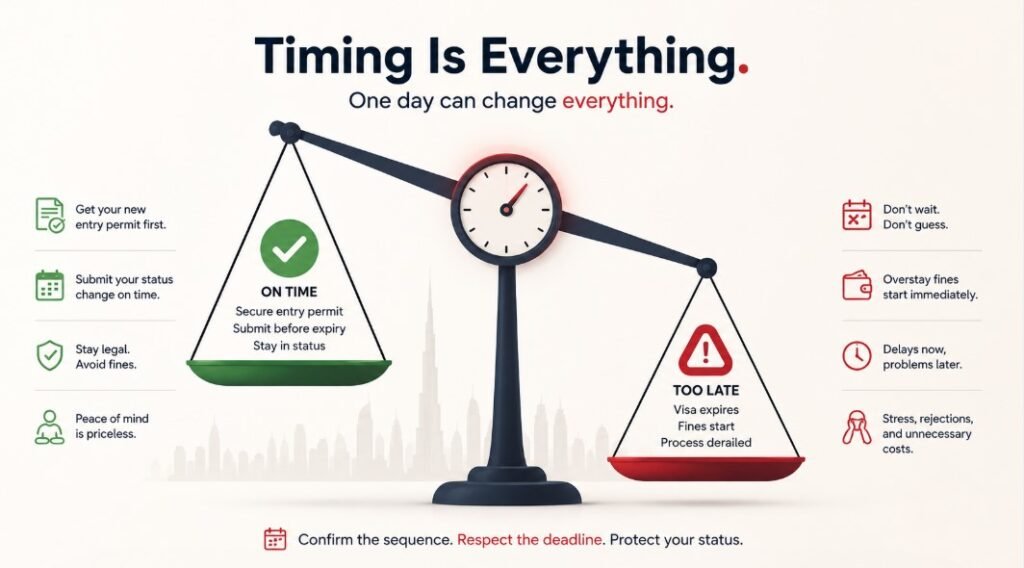
The most common mistake people make is waiting too long. If your employer cancels your residence visa before your new entry permit is ready, you could find yourself in a gap with no legal status. Similarly, if your visit visa expires while you are still gathering documents for a status change, the fines start immediately and can derail the entire process.
Always confirm the sequence before anything is cancelled. Make sure your new entry permit is issued and your status change application is submitted before your current authorised stay expires. If you are on a visit visa with no grace period, there is zero margin for error. The expiry date printed on your visa is the hard deadline.
Where to Apply and Track Your Status
For Dubai-issued visas, use the GDRFA Dubai website or the GDRFA app. You can also visit any Amer Service Centre. For visas issued in Abu Dhabi, Sharjah, or any other emirate, use the ICP Smart Services portal at icp.gov.ae or visit a Tasheel centre.
You can check your current visa status, expiry date, and any outstanding fines by selecting File Validity on either portal and entering your passport number and expiry date. This is the only authoritative record. Do not rely solely on PDF copies or agent assurances. Verify your status directly on the official government system.
Final Thoughts
Switching visas without leaving the UAE is entirely possible, but it is not automatic. You need the right documents, the correct sequence, and strict attention to deadlines. The 2026 rules have made the process more digital and faster through platforms like the Work Bundle, but they have also removed the buffer of grace periods for many visitors.
If you are considering a status change, start the paperwork early, verify your exact expiry date on the official portal, and make sure your new visa is secured before the old one lapses. Do that, and you can transition smoothly without ever stepping foot in an airport departure lounge.
Disclaimer: The information in this article is for general guidance only and does not constitute official legal or immigration advice. UAE visa rules and regulations change frequently. Please verify current requirements with official government portals (ICP or GDRFA) or a licensed immigration expert before taking action.