
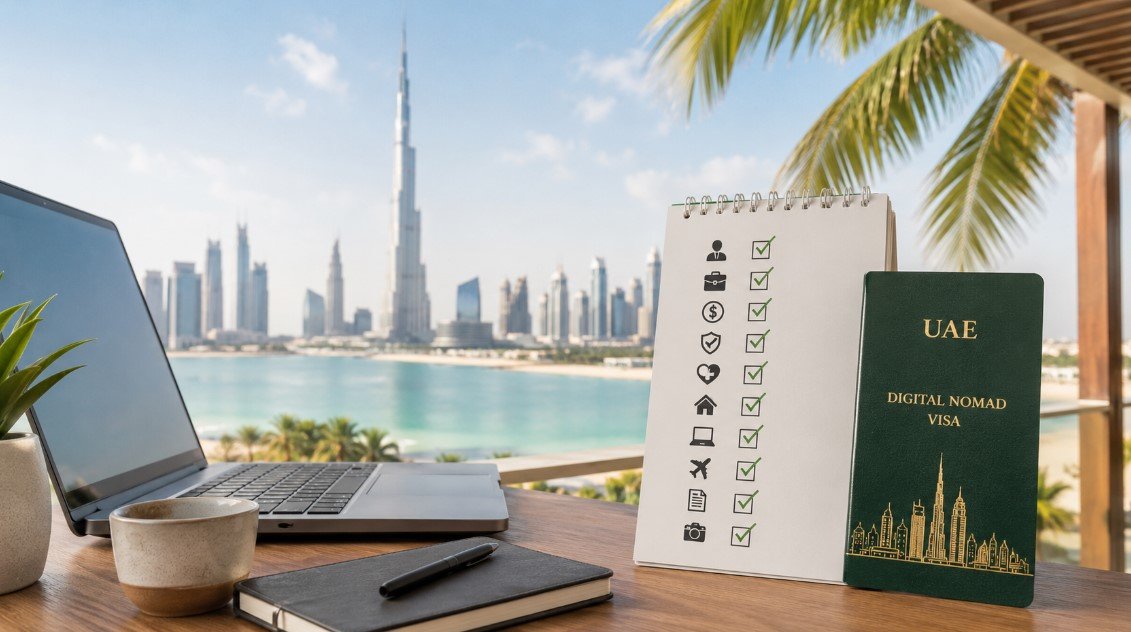
Requirements for the UAE Digital Nomad Visa : Everything you need to qualify for the UAE Virtual Work Residence Permit — with the 2026 document changes most applicants miss.
The UAE Digital Nomad Visa — officially called the Virtual Work Residence Permit — lets remote workers live legally in the UAE while continuing to work for employers or run businesses based outside the country. No UAE employer. No local sponsor. No trade licence required.
Since it launched in 2021, the application process has tightened. A significant documentation change came into effect on January 27, 2026, raising the bank statement requirement from three months to six. If you’ve read a guide written before that date, it may be out of date on this point.
Applications go through GDRFA in Dubai and through ICP for all other emirates. The ten requirements below reflect what both authorities currently ask for.
| Visa requirements, fees and processing times are set by the UAE government and can change without notice. Always verify current requirements directly at gdrfad.gov.ae (Dubai) or smartservices.icp.gov.ae (other emirates) before submitting your application. This guide reflects guidance current as of mid-2026. |
At a Glance
| Requirement | Current standard (2026) |
| Minimum monthly income | USD 3,500 / month from foreign source |
| Bank statements | 6 consecutive months (changed January 27, 2026) |
| Employment proof | 1-year contract or 1-year company registration |
| Passport validity | Minimum 6 months |
| Health insurance | Comprehensive international cover — mandatory |
| UAE accommodation | Hotel booking, tenancy contract or Airbnb confirmation |
| Application platform | GDRFA (Dubai) or ICP Smart Services (other emirates) |
| Medical fitness test | Required after initial approval |
| Emirates ID biometrics | Required in person at ICP or GDRFA centre |
| Government fees | AED 1,535 (~USD 420) federal route; higher via AMER centre |
1. Minimum Monthly Income of USD 3,500
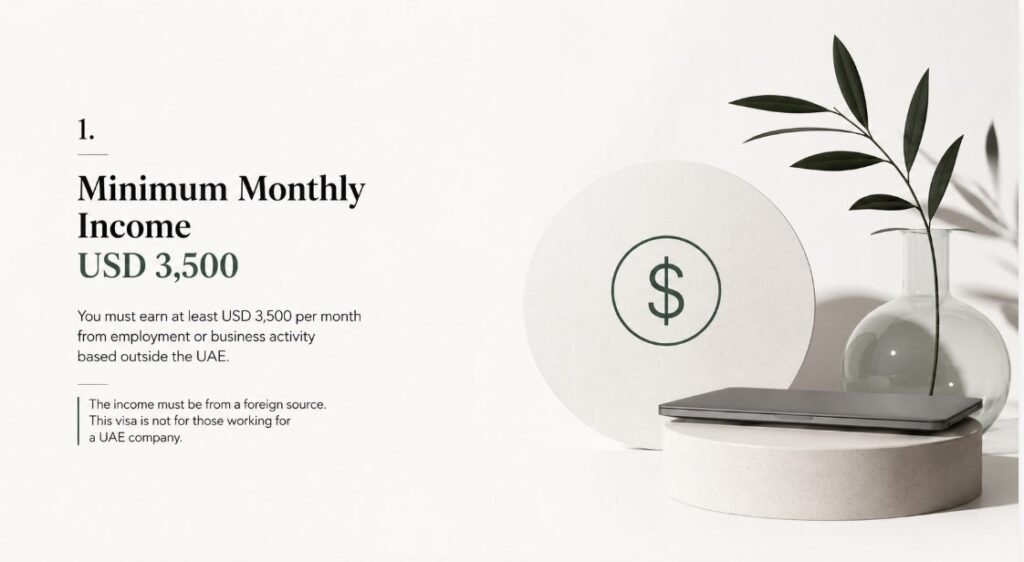
The official income threshold is USD 3,500 per month — or the equivalent in another major currency. This must come from employment or business activity based outside the UAE.
In practice, applicants earning closer to USD 5,000 per month report smoother approvals. Some AMER centres and third-party service providers informally screen at a higher threshold. The official GDRFA and UAE government portal still list USD 3,500 as the published minimum as of May 2026, but building in a buffer reduces the risk of delays or additional document requests.
The income must be demonstrably from a foreign source. If you are working for a UAE company — even remotely — this visa does not apply.
Relatd : The Ejari Guide – Everything You Need Know
2. Six Consecutive Months of Bank Statements
This is the requirement that changed most recently. Prior to January 27, 2026, applicants needed three months of bank statements. The requirement is now six consecutive months, and each monthly statement must clearly show income at or above the USD 3,500 threshold.
The practical impact: if you changed jobs, started freelancing or had any gap in income after July 2025, you may need to wait until your sixth qualifying month’s statement is available before applying. Submitting before that window closes is unlikely to succeed.
Statements must be official documents — either bank-issued or electronically authenticated through your bank’s portal. Informal screenshots are not accepted.
3. Proof of Remote Employment or Foreign Business Ownership
Exactly what you need here depends on your working arrangement.
If you are employed remotely: a copy of your employment contract (ideally showing at least one year remaining), an employer letter confirming your remote working arrangement, and a salary certificate or payslip are the standard documents. The contract must show employment with a company registered outside the UAE.
If you own a business: a foreign company registration document, business licence, ownership certificate or equivalent legal proof is required. The business must have been operational for at least one year. Documents issued in a language other than Arabic or English need certified translation.
Freelancers should prepare client contracts, invoices, income statements from freelance platforms (Upwork, Fiverr, Toptal, etc.) or business registration showing non-UAE clients. The key in every case is demonstrating that the income source is based outside the UAE.
4. Valid Passport with at Least Six Months’ Remaining Validity
Your passport must be valid for at least six months from the date you submit the application. A clear scanned copy of the bio-data page is required for the online application, and the original passport is needed for the in-person steps.
If your passport is close to expiry, renew it before starting the process. A passport that expires mid-application will require you to restart from the beginning with the new document.
All pages of the passport are typically required in the scan — not just the bio-data page. Ensure the scan is clear, well-lit and shows the full document without cropping any edges.
5. Comprehensive Health Insurance
Health insurance is mandatory for UAE residency and is required for the Emirates ID. The policy must provide comprehensive international cover that is valid in the UAE.
Basic travel insurance or policies that cover emergencies only are generally not accepted. The insurance must cover inpatient and outpatient treatment, and some processing centres require policies that explicitly state coverage within the UAE.
Budget for this separately from the visa fees. Depending on age, cover level and provider, annual premiums for a comprehensive international health insurance policy run between AED 2,500 and AED 8,000 or more. Some applicants use international providers like Cigna, AXA or Allianz; others arrange local UAE policies after arrival.
6. Proof of UAE Accommodation
You need to demonstrate that you have a place to stay in the UAE. This is a standard residence visa requirement and applies regardless of whether you are applying from inside or outside the country.
Acceptable documents include a signed tenancy contract registered with Ejari, a hotel booking confirmation, a serviced apartment agreement or a confirmed Airbnb booking. The accommodation must be for the UAE emirate where you are applying for residency.
If you are applying from outside the UAE, a hotel or serviced apartment booking for your intended arrival period is normally sufficient for the initial application. Long-term accommodation will be required once you are in the country and proceeding to the medical and biometrics steps.
7. Online Application Submission
The application is submitted online. Which platform you use depends on which emirate you want residency in.
For Dubai: apply through the GDRFA Virtual Working Programme portal. For Abu Dhabi, Sharjah, Ras Al Khaimah and all other emirates: apply through ICP Smart Services.
The online form requires your personal details, passport information, proof of income, bank statements, employment or business documents, accommodation confirmation and health insurance details. Have all documents scanned and ready before you start — the system does not always allow you to save and return easily.
The UAE government portal at u.ae also has a summary of the remote work visa programme that is useful for an overview before you begin the formal application.
8. Medical Fitness Test
After your initial application is approved online, you attend a medical fitness examination. This is standard for all UAE residence visas and is not specific to the digital nomad visa.
The test includes a blood test for communicable diseases and a chest X-ray. In 2026, most results are returned within two to four working days. You attend at an approved medical centre — a list is available through GDRFA or ICP depending on your emirate. The medical is booked and paid for separately from the visa fees.
Some medical conditions identified during the test can result in visa denial. This is a UAE immigration policy matter and varies by condition. If you have any pre-existing health concerns, this is worth researching before proceeding with the application.
9. Emirates ID Biometrics
Once the medical test clears and the visa is formally issued, you attend an ICP or GDRFA service centre in person to submit biometrics: fingerprints and a digital photograph. This is the step that generates your Emirates ID.
In 2026, Emirates IDs are typically issued within five to ten working days after the biometrics appointment. The card is essential — it functions as your UAE identity document for everything from opening a bank account to registering for government services. You cannot complete the residency process without it.
UAE residents living in Dubai can book Emirates ID appointments through GDRFA’s online system. Residents in other emirates use the ICP Smart Services portal or visit an Amer Centre.
10. Application Fees
The fee structure depends on where and how you apply.
The federal ICP route carries the lowest government-only fees — approximately AED 1,535 (around USD 420) covering the visa processing and Emirates ID. This is the route for applicants in all emirates except Dubai.
The Dubai GDRFA route has two options. Applying directly through the GDRFA portal costs approximately USD 287 in base fees. Applying through an AMER centre adds a service fee of around USD 334 on top of the base fee.
Neither figure includes health insurance, the medical fitness test, document translation or any third-party processing fees. A realistic all-in budget for the first year — including health insurance — runs between USD 1,200 and USD 1,600 if you apply yourself, and USD 1,800 to USD 2,000 if you use a visa agent.
Total Cost Summary
| Item | Estimated cost |
| Government visa fees (ICP/federal route) | AED 1,535 (~USD 420) |
| Government visa fees (GDRFA Dubai direct) | ~USD 287 |
| AMER centre service fee (Dubai) | ~USD 334 (additional) |
| Medical fitness test | AED 200–350 depending on centre |
| Health insurance (annual, basic-comprehensive) | AED 2,500–8,000+ |
| Document translation (if applicable) | AED 100–400 per document |
| Visa agent fee (if used) | AED 1,500–3,000+ |
| Total without agent (estimated) | USD 1,200–1,600 |
| Total with agent (estimated) | USD 1,800–2,000 |
The visa is valid for one year and renewable annually, subject to meeting the same eligibility criteria at renewal. You will need to submit updated bank statements, current employment or business documentation and valid health insurance at each renewal.
How to Apply
- Gather all documents before starting the online form: passport scans (all pages), 6 months of bank statements, employment contract or business registration, accommodation proof, health insurance certificate and passport-sized photo.
- Submit the online application through GDRFA (Dubai) or ICP Smart Services (other emirates). Most applications take 5 to 7 business days for initial approval once all documents are complete.
- After approval, attend the medical fitness test at an approved UAE medical centre. Book in advance — appointments fill up at popular centres.
- Once the medical clears, visit an ICP or GDRFA centre for Emirates ID biometrics. Allow 5 to 10 working days for the ID to be issued.
- Your residency stamp is placed in your passport at the final stage. Once stamped, you are officially resident in the UAE under the Virtual Work Residence Permit.
Can You Sponsor Family Members?
Yes. Digital nomad visa holders can sponsor family members — spouse and children — for dependent residence visas. The main applicant must meet the income and documentation requirements, and each dependent visa carries its own government fees and processing requirements.
The dependent visa process runs separately from the main application. Sponsors typically need to show a combined income sufficient to support dependants, along with marriage or birth certificates for the relevant family members.
Official Sources
GDRFA Virtual Working Programme (Dubai): gdrfad.gov.ae
ICP Smart Services (all other emirates): smartservices.icp.gov.ae
UAE Government portal — remote work visa overview: u.ae/en/information-and-services/visa-and-emirates-id/types-of-visa/remote-work-visa


[…] Related: Top 10 Requirements for the UAE Digital Nomad Visa […]
[…] Related: Top 10 Requirements for the UAE Digital Nomad Visa […]