Walk into any Dubai property expo, scroll through Bayut on a quiet evening, or sit next to the right person on a flight from London — and off-plan property will come up within minutes. It dominates conversations, headlines dominates the actual transaction data. According to figures compiled by fam Properties from Dubai Land Department records, off-plan sales accounted for approximately 70% of all residential transactions in Q1 2026, with total sales hitting AED 176.7 billion across nearly 48,000 deals — a 23.4% rise in value year-on-year. That is not a niche market. That is the market.
But popularity and safety are different things. Dubai’s off-plan sector has produced extraordinary returns for buyers who understood what they were doing, and genuine financial pain for those who did not read the contract carefully enough, did not check the developer’s history, or got swayed by an unusually low launch price. This guide is written for both audiences — the serious buyer who wants to understand exactly how the process works, and the cautious one who wants to know what can go wrong before committing a six or seven-figure sum to a building that does not yet exist.
We cover everything: the mechanics of how off-plan buying works in Dubai, the legal protections that actually exist (and their real limits), an honest look at which developers have earned their reputations, the different payment structures available, and the specific red flags that experienced buyers and lawyers say matter most on Off-Plan Property Dubai.
What Off-Plan Actually Means — and Why Dubai Buyers Keep Choosing It
Off-plan simply means buying a property before it is built — or while it is still under construction. You sign a Sale and Purchase Agreement (SPA) with the developer, pay a deposit and then instalments linked to construction milestones or a calendar schedule, and wait for the handover of a finished unit. The title deed comes at the end, not the beginning.
The appeal in Dubai has never been purely speculative. Several practical factors drive the numbers:
- Entry prices are lower. Launch pricing on off-plan units typically sits 10–30% below the equivalent completed property depending on the developer, location, and launch phase. For buyers who cannot quite afford a ready unit in a preferred area, off-plan is often the only viable route.
- Payment plans spread the cost. Rather than arranging a full mortgage upfront, buyers pay in structured instalments — often 30–40% during construction and the remainder on handover or over several post-handover years. This dramatically lowers the initial capital requirement.
- Capital appreciation during construction. When the market moves favourably, buyers who secured a unit at launch pricing can see meaningful paper gains before they have even taken the keys. Some 2025 launches had already shown 15–20% appreciation by early 2026 according to data tracked by Bayut.
- Modern design and customisation. Off-plan buyers in many developments can choose finishes, layouts, or configurations that simply are not available in the secondary market.
None of this means off-plan is risk-free. The risks are real and we address them directly below. But they are manageable — if you go in understanding how the system actually works.
How the Process Works, Step by Step
The mechanics of buying off-plan in Dubai are more structured than most first-time buyers expect. There is a regulatory framework that did not exist before 2007, and it shapes every step of the transaction.
1. Finding and reserving a unit
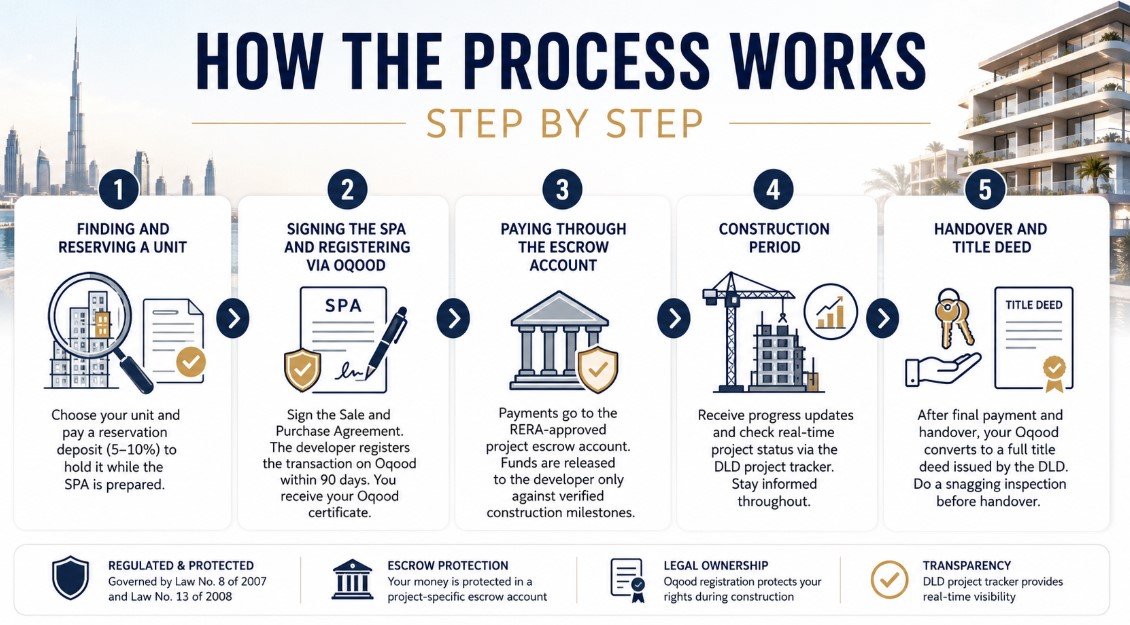
Most serious off-plan launches happen through developer sales events or registered brokers. You can search Property Finder or Bayut for listings, but the most competitive units in popular projects often sell before they appear on portals. A good broker with developer relationships can give you early access to launches. Once you identify a unit, you pay a reservation deposit — typically 5–10% — to hold it while the SPA is being prepared.
2. Signing the SPA and registering via Oqood
The Sale and Purchase Agreement is the central legal document. It sets out the purchase price, payment schedule, projected handover date, specification details, and what happens in the event of delays. Read this document carefully — or have a lawyer read it. The grace period clauses and delay compensation terms vary significantly between developers and matter enormously if things run late.
Once the SPA is signed, the developer must register the transaction through Oqood — the Dubai Land Department’s off-plan registration system, established under Law No. 13 of 2008. This must happen within 90 days of signing. Your Oqood certificate is the legal proof of your ownership during the construction period. Without it, your investment is not protected by the escrow framework, you cannot resell the unit before handover, and you cannot use it as security for financing. Always verify your Oqood has been issued.
3. Paying through the escrow account
Under Law No. 8 of 2007, every off-plan project in Dubai must have its own dedicated escrow account at a RERA-approved bank. This account is project-specific — a developer cannot mix funds across developments. Your payments go into this account, not into the developer’s general operating budget. The developer can only draw from escrow against verified construction milestones, overseen by a RERA-appointed trustee.
Always pay directly to the escrow account, never to the developer’s general account. Confirm the escrow account details in your SPA and cross-reference with the RERA project registration. If a developer cannot or will not provide clear escrow account details, that is a reason to stop.
4. Construction period
During construction, you will receive progress updates from the developer, often linked to payment triggers. You can check real-time project status through the DLD project tracker. This is worth doing periodically rather than waiting passively. If construction appears to have stalled, ask the developer directly and check the DLD records.
5. Handover and title deed
When construction is complete and the final payment is made, the developer hands over the unit. Your Oqood registration converts into a full title deed issued by the DLD. This is when the property is legally yours in the conventional sense. A snagging inspection before handover is advisable — it gives you a documented record of any defects the developer is obligated to address.
Key legal protections at a glance Law
- No. 8 of 2007: Mandates dedicated escrow accounts for every project. Funds are ringfenced and released only against verified construction milestones.
- Law No. 13 of 2008: Established the Oqood off-plan registration system. Buying without Oqood registration means significantly reduced legal protection.
- RERA developer licensing: Developers must hold a valid RERA licence and demonstrate financial capacity before launching a project.
- Cancellation rights: If a developer defaults seriously enough, RERA can intervene, appoint a replacement developer, auction the project, or initiate refunds from the escrow account.
Payment Plans— What Developers Are Actually Offering
Payment plan structures have become increasingly creative in the past few years. Understanding the differences matters because the structure you choose affects not just your cashflow, but your risk profile.
Construction-linked plans
The most traditional format. Payments are tied to construction milestones: you might pay 10% on booking, a further 40% across construction phases, and the remaining 50% on handover. The logic is intuitive — your payments track the physical progress of the building. The risk is clear: if construction slows, your capital is tied up for longer than planned.
slower construction delays milestone payments, so you don’t pay faster; but overall project duration extends, keeping your money in the deal longer before handover
Post-handover payment plans (PHPP)
These have become very popular among investors. A typical structure might be 30–40% during construction, then the remaining 60–70% spread over two to five years after you receive the keys. The significant advantage is that once you take handover, you can rent the property and use that income to service the remaining developer payments.
The trade-off: developers typically price PHPPs at a 5–15% premium over comparable units on standard plans. Missing post-handover payments can trigger penalties and, in severe cases, property forfeiture. And because this is a developer arrangement — not a bank mortgage — the terms and protections are different.
1% per month plans
A number of developers, particularly in the mid-market segment, have popularised flat monthly payment structures: pay 1% of the purchase price each month over the construction period, sometimes with a small down payment. Samana and Danubeproperties Developers and several others have used this format extensively. It is appealing for cash-flow management but worth examining the total cost versus a lump sum at handover.
Typical payment plan structures:
| Plan type | How it works |
| Construction-linked | Payments tied to build milestones. 40/60 or 60/40 splits are most common. |
| Post-handover (PHPP) | 30–50% during construction, balance paid over 1–5 years after keys. Usually 5–15% price premium. |
| 1% per month | Flat monthly instalments across the construction period. Popular in mid-market projects. |
| 80/20 or 90/10 | Heavy back-loading — most payments due at or after handover. Usually carries a price premium. |
The Best Developers in Dubai — and What Sets Them Apart
Choosing the right developer is arguably more important than choosing the right unit. A great location in a delayed or poorly built project is a worse outcome than a good-not-great location delivered on time by a developer with a track record of quality.
Emaar Properties
Dubai’s largest developer by value and the name behind Downtown Dubai, Dubai Hills Estate, Dubai Creek Harbour, and the Burj Khalifa. Emaar’s delivery record is the benchmark by which others are measured — top-tier developers like Emaar typically deliver on time 80–90% of the time. Their current pipeline includes Emaar South (villas from AED 3.15 million, adjacent to the expanding Al Maktoum International Airport) and further phases at Creek Harbour. For first-time off-plan buyers who want the lowest-risk entry point, Emaar is the natural starting comparison.
Nakheel
The government-linked master developer behind Palm Jumeirah is back in the spotlight with Palm Jebel Ali — a project that has been in various stages of planning for years and is now advancing seriously. The second palm island is designed to surpass the original in scale, with ultra-luxury beachfront villas starting from AED 15 million. The timeline extends to 2028 and beyond. Nakheel’s government backing gives buyers additional confidence that the project will complete, even if timelines shift.
DAMAC Properties
DAMAC occupies an interesting position. Their branded residences — partnerships with Versace, Cavalli, and Chelsea FC — generate enormous marketing buzz and their sales volumes are consistently high. The honest reality, acknowledged even by DAMAC’s advocates, is that their delivery timelines have historically been mixed.
Factoring in a 6–12 month buffer beyond the stated handover date is sensible for any DAMAC project. For investors prioritising the branded luxury segment, their projects in Damac Hills and the Marina remain among the most actively traded.
Sobha Realty
Sobha is the developer that more research-oriented buyers often land on after doing genuine due diligence. They have a vertically integrated construction model — they build their own projects rather than subcontracting — which gives them more control over quality and timing. Sobha Hartland and Sobha Seahaven are their headline current projects. Build quality is consistently praised, and their delivery track record is strong relative to the industry average.
Aldar Properties
Abu Dhabi’s largest developer has been expanding steadily into Dubai, and their institutional size brings real benefits: strong post-handover support, reliable escrow management, and a level of corporate governance that smaller developers cannot match. Their Dubai pipeline includes projects in Dubai Investment Park with 3-bed townhouses from AED 1.5 million and Q4 2027 handover, making them a strong option for buyers seeking mid-market value with developer credibility.
Samana Developers
Samana has found a strong audience among first-time investors and yield-focused buyers with their resort-style residential concepts and accessible 1%-per-month payment structures. Their pricing sits at the affordable end of the Dubai off-plan market, and for buyers who want exposure to the asset class without six-figure upfront commitments, they represent a genuine option. Go in with realistic return expectations and confirm delivery timelines carefully.
Meraas
Meraas is the developer that high-net-worth buyers and lifestyle-first investors target when location and land value take absolute priority. As a government-backed master developer, they control some of Dubai’s most exclusive waterfront and urban real estate, meaning they don’t just build towers—they create the entire surrounding ecosystem.
The Acres, Nad Al Sheba Gardens, and Madinat Jumeirah Living (MJL) are their headline current projects. Build quality is premium, but the real premium is in the master plan itself, as their developments consistently command high resale margins and strong rental yields due to land scarcity in their chosen pockets.
Ellington Properties
Ellington is the boutique developer that design-conscious investors and end-users pivot to when they want an alternative to mass-market layouts. They operate on a design-led model, heavily investing in hotel-inspired lobbies, functional floor plans, and custom-made interior finishes that outclass the industry standard for their price brackets.
Mercer House in Uptown Dubai and their extensive portfolio in JVC (such as the newly handed-over Arbor View) are their headline current projects. Their delivery track record is highly reliable, and they are widely recognized in the market for generating superior rental yields because tenants are willing to pay a premium for their aesthetic and build quality.
Binghatti Developers
Binghatti is the developer that high-volume investors turn to for aggressive rental yields, rapid construction timelines, and distinct architectural statements. They rely on a highly optimized, vertically integrated building model—leveraging their own contracting and manufacturing arms—to deliver projects far faster than the market average.
Mercedes-Benz Places | Binghatti City and Burj Binghatti Jacob & Co are their headline current projects, anchoring a massive pivot into ultra-luxury branded residences alongside their high-volume mid-market hubs in JVC and Business Bay. Their build velocity is lightning-fast, making them ideal for capital deployment where a quick transition from off-plan to active rental income is the primary goal.
Danube Properties
Danube is the developer that budget-disciplined investors and first-time buyers rely on for maximum cash-flow flexibility and entry-level luxury. They built their entire market dominance around a signature, highly accessible 1% monthly payment plan, combined with selling units fully furnished to offer an end-to-end investment loop.
Bayz 102 in Business Bay, Breez in Dubai Maritime City, and their massive new Greenz master villa community are their headline current projects. Backed by the massive procurement power of the Danube Group’s building materials division, their delivery pipeline is remarkably consistent, making them a staple for thin-capital plays looking for predictable capital appreciation.
The Best Areas for Off-Plan Investment
Location selection interacts with developer selection in ways that matter. The same payment plan from the same developer delivers very different risk and return profiles depending on where the project sits.
Dubai Creek Harbour
Dubai Creek Harbour is one of the most talked-about waterfront districts in Dubai, positioned along the historical creek with clear views toward Downtown Dubai and the Burj Khalifa. Backed by Emaar’s signature master-planning, the area boasts significant infrastructure investment and an exceptionally active off-plan and resale pipeline, with 44 projects currently in development.
According to recent Dubai Land Department transaction data, the district has established itself as a top-performing growth corridor, registering a 16.8% year-on-year capital appreciation in 2025—the second-highest in Dubai. This upward momentum reflects strong end-user absorption (over 4,200 transactions in 2024 alone) and positions Dubai Creek Harbour as a resilient, pedestrian-friendly lifestyle hub built for long-term value, with rental yields of approximately 7%.
Dubai Hills Estate
Established enough to have a functioning community with schools, a mall, a hospital, and mature parks — but still expanding with new phases. The combination of lifestyle infrastructure and Emaar’s brand makes it consistently attractive to end-users, which sustains rental demand and resale values. Off-plan pricing for new phases tends to be firmer here than in emerging districts.
Jumeirah Village Circle (JVC)
Jumeirah Village Circle (JVC) is Dubai’s most transacted residential area by volume, with 4,845 transactions in Q2 2025 alone—the highest of any Dubai community and representing 12.2% of all off-plan apartment transactions that quarter. In H1 2025, JVC recorded 16,749 total transactions worth AED 16.92 billion, led by studios and one-bedroom units.
Affordability (entry prices below AED 600,000), multiple school options, excellent road access via Sheikh Mohammed Bin Zayed Road, and a growing F&B scene combine to deliver rental yields that regularly exceed 7%. JVC delivers some of Dubai’s highest gross rental yields: 7.94% for studios, 7.11% for 1-bedroom units, 7.04% for 2-bedroom units, and an average of 7.30% across all property types.
Dubai South
The area around Al Maktoum International Airport is a long-term infrastructure bet. The airport expansion — projected to eventually handle 260 million passengers annually — has begun driving genuine residential demand from logistics workers, airline staff, and businesses relocating near the new hub. Transaction data from Q1 2026 showed Dubai South among the highest-volume areas for new off-plan sales. The caveat: the infrastructure timeline is measured in years and requires patience.
Palm Jebel Ali
For buyers with AED 15 million-plus and a five-year-plus horizon, Nakheel’s second palm island is one of the most asymmetrically interesting bets in the Dubai market. Physically, there will not be a third palm. Early investors in Palm Jumeirah who held long-term saw returns that justified the wait. The risk is execution, timeline, and a genuinely small buyer pool at that price point.
What Can Go Wrong — Red Flags and Genuine Risks
The regulatory framework in Dubai is genuinely protective compared to many markets, but it does not eliminate risk. Here are the situations that experienced buyers, brokers, and property lawyers consistently flag.
Developer with no completed track record
New developers enter the Dubai market regularly. A new developer is not automatically bad, but they deserve significantly more scrutiny. Before buying with a developer who has not completed at least one project in Dubai, verify: is the project properly registered with RERA? Is there a clear, specific escrow account?
Missing or delayed Oqood registration
Treat this as a serious warning sign, not an administrative inconvenience. If the developer has not registered your SPA through Oqood within 90 days, your payments are not protected by the escrow framework in the same way as a properly registered buyer’s. Escalate immediately with the developer, and if unresolved, directly with RERA.
Unusually aggressive payment plans
Developers frequently use aggressive payment structures—such as 1% to 2% down payments followed by low monthly installments (often ranging from AED 5,000 to AED 8,000)—to attract buyers looking for minimal initial outlays. A prime example is Danube Properties’ “1% plan” (featured in projects like Serenz and Eleganz), which pairs a 5% down payment with 1% monthly installments and below-market pricing, positioning property ownership as a viable alternative to renting for five years.
However, buyers must approach these plans with caution. While Dubai’s strict escrow account regulations mandate that developer-funded protections safeguard buyer capital, project delays or cancellations can still result in prolonged refund processes and disrupted timelines
Force majeure clauses
Worth reading carefully . Under Article 273 of the UAE Civil Code and updates effective June 2026, developers can invoke force majeure — citing material shortages, supply chain disruption, or regional instability — to excuse delays. Most SPAs include a grace period of six to twelve months beyond the stated handover date before a buyer can pursue cancellation. During that period, your capital is committed and your options are limited.
Specification changes
Developers can legally make reasonable changes to specifications during construction. Some buyers have been surprised to receive units with different floor finishes, window sizes, or layout configurations than the showroom suggested. Read the specification section of the SPA carefully — not just the price and payment schedule.
Overcommitting across multiple projects
The Dubai market makes it tempting to reserve multiple units across projects — payment plans can seem manageable in isolation. Across three or four projects simultaneously, with construction milestones triggering payments at overlapping intervals, the combined commitment can exceed what buyers can comfortably service. Go in with a clear month-by-month picture of total committed capital.
| Due diligence checklist before signing |
|---|
| Verify the developer’s RERA licence is valid and active on the DLD website. Confirm the project DLD approval number (M-code) and provisional register status. Request escrow account details in writing and verify with the named RERA-approved bank. Read the SPA delay and grace period clauses — know when you can pursue cancellation and what compensation is available. Check the developer’s completed project history — at minimum one delivered project in Dubai is a meaningful bar. Verify your Oqood certificate within the 90-day registration window. Model total payment obligations month by month across all off-plan commitments you hold. |
Off-Plan vs. Ready Property — When Does Each Make More Sense?
The classic real estate debate in Dubai has taken an interesting turn. According to recent Q1 market data from agencies like Springfield Properties and fäm Properties, the city-wide blended average has climbed past AED 1,940 per square foot. More notably, off-plan developments now capture over 70% of all transaction volumes.
With the traditional “under-construction discount” compressing in several premium areas, choosing between a brand-new project and an existing home isn’t as simple as it used to be. Deciding which route makes the most sense depends entirely on your financial strategy, timeline, and risk tolerance.
Off-plan makes more sense if you are investing for medium to long-term capital appreciation; comfortable with a 2–4 year wait before the property generates income; able to sustain payment obligations without the unit being tenanted; or primarily motivated by the payment plan structure spreading the cost over time.
Ready property makes more sense if you are looking to generate rental income immediately; moving to Dubai and need somewhere to live on arrival; risk-averse and unwilling to carry construction risk; or buying in a segment where off-plan pricing is no longer significantly below the ready market.
If you have a flexible living timeline and your primary goal is to leverage structured payment plans to step into the real estate market, off-plan offers an incredibly accessible runway. However, if you prioritize instant utility, tangible asset inspection, or immediate cash flow—and want to avoid the holding costs of waiting for a handover—the ready market remains the safer, more practical anchor for your capital.
The Golden Visa Connection
A property purchase of AED 2 million or more qualifies the buyer for the UAE’s Golden Visa — a ten-year residency that does not require employer sponsorship. Off-plan units count toward this threshold, but the visa is typically issued after Oqood registration confirms the investment value. For international buyers using Dubai property as a route to long-term residency, the off-plan market at the AED 2 million price point — where there is still significant developer supply — makes genuine strategic sense.
Fees to Budget For
Off-plan buyers sometimes underestimate the full cost of a transaction. Beyond the purchase price, budget for:
- Oqood registration fee: 4% of the purchase price, paid to the DLD at registration. Some developers offer to cover this as a launch incentive on premium projects.
- Agency commission: Typically 2% if buying through a broker. On developer direct sales, this is usually absorbed by the developer.
- NOC and trustee fees: Smaller administrative costs at handover, typically AED 500–5,000 depending on the project.
- Service charges: Annual maintenance fees applied once you take ownership. These vary significantly — some service charges in premium projects run to AED 25,000–50,000 per year or more.
- Mortgage costs (if applicable): Arrangement fees, valuation fees, and a mortgage registration fee of 0.25% of the loan amount.
The Bottom Line
Off-plan property in Dubai is neither the effortless money machine that the most enthusiastic brokers describe, nor the reckless gamble that the most cautious observers sometimes suggest. It is a legitimate and well-regulated investment category that, approached carefully, has produced genuine wealth for thousands of buyers over the past two decades.
The 70% market share figure for Q1 2026 is not a sign of irrational exuberance. It reflects the structural reality that Dubai’s population is growing, its infrastructure is expanding, and its regulatory framework — for all its imperfections — provides meaningful protections that most off-plan markets globally do not. Buyers who understand the Oqood system, know which escrow questions to ask, and have chosen a developer whose track record can be verified are in a fundamentally different position to those who sign based on a showroom experience and a promotional price.
The risks we have outlined are not hypothetical. Delays happen — industry data suggests 40–50% of Dubai off-plan projects experience some form of handover delay. Smaller developers default. Payment plans can become overextended. But for buyers who read the contract, check the RERA registration, choose established developers for their primary exposure, and budget conservatively for both fees and timeline, the fundamentals of Dubai’s off-plan market remain as attractive as they have been at any point in the past five years.
If you are buying for the first time, start with a project from a developer who has completed at least one comparable development in Dubai. Understand your Oqood certificate. Pay into the escrow account. Read the grace period clause. And if any numbers in the payment plan look too good relative to the market, ask why — that question alone has saved more buyers from difficult situations than any amount of due diligence after the fact.
Related reading on DubiTop
- Buying vs Renting in Dubai —analysis
- Moving to Dubai Checklist — the complete expat setup guide
- Top 9 communities near the Dubai Metro Blue Line
Disclaimer: This article is for informational purposes only and does not constitute financial, legal, or investment advice. Property markets fluctuate. Always conduct independent due diligence and consult a RERA-licensed agent and qualified legal adviser before making any property purchase.