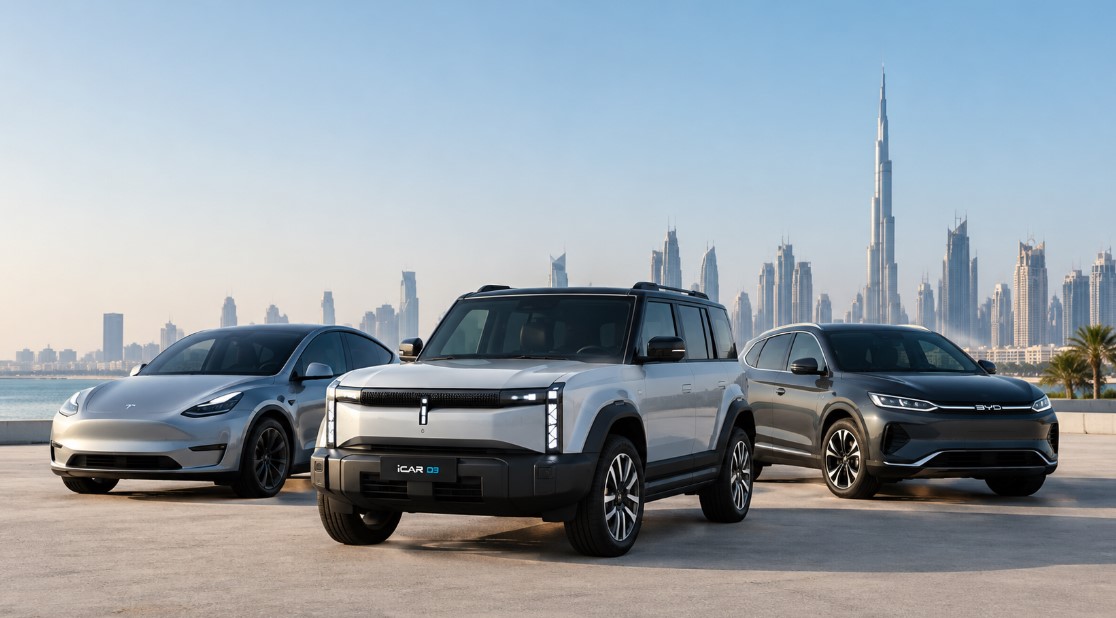
Buying a used electric vehicle in Dubai feels like hitting the jackpot on paper. You get to skip the painful initial depreciation drop, bypass peak showroom price tags, and snag a high-tech ride that qualifies for DEWA Green Charger perks and free Salik tagging options.
However, buying a pre-owned EV in the UAE isn’t quite the same as picking up a standard petrol car. You aren’t just inspecting brake pads and oil change records; you’re evaluating battery health degradation after summers in 45°C heat, verifying fast-charging compatibility, and making sure the factory warranty actually transfers to a second owner.
Whether you’re eyeing a pre-owned Tesla, a sleek Porsche Taycan, or an economical BYD, taking a few strategic precautions will save you from a multi-thousand-dirham headache down the road. Here are the top 10 Things to Know Before Buying a Used EV in Dubai.
1. Battery Health Is Everything — Ask for the SoH Report
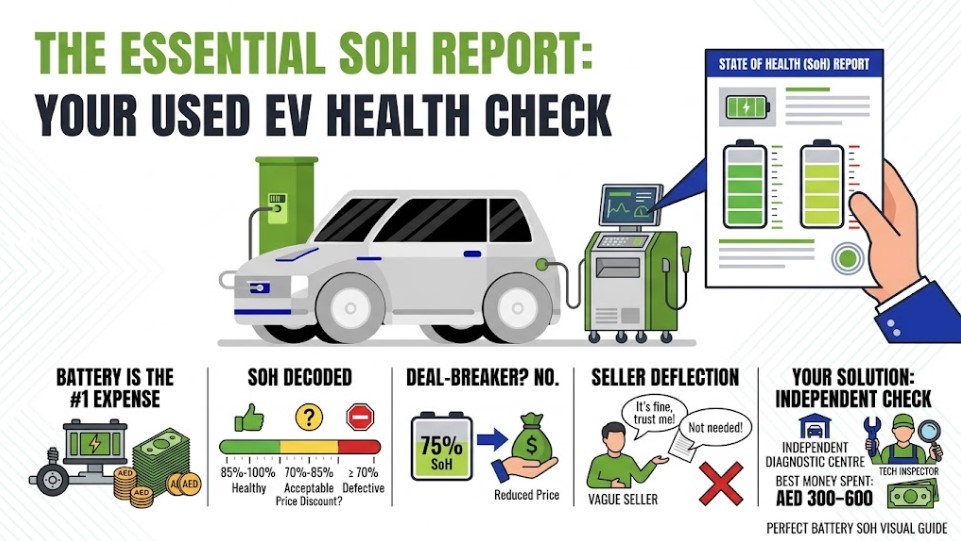
If you take one thing from this guide, make it this: the State of Health (SoH) report is the single most important document in a used EV transaction. It tells you how much of the battery’s original capacity remains — and the battery is the single most expensive component in the car.
As a rough benchmark, a healthy used EV should show 85% or higher. Anything below that isn’t automatically a deal-breaker, but it deserves a price discount to match, because you’re buying a smaller battery than the brochure promised.
Any reputable seller can produce this from the agency or a diagnostic tool. If you get deflection — “it’s not needed,” “the battery is fine, trust me,” or a vague change of subject — that’s your answer. Pay for an independent battery health check (think AED 300–600 at an independent centre) and remove the argument entirely. It’s the best money you’ll spend in this entire process.
The Dubai factor: heat. Battery degradation accelerates in extreme temperatures, and our summers are brutal on a cellular level. A car that spent three years parked outdoors in Al Quoz, baking at 50°C, may have degraded faster than an identical one that lived in a covered basement. Ask where it was parked. Then check whether the SoH is consistent with the story.
2. Cross-Check Real-World Range Against a 100% Charge
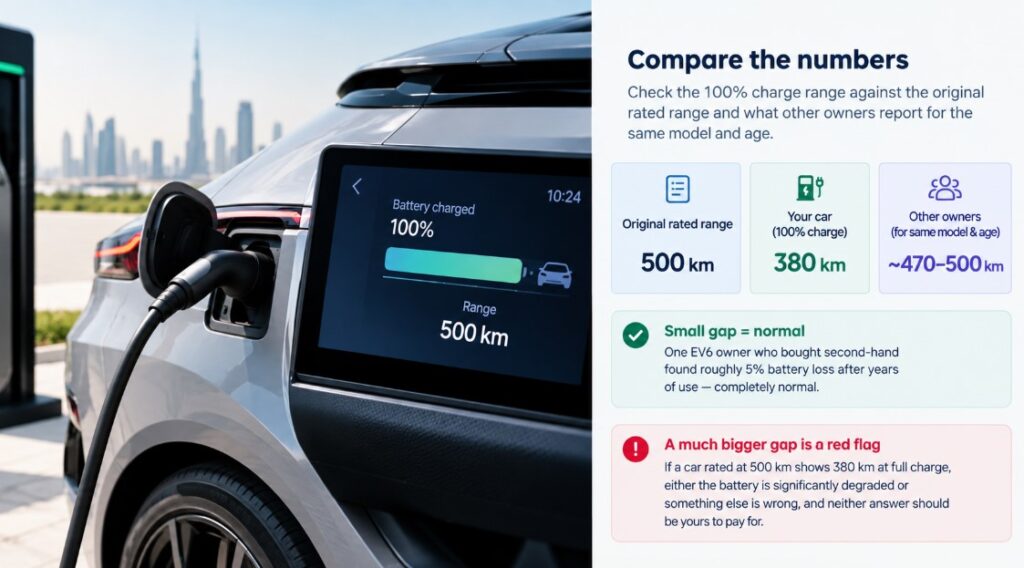
The SoH report is one data point. The more human test is simpler: charge the car to 100% and read the displayed range, then compare it against the original rated range and what owners on forums report for the same model and age.
One EV6 owner who bought second-hand found roughly 5% battery loss after years of use — completely normal. What you’re hunting for is a much bigger gap. If a car rated at 500 km shows 380 km at full charge, either the battery is significantly degraded or something else is wrong, and neither answer should be yours to pay for.
Related : Top 13 Cheapest Electric Cars in UAE Specs, Prices & Charging Guide
3. Software, Recalls, and the ICCU Word You Need to Know
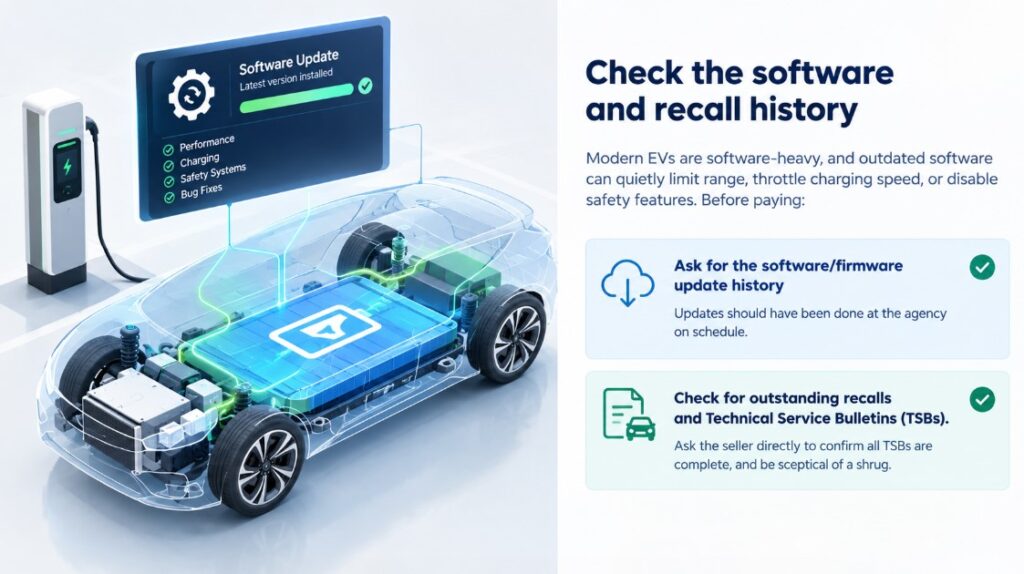
Modern EVs are software-heavy, and outdated software can quietly limit range, throttle charging speed, or disable safety features. Before paying:
- Ask for the software/firmware update history — updates should have been done at the agency on schedule.
- Check for outstanding recalls and Technical Service Bulletins (TSBs). Ask the seller directly to confirm all TSBs are complete, and be sceptical of a shrug.
And here’s the one model-specific landmine worth knowing: Hyundai and Kia EVs built on the 800V E-GMP platform — the Ioniq 5, Ioniq 6, EV6, and EV9 — have a well-documented Integrated Charging Control Unit (ICCU) failure pattern.
The unit charges the 12V battery, and when it fails, the car gradually loses power and stops. InsideEVs has tracked the issue closely, Consumer Reports found 2–10% of owners affected depending on model — far above the 1% average for other EVs — and some cars have failed again after repair. These are exactly the problems owners’ forums surface long before dealers volunteer them. Search “model name + problems” before you commit.
The silver lining: Hyundai and Kia have extended warranty coverage on the ICCU to 15 years — so if you’re buying one of these, verifying that the recall work is done doesn’t just protect you; it extends your safety net.
4. Test Both AC and DC Charging — and Know Your Connector
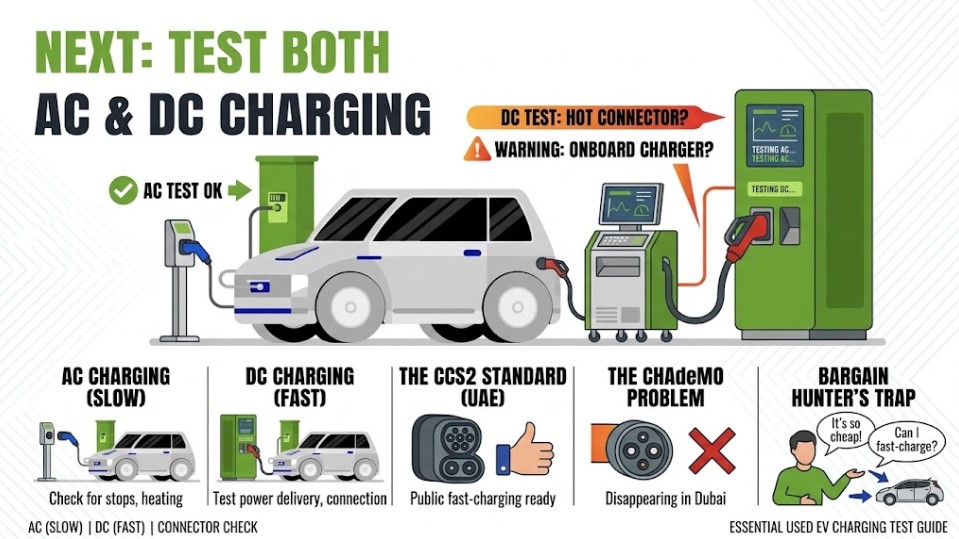
This is the check most buyers skip, and the one that bites hardest afterward.
- Test both AC (slow) and DC (fast) charging before you buy. Slow charging, interruptions, or a hot connector can signal problems with the onboard charger or wiring.
- Check the connector type — especially on cheap older EVs. The UAE’s public charging network is built around CCS2 for DC fast charging. Older Nissan Leafs — which appear everywhere at temptingly low prices — use CHAdeMO, a connector that’s quietly disappearing from public chargers. A cheap Leaf with a CHAdeMO port may leave you effectively unable to fast-charge in Dubai. This single detail has stranded more bargain hunters than any other.
5. The RTA Transfer: What It Costs and What It Won’t Tell You
The ownership transfer inspection is mandatory before a used car can be registered in your name — and RTA’s rules have specific traps for the unwary:
| Item | Fee (AED) |
|---|---|
| Ownership transfer (private light vehicle) | 350 |
| Selling fee | 50 |
| Knowledge & Innovation fees | 20 |
| Technical inspection (cars over 3 years) | 170 |
| New Traffic File (first-time Dubai owners) | 200 |
| Typical total | ~590–640 (excluding insurance) |
Three rules that genuinely catch people out:
- The inspection certificate is valid only 30 days. Inspect too early and it expires before your transfer completes.
- After the online Sale and Purchase Agreement is signed, you have 14 days to finish everything — miss it and the transaction is cancelled with fees forfeited.
- Insurance must be active in your name before transfer. A seller’s policy doesn’t count for a second.
Also know what the RTA test isn’t: it’s a roadworthiness check — brakes, lights, tyres, chassis — not a battery health assessment. RTA’s own inspection guidance exempts new cars for three years, but for anything older, the RTA certificate plus your independent diagnostics are two different things. You need both.
6. Do the Charging Math for Your Life
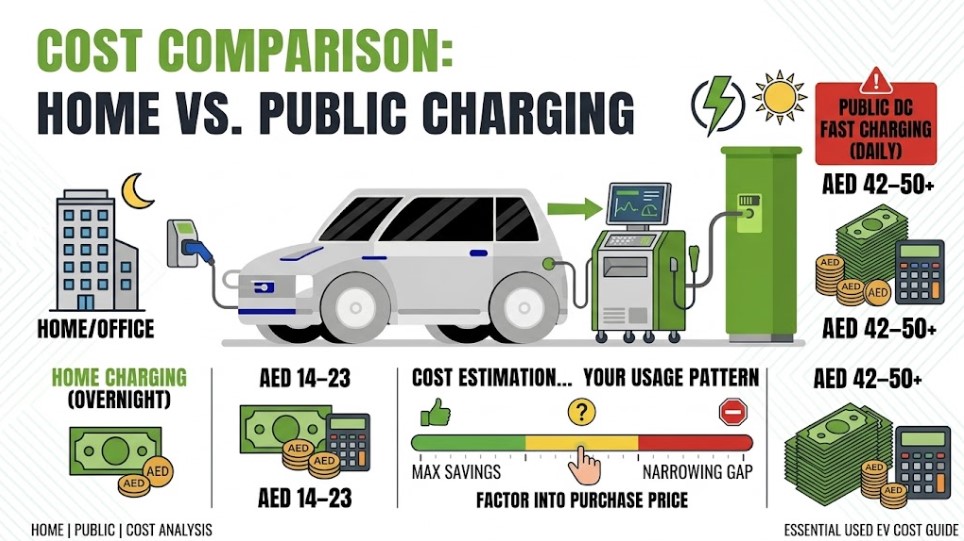
The running-cost case for a used EV in Dubai is real, but run the numbers for your situation using current rates. DEWA’s official EV charging guidance confirms:
- Public AC charging: AED 0.7/kWh + VAT
- Public DC fast charging: AED 1.2/kWh + VAT
- Home charging: billed at standard residential DEWA rates via a DEWA-approved contractor installation
- No DEWA account? Guest Mode lets you scan the QR code on any station and pay per package.
Concrete example: a 60 kWh battery costs roughly AED 14–23 to fill at home versus AED 42–50+ on DC fast charging. If you can charge overnight at home or at the office, the savings are excellent. If you’d depend on daily DC fast charging, the gap narrows dramatically — factor that into what you’re willing to pay for the car.
7. Read the Warranty Fine Print — It Might Save You AED 50,000
EV warranties work differently from what most buyers expect. Some cover components for a number of years, others by kilometres, and the battery warranty often outlasts the car warranty — but there’s a catch that trips people up: missed or delayed services at the agency can void it.
If the previous owner skipped scheduled maintenance at the official dealer, the warranty you think you’re buying may not exist. Check the service book against the warranty terms, line by line.
And remember that ICCU story from point 3? Cases like that are exactly why manufacturers now extend coverage on known weak points — but extended warranties only help if the recall and update history is clean. Verify it before you pay, not after something breaks.
8. Sort Insurance Before You Shake Hands
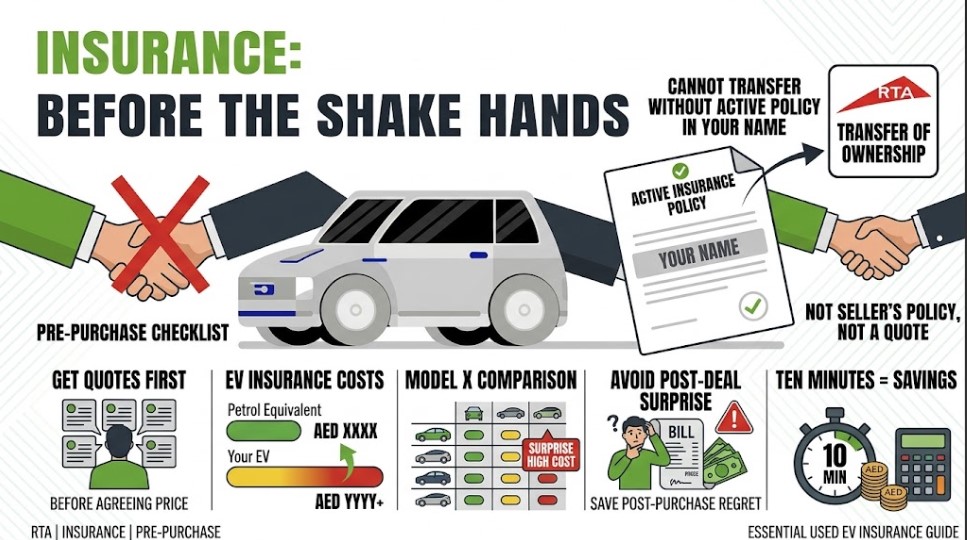
This one surprises almost every first-time buyer: you cannot complete the RTA transfer without insurance already active in your name. Not a quote, not the seller’s policy — an active policy with your name on it.
Get quotes before you agree a price. EVs can cost more to insure than their petrol equivalents (higher repair costs, battery-related claims), and a model that’s cheap to buy can be surprisingly expensive to cover. Ten minutes on comparison sites before the deal can save you from a nasty surprise after it — or worse, discovering your dream car costs more to insure than to fuel.
9. Think About Where It Will Sleep at Night
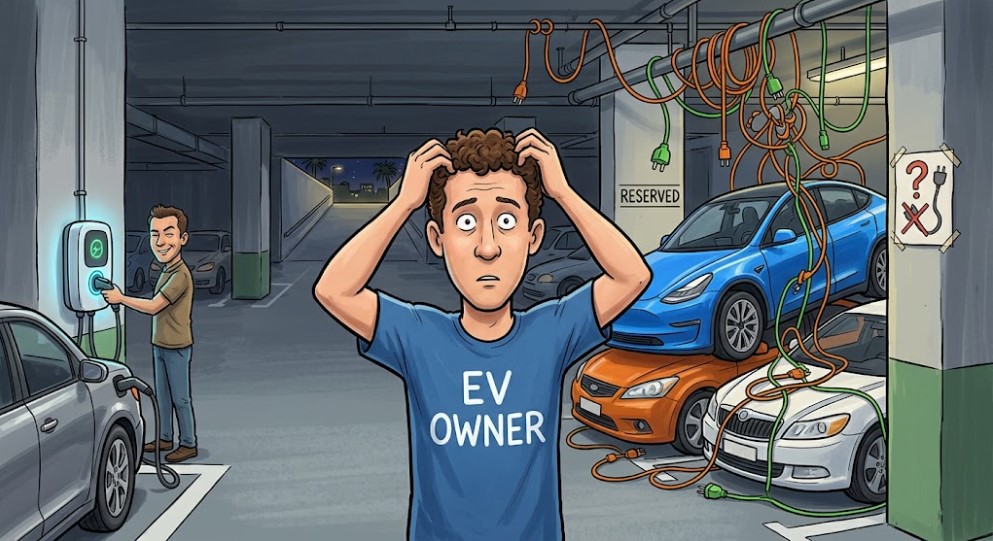
The single biggest quality-of-life factor for EV ownership in Dubai isn’t the car — it’s where it charges. Before buying, answer honestly:
- Do you have dedicated parking with access to a power point? If yes, ask a DEWA-approved electrical contractor for a home wallbox quote — it transforms the economics and convenience of the car.
- If not, is your office or building fitted with chargers? Many Dubai buildings are still catching up, and fighting for the one working charger in a tower garage gets old fast.
- If neither, you’re a public-charging driver. That’s workable with Guest Mode and the Green Charger network, but go in with open eyes about cost (point 6) and time.
A used EV without a charging plan is like buying a boat without a marina. The boat is fine. The logistics are not.
Related : Buying a Used Car in the UAE: The Real Checklist Beyond a Test Drive
10. The Boring Checks That Matter Even More on an EV
Strip away the batteries and software, and an EV still wears out the boring stuff — sometimes faster:
- Tyres. EVs are heavy with instant torque, which eats rubber. Some drivers report front tyres lasting only 10,000–20,000 miles. Check tread depth (RTA wants above 1.6 mm) and ask when they were last replaced — four new tyres on a performance EV is a real line item.
- Suspension and underbody. Battery weight stresses control arms and bushings. Get the car on a lift — this wear is invisible from the outside.
- Cooling system. EVs run thermal management loops that are critical to battery health and are among the more common failure points in inspections.
- Fleet or taxi history. High mileage alone isn’t disqualifying — but a history of commercial use, especially relentless DC fast charging, accelerates battery wear. Check the service records and ownership history, and treat a suspiciously cheap, high-mileage car with the scepticism it has earned.
Red Flags That Should End the Conversation
- The seller refuses a battery health report or a diagnostic scan
- No service history, or repairs that don’t add up
- Chassis/VIN mismatch — this halts the RTA transfer on the spot
- A temptingly cheap older EV with a CHAdeMO charging port
- Displayed range at 100% wildly below what’s normal for the model’s age
- “It just passed RTA” used as an answer to a battery question — those are different tests
- Any pressure to skip the independent inspection
Quick Answers
Is it worth buying a used EV in Dubai?
Yes — if you can verify battery health and you have (or can get) home or work charging. Supply is growing fast, prices are soft, and running costs undercut petrol significantly. The risk was never the technology; it’s skipping the verification steps above.
Is lower mileage worth paying extra for?
Context beats the number. 40,000 km versus 55,000 km on identical cars is a modest difference. What matters more is how those kilometres happened — fast-charging-heavy fleet use versus gentle commuting — and whether the SoH report backs up the story. A documented higher-mileage car beats a mysterious low-mileage one.
How much does a battery replacement cost?
Potentially more than the car is worth. This is why the SoH report is non-negotiable, full stop.
Can I charge without a DEWA account?
Yes — Guest Mode works at any Green Charger station via QR code, with package-based pricing.
Bottom line:
A used EV in Dubai can be one of the smartest buys on the market right now. The batteries are proving far more durable than the petrol-head folklore claimed — owners are seeing single-digit percentage loss over years of driving. But the deal lives or dies on paperwork and diagnostics. SoH report, update history, a charging test, insurance quotes, and a lift inspection. Do those five things, and you buy with your eyes open. Skip them, and you’re gambling on the most expensive component in the car — with someone else’s word as your only warranty.