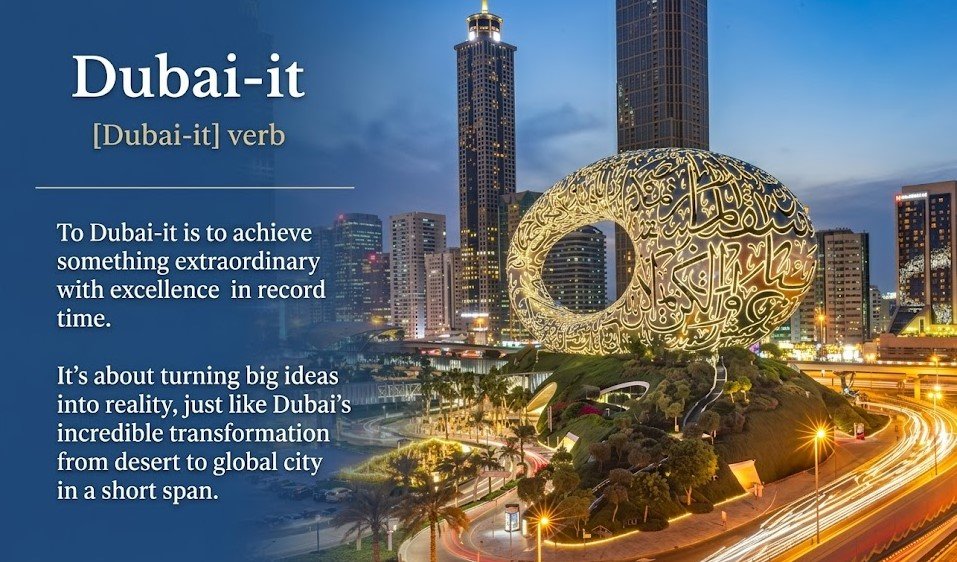
How a single social media post turned Dubai’s work ethic into a national philosophy — and what it means for the city’s next chapter.
Dubai has a habit of turning itself into shorthand. This week, it became a verb. On Wednesday, June 17, 2026, His Highness Sheikh Mohammed bin Rashid Al Maktoum, Vice President and Prime Minister of the UAE and Ruler of Dubai, launched “Dubai-It,” a citywide initiative designed to take the emirate’s particular brand of speed, precision and follow-through and turn it into something institutions, companies and future generations can actually replicate. It is part history lesson, part management doctrine, and part global branding exercise. Here is everything worth knowing about it.
1. It Began With a Single Post on X — and a Decades-Long Time-Lapse
Sheikh Mohammed announced Dubai-It himself, on his personal X account, rather than through a ministerial statement or press conference. The post arrived with a striking piece of video: footage of him riding in a helicopter over Dubai, filmed decades apart. In the older clip, the camera looks down on an empty stretch of desert. In the newer one, the same coordinates show the Burj Khalifa, Palm Jumeirah and a dense, glittering skyline where there was once only sand. The contrast was the entire pitch.
2. The Idea Itself Is Simple: Visible Results, Delivered Fast
In his post, Sheikh Mohammed laid out what the term is meant to capture. “Speed does not mean haste, quality does not mean slowness,” he wrote, adding that ambition carries no weight without execution behind it. Dubai-It, as he defined it, stands for swift achievement, meticulous implementation, and outcomes the world can see within a short timeframe. In short: move quickly, but never sloppily, and let the results speak before the explanations do.
Related : How to ‘Dubai-It’ Your Own Business- The 4 Principles
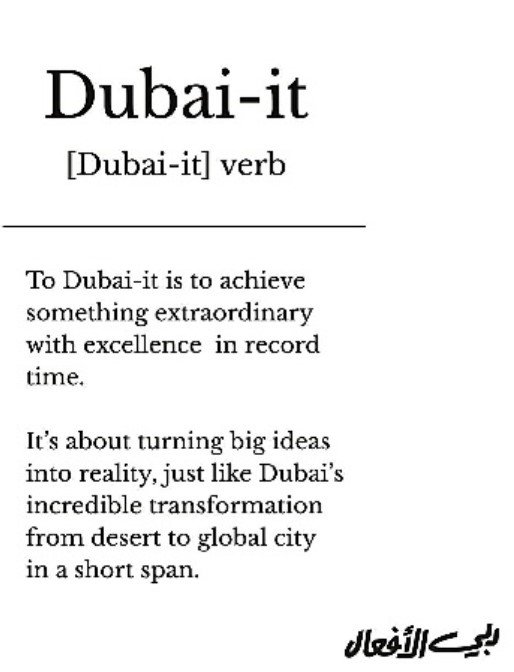
3. The Arabic Name Is Even More Direct: “Dubai of Actions”
Sheikh Mohammed’s original Arabic post used the phrase “دبي الأفعال” — roughly, “Dubai of Actions” or “Dubai of Deeds” — which lands even more bluntly than the English version. The English “Dubai-It” is the branding; the Arabic original is the instruction. Both versions of the post closed on the same long-standing motto Sheikh Mohammed has repeated for years: “We say what we do, and we do what we say.”
4. Why Now: Passing the Culture to the Next Generation
Sheikh Mohammed framed the launch as something bigger than a slogan refresh. He said the initiative is meant to transfer Dubai’s philosophy of work to future generations, embed it as a working culture across government institutions and private companies, and use it as the foundation for the emirate’s next phase of growth. In other words, Dubai-It isn’t aimed primarily at outsiders. It’s an internal instruction manual, dressed up for an international audience.
5. The Track Record Behind the Slogan Goes Back to 1958
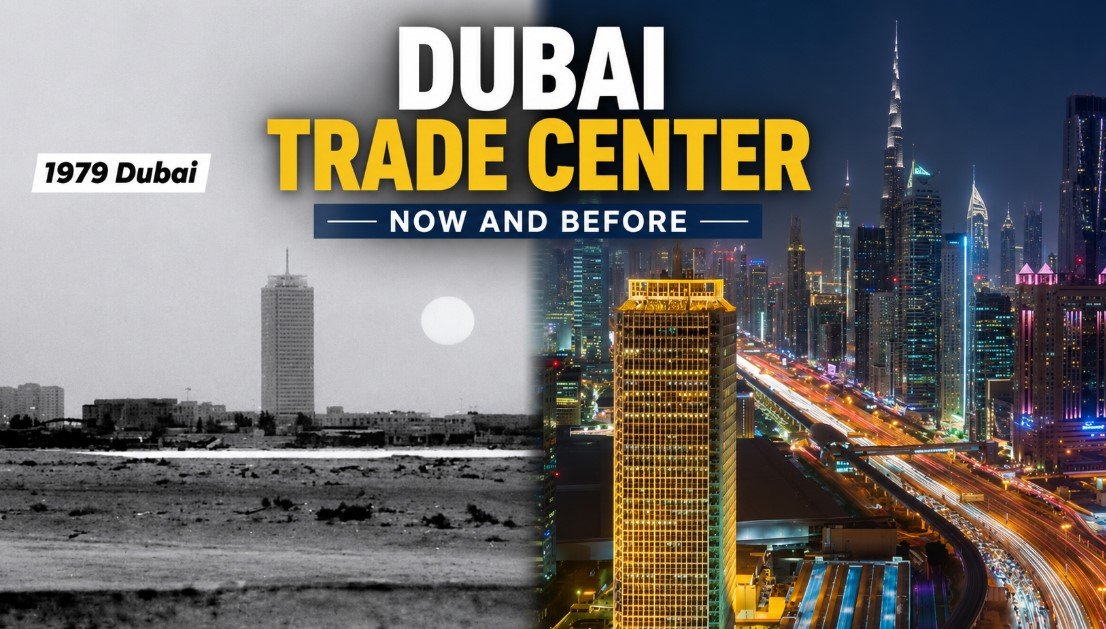
What gives the campaign its credibility is seven decades of receipts. The original Dubai-it moment, by most local accounts, was the 1958 dredging of Dubai Creek under then-ruler Sheikh Rashid bin Saeed Al Maktoum, a financially risky call made while the city’s pearling economy was collapsing. It set the template for everything after. A few of the milestones most commonly cited as proof of the philosophy in action:
- Dubai World Trade Centre (1979) — once mocked for being built on remote, empty land, it now anchors a business district estimated to generate around Dh295 billion in economic output and draw roughly 43 million business visitors.
- Jebel Ali Port (1979) — a 134-square-kilometre man-made harbour that grew into one of the world’s largest container ports; the adjoining free zone, JAFZA, now hosts more than 11,000 companies.
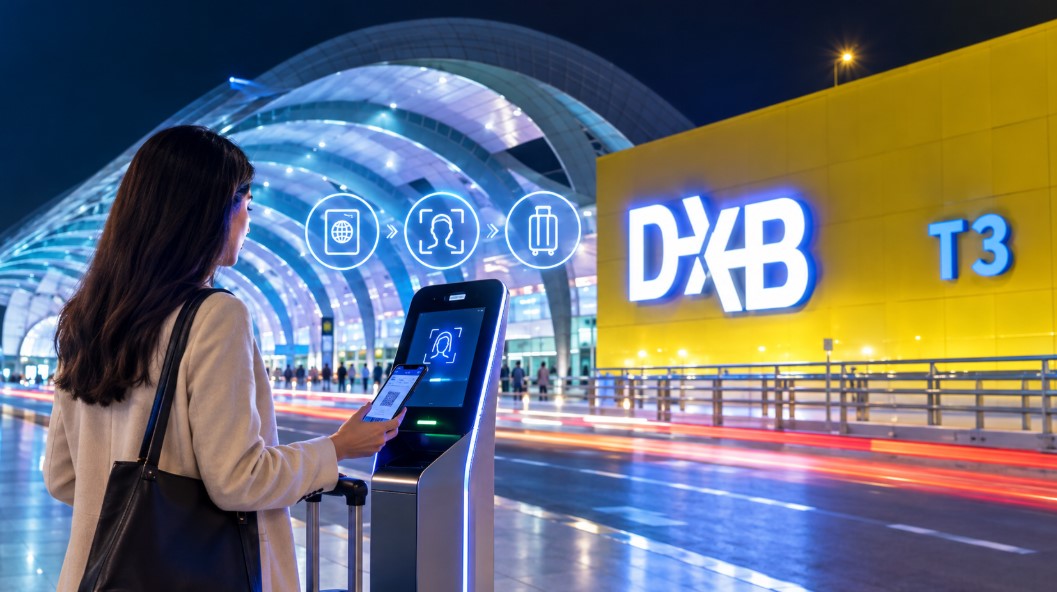
- Dubai International Airport (DXB) — opened in 1960 as a sand-compacted runway and grew into the world’s busiest hub for international passengers, handling a record 95.2 million travellers in 2025. Its successor, Al Maktoum International Airport, is being built for a capacity of 260 million passengers a year.
- Burj Al Arab (1999), DIFC (2004) and Palm Jumeirah (2007) — a hotel built on its own artificial island, a financial free zone built from scratch, and the world’s largest man-made island, all built on the assumption that the answer to “why?” was “why not?”
- Dubai Metro (2009) — opened as the world’s longest fully automated, driverless metro network; the Red and Green lines alone carried close to 295 million riders in 2025, with the Blue and Gold lines under construction.
- Burj Khalifa (2010) — completed on schedule through the 2008 financial crisis, when many assumed the project would be shelved; at 828 metres, it remains the tallest building on earth.
- Museum of the Future (2022) — nine years in the making, it drew one million visitors in its first year and is etched with Sheikh Mohammed’s own words on the nature of building what’s next.
6. Dubai’s Tourism Chief Turned It Into a Manifesto
Issam Kazim, CEO of the Dubai Corporation for Tourism and Commerce Marketing, posted his own reaction within hours, framing Dubai-It as a question the city has been answering for fifty years. He noted that Sheikh Mohammed has repeatedly been asked why he pursues the biggest and hardest projects, and that the answer has always been the same two words: “Why Not?” Kazim’s post went on to describe the philosophy as the belief that the extraordinary is achievable, that speed and excellence aren’t in tension, and that the future is something you build rather than wait for.
7. Entrepreneurs Are Already Speaking the Language
Within days, Dubai-based business owners were using the term to describe how they actually built their companies. Amy Morris, founder and CEO of entertainment company Pop Up Global, said there was never a moment she felt fully ready to start — she built the business while already moving. “Perfect timing is a myth people use to justify staying still,” she said.
Rohit Bachani, co-founder of Merlin Real Estate, who started his company with a small shop and Dh10,000 in savings, said the city taught him that speed and quality work as partners rather than opposites. Naresh Perwani, founder and chairman of Neoterra Developments, described his version of the philosophy as setting a clear goal and moving on it immediately rather than sitting with the idea.
And Ana Elisa Seixas, head of marketing for New Balance Middle East, Africa and India, pointed to a recent campaign her team mobilised within days to support local cafés and restaurants during regional disruption as a real-world example of the mindset in practice.
8. It Lands Alongside a Wider Push on Government Speed and Bureaucracy
Dubai-It didn’t arrive in isolation. It landed in the same stretch of weeks as Sheikh Hamdan bin Mohammed’s approval of three new Dubai 10X projects spanning mobility, health and travel, the second and larger Dh1.5 billion economic incentives package approved to strengthen Dubai’s economic resilience, and the rollout of Phase 2 of the Zero Government Bureaucracy programme. Taken together, the timing suggests Dubai-It is meant to function as the cultural umbrella over a broader run of efficiency and growth-focused government initiatives, rather than a standalone campaign.
9. It’s a Soft-Power Play as Much as a Management Memo
There’s a wider strategic logic at work here too. Very few places become verbs — Google it, Uber it — and Dubai now wants to join that short list. By packaging its own work culture as something transferable, Dubai isn’t just promoting an economic track record; it’s positioning itself as a cultural export, competing with other ambitious global cities not just for capital and tourists but for the right to be seen as a model worth copying. That’s soft power expressed through branding rather than diplomacy.
10. What’s Confirmed Now — and What’s Still to Come
As of this writing, Dubai-It has been announced as a philosophy and culture-transfer campaign to be embedded across Dubai’s government entities and private companies, rather than as a regulated programme with its own budget line, governing body or published performance metrics.
No such operational details have been made public yet. What is clear is that it sits alongside, rather than replaces, existing frameworks like the Dubai Economic Agenda (D33), Dubai 10X and the Zero Government Bureaucracy programme — and that Sheikh Mohammed has described it as the foundation for the emirate’s next phase of growth. Whether that takes the shape of training programmes, corporate partnerships, or simply a recurring talking point in government communications is something only time, and presumably another fast-moving announcement, will answer.
Dubai-It means achieving exceptional results in record time, just as Dubai transformed from a desert into a global city. — His Highness Sheikh Mohammed bin Rashid Al Maktoum
For residents and businesses watching from the ground in the UAE, the practical takeaway is less about the slogan itself and more about what it signals: continued pressure on government entities and private companies alike to deliver visibly and quickly, and another data point in Dubai’s long-running case that ambition, backed by execution, is the city’s actual operating system.