
A practical playbook for translating Dubai’s speed-and-execution philosophy into operating decisions — hiring, delivery, governance and everyday follow-through.- How to ‘Dubai-It’ Your Own Business
On June 17, 2026, Sheikh Mohammed bin Rashid Al Maktoum, Vice President and Prime Minister of the UAE and Ruler of Dubai, launched “Dubai-It,” an initiative built on one operating idea: results delivered quickly, without compromising on quality, carry more weight than plans that remain plans. He framed the goal as transferring Dubai’s philosophy of work to future generations and embedding it as a working culture across government institutions and private companies.
For a business owner, that’s less a slogan than a fairly specific set of operating habits — the kind that show up in how decisions get made, how fast work actually ships, and how reliably a company follows through on what it tells clients and staff. This playbook breaks the philosophy into four core principles drawn directly from Sheikh Mohammed’s own framing of the initiative, then translates each one into concrete steps for hiring, delivery, client communication and governance inside your own company.
The Four Operating Principles Behind Dubai-It
Stripped of branding, the original announcement makes four distinct claims, each pairing a virtue with the flaw people commonly mistake it for. Treated as a checklist rather than a slogan, they translate fairly directly into management practice.
Principle 1: Speed Without Haste
“Speed does not mean haste.” — Sheikh Mohammed bin Rashid Al Maktoum
The claim here is that moving quickly and moving carelessly are not the same behaviour, even though they’re frequently confused for one another. In a business, the distinction usually comes down to where speed is applied: decisions can move fast; what ships externally still needs a checkpoint.
- Set a default response time for internal decisions — say, 48 hours — and treat exceeding it as the exception that requires justification, not the norm.
- Separate the speed of deciding from the speed of executing. Decide quickly, but keep a short, fixed quality check before anything reaches a client or the public.
- Track the gap between when something is approved and when it’s actually delivered. A consistently wide gap usually points to a process bottleneck, not a resourcing one.
Principle 2: Quality Without Delay
“Quality does not mean slowness.” — Sheikh Mohammed bin Rashid Al Maktoum
This is the mirror claim, and it’s the more uncomfortable one for most organisations, because caution is routinely used to justify avoidable delay. The fix isn’t to lower the bar — it’s to make the bar specific enough that it stops functioning as an open-ended excuse.
- Write down what “quality” actually requires for each recurring deliverable, rather than leaving it as a vague standard that any timeline can hide behind.
- Build review steps into the workflow at fixed points, rather than adding them reactively once something already feels behind schedule.
- Separate “this genuinely needs more time” from “I’m not confident in this yet.” They’re different problems, and they need different fixes.
Principle 3: Execution Over Ambition
“Ambition has no value without execution.” — Sheikh Mohammed bin Rashid Al Maktoum
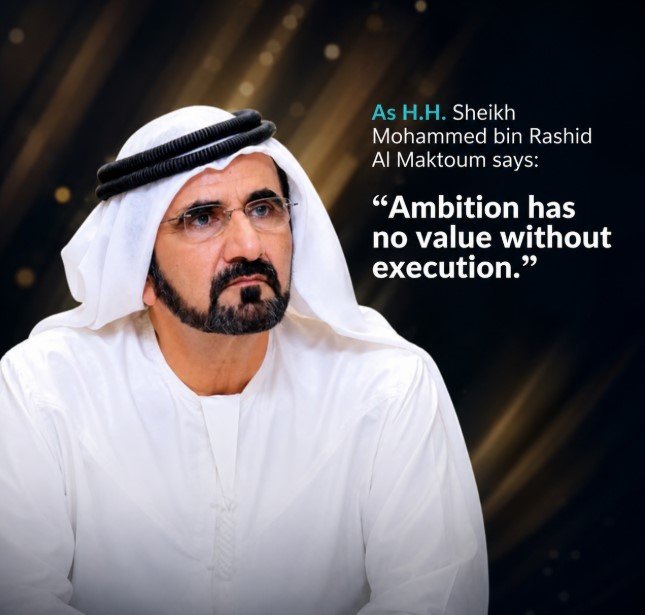
Strategy documents are cheap to produce and easy to admire. This principle is a direct rejection of that comfort — a goal that hasn’t been acted on, in this framing, isn’t worth anything yet, regardless of how well it was argued.
- For every strategic goal, assign a named owner and require a first concrete action within a set number of days, or the goal doesn’t count as active.
- Replace long planning documents with shorter ones that commit to fewer, more specific deliverables — breadth of ambition is not the same as depth of commitment.
- Each quarter, review not just what was planned but what actually shipped, and treat the gap between the two as the metric that matters most.
Principle 4: Consistency Between Word and Action
“We say what we do, and we do what we say.” — Sheikh Mohammed bin Rashid Al Maktoum
This is the least dramatic principle on the list and arguably the most commercially useful one. Trust from clients, partners and staff is built on a track record of delivery, not on how ambitious a pitch sounded — and it erodes quickly once the gap between promise and delivery becomes visible.
- Confirm internal capacity before making an external commitment to a client, partner or investor — not after.
- Where possible, slightly under-promise in public communication and let delivery exceed it, rather than the reverse.
- Review your own follow-through rate on commitments made last quarter. A declining rate is an early warning sign worth investigating, not a one-off to shrug off.
What This Looks Like in Practice
The pattern isn’t theoretical, and it shouldn’t read as if it were assembled from thin air. In the days following the launch, Khaleej Times spoke directly with several Dubai-based business owners who had been operating this way long before the term existed.
Pop Up Global, a Dubai-based entertainment company that builds theatrical shows for cruise lines, theme parks and major regional events, grew from a single performer act into a multi-million-dirham operation. Its founder told Khaleej Times that there is no such thing as a perfectly timed launch — the business was built while already in motion, not before.
Merlin Real Estate, a Dubai property brokerage, was started with a small shop and Dh10,000 in personal savings, according to its co-founder, who has described speed and quality as partners rather than competing priorities in the same feature — a discipline he credits directly to operating in a market that rewards both at once.
Neoterra Developments, a Dubai-based property development firm, was built around a simpler internal rule, according to its founder and chairman: once a goal is clear, the move is to start working toward it immediately rather than continuing to refine the plan around it.
New Balance Middle East, Africa and India pointed to its Local Legends initiative — a campaign mobilised within days of a recent regional disruption to support local cafés and restaurants — as a direct example of the mindset translating into action under real time pressure, not just in calmer conditions, as reported in the Khaleej Times piece.
None of these are unusual stories on their own. What’s notable is how consistently the same four habits — start before conditions feel ideal, treat speed and quality as one job, commit to the goal before the plan is finished, and move fast specifically when it counts — show up across companies in entirely different industries, each confirmed in its own words to a national publication rather than assembled secondhand.
Calibrating the Approach by Company Stage
The four principles hold at every size, but the practical mechanics of applying them shift as a company grows.

Solo Founders and Very Small Teams
At this stage, the constraint usually isn’t process, it’s personal bandwidth. The most useful version of “speed without haste” is a hard rule about which decisions get made same-day on instinct and which ones get a short, scheduled think before acting — without that line, everything either moves too fast or stalls indefinitely.
Small Teams (Roughly 5–20 People)
This is where unclear decision ownership starts to cost real time, because more than one person is now waiting on the same call. The priority is documenting who decides what, in writing, before it becomes a recurring source of friction rather than after.
Growing or Scaling Organisations
At this size, the risk shifts toward the overcommitment pitfall described above — public promises starting to outpace what the operational side can reliably deliver. The follow-through tracking mentioned under Principle 4 stops being optional at this stage; it becomes the main early-warning system for a culture that’s starting to drift from saying what it does.
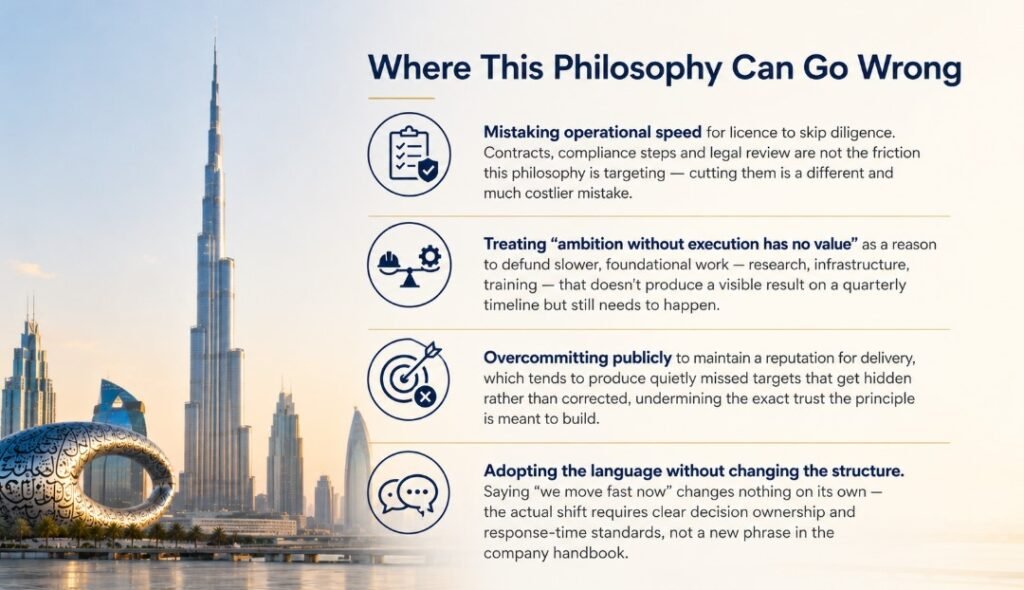
Where This Philosophy Can Go Wrong
A playbook built around speed is incomplete without an equally direct list of where speed becomes a liability rather than an advantage.
- Mistaking operational speed for licence to skip diligence. Contracts, compliance steps and legal review are not the friction this philosophy is targeting — cutting them is a different and much costlier mistake.
- Treating “ambition without execution has no value” as a reason to defund slower, foundational work — research, infrastructure, training — that doesn’t produce a visible result on a quarterly timeline but still needs to happen.
- Overcommitting publicly to maintain a reputation for delivery, which tends to produce quietly missed targets that get hidden rather than corrected, undermining the exact trust the principle is meant to build.
- Adopting the language without changing the structure. Saying “we move fast now” changes nothing on its own — the actual shift requires clear decision ownership and response-time standards, not a new phrase in the company handbook.
A Short Self-Assessment
Before applying any of the above, it’s worth establishing a baseline. The table below is a quick gut-check against each of the four principles — answer honestly rather than aspirationally.
| Principle | Self-Check Question |
| Speed Without Haste | Do internal decisions have a default turnaround time, and is exceeding it treated as the exception? |
| Quality Without Delay | Is your quality standard written down and specific, or is it an open-ended feeling that can justify any timeline? |
| Execution Over Ambition | Does every active goal have a named owner and a first action already taken, not just a plan? |
| Word and Action | Has your follow-through rate on external commitments improved, held steady, or declined over the last quarter? |
How to ‘Dubai-It’ Your Own Business
None of this is unique to Dubai, and the city would be the first to acknowledge its own growth had government backing and capital behind it that an individual business will never have.
Free zones, sovereign investment and a government willing to absorb risk on megaprojects aren’t things a private company can replicate on its own. What does scale down, fairly cleanly, is the underlying behaviour: commit to the goal before the plan is finished, treat speed and quality as one job rather than two, and let a consistent delivery record carry more weight than the announcement ever did. Applying it doesn’t require a launch event. It requires picking one of the four principles above and changing one specific habit this week.