How To Start A Business In UAE: How to choose the right structure, which zone suits your business, what it actually costs in year one, and who the main consultants are.
| All figures in this guide are indicative only . Fees change regularly. Always request a formal written quote from the relevant authority or a licensed UAE business consultant before making any financial commitment. |
The UAE has one of the most accessible business registration environments in the world — zero personal income tax, 100% foreign ownership across most structures, and free zones processing licences in three to five working days. Over 40,000 new companies register here every year. But the structure you choose matters more than the speed of setup.
A freezone licence that prevents you from selling directly to UAE mainland clients, or a mainland company that requires office rent you didn’t budget for, or a corporate tax position you didn’t qualify for — these are the decisions that determine whether your setup serves your business or works against it. This guide takes you through those decisions in the right order, with verified costs at each stage.
Step 1: Choose Your Legal Structure
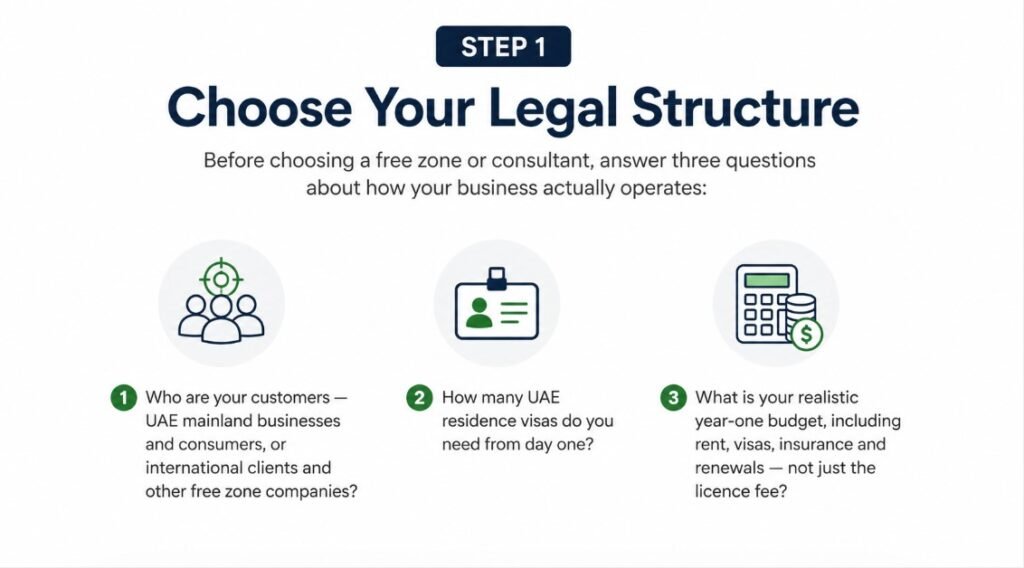
Before choosing a free zone or consultant, answer three questions about how your business actually operates:
- Who are your customers — UAE mainland businesses and consumers, or international clients and other free zone companies?
- How many UAE residence visas do you need from day one?
- What is your realistic year-one budget, including rent, visas, insurance and renewals — not just the licence fee?
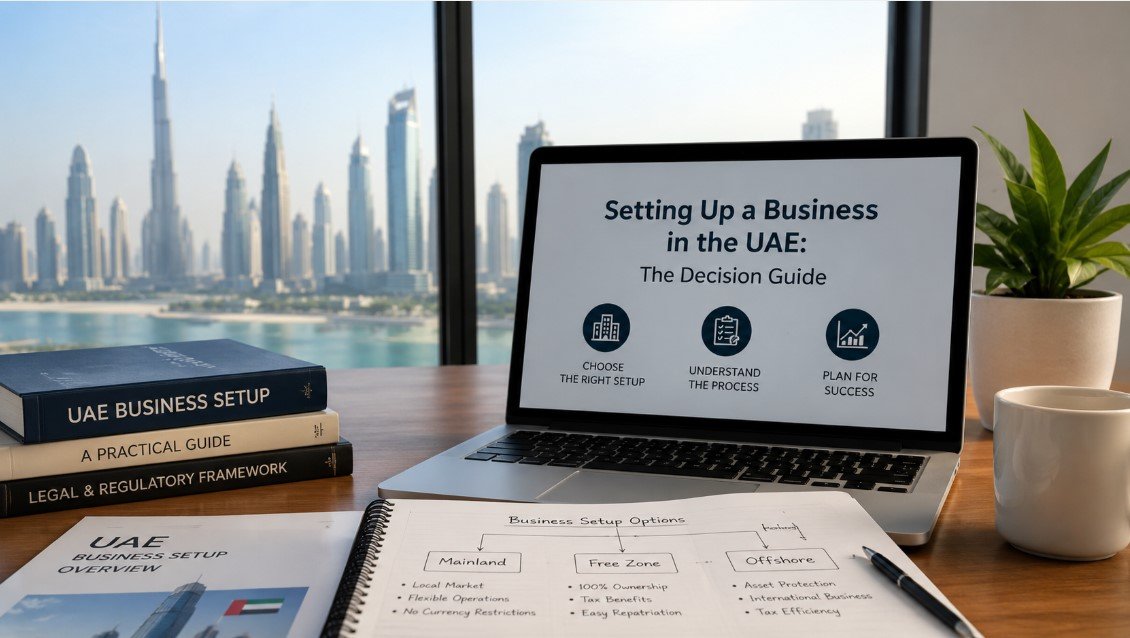
The UAE has three main business structures for foreign-owned companies: mainland, free zone and offshore. Each operates under different rules, serves different purposes and carries different costs.
| Structure | Best for | Year cost range (indicative) | Critical limitation |
| Mainland (DED licence) | Trading directly with UAE consumers, government contracts, retail operations | AED 40,000–120,000+ | Physical office (Ejari) mandatory — typically AED 20,000–60,000/year in rent minimum |
| Free Zone | Consultants, tech, media, e-commerce, international trading, remote-first businesses | AED 18,000–55,000+ | Cannot sell directly into UAE mainland without a local distributor or dual licence |
| Offshore (RAK ICC, ADGM) | Asset holding, international structures, group holding companies | AED 9,000–18,000 | No UAE residence visas. No UAE commercial operations. Corporate bank account difficult to open. |
| Since June 2023, all UAE entities — mainland and freezone — fall within the UAE Corporate Tax regime. Free zone companies can qualify for a 0% rate on qualifying income, but this is not automatic and requires meeting specific substance, activity and compliance conditions under Federal Decree-Law No. 47 of 2022. The standard rate is 9% on taxable income above AED 375,000. Register with the Federal Tax Authority (tax.gov.ae) and take proper tax advice before your first full financial year ends. |
Related : Top 12 Low Cost Free Zones in the UAE That Actually Save You Money
Step 2: Choose Your Free Zone
The UAE has over 40 free zones. Most Dubai founders narrow the choice quickly based on three factors: the business activity permitted, the address credibility needed for clients and banking, and the total cost including office and visas. Below are the main zones by use case, with cost ranges sourced from official authority pricing and published package schedules. All figures are indicative — request a formal quote from the zone authority before committing.
DMCC — Dubai Multi Commodities Centre
The world’s largest free zone by registered company count, with over 26,000 businesses across trading, commodities, fintech, professional services and 20+ sectors. Based in Jumeirah Lakes Towers. Named Global Free Zone of the Year by fDi Intelligence for ten consecutive years.
DMCC is the most credible Dubai freezone address for banking — companies consistently report faster bank account onboarding than in newer or less-established zones. It is also the most expensive of the standard Dubai free zones.
| DMCC package | Includes | Typical year-one cost |
| Virtual office | Licence, registration, establishment card, 1 visa allocation | AED 19,500–23,500 |
| Flexi-desk | Above plus co-working desk access, 2 visa allocations | AED 24,500–29,500 |
| Serviced / private office | Above plus dedicated office space, higher visa quota | AED 45,000–90,000+ |
Add AED 4,000–6,000 per visa for government medical, Emirates ID and stamping costs on top of the package prices above. DMCC requires AED 50,000 minimum share capital for most structures — this is deposited into the corporate bank account and is not consumed by setup fees. Annual licence renewal typically costs AED 10,620 (trade licence renewal plus company registration renewal), with office and visa renewals on top.
Official pricing: dmcc.ae/business/business-setup-packages
IFZA — International Free Zone Authority
Based in Dubai Silicon Oasis, giving companies a Dubai address at well below DMCC rates. IFZA is the most widely chosen entry point for solo consultants, digital businesses and startups. Professional licences start from approximately AED 12,500–13,000 for the licence, registration and establishment card in year one. No minimum share capital. A flexi-desk is included in standard packages. Up to three related activities can be combined on one licence.
Most IFZA applications process in three to five working days. UAE banks accept IFZA entities, though tier-one banks sometimes apply more conservative KYC scrutiny than for DMCC companies. Realistic year-one total for a solo founder with one visa: AED 18,000–25,000.
Direct registration: ifza.ae
RAKEZ — Ras Al Khaimah Economic Zone
Consistently among the most cost-competitive zones in the UAE. Licence fees start from approximately AED 7,500–12,000 depending on activity and package. Office and warehouse space costs run well below Dubai rates. RAKEZ has a specific industrial zone for production and logistics, an academic zone for educational businesses, and a business zone for professional and service companies.
RAKEZ is the practical choice for businesses that don’t need a Dubai address — industrial operations, trading companies, light manufacturing, and founders based in the Northern Emirates who want local administration without the Dubai premium. Visa processing, renewals and company administration can all be handled at RAK rather than requiring trips to Dubai.
Direct registration: rakez.ae
SHAMS — Sharjah Media City
The lowest-cost credible free zone in the UAE for solo operators and digital businesses. Licence packages from approximately AED 5,750 for the first year. Suited to media, content creation, publishing, e-commerce, marketing and creative businesses where a Sharjah rather than Dubai address doesn’t disadvantage client relationships. UAE banks accept SHAMS entities, though banking familiarity is lower than DMCC or IFZA.
Direct registration: shams.ae
DIFC and ADGM — For Financial Services
The Dubai International Financial Centre and Abu Dhabi Global Market operate under English common law with their own regulators (DFSA and FSRA respectively).
These are the right structures for financial services firms, asset managers, family offices and regulated fintech companies where English common law governance is a requirement for investors or counterparties. Licence fees start at AED 50,000 and regulatory approval costs can add AED 5,000–50,000+ depending on the activity. Year-one totals of AED 100,000–200,000+ are common for regulated entities. Not appropriate for most startups.
DIFC: difc.ae · ADGM: adgm.com
Zone Comparison at a Glance
Choosing the right free zone can feel overwhelming when starting a business. The following comparison breaks down the most popular options in the UAE, highlighting costs, credibility, and what each location actually offers to help streamline the decision-making process.
| Zone | Best for | Licence from | Year-one total (indicative) | Dubai address? |
| DMCC | Trading, commodities, premium banking credibility | ~AED 15,000/yr | AED 35,000–55,000+ | Yes — JLT |
| IFZA | Consultants, digital, startups | ~AED 12,500/yr | AED 18,000–25,000 | Yes — Silicon Oasis |
| RAKEZ | Industrial, trading, Northern Emirates-based founders | ~AED 7,500/yr | AED 14,000–30,000 | No — RAK |
| SHAMS | Media, content, e-commerce, solo founders | ~AED 5,750/yr | AED 12,000–20,000 | No — Sharjah |
| DIFC | Financial services, regulated fintech | ~AED 50,000+/yr | AED 100,000–200,000+ | Yes — DIFC |
| All figures are indicative ranges only. Actual costs depend on your specific activity, visa requirements, office type and applicable government fees. Request a formal written quote from the relevant zone authority before budgeting. |
Related: 7 Costly UAE Corporate Tax Errors Every Business Must Avoid
Step 3: Decide Whether to Use a Setup Consultant
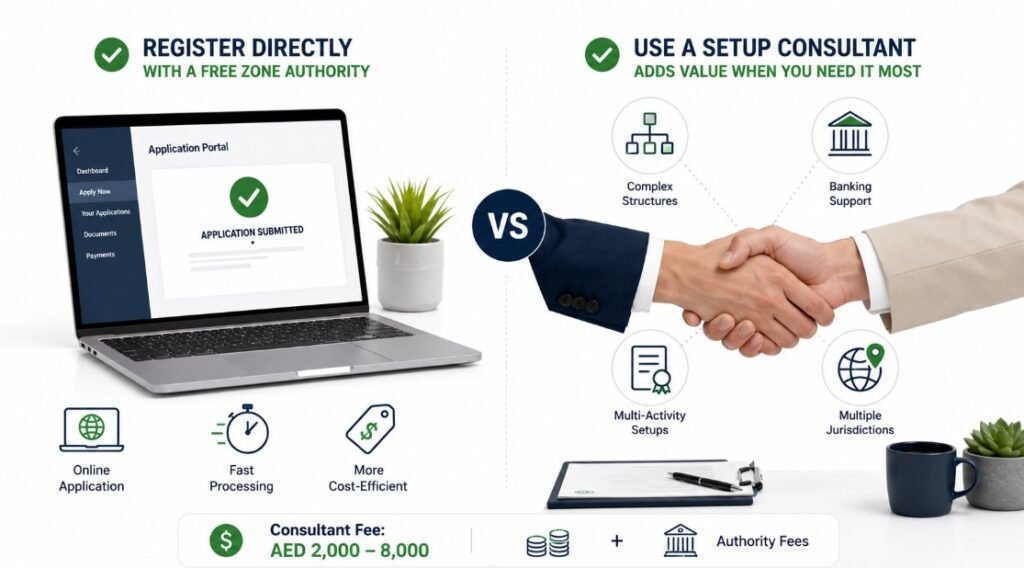
Registering directly with a free zone authority is possible and often the most cost-efficient route for straightforward setups. Most zones have fully digital application portals — IFZA, SHAMS and RAKEZ in particular process applications cleanly online without requiring an intermediary.
A setup consultant adds value in specific situations: complex ownership structures, founders navigating the UAE system for the first time, businesses needing banking introductions alongside the licence, or setups spanning multiple activities or jurisdictions. The consultant fee sits on top of the authority’s fees and typically runs AED 2,000–8,000 for standard freezone setups.
Related : Freezone vs Mainland UAE – The Real Cost Breakdown
The main consultants
Virtuzone (virtuzone.com) — founded 2009, one of the largest dedicated formation companies in the UAE. Published pricing: freezone from approximately AED 12,500, mainland from AED 14,999. Covers setup, visas, banking introductions, VAT and accounting. Banking relationships are a genuine practical advantage for founders who need bank account support alongside the licence.
Shuraa (shuraa.com) — operating since 2001, covers mainland, freezone and offshore across all seven emirates. Freezone from approximately AED 8,999, mainland from AED 18,500. Face-to-face consulting model with PRO services as a core offering. Strong for founders who need ongoing document management, visa renewals and municipality coordination over the long term.
Creative Zone (creativezone.ae) — freezone packages from approximately AED 5,750, standard freezone trade licences from AED 16,750. The coworking space (CZ One) makes it useful for founders who want a physical workspace in the first year without a separate office lease. Also covers tax, accounting and recruitment under one relationship.
Commitbiz (commitbiz.com) — good coverage of IFZA, SHAMS and newer free zones with competitive pricing. Handles the full stack from licence through bank account opening support, VAT registration and corporate secretarial services. Worth getting a quote from as a comparison point against the larger names above.
Step 4: Build Your Year-One Budget Properly
The advertised licence fee covers only part of year-one spend. The items below are commonly omitted from comparison articles but represent real, unavoidable costs.
Government fees on top of the licence
- Knowledge and Innovation dirham fee: AED 20 per transaction (minor but frequently forgotten)
- Establishment card: AED 200–500 (required to process visas)
- Trade name reservation: AED 200–620 depending on zone
- Initial approval fee: AED 500–2,000 for some zones
- Regulated activity approvals (health, food, education, financial): AED 500–50,000+ depending on the additional regulator involved
Visa costs — per person
- Entry permit, medical fitness test, Emirates ID biometrics, visa stamping: AED 3,500–6,000 per investor or employee visa
- Health insurance: mandatory for UAE residence visa holders — AED 700–2,500/year for basic cover, more for comprehensive plans
- Visa renewal: every two to three years at similar government fees to the initial application
Banking — the real bottleneck
Opening a UAE corporate bank account takes six to twelve weeks on average, and some applications are declined. Traditional UAE banks (Emirates NBD, ADCB, Mashreq) offer stronger local infrastructure but are slower and require higher minimum balances — typically AED 25,000–100,000 depending on the bank and account type. Electronic Money Institutions (Wise Business, Airwallex, Wio) onboard faster and offer better multi-currency capability but are not full banks.
Banking is a parallel process, not a sequential one. Begin your bank application immediately after your licence is issued, not after everything else is done.
Annual renewals
Budget for licence renewal at roughly 70–100% of the initial licence fee, plus visa renewals and office contract renewals, all landing within the same twelve-month window. Late renewal in Dubai incurs AED 200 per day in penalties after the grace period; authorities can cancel licences after 60 days of non-renewal.
Step 5: The Registration Process
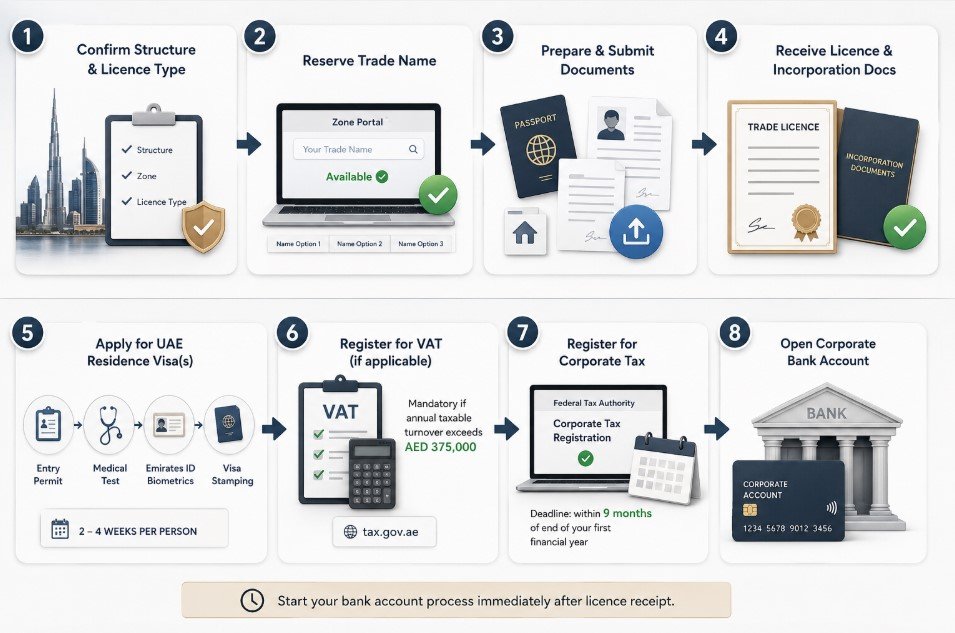
- Confirm your structure, zone and licence type. Define your business activity precisely — vague descriptions delay approval and create banking problems later.
- Reserve your trade name through the zone portal. UAE naming rules prohibit offensive terms, references to political figures and duplicates of existing registered names. Have two or three name options ready.
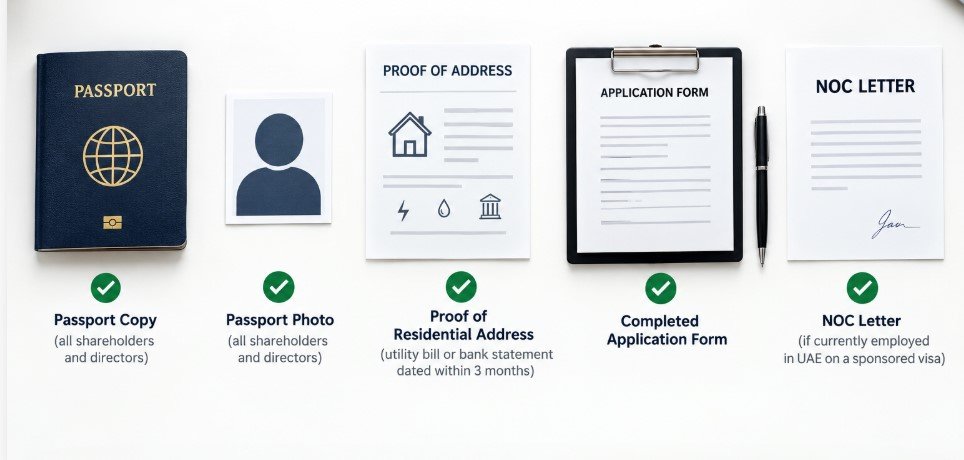
- Prepare documents: passport copy (all shareholders and directors), passport photo, proof of residential address (utility bill or bank statement dated within three months), completed application form, NOC letter if currently employed in UAE on a sponsored visa.
- Submit application and pay initial fees. Most major free zones are fully digital — IFZA, SHAMS, RAKEZ and DMCC all process applications online without requiring a physical visit to Dubai.
- Receive trade licence and incorporation documents. Timeline: IFZA, SHAMS, RAKEZ — three to five working days; DMCC — ten to fifteen working days; DIFC — seven to fourteen working days for standard activities, longer for regulated ones.
- Apply for UAE residence visa(s). Process: entry permit → medical fitness test → Emirates ID biometrics → visa stamping. Total time per person: two to four weeks from entry permit issuance.
- Register for VAT with the Federal Tax Authority if annual taxable turnover exceeds AED 375,000, or is expected to do so within the next thirty days. Registration is mandatory above this threshold and can be completed online at tax.gov.ae.
- Register for Corporate Tax with the FTA. The deadline is within nine months of the end of your first financial year.
- Open corporate bank account. Start this process immediately after licence receipt, not after visas are sorted.
Six Things That Catch Founders Out
1. The freezone/mainland trading restriction
A free zone company cannot sell goods or services directly to UAE mainland customers without either appointing a registered mainland distributor (who typically charges 5–15% commission on revenue) or obtaining a separate mainland licence. If your primary customers are UAE-based businesses or consumers, a free zone structure may create ongoing friction that a mainland licence would eliminate.
2. The QFZP tax position
The 0% corporate tax rate for free zone companies is not automatic. To qualify as a Qualifying Free Zone Person, your company must maintain adequate economic substance in the UAE, earn income primarily from qualifying activities, pass a de minimis test (non-qualifying income must not exceed 5% of total revenue or AED 5 million), produce audited financial statements and comply with transfer pricing rules.
A company that fails any single QFZP condition loses the 0% rate on all income for the current year and four subsequent years — not just on the disqualifying activity. The current operative regulation is Ministerial Decision No. 229 of 2025 (issued August 2025), which replaced MD 265 of 2023.
3. Visa quota misalignment
The cheapest freezone packages typically include a zero or one-visa allocation. If you need three or more visas — for employees, co-founders or family — the upgrade cost frequently exceeds the headline price difference between packages. Calculate total visa needs before choosing a package.
4. Banking timeline
Most founders expect banking to take a few days. It routinely takes six to twelve weeks, and the application can be declined without a detailed explanation. Begin the bank application in parallel with your visa processing, not after. Prepare a comprehensive banking pack: business plan, source of funds declaration, client contracts or engagement letters, six months of personal bank statements, all company incorporation documents.
5. Renewal costs from year two
Licence renewals run at approximately 70–100% of initial licence fees annually, plus visa renewals every two to three years and office contract renewals. A company that budgets carefully for year one and ignores year two is often caught short. Build a twelve-month renewal calendar from the day the licence is issued.
6. The share capital requirement at DMCC
DMCC requires AED 50,000 minimum share capital for most company structures. This is deposited into the corporate bank account and is not consumed by setup fees — it remains in the company. However, it needs to be available immediately after the licence is issued and before DMCC closes the registration process. Factor this into your cash flow planning alongside the licence costs.
Official Sources
All structural and regulatory questions should be verified through official UAE government and authority sources. Published consultancy guides and comparison sites can lag behind regulatory changes — particularly around corporate tax, which has evolved significantly since 2023.
- UAE Federal Tax Authority (VAT and Corporate Tax): tax.gov.ae
- UAE Government business setup portal: u.ae/en/information-and-services/business
- Ministry of Finance (Corporate Tax guidance): mof.gov.ae
- DMCC: dmcc.ae · Schedule of Charges: dmcc.ae/members/support/schedule-charges
- IFZA: ifza.ae
- RAKEZ: rakez.ae
- SHAMS: shams.ae
- DIFC: difc.ae · ADGM: adgm.com